
Global Warming Made Simple

A new film captures the melting of glaciers:

How nature photographer James Balog describes the film’s purpose:

[T]he science community is really interesting because they have a huge amount of knowledge. You canot believe what the specialists in these various fields know. You go to these science meetings and you sit there in rooms like this and you listen to presentations. They know a thousand times more information about amazing world-changing events than ever gets out into the public awareness. So the challenge is to be able to kind of filter it. To take all of that information, run it through some kind of funnel, and way down at the bottom of that funnel be able to turn it into something that we can make new stories and good pictures out of.

That’s the real problem. And part of that problem is to make the story of what they’re doing simple. And you spend a lot of time to work with them to squeeze down a lot of complexity into something that’s a really clear, straightforward narrative thread that’s still accurate to the intentions that they have. That was the real creative challenge to get all of that right, and this film has been vetted by many many scientists over and over again to tweak the nuances and get everything just right.

The Vinyl Solution

Michael Clarke details why "more vinyl will be sold in 2012 than in any year since 1991":

They don’t make their customers choose between analog or digital. Whenever you buy a record from just about any indie band, it comes with either a CD or with a card that contains a URL and a download code so you can get a digital copy at no additional cost. 

Clarke thinks this could translate to hardcover books since they "have similar characteristics to vinyl records":

If implemented in the right way, publishers could kill two birds with one stone: they could support a mechanism for downloading e-books purchased in conjunction with hardcovers that not only makes their best customers happy and extends the life of hardcover sales, but that actually fosters competition in the ebook marketplace. If publishers were to decide to partner with organizations other than (or in addition to) the incumbent tech and retail giants to support e-book downloads, it will introduce more competition into the marketplace. Moreover, publishers can use such a distribution mechanism to encourage the use of non-proprietary formats and DRM-free files, thus removing two critical hurdles to a more competitively e-book marketplace.

Sensing Too Much

Miguel Jiron’s “Sensory Overload”, seen above, is part of the Interacting With Autism Project at New York’s Imagine Science Film Festival. Rachel Cohen-Rottenberg, who has Asperger’s, describes her own experience with sensory overload:

I’m flooded constantly by other people’s energy, by sounds, visual images, everything. I can walk into a room and feel all the emotional energy in the room, but it’s completely undifferentiated. I’m unable to translate facial expressions or body language. I’m unable to filter anything out. Everything comes in, but my brain can’t parse it fast enough … I become very disoriented and overloaded. I say too much, or stumble over my words, or simply feel paralyzed and mute.

(Hat tip: Robert Krulwich)

Up For Review

In a conversation on work and dignity, Matthew Crawford highlights a hurdle in the creative economy:

Let’s say you’re a carpenter, and you have a problem with your boss. If he doesn’t like the work you’ve done, you can say to him: "It’s plumb, it’s level, and it’s square. Go check it yourself." But in so many professions we don’t have the ability to appeal to concrete standards like that. So everything’s open to interpretation, and you have to spend a lot of time managing what others think of you. In that situation I think your dignity becomes "manipulable" by social techniques. Whereas when the work does answer to concrete standards, you have solid ground to stand on in your own self-assessment, and it’s the same ground on which others will assess you. Either you can bend conduit or you can’t, and either way it’s plain for all to see.

(Hat tip: Alan Jacobs)

The Daily Wrap

GT ISRAELIBOMBSHELTER 20121119

Today on the Dish, we again spent much of the day covering the ongoing situation in Gaza, as Andrew was less than optimistic about the conflict's perpetual irresolution, then tore into Walter Russell Mead for seeking an "Israeli Sherman". Karl Vick examined the mind games at work from both sides, Goldblog and others offered their ideas about a possible ground war, Dahlia Lithwick elaborated on how much it sucks to live in Israel at the moment, and Mairav Zonszein was glad Tel Aviv had its bubble burst. We also looked into whether or not Hamas could actually be a peaceful partner and tried to figure out how a cease fire might work, though one definitely didn't start tonight.

In political coverage, Andrew gave Obama some advice on how to deal with the fiscal cliff and reminded us that Marco Rubio was not only not a scientist, but possibly not even sane. Chait and Larison differed on how much libertarianism was hurting the GOP, Rupert Murdoch let us know his thoughts on "the Jews", Ryan D. Enos made it clear that Sandy didn't beat Romney, and Nate Cohn made Texas' swing-state future a little bleaker, while the other Nate quashed dreams of a 2014 Democratic majority in the House. Jim Geraghty kicked Romney's worldview to the curb and earned himself an Yglesias nomination. Peter Wehner tried for one too by standing up for same-sex marriage. We also caught up on Obama's in-person overtures in Burma and saw the US beating Europe in the race to economic recovery.

In assorted coverage, readers were still chiming in on our over-medaled servicemembers, Emily Bazelton raised some concerns about shaming racist teenagers, cops gained Pinterest for their most wanted criminals, and Nick Carr blamed a faster Internet for our impatience. Also, Matthew Belinkie noted the juiced stats of "Law And Order", we dug into the economics of kid-having, Tonkean macaques enjoyed the fruits of Democracy, Mark Wilson favorably compared the carbon footprint of plastic to chicken nuggets, and Sara Davis appreciated the almighty (dental) taste of mint. Dronestagram is an interesting project and we took a look at it, David Wolman rocked out to keep his writing flowing, Ellie Robins worried about reader-snooping books, and we wondered is if humans was were becoming dumber. Grover Norquist and "poopy-head" factored into our Correction Of The Day. 'Big Beard' Andrew reflected on coming out. We saw Minnesota farmland in the VFYW, death was stupid but adorable in our MHB, and a Japanese astronaut was welcomed to Kazakhstan in our FOTD. Weekend wrap here. And lastly, sadly, Twinkies found rock bottom.

– C.D.

(Photo: An Israeli child plays in a large concrete pipe used as a bomb shelter on November 19, 2012 in Nitzan, Israel. By Uriel Sinai/Getty Images)
When Will Texas Become A Swing State? Ctd

Nate Cohn wouldn't bet on Texas turning blue:

If the two parties continue forward along the lines carved by the Bush and Obama years, then Texas would become quite competitive by the end of the next decade and Democrats will routinely approach 400 electoral votes in national elections. But between now and the mid-2020s, the Republican party will make adjustments to compensate for changing demographics and new issues will rejigger the electorate along unforseen lines. After Bill Clinton won West Virginia by 15 points and lost its eastern neighbor by 2, I suspect that few analysts in 1996 forseaw West Virginia becoming the fifth-most Republican state or Virginia voting more Democratic than the country. The ascent of Democrats in Texas is hardly inevitable and even if it is, it won't be in 2016 or 2020, at least not in a close election.

Welcome To The War

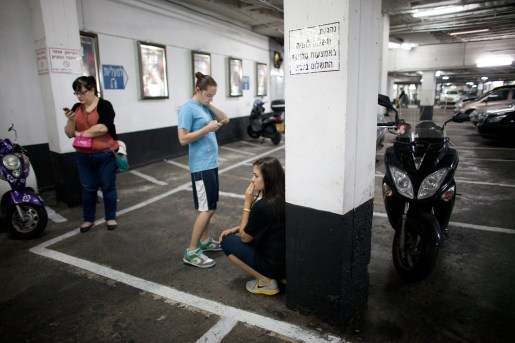
GT TELAVIVROCKETATTACKSHELTER 20121119

Mairav Zonszein, who opposes the IDF operation in Gaza, wonders if the rocket-bursting of Tel Aviv's bubble is necessary for Israel, since "maybe this means the status quo will break, because it must break":

Of course [the situation in Tel Aviv is] nothing like what Israelis are going through in the south, or remotely even close to what Gazans are going through. It’s all relative and hierarchic, and middle-high class Tel Avivians like me are near the very top of the food chart, with those in Gaza currently at the very bottom. So there’s no comparison.

But that doesn’t make the sirens followed by booms any less scary and awful. Regardless, Tel Aviv is geographically now a part of one of the local wars Israel periodically wages with one of its bordering neighbors. It is no longer immune. And as crappy as that is, maybe it’s exactly what needs to happen – that Tel Aviv now needs to also be part of this cycle of violence – that the daily routines and the bars and the nightlife and the hi-techs cannot function normally. They tell you to continue with your daily routine, but who the hell really can? And who the hell really should?

Allison Kaplan Sommer reflects on life in the new bubble: the suburbs north of Tel Aviv that remain out of the range of Gazan rockets:

Life in the bubble is clearly preferable to living in a terrifying state of war. But it is still bizarre and somewhat surreal weighing whether a routine venture into ‘the city’ for a business meeting or a scheduled shopping venture, or a yoga class is worth coping with sirens and ‘booms’. Is deciding to go ahead with the trip foolish and risky? Is deciding against leaving the ‘bubble’ cowardly and unpatriotic? As we make these crazy judgment calls and deal with these first-world problems in a third-world situation, of course, we never forget for a minute how quickly our situation can change.

(Photo: Israelis take cover at a shopping centre parking garage during a rocket attack on November 18, 2012 in Tel Aviv, Israel. By Uriel Sinai/Getty Images)

Scapegoating Sandy

Ryan D. Enos finds little evidence that the hurricane significantly impacted the election. But that won't stop pundits from blaming it for Romney's loss:

Attribution error (which has many other names and sub-theories attached) is a sweeping psychological concept that simply means humans try to explain the causes of behaviors and events – but we are bad at it. The theory says we tend to act as "naive scientists", so we often attribute causal explanations to things that occur at the same time: a poll moves after a debate, so the debate must have caused the poll to move; a storm happened before the election, so the storm must have caused Obama to win. This is not because people are stupid or incapable in a general sense, but just because we usually rely on heuristics, or mental shortcuts, to make sense of events. Concepts like partisan stability, regression to mean, and economic fundamentals are hard to understand, so as naive scientists we use the mental shortcut of correspondence in time to attribute cause to effect.

The Medals They Carried, Ctd

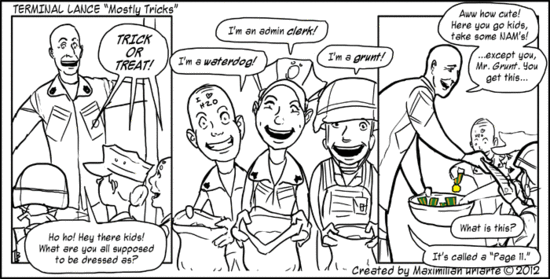
2012-10-30-Strip_Halloween_2012_web

Readers continue the popular thread:

I'm an officer in the Army National Guard, and I've enjoyed your posts on the ridiculousness of ribbon racks in the Army. I'm a junior officer, and I've never cared about ribbons. But I'm an extreme minority. Aside from just ribbons and medals, officers are expected to win foreign awards to wear on their dress uniform. Petraeus famously wore Italian paratrooper wings. The more common award is the German Armed Forces Badge of Military Proficiency, which most junior officers are expected to obtain within the first year of service. You might remember one from the Obama speech on the Afghan surge at West Point – the gray uniforms awkwardly propping up this giant German eagle, all in the name of swag.

Another writes:

After reading the Marine’s description of the actions required to receive a medal in today’s military, it suddenly became clear: this is today’s "everyone is unique and special!" culture permeating the services. My children, now in their mid-20s, received participation trophies for playing on sports teams that finished way back in the rankings; plaques for diving in swim meets regardless of where they placed individually or as a team; and their elementary school teachers awarded blue ribbon stickers and "Great job!" stickers quite routinely – even on assignments that didn’t make the grade. It would make sense that those children, when they entered the military, would feel medals for participating in any capacity are perfectly correct.

Another adds, "And just like rewarding a kid for simply showing up rather than rewarding him or her for a real achievement (like winning), it diminishes the very point of the reward." Another reader has a great story:

In the mid-1990s, I was living in St. Petersburg, Russia. During their celebrations for the 50th anniversary of V-E day, ships from all over the world sailed in to take part – including at least one US Navy ship. I acted as an unofficial translator when Russian and American sailors went out for drinks together, and we got to discussing medals and citations.

The US sailors had many more decorations – ribbons and medals - than their Russian counterparts. And the most amusing snippet of conversation came when I tried to translate what one US sailor's decorations were for. I didn't know the word for "conduct," so I described his good conduct ribbon as being for "good behavior." The Russian sailor looked at me like I had three heads. "Good behavior?" he asked. "What is this, kindergarten? Or the navy?"

(Cartoon from Terminal Lance, an illustrated blog by Lance Corporal Maximilian Uriarte, USMC)

Putting A Price On A Son Or Daughter

Nadia Taha, a finance writer living in NYC, calculates the total minimum cost of her and her spouse raising a child: $1.8 million. In the defense of high amounts such as that one, KJ Dell'Antonia broaches the problem of our aging economy:

[E]very one of us, parent or not, will at some point depend on today’s children to provide our medical care, to pick up our trash, or to grow our food. An economic exchange of money, goods and services isn’t possible unless there is someone willing to make that exchange and capable of providing the service or goods you seek. "Capitalism," that masterful force, can’t function without fresh people on which to exert its incentives.

Nancy Folbre reframes the macroeconomic case for reproducing:  

Capitalism, that masterful force, would have to pay much more for workers if families weren’t willing to pony up most of the time, money and effort necessary to raise them, train them and educate them.

She concludes:

Our standard economic accounting system ignores the value of goods and services that lack a market price – including clean air and a stable climate, as well as the health and well-being of our human resources. Nature instructs us in the danger of ignoring the value of unpriced inputs into the output we label gross domestic product. Efforts to assign a dollar value to ecosystem services are analogous to efforts to assign a dollar value to the work parents do and better estimate the costs of children.

James Pethokoukis looks at how tax incentives for parents might address this:

[B]y raising and educating their children, parents have already contributed hugely (in the form of human capital) to social insurance systems. The cost of their contribution, in both direct expenses and forgone wages, is often measured in the millions. Requiring parents to also then contribute to payroll taxes is not only unfair, but imprudent for societies that are already consuming more human capital than they produce.

So one option is giving parents a break on payroll taxes. The more kids you have, the less you pay. Another option is a new, larger child credit that can be applied against income taxes and payroll taxes.