Will Israel Invade?

Gaza_Israel

Goldblog makes the case against a ground war:

The air campaign against Hamas rocket sites is understandable and defensible. A ground invasion will lead to misery and woe; to a total rupture with Egypt; to a further loss of legitimacy, and thus, deterrent capability — and, at the end of the day, does anyone actually believe that Israel would be able to fully neutralize the Hamas/Islamic Jihad threat? These groups might need time to rebuild, but they would be rebuilt. And then what? Another ground invasion?

Eli Lake's reporting suggests that a ground invasion by Israel isn't likely:

[U.S. officials briefed on Netanyahu's call with Obama] say Netanyahu said Israel would not consider a full-scale ground invasion unless there was escalation from Hamas or a strike that caused significant casualties. There has not been, for example, a date set for such an invasion—nor are the other kinds of contingency plans Israel would need in such a circumstance in place, according to these U.S. officials, who declined to be named due to the sensitivity of the conversations.

Sarah Topol and Dan Ephron add:

An opinion poll published in the newspaper Haaretz today showed that some 84 percent of Israelis back the offensive against Gaza. But it also suggested Netanyahu’s approval rating could drop if he orders a ground invasion, which only 30 percent of Israelis support. Netanyahu faces a national election in two months.

(Photo: Israeli soldiers prepare an artillery emplacement overlooking Gaza on November 19, 2012 on Israel's border with the Gaza Strip. The death toll has risen to at least 85 killed in the air strikes, according to hospital officials, on day six since the launch of operation 'Pillar of Defence.' By Christopher Furlong/Getty Images)

Are Humans Getting Dumber?

Stanford geneticist Gerald Crabtree recently theorized that, due to that the diminishing impact of natural and sexual selection in procreation, human intelligence peaked some 2,000 to 6,000 years ago, when thousands of genes that determine smarts began to mutate. He argues:

I would wager that if an average citizen from Athens of 1000 BC were to appear suddenly among us, he or she would be among the brightest and most intellectually alive of our colleagues and companions, with a good memory, a broad range of ideas, and a clear-sighted view of important issues.

Pointing to the steady rise in average IQ over the last 100 years, known as the Flynn effect, Andrew Brown considers IQ research on people who most resemble our ancestors:

[T]he kind of reasoning that an IQ test measures is quite finely adapted to the modern, technological world in which most people who take one have grown up. It rests on assumptions that simply don't hold in different societies. Flynn illustrates this with studies conducted on Siberian hunter-gatherers in the 1930s. Their answers, apparently stupid, were highly acute once you realised that they did not trust the questioners at all. In their society, suspicion was not in the least bit stupid as a general rule, no matter how much it might fail to provide useful answers in this particular instance.

It well may be that contemporary adults are hopeless stupid and inadequate by the standards of hunter-gatherer life and that adult hunter-gatherers would die quickly in a modern city, too. But neither of these tests are measures of innate intelligence, as Flynn makes clear.

Tia Ghose summarizes Crabtree's counter-argument to the Flynn effect: that most of the increase in IQ "probably resulted from better prenatal care, better nutrition and reduced exposure to brain-stunting chemicals such as lead":

But just because humans have more mutations in their intelligence genes doesn't mean we are becoming less brainy as a species, said psychologist Thomas Hills of the University of Warwick, who was not involved in the study. Instead, removing the pressure for everyone to be a superb hunter or gatherer may have allowed us to evolve a more diverse population with different types of smarts, he said.

"You don't get Stephen Hawking 200,000 years ago. He just doesn't exist," Hills told LiveScience. "But now we have people of his intellectual capacity doing things and making insights that we would never have achieved in our environment of evolutionary adaptation."

George Dvorsky pushes back on a more general point:

[Crabtree] completely understates the importance of sexual selection — an ongoing process that most certainly has an impact on our ongoing genetic constitutions. In his study, Crabtree writes that modern Wall Street executives only have to worry about receiving a substantial bonus in order to attract a mate. "Clearly," writes Crabtree, "extreme selection is a thing of the past."

But what Crabtree is grossly under-appreciating is the degree to which intelligence brings couples together in modern society. His Wall Street executive wouldn't be a Wall Street executive without a requisite level of intelligence. The same goes for anyone else with a complex and modern job. And without the ability to survive and thrive in today's highly competitive environments, it's very unlikely that anyone would be capable of attracting a mate. 

America … And The Rest

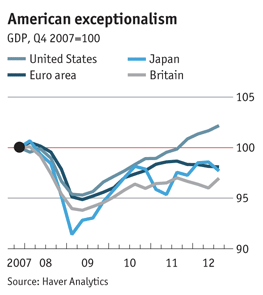
It's funny how this has not really sunk in with most Americans, and was not an argument that featured much in the campaign, but the recovery in America has been far better in the US than anywhere else in the West. Why the Obama peeps didn't make more of this is beyond me. But there's no question, for example, that the British Tory approach to debt and growth has not succeeded as well as Obama's (although the US, of course, has the ace of a global reserve currency):

111712krugman1-blog480

Ryan Avent looks ahead:

The really distressing thing is to try and project these lines forward a bit. Japan is in recession. Britain may be out of it, but on the other hand may not. The euro zone has Usnot grown for over a year, is almost certainly contracting faster in the fourth quarter than it did in the third and may well continue shrinking into 2013. One wonders whether the euro zone has already had the best quarterly output performance it will ever manage.

And then there is America, trudging steadily upward to the beat of its own drummer. How long can the divergence between America and the rest persist? And on what terms will these lines cross again?

One thing seems reasonably clear: America will not be able to rely on demand from the rest of this bunch to keep its line going up. Most of all, it will have to count on the durability of domestic demand. 

Paul Krugman admires the periwinkle line as well, noting that the "across-the-board poor performance puts the lie to claims that it’s all because of that scary Obama person." His backward-looking read on the differing trajectories of recovery:

What accounts for the differences? The most obvious culprit is austerity, which has been much more marked in Europe and the UK than in the US…. And this means that much of the advanced world blithely repeated the mistakes of the 1930s.

Yglesias Award Nominee

"We can only conclude that Romney's '47 percent' comments were not a gaffe or slip of the tongue but actually represent his genuine assessment of the nature of the American people right now. A president with that worldview wouldn't keep it under wraps for a four-year term, and it is a good thing for the Republican party and the conservative movement to not have to defend a president who effectively writes off nearly half the country as lazy and selfish, and even more important, unpersuadable, unreformable, and unchangeable," – Jim Geraghty, National Review, with Andrew Sprung's mordant take attached.

Democracy, Animal Style

800px-Macaca_tonkeana_groupe

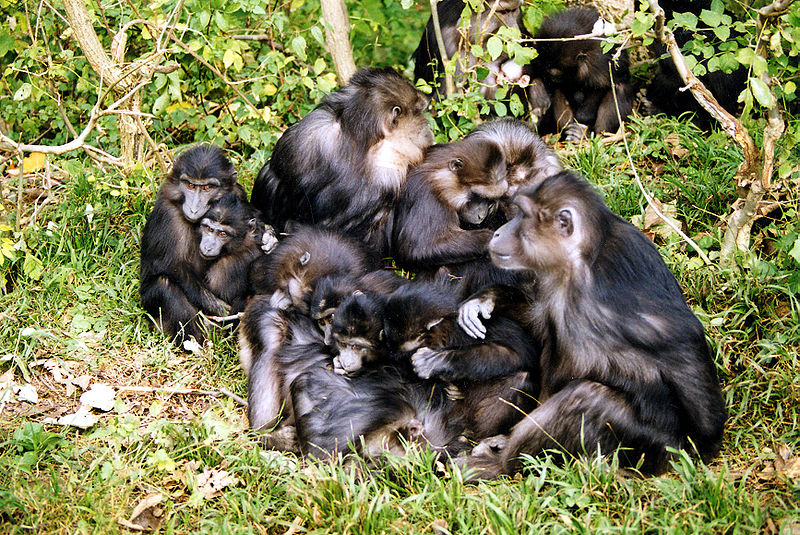
When searching for the best fruit trees, Tonkean macaques decide by majority vote:

When a particular Tonkean macaque wishes to move the group, he or she walks a few steps in the desired direction, pauses, and then turns his or her head back towards the rest of the group. This indicates that the group should move to a new food patch. The other monkeys then decide whether to support the direction suggested, or whether to offer an alternative. If an alternate direction is proposed, each group member votes by joining with his or her favoured candidate. Like the leader himself, they walk a few steps, pause, and then turn their heads back to inspect the rest of the group.

Once the majority of the group has voted, the remaining undecided voters simply side with the majority, walking along but not turning back to monitor the others. Those who opted for the losing recommendation turn around and catch up the group.

They’re the Republicans, one hopes.

(Photo by Christophe Chauvin via Wikimedia Commons)

The Psychological War

Karl Vick examines the horrifying head games at play in the Israel-Gaza conflict:

The daily Ma’ariv wrote that by reaching Tel Aviv from Gaza, the militants “put another 1.5 million civilians into siren anxiety.” That no one was killed, or even hurt, did not seem to matter. In military terms, the conflict is so lopsided that the most meaningful competition is for perception and psychology. 

And from the other side:

Israeli forces play an intimidation game as well. On Thursday, according to a report in the Hebrew press, an Israeli gunboat fired a salvo near enough to the refugee camp home of Hamas prime minister Ismail Haniyeh to make a point. The Israel Defense Forces also continued to publicize its preparation of ground forces, even naming the units that would participate: the Givanti Brigade, paratroopers, and an elite tank unit.

A Battle The GOP Can’t Win?

136326350

Yglesias offers the GOP a fiscal cliff plan – giving in to Obama's demands:

[I]t continues to be the case that a scenario where the GOP just folds quickly and cleanly seems very unlikely. Democrats don't seem to have given much thought to that scenario, precisely because it would be amazingly out of character. But I'm increasingly convinced it would be the tactically savviest move. Surrender on middle class tax cuts, and fight on the sequester and the debt ceiling.

Steve Conover sees the coming debt ceiling fight as more dangerous than the fiscal cliff. His preferred solution:

The current, obsolete debt ceiling is set at a specific dollar level: “X trillion dollars” of debt — similar to setting a mileage limit for a car, which forces a hard stop when the odometer reaches some arbitrary number. A new, better way to limit the debt would be to switch our focus from the odometer to the speedometer, i.e., to set a target ratio for debt relative to the size of our economy — “X percent debt-to-GDP.” A car’s speedometer helps us keep miles-per-hour under control; a new measure for the debt limit would help us keep debt-to-GDP in bounds. It would create new incentives for lawmakers: all of a sudden, a “new” way to stay under the debt limit would be to implement growth-friendly laws and policies that help the economy grow faster than the debt grows.

That does seem more sensible, given the huge numbers involved.

But my overall view is that the most important thing is to increase revenues, not rates necessarily. I can understand why Obama wants to get the top rate back to Clinton levels – and it would require much deeper inroads against deductions than the GOP has previously accepted. But, pace Matt, I'd give on this if I were Obama – in order to see if the GOP could come up with removal of tax deductions for those earning over $250,000 that would bring in the same amount of revenue. If they don't want a rate increase, ask them how to get the same amount of money from the same group of people by ending deductions. Call their bluff – and show you are not wedded to redistribution that could even theoretically impede growth and entrepreneurialism.

I can see why Obama feels the way he does; and I wouldn't be fazed by a return to Clinton tax rates (which reflect a post-Reagan consensus, after all). At the same time, I see the political potency of magnanimity, especially with Obama's brand. The last meeting between the Congressional leaders and the president on the "fiscal cliff" was surprisingly congenial; Obama's victory was made possible by those calling themselves "moderates," i.e. the types who want to see compromise, not brinksmanship; the president's own debt commission favored more revenues via tax reform rather than rate hikes … so 39 percent is not a hill I would choose to die on.

Maybe that's naive. And I'm not a liberal Democrat. But the promise of Obama was always a pragmatism that could practically move all this country forward. If the Republican fever is broken, then give them some space, if not time, to climb down. I still favor the contours of Bowles-Simpson for the long term. Most of all because it is the only deficit-reduction plan that really, truly cuts the absurdly high level of military spending. Forcing the GOP to accept that may be more of a longer-term victory than getting the top tax rate back to something more realistic for long term deficit reduction. One of the biggest drivers of our current debt is the war-machine. Dismantle some of that and the savings are potentially huge.

(Photo: Boys jump from cliffs into the ocean on December 28, 2011 in Blairgowie, Australia. By Bruce Magliton/Newspix/Getty Images.)

Fooled Into Freshness

Sara Davis unpacks the dominance of mint flavoring in the world of dental hygiene:

It’s the sensation, more than the scent or the taste, that causes us to associate mint with clean mouths. Mint makes the mouth feel cold. That "fresh" sensation is a thermal illusion: the actual temperature of your mouth doesn’t change.

Mouths contain particular cells that that activate in the presence of hot or cold: the condition of extreme temperature "turns on" the cell, which then sends a message to the brain that the mouth is rather hot or rather cold. But menthol also "turns on" these cells, which send their message to the brain as directed, and we experience a coolness in the mouth that isn’t there.

By itself, mint doesn’t make the mouth a less suitable environment for germs; it’s the abrasives in toothpastes or the alcohols in mouthwashes that do the dirty work. But it’s easy to see how minty freshness became associated with cleanliness: the illusory change of temperature and the sharp, distinctive taste remind us more of cleaning agents than candy.

The Carbon Footprint Of Packaging

Xlarge

Mark Wilson reviews a new book on it. Among other lessons learned:

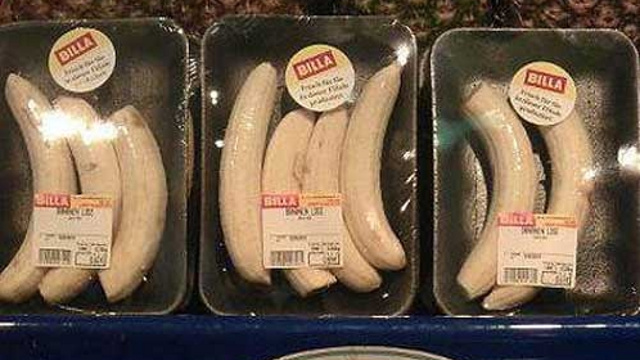
Most of us assume glass is environmentally superior to plastic, but its footprint is generally far worse than recyclable plastics. Plastics can be tough to dispose of, but creating them is relatively environmentally friendly: The process is a byproduct of existing fossil fuel production (in the same way chicken nuggets find a use for every last scrap of the bird). And things are getting better, often invisibly: The modern beer can weighs one quarter what it did in the 1960s.

(Image of peeled, shrink-wrapped bananas via Arbroath. The supermarket chain has since apologized.)