Steve Silberman surveyed writers about the music they write to. David Wolman's playlist doesn't include Mozart:
A writer friend of mine–a real talent–once told me he only listens to classical music when he’s writing. Songs with lyrics tend to interfere with his inner voice. I remember thinking: Damn, that’s a real literary guy kind of answer. I want that answer.
But as my neighbors can attest, that is not my answer. I need to get pumped up to write, which means I listen to some decidedly un-relaxing tunes, often the same ones over and over again. And who knows? Maybe loud music helps my writing because the prose has to compete. Without tempo and sharp diction, the words will be overwhelmed. It’s as if the music provides both a challenge and a warning: DO NOT BE BORING.
This weekend on the Dish, we only took a glancing look at politics: Paul Waldman defined the GOP's scandal envy, Andrew Polsky explained why Obama was the third consecutive president to win a second term, Douthat envisioned the future of the Republican platform, Tony Dokoupil explored the connection between marijuana legalization and regulation, and Israel's Interior Minister expressed an astonishing goal for what will happen in Gaza.
In literary and cultural coverage, we remembered the poet Jack Gilbert with an introduction to his life and work, and a brilliant poem of his, here and another poem of his here. Colin Burrow dissected the best and worst of fictional names, Sam Kashner recounted the sad tale of Truman Capote's last attempted novel, Chloe Schama pondered the autobiographical elements of Alice Munro's new short stories, Michael Thomsen asked why great writers struggle with depicting sex in their fiction, Jim O'Grady told his story in 91 words or less, Carl Zimmer appreciated all those minute descriptions of whales in Moby-Dick, Aaron Brady remembered John Ford's Young Mr. Lincoln, Torie Bosch profiled Patrick Tresset and his robot artists, and Rita Tyrne Bull divulged the perils of learning American English.
In matters of faith, doubt, and philosophy, the Public Religion Research Institute broke down the religious beliefs of Romney's and Obama's supporters, Stephen T. Asma defended favoritism, Malcolm Harris considered today's tamer versions of anarchism, Oliver Burkeman extolled the power of negative thinking, Ahmed Rashid appreciated Leonard Cohen's spiritual side, Christian Wiman meditated on hope, and Wesley Hill thought about Rowan Williams' Lent-infused theology.
We also covered the latest in what we eat and drink. Taffy Brodesser-Akner detailed the Jewish love-affair with margarine, E.J. Schultz took stock of Americans' on-the-go eating habits, scientists worked hard at building a better beer head, and Tim Heffernan found out why Brits drink harder than Americans.
In assorted coverage, it proved to be getting worse in Uganda, Lizzie Plaugic railed against the term "friend zone," Scott Adams asked when terrorists will get drones, Daniel Burke described how the military defends its adultery ban, and Mike Deri Smith contrasted to the the giants of the journalistic past and their work in warzones. MHBs here and here, FOTDs here and here, VFYWs here and here, and the latest window contest here.
Bridle's Instagram feed finds and filters images of drone strike locations using satellite data from Google Maps, adding contextual information from a variety of news sources, including the Bureau of Investigative Journalism. The number of casualties from such strikes has quadrupled under the Obama administration, but Bridle says the true power of drones is their role as a "distancing technology" which further abstracts a disengaged populace from acts of state-funded aggression. …
To Bridle, Instagram is just one of various technologies we can use to map the course of history. "These technologies are not just for 'organising' information, they are also for revealing it, for telling us something new about the world around us, rendering it more clearly," he writes. "We should engage with them at every level. These are just images of foreign landscapes, still; yet we have got better at immediacy and intimacy online: perhaps we can be better at empathy too."
Simon Willis theorizes why the project, with more than 1,700 followers after six tweets, strikes a nerve:
We are told that attacks took place, but we can't see the evidence. The pictures on Dronestagram are informative partly because they remind us of what we don't know. We are looking at warzones, but we are viewers twice-removed.
So far this year the American military has launched more than 330 drone strikes in Afghanistan alone — an average greater than one per day. In Pakistan, Yemen, and Somalia the numbers are smaller — 80 altogether — but the lesser frequency doesn't make the strikes any more comprehensible. From this side of the war, America's drone strikes feel very remote, their consequences quite abstract, their targets unmoored to actual physical locations. But with our powerful maps and comprehensive satellite images of the world over, visuals of each of those places lives online, a few clicks away, if we would bother to look.
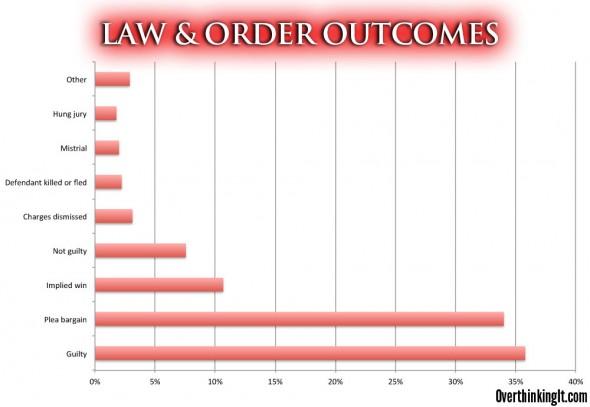
Matthew Belinkie graphed how all 456 episodes of "Law & Order" ended and compared the results to real life:
Over the entire run of the show, more than a third of all the episodes ended in Guilty verdicts, while another third ended in plea bargains. 80% of episodes ended in solid wins: either Guilty verdicts, plea bargains, or implied victories. That’s not too shabby, considering that the actual NYPD has a homicide clearance rate of about 50%. … Another thing that’s not realistic is that there are more Guilty verdicts than plea bargains. In real life, about 95% of all felony convictions are pleas.
Three universities are piloting software that can track a student's reading:
Say a student uses an introductory psychology e-textbook. The book will be integrated into the college’s course-management system. It will track students’ behavior: how much time they spend reading, how many pages they view, and how many notes and highlights they make. That data will get crunched into an engagement score for each student.
Railing against this kind of data mining is probably like howling into the wind at this stage, but this feels misguided even beyond broad issues of privacy. For a start, there’s no accommodation for different learning styles or reading speeds. It also assumes the worst of students, which has got to be a de-motivator, and it neurotically turns reading into a surveyed activity, which rarely does much for engagement.
Reviewing a new book on Rowan Williams' theology, Christ the Stranger, Wesley Hill notes how Williams focuses on "God's elusiveness, God's refusal to satisfy our yearning, our quest for uncomplicated assurance":
One of the most insightful and poignant moments in [author Benjamin] Myers' book is when he links Williams' theology to the church season of Lent. Lent is the moment in the church's calendar in which Williams' theology seems most at home. During the forty days leading up to Easter, we practice abstinence, we repent and discipline our desires, placing our hands over our mouths, partaking of what Bulgakov calls the "luminous sorrow" of the preparatory fast. If we recognize the legitimacy of this pentitential discipline, perhaps we can better appreciate what Williams aims to achieve in his theology. But at the same, recognizing that Lent eventually yields up its shadows to the brightness of Easter, perhaps we can also find room to criticize Williams' choice to linger over Lent. Darkness and fasting can't be the whole story. "A theology of Lent is a great thing," writes Myers, "but one cannot live by ash alone."
Still, whatever his excesses, Hill believes Williams might be a necessary corrective to the optimism of modernity.
Even though he personally disagrees with marriage equality and marijuana legalization, Douthat believes it would be politically wise for the GOP to moderate on both issues. How he sees the politics of marriage equality:
It’s probably no longer a question of “if” but “when” the party beats a strategic retreat on the issue (I expect there will be a pro-life, pro-gay marriage Republican nominee within a generation if not sooner), and it makes a certain raw political sense to pre-emptively declare a big tent on the question, and make the party’s litmus tests support for federalism rather than a Supreme Court settlement and (as Rod Dreher of the American Conservative has argued, presciently and strenuously) support for the broadest possible protections for religious liberty. I’m not sure how such a shift would affect the rate at which evangelicals and conservative Catholics turn out for Republicans — that would be the big strategic risk, obviously. But my sense is that the party would just be formally acknowledging what many religious conservatives already accept — that a political platform can’t hold back a cultural tide, and that if the American understanding of what marriage is and ought to be someday turns back in a direction that cultural conservatives find congenial, the details of the Republican platform will be largely incidental to that shift.
Ten years ago, Scott Adams wrote The Religion War, a novel that "predicted a future in which terrorists could destroy anything above ground whenever they wanted." He thinks it's starting to come true:
Hamas has its own drone production facility, or did, until Israel found it. One presumes Hamas will build more. How long will it be before Israel is facing suicide drones that only cost its enemies $100 apiece, fit in the trunk of a car, and can guide themselves to within 20 feet of any target? I'd say five years.
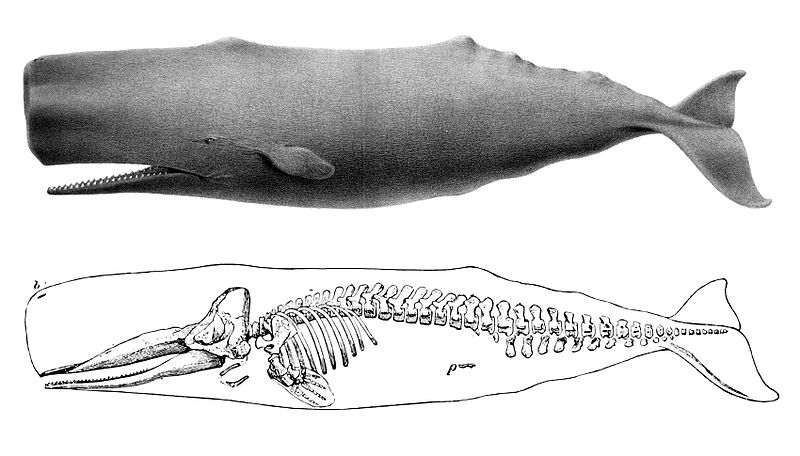
Carl Zimmer, a science writer, expresses his fascination with Herman Melville's chapter in Moby-Dick on the anatomy of whales, "Cetology," which frequently is ignored or considered irrelevant when the novel is taught in literature classes. What Zimmer gleans from Melville's minute descriptions of whales:
"Cetology" reminds the reader that Melville came before Darwin. Ishmael tries to make sense of the diversity of whales, and he can only rely on the work of naturalists who lacked a theory of evolution to make sense of the mammalian features on what looked like fish. You couldn’t ask for a better subject for a writer looking for some absurd feature of the natural world that could serve as a wall against which Western science could bang its head.
The people I know who don’t like the "whale stuff" in Moby Dick probably hate this chapter. It seems to do nothing but grind the Ahab-centered story line to a halt. (No movie version of Moby Dick has put "Cetology" on film.) But do you really think that a writer like Melville would just randomly wedge a chapter like "Cetology" into a novel for no reason–not to mention the dozens of other chapters just like it? Or perhaps it would be worth trying to find out what Melville had in mind, even if you might have to do a bit of outside reading about Carl Linnaeus or Richard Owen? It would be quite something if students could be co-taught Moby Dick by English professors and biologists.



 The Dish