Learning American

Rita Byrne Tull, who came to the United States from England many years ago, quips that her "accent must be hovering somewhere in the mid-Atlantic." She divulges the embarrassing difficulties of learning the intracies of the American dialect:

“Look,” I exclaimed in a loud, excited voice, “I found this beautiful silver rubber in the gutter and it’s hardly been used!”  My boyfriend’s mouth hung open with an expression of amazed incredulity.  He tried to speak but just stuttering laughter came out.  Around me I heard stifled giggles and realized everyone in the vicinity was staring at me.  Once again I had that sinking feeling that I must have said something wrong, but I had no idea what.  We walked on and when he regained his composure my boyfriend explained.  In America the piece of rubber used to rub out pencil marks is called an “eraser.”  A “rubber” is a condom.  You might well expect to see a condom in a gutter.  I had just announced to everyone within earshot that I was thrilled to find a “hardly used” condom!

Rabbinical Songwriting

Ahmed Rashid appreciates Leonard Cohen's spiritual side:

A Canadian Jew descended from rabbis, Cohen infuses his music with his enduring interest in religion. He reads Jewish scriptures but is also a master of Zen Bhuddism of the Rinzai school; his closest friend and mentor is the 105-year-old California-based Japanese Zen master Joshu Sasaki Roshi. Going through a bad spell in the 1990s, Cohen spent five years in a Zen monastery outside Los Angeles. For a time he gave up music; he returned to it partly out of necessity, after discovering that his manager had run off with all his money. He later spent several years studying with a Hindu mystic, Ramesh Balsekar, in Mumbai. He is also extremely knowledgeable about Islam and, in particular, Sufism, the most spiritual branch of Islam. Some of the Sufi whirling dervishes in Turkey have even danced to his songs.

Carl Wilson tackles another major influence for Cohen – women – in a review of Sylvie Simmons’ new biography I’m Your Man: The Life of Leonard Cohen:

[Cohen] tells Simmons, “I had wonderful love, but … I was unable to reply to their love. Because I was obsessed with some fictional sense of separation, I couldn’t touch the thing that was offered me, and it was offered me everywhere.” He says he doesn’t know if it was spiritual practice or an aging brain that relieved him. Part of me wondered, unkindly, if he’d simply lost the appetite for the habits the despair excused.

The Power Of Negative Thinking

Oliver Burkeman deconstructs self-help books in his recently released, The Antidote: Happiness for People Who Can't Stand Positive Thinking. In an interview with NPR he describes his approach to human flourishing:

I think the premise from which I start is this idea that … relentless positivity and optimism is exactly the same thing as happiness; that the only way to achieve anything worthy of the name of happiness is to try to make all our thoughts and feelings as positive as possible, to set incredibly ambitious goals, to visualize success, which you get in a million different self-help books. Whereas, actually, there's a lot of research now to suggest that many of these techniques are counterproductive, that saying positive affirmations to yourself in the mirror can make you feel worse and that visualizing the future can make you less likely to achieve it. And so what I wanted to do in this book was to explore what I ended up calling 'the negative path to happiness,' which involves instead turning toward uncertainty and insecurity, even pessimism, to try to find a different way that might be more durable and successful.

In a separate interview, Burkeman touches on the history of negative thinking, going back to Seneca and the Stoics:

There’s a wonderful Stoic technique called “the premeditation of evils”, which involves deliberately visualising the worst-case scenario, instead of the best one. One benefit of that is that you replace limitless panic and fear – which is how we often respond to problems – with a sober analysis of exactly how badly things could go wrong. The answer might still be “really bad” – but not infinitely bad, as the Stoic-influenced psychotherapist Albert Ellis would say. That’s something I put into practice every day, and find helpful.

Edith Zimmerman asked Burkeman whether people can really change. His answer:

[T]he go-to fridge-magnet quote here is from Carl Rogers: “The curious paradox is that when I accept myself just as I am, then I can change.” Positive thinking demands that you change unwelcome thoughts and feelings. Whereas it seems to me that something like Buddhist meditation, and some modern forms of therapy, are focused much more on learning to observe thoughts and feelings without giving in to the urge to try to manipulate them. So that’s the paradox: perhaps the best change you can make is resisting the compulsion to change.
Quote For The Day

"I was brought up with the poisonous notion that you had to renounce love of the earth in order to receive the love of God. My experience has been just the opposite: a love of the earth and existence so overflowing that it implied, or included, or even absolutely demanded, God. Love did not deliver me from the earth, but into it. And by some miracle I do not find that this experience is crushed or even lessened by the knowledge that, in all likelihood, I will be leaving the earth sooner than I had thought. Quite the contrary, I find life thriving in me, and not in an aestheticizing Death-is-the-mother-of-beauty sort of way either, for what extreme grief has given me is the very thing it seemed at first to obliterate: a sense of life beyond the moment, a sense of hope. This is not simply hope for my own life, though I do have that. It is not a hope for heaven or any sort of explainable afterlife, unless by those things one means simply the ghost of wholeness that our inborn sense of brokenness creates and sustains, some ultimate love that our truest temporal ones goad us toward. This I do believe in, and by this I live, in what the apostle Paul called 'hope toward God,"- Christian Wiman, reflecting on his cancer diagnosis, among other subjects.

Face Of The Day

Screen shot 2012-11-15 at 8.13.50 AM

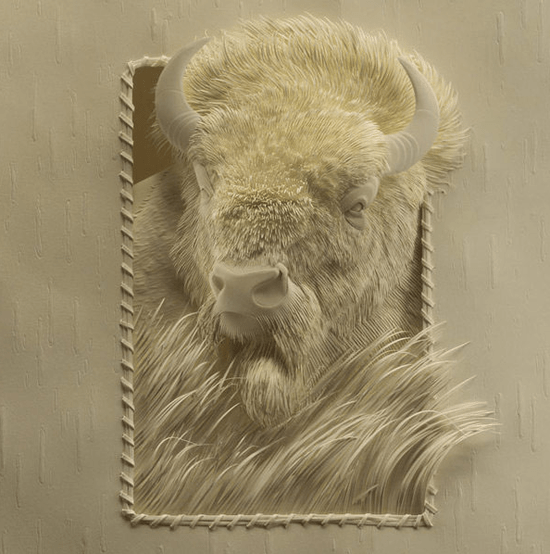
Emily Temple applauds Calvin Nicholls' intricate cut paper artwork:

Ontario-based artist Calvin Nicholls, whose work we recently spotted over at My Design Stories, has combined a lifelong interest in wildlife with an equally long love of art to create these gorgeous white-on-white paper sculptures depicting nature scenes and portraits of animals that bristle with depth. It’s amazing to us how real his animals feel, even with the barrier of a computer screen, without any attempt to colorize them. 

(Image courtesy of Nicholls)

A Poem For Sunday

Water

“A Brief for the Defense” by Jack Gilbert:

Sorrow everywhere. Slaughter everywhere. If babies
are not starving someplace, they are starving
somewhere else. With flies in their nostrils.
But we enjoy our lives because that’s what God wants.
Otherwise the mornings before summer dawn would not
be made so fine. The Bengal tiger would not
be fashioned so miraculously well. The poor women
at the fountain are laughing together between
the suffering they have known and the awfulness
in their future, smiling and laughing while somebody
in the village is very sick. There is laughter
every day in the terrible streets of Calcutta,
and the women laugh in the cages of Bombay.
If we deny our happiness, resist our satisfaction,
we lessen the importance of their deprivation.
We must risk delight. We can do without pleasure,
but not delight. Not enjoyment. We must have
the stubbornness to accept our gladness in the ruthless
furnace of this world. To make injustice the only
measure of our attention is to praise the Devil.
If the locomotive of the Lord runs us down,
we should give thanks that the end had magnitude.
We must admit there will be music despite everything.
We stand at the prow again of a small ship
anchored late at night in the tiny port
looking over to the sleeping island: the waterfront
is three shuttered cafes and one naked light burning.
To hear the faint sound of oars in the silence as a rowboat
comes slowly out and then goes back is truly worth
all the years of sorrow that are to come.

(Reprinted from Collected Poems © 2012 by Jack Gilbert. Used by permission of Alfred A. Knopf, a division of Random House. Photo by Flickr user the_toe_stubber)

Anarchy Light

Malcolm Harris reviews James C. Scott's Two Cheers for AnarchismHarris explains the problem with turning "insurrectionary politics" into "a self-help strategy, a personal faith that promises a freer and more productive life":

It’s a long-standing premise of American politics that the only thing worse than having a government is not having a government. But if the abolition of the state isn't even theoretically an option for Scott, then Two Cheers isn't about anarchy or even anarchism so much as an anarchist-type attitude: it's not anarchist but anarchish. This is anarchism, in other words, in the mold of reform Judaism: show up for some holidays (marches) and try to live a good anarchist life, and you can feel comfortable with the expectation that if the messiah does ever happen to arrive, you'd find yourself on the right side of divine judgment. If you're unable to tell the difference between your behavior and that of your more genteel gentile neighbors, name them honorary anarchists. But don't hold your breath, or rearrange your life, waiting for a prophet you don't really expect to show.

The Other Lincoln Movie


Aaron Brady remembers John Ford's classic film, Young Mr. Lincoln, detailing its subtle misgivings about American democracy:

[T]he responsibility of America’s great men is not to inspire the better angels of our human nature—because we don’t have them—but to manipulate us into doing what needs to be done, to tell lies so persuasively that we mistake them for truth, and in that way, they can actually come true. When he declares to his first audience, at his first political speech that “You all know who I am, plain Abraham Lincoln,” the double irony is that this is true and untrue: he is working to become that, to become the plain Abraham Lincoln which would be worthy of their trust, but he’ll have to lie and deceive to do so, and they’ll never see through the deception that makes it true.

The Kitchen’s False Messiah

Taffy Brodesser-Akner details the Jewish love-affair with margarine, which became popular because it was "cheap, readily available, pareve, and kosher":

All we wanted was an opportunity to assimilate our kitchens a little bit, to not have to wait until the traditionally dairy holiday of Shavuot to try that new cookie recipe. Jews cannot live on fruit compote alone! Thanks to Crisco, and all the other pareve margarines and “vegetable shortenings” that followed, we were finally able to enjoy the dignity of post-meat desserts beyond oil-based honey cakes, now that we had a nondairy hard fat (as opposed to oil), the hardness so important for the structure and stability of baked goods. Jews were finally able to see what all the hullabaloo was about over pie crust now that they didn’t have to just stand by while their gentile friends employed lard for the job.

Regardless, Brodesser-Akne urges Jews to "just say no" to margarine for health reasons:

While it doesn’t have cholesterol or saturated fats, however, margarine does contain trans fat, which has since been found to raise the risk of heart disease and has been declared by a Harvard study to be “the worst fat for the heart, the blood vessels, and rest of the body.” In 2006, when the FDA legislated that trans fat had to be listed on food labels, the public started to understand that the love affair with margarine had to end.