Playing Favorites

Stephen T. Asma critiques the way we think and argue about fairness, holding that "the real opposite of fairness is favoritism—filial, tribal, nepotistic partiality—not egoistic selfishness" – and that we shouldn't feel bad about such attachments:

[F]avoritism or bias toward your group is not intrinsically racist, sexist, or closed-minded.

Privileging your tribe does not render you negative or bigoted toward those outside your tribe. And to top it off, we're now beginning to understand the flexible nature of our ingroup favoritism—it doesn't have to be carved along bloodlines, or race lines, or ethnic lines. Psychological experiments reveal a whole range of criteria for ingroup bias. For example, test subjects have been shown to award higher payoffs to arbitrary ingroups, like people who just happen to share the same birthday as the test subject. And ingroup bias can be demonstrably strong when subjects share allegiance to the same sports teams, and so on.

Young people in our schools are repeatedly exposed to a bogus association between unbiased equality for all and open-mindedness. But even the laudable pantheon of fairness fighters, paraded before elementary students, have their origins in ingroup favoritism. Rosa Parks and Susan B. Anthony were not fighting for the equality of all people per se, but for the inclusion of their ingroups. It's no disservice to them or denigration of them to point out this basic fact of favoritism. Some serious allegiance to one's tribe is, after all, how anything gets done at the social level—including civil rights.


The Graying Religious Right

Public Religion Research Institute breaks down the religious beliefs of  Romney’s and Obama’s supporters (click to enlarge):

Whitechristian

Mark Silk declares that “Republicans should be more worried about appealing to Nones than to Latinos”:

Romney’s coalition most closely matches the over-65 crowd, only older. It’s whiter and less religiously diverse than seniors are. Call it your great-grandfather’s Oldsmobile.

By contrast, Obama’s coalition fits snugly in between the youth cohort of 18-to-29-year-old Millennials and the 30-49-year-old Gen-Xers. It’s unsurprisingly overrepresented among African-Americans and a little light on evangelicals and “other Christians,” but generally presents a fair picture of where America’s religious layout is headed in the coming decades.

A Life, Condensed

The Gotham Writers' Workshop held a contest to "tell a story of your life in 91 words or less." The brilliant winner by Jim O’Grady:

Cops, cashiers and railroad men: my people sprang from the Bronx. My parents used college like a pole vault, soft-landing in the burbs.

At 23, having horrified my family by salmoning back to that borough, I hung on the roof of a tenement building with Hector and Luis. I wanted a sharper life with guys like them, who dealt Mexican weed and stripped junkers on the Mosholu Parkway service road. They were like brothers until one caught the other with his woman. Out came the knife.

Too sharp. I moved.

Caught In The Friend Zone

Lizzie Plaugic rails against the term, which she argues "implies a sort of capricious, unfair act, perpetrated by the vagina-ed set":

If you say you're "in the Friend Zone," you've just created a space where, through no fault of your own, the person you were pursuing put you in a no-man's-land of eating pizza without touching knees and late-night discussions without sex. But in actuality, you haven't been moved to a new relationship sector, and your train to Vagina Heaven hasn't suddenly been derailed — you just didn't know which track you were on in the first place. Maybe use of the term is evidence of a breakdown in communication, but it's not a reflection of some social phenomenon wherein women perniciously sort their relationships into Would Fuck and Would Never Fuck, But Would Watch a Movie With.

War And Infidelity, Ctd

Daniel Burke describes how the military defends its adultery ban:

The rules may seem archaic to modern Americans, but they are essential to the military, where officers and soldiers entrust their lives to one another other, Breasseale said. Imagine if a senior officer was having an affair with an enlisted soldier’s spouse. "His decision-making would rightly be second-guessed," [Pentagon spokesman Lt. Col. Todd] Breasseale said, "and that would cause a ripple-effect through the unit."

Reminding us again of how the protracted wars waged by the US have increased infidelity, Burke continues:

As in civilian America, extramarital affairs are fairly common in the military, experts said, as soldiers spend long tours of duty stationed far from home. Adultery tends to be prosecuted only when the conduct is egregious, when it accompanies other crimes like sexual misconduct, or when a high-ranking officer is involved. "It’s hard to make the case when I’m representing a senior military officer on adultery that the good order and discipline of the unit was not affected," said Victor M. Hansen, a professor at New England Law in Boston.

William Galston, on the other hand, takes issue with the Uniform Code of Military Justice's blanket focus on adultery:

It is easy to imagine circumstances in which adultery might well undermine the ability to command. But … [s]urely the burden should be on the military to demonstrate a concrete, functional, operational link between the adulterous conduct and military discipline. In the absence of such a showing, the simple fact of adultery should not suffice, and the UCMJ should make that crystal-clear. At present, it does not.

He adds some historical context:

All this transpires under the aegis of language that has been part of our military law since 1775 and that directly traces to British sources from the late seventeenth century. Can anyone seriously argue that public norms have remained unchanged for the past three hundred years? The U. S. military is not—and should not be treated as—a hermetically sealed world. It is part of our society. 

Why Do Brits Drink Harder Than Yanks?

First, a snapshot of the problem in the UK:

Tim Heffernan finds that the answer lies in the business of alcohol production:

Monopolistic enterprises control the flow of drink in England at every step—starting with the breweries and distilleries where it’s produced and down the channels through which it reaches consumers in pubs and supermarkets. These vertically integrated monopolies are very "efficient" in the economist’s sense, in that they do a very good job of minimizing the price and thereby maximizing the consumption of alcohol.

The United States, too, has seen vast consolidation of its alcohol industry, but as of yet, not the kind of complete vertical integration seen in the UK. One big reason is a little-known legacy of our experience with Prohibition.

From civics class, you may remember that the 21st Amendment to the Constitution formally ended Prohibition in 1933. But while the amendment made it once again legal to sell and produce alcohol, it also contained a measure designed to ensure that America would never again have the horrible drinking problem it had before, which led to the passage of Prohibition in the first place. Specifically, the 21st Amendment grants state and local governments express power to regulate liquor sales within their own borders. Thus, the existence of dry counties and blue laws; of states where liquor is only retailed in government-run stores, as in New Hampshire; and of states like Arkansas where you can buy booze in drive-through liquor marts. More significantly, state and local regulation also extends to the wholesale distribution of liquor, creating a further barrier to the kind of vertical monopolies that dominated the United States before Prohibition and are now wreaking havoc in Britain.

But those monopolies are making a comeback, namely in "two giant companies—Anheuser-Busch InBev and MillerCoors, which together control 80 percent of beer sales in the United States."

Sex As Metaphor

Michael Thomsen wonders why great writers can't do justice to the act itself:

Sex is usually a side dish, one that causes some wavering mania in a great character just before he redeems himself in the fifth act. And even in these brief glimpses, sex is rarely more than a signifier—a dropped handkerchief, a double entendre, a clever narrative ellipsis. One never hears just how the sex went; what matters is that it was had. … David Foster Wallace doesn’t shy away from adjective nor word count when it comes to a tennis backhand, but a similarly prolonged reverie on the use of one’s loin muscles is inconceivable. Virginia Woolf lavishes Clarissa Dalloway in a web of memory and sensual detail, and yet the closest she comes to describing sex is the recurring image of a match burning in the crocus.

Compare that to Oriana Small, author of Girlvert: A Porno Memoir:

Our presumptions about Small as a writer are powerfully skewed by literary dogma. It is all too easy to think of her as a porn star who happened to write a book about her experiences. She is not a writer, or painter—though she does both—but a porn star who writes and paints. (By the same logic, we could conclude that Ken Kesey is not a writer but an aide in a mental hospital who happened to write about his experiences there.) Her writing is easier to digest as a non-literary, transgressive, one-time only confession. This judgment says much more about the delusions of the literary audience than it does about Small’s (disarmingly good) work.

The Robot Artist

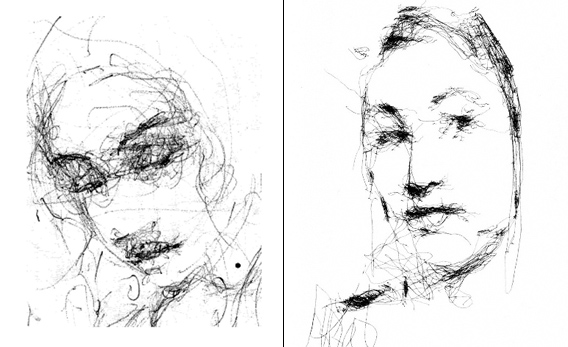
121115_FUT_TressetPaulSketches

After struggling with his mental health and going on medication, Patrick Tresset lost his passion for art. But he built a generation of robots, all named Paul, that can draw portraits. Torie Bosch profiles Tresset, his creations, and his creations' creations:

Tresset’s robots use computer vision to identify their subjects—they can recognize faces—and then they spend about 30 minutes on each portrait. (One of his earlier-generation robots, Pete, will actually doodle when there are no faces in sight to draw.) The early versions were crude and involved not physical robots but simulated drawing created with computer-aided drafting programs. But over the past 10 years or so, Tresset and Frederic Fol Leymarie, his co-director at the Aikon project at Goldsmiths University of London, have made tremendous progress. Can you tell which image [above] was made by a computer and which was created by Tresset before he lost his inspiration?

Robots face some of the same problems in learning to draw as humans do, Tresset says. "When we draw, the difficulty is not in making the lines. The difficulty is in the perception of the subject and the perception of the drawing in progress." But sometimes, it may help to make it seem that the robot has difficulty in making the lines—Tresset has found that people feel more empathy for the machines when they make human-esque mistakes like crooked or tilted lines. 

(The left sketch is by Tresset, the right one by robot Paul.)