Across The Universe

It's hard to explain what it's been like living as a gay person of my generation – the vast distance we have covered in such a relatively short space of time. From liberation to plague, and then from survival to revolution – all bound up together in that uncontrollable mess we call human consciousness. We sometimes get flashbacks. Integration provokes panic as well as relief. Many AIDS and HIV-survivors of my generation turned to crystal meth to numb what they had been through, like soldiers with PTSD. And so we see that beneath a new surface, old fears and hatreds still lie, desperate children still cry at night, cruelty lurks – and will always be there.

And yet the gap between my grandparents and my niece and nephews on this issue is greater than on any other issue I can think of. The journey I and so many others have made is sometimes bewilderingly long. I went from living for eighteen years in a small town never even hearing the word "homosexual" – let alone gay – to being legally married to another man. In between? Just a mountain of dead bodies and tortured souls – those in the vanguard, those flipped into resistance, and those whose whole lives have been beached by the tides of expanding human self-understanding.

And there's no question in my mind that the past is constantly informing the future. I do not believe, for example, that even a fraction of the progress on civil rights for gays could have come about at this speed without the human catastrophe of the 1980s and 1990s, a decade in which five times as many young Americans died as in the entire Vietnam War. Wars catalyze social change – and the war against a plague was no exception.

Last week, as I and others are slowly absorbing, is when we found, definitively, we had a popular yes for an answer. Not everywhere – but certainly somewhere. And yet the exhilaration of that is marbled with memory that will not let go. Here is EJ Graff, remembering the past, even as she absorbs the tectonic progress of now. Both matter. The one cannot exist without the other – which is why, at this point, so more and more of us bear scars rather than open wounds. But the scars never disappear. In some ways, for some of us, our very identity is difficult to distinguish from scar tissue:

But the bridge EJ mentions was metaphorically crossed last week, as she notes. Somehow the scars are no longer merely things to remember in grief and numbness, but medals of a war whose tide we have now turned. It is a mixture of things, this feeling, this generation, this moment. But it is, in the end, a triumph of the human spirit, and will one day be seen, I believe, as a remarkable social achievement to have turned such a terrifying abyss into rising ground  – and so fast.

To quote Mark Helprin again, from his great novel, A Soldier Of The Great War,

and even when I was broken the way sometimes one can be broken, and even though I had fallen, I found upon arising that I was stronger than before, that the glories, if I may call them that, which I had loved so much and that had been darkened in my fall, were shinning even brighter and nearly everytime subsequently I have fallen and darkness has come over me, they have obstinately arisen, not as they were, but brighter.
Rich And Poor Politics

Avi Feller and Andrew Gelman unpack the relationship between voting and income. They find "only a strong red America-blue America split toward the top of the income distribution" and that toward "the bottom, the electoral map is a sea of blue":

Why does this happen? Our research on opinion poll data from earlier elections finds that lower-income Americans tend to vote based on economic issues, while richer voters consider social issues as well as economics in their voting decisions. This is sometimes called post-materialism: the idea that, as individuals or groups become more comfortable, they can afford to think beyond their immediate needs.

The so-called culture war between red and blue America is concentrated in the upper half of the income distribution, and voting patterns reflect this.

Yglesias frames these splits differently:

It’s always the case that the poor vote for Democrats and the rich vote for Republicans (but by a smaller margin) while the middle class is contested terrain. But compare the GOP’s best year (2004) to its worst (2008) and you’ll see a dramatic shift among low-income voters to the Democrats. Whether you want to attribute that to fundamentals or message or whatever, the same point holds—the shifts are pretty broad-based and whatever it is that makes a party more popular with the middle class probably also makes it more popular with the rich and the poor.

Benghazi Is Not A Scandal

Matt Steinglass delivers a reality check:

At the most fundamental level, the reason it is absurd to suspect the existence of a “cover-up” over the Benghazi attack is that such a cover-up could not have had any conceivable goal. Back to the beginning: the underlying accusation about Benghazi is that the Obama administration deliberately mischaracterised the terrorist attack there as having grown out of a spontaneous demonstration because that would be less politically damaging. Such a cover-up would have made no sense because the attack would not have been less politically damaging had it grown out of a spontaneous demonstration. The attack on the Benghazi compound would not have been any less politically difficult for the administration if it had grown out of a riot, nor would any normal voter have expected it to be less politically damaging, nor would any normal campaign strategist have expected any normal voter to have expected it to be less politically damaging. 

Translation: you’re sane. They’re crazy. Remind yourselves of that. At most, it seems to me, this involves a government failure to anticipate this kind of attack in Benghazi and some ass-covering after the fact from those on the ground responsible for such things. The attack was a tragedy. Governments – all the way down to security at consulates – make mistakes, miss things, and suffer the consequences. And the truth is that our intelligence in that region – once completely dependent on Qaddafi and other tyrants – is very weak. It’s all electronic and from on high. We need to develop more human intelligence on the ground to guard against these incidents that have always occurred and always will in troubled countries in the midst of revolutions. That’s what we need to learn from this.

But that’s not the debate the current GOP wants to have. Because they are not actually interested in government so much as in politics. And rather than figure out why they have strayed so far from sanity, and lost the support of an entire generation, they wallow in paranoia and conspiracy.

Israel On The Brink, Ctd

156513217

First Tel Aviv, now Jerusalem?

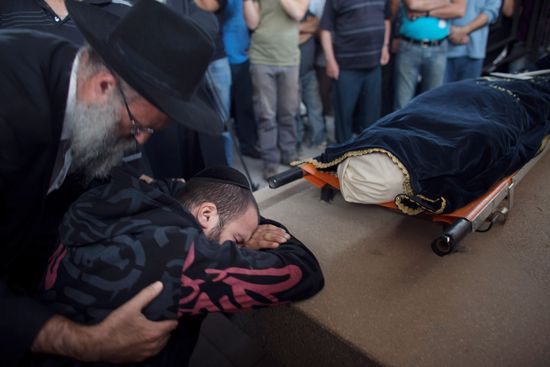
(Photo: A relative grieves during the funeral on November 16 for Itzik Amsalem, 49, one of the three people who died in a rocket attack in Kiryat Malachi, Israel. Three people were killed in Israel on November 15 after a building was hit by a rocket fired from the Hamas-ruled Gaza Strip. Palestinian rocket attacks followed a series aerial strikes on targets in Gaza launched by Israeli Defense Forces (IDF) which killed a top military commander of Hamas. By Uriel Sinai/Getty Images)

The Voters Were Bribed! Ctd

Romney could have been getting his cues from Limbaugh, who released this dreadful ditty a day before Mitt’s comments:

A reader writes:

My diabetic, marginally-employed brother is just the sort of person Romney is speaking of in his implication that the bribe of free healthcare won Obama the election. My brother doesn’t want or expect free health insurance.  He just wants to be able to buy it.

Another writes:

You say that “Jindal seems to get it. Which is encouraging, don’t you think?” Not necessarily.

You quote Jindal as saying “we need to continue to show how our policies help every voter out there achieve the American Dream, which is to be in the middle class, which is to be able to give their children an opportunity to be able to get a great education…” Emphasis mine. Jindal is not saying that the Republican Party needs to CHANGE its policies; they just need to market them better to convince the voters that their policies help everyone whether they really do not. So lower taxes on the wealthy, increasing income inequality, Wall Street deregulation, etc – those are really going to help the middle class. Now if he had said that we, the Republican Party, need to change our policies, that would be a different matter. Then I might have some hope.

And he did hop on the bus in Iowa to vote down a pro-equality judge on the state court. Jindal does not want 100 percent of the voters. He wants to actively discriminate against 5 percent of us. Dish collection of #ObamaGift tweets here.

Israel On The Brink

156451007

Simon Tisdall sees few barriers to a full war:

Past constraints on Netanyahu’s behaviour are absent this time. There is no discernible peace process, and no active US engagement (after Barack Obama’s first-term efforts were ignominiously rebuffed). The west’s favourite “moderate Arabs” are missing in action, or on the other side of the fence. Egypt’s government has condemned Israeli actions; Jordan, destabilised by the Syria chaos, is in the throes of what could be the next Arab spring uprising. Meanwhile, the imminent bid by Mahmoud Abbas, the Palestinian president, for non-member UN observer status for Palestine, staunchly opposed by Israel and the US, threatens further polarisation inside and outside Palestine.

Elsewhere, about that long-range rocket that was fired at Tel Aviv yesterday:

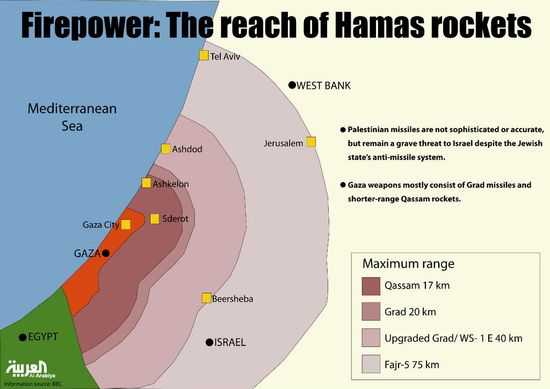
[T]he Fajr-5 rocket [was built] by Iran — possibly with Russian and Chinese help — the rockets were first shipped through Syria to the Hezbollah militant group in 2002. Today, an unknown number are now in the hands of Hamas. (Presumably, that’s thanks in part to a porous border between southern Gaza and the Sinai, now controlled by the new Islamist regime in Egypt.) The rocket is liquid-fueled, has an estimated 45 mile range, and is fired from a mobile launcher. And while it’s more powerful than anything Hamas had before, it’s still unguided and not particularly accurate — the rocket could land anywhere within a one-kilometer radius of its target. But where the Fajr-5 is short on accuracy, it’s a significant boost in destructive power: the rocket can lob up to 200 pounds of high explosives.

The Israeli military claims to have destroyed dozens of the rockets. But as this video uploaded to the Twitter account of Hamas’ al-Qassam Brigades shows, the stockpile hasn’t been exhausted entirely.

Here’s an infographic made by Al Arabiya showing the range of Hamas’ rockets:

Hamas-rocket-range-al-arabiya

As I wrote yesterday, it is impossible and wrong to blame Israel for self-defense against Hamas rockets with greater range and power, if not much greater accuracy, than the past. There is no defense of Hamas’s use of terrorism. Equally, the kind of ground assault that now looks inevitable is yet another iteration of the same dead end. Except, this time, for Israel, the region is shifting against it. The visit to Gaza by the Egyptian prime minister yesterday – he and Hamas’s leader together beheld the body of a Gazan boy killed by Israeli firepower yesterday – represents a tectonic shift. And the deeper regional and international isolation of Israel is pregnant with foreboding. If we see another civilian bloodbath in Gaza, four years after the last one, the failures of the Israeli government to seize the opportunity Obama offered them four years ago – indeed to treat the United States president with contempt combined with an open attempt to elect his opponent – will haunt the Jewish state. Greater Israel is as unsustainable as it appears to be inevitable. There was, and maybe still is, a ramp off this conflagration. But Netanyahu and Hamas feed off it domestically – a gruesome and ominous fact.

They are radicalizing each other. And while we finance and defend the more democratic one, we are seemingly powerless to shape or influence, let alone, dictate its policies.

(Photo: Palestinian relatives mourn over the body of Hanen Tafish, a 10-month-old girl, at the morgue of the al-Shifa hospital in Gaza City, on November 15, 2012, after she died following an Israeli air strike in the Zeitun neighbourhood.By Mahmud Hams//AFP/Getty Images.)

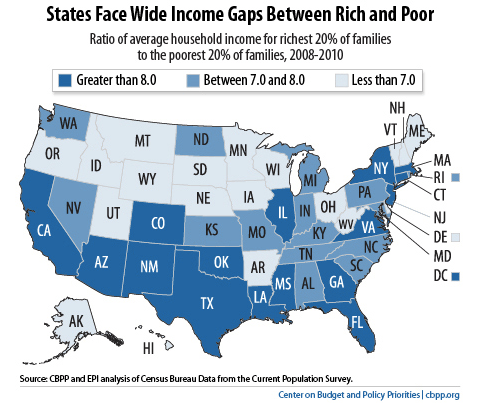
Where Inequality Intensifies

Screen Shot 2012 11 15 at 3 26 11 PM

Elizabeth McNichol breaks down the general trend:

[O]ver the most recent full business cycle (from the late 1990s to the mid-2000s), average incomes fell by close to 6 percent among the bottom fifth of households while rising by just 1.2 percent among the middle fifth, by 8.6 percent among the top fifth, and by 14 percent among the top 5 percent of households.

Towards A Crappier Cola

A dietary supplement that promotes bowel-movements is the key ingredient in Pepsi Special, a new cola in Japan. Samantha Bonar explains:

Pepsi Special is made with dextrin — an indigestible form of dietary fiber sold as Benefiber in the U.S. It is also commonly used in glue. Studies on rats have suggested dextrin can reduce the absorption of fat in the body and lower cholesterol levels. There is no information about how much sugar Pepsi Special contains compared to regular Pepsi, but a spokesman told the Mail it would have a “crisp refreshing and unique” aftertaste. (Dextrin is said to have a rather unpleasant aftertaste, which could account for the “unique.”)

A dumbfounded James Hamblin unpacks the health angle:

Is high-fiber cola healthier than regular cola? Sure. Dextrin has been found to have several health benefits: It “may increase micronutrient absorption, stabilize[s] blood glucose, lower[s] serum lipids, may prevent several gastrointestinal disorders, and ha[s] an accepted role in prevention of cardiovascular disease.” But pairing it with soda and looking at the end product as healthy is insidious. If it leads us to justify drinking more soda, the benefits will be negated.