A Near Miss

Spanish astronomers recently calculated that, on next February 15, approaching asteroid 2012 DA14 will pass within 17,000 miles of the Earth – potentially closer than many satellites. redOrbit explains what would happen if the asteroid did hit:

The [University of Central Florida] said that the impact of an asteroid approximately the size of DA14 would have destructive power equivalent of “an atomic bomb”, while a larger one would be "catastrophic."

According to the UCF, NASA has identified more than 4,700 asteroids that are "potential threats to Earth, some as big as 16 football fields." Meanwhile, an MIT graduate student has a plan for deflecting asteroids:

Sung Wook Paek, a graduate student in MIT’s Department of Aeronautics and Astronautics, says if timed just right, pellets full of paint powder, launched in two rounds from a spacecraft at relatively close distance, would cover the front and back of an asteroid, more than doubling its reflectivity, or albedo. The initial force from the pellets would bump an asteroid off course; over time, the sun’s photons would deflect the asteroid even more.

For a better sense of the potential damage of an asteroid collision, Purdue University's Impact Earth! is a handy simulation tool. Previous Dish coverage on the axing of NASA's asteroid research here.

The Lamb Chop Is Ready For Its Close-Up

Joel Keller reveals how the food on "Top Chef" looks so incredible:

[L]ike food stylists, [Sandee Birdsong, the show's supervising culinary producer] and her staff use some decidedly non-culinary ingredients to make sure the dishes look their best. Like the Windex she mentioned, which is used to wipe fingerprints off the plate. The beet juice is at least edible, though it’s generally used to touch up meat that has lost its rosy glow.

"The biggest problem that we have is when you sear a lamb and they serve it perfectly medium rare, by the time it sits there for a minute and it gets up under the light, that center is no longer a bright beautiful red," she says. If there is a meat product that they need to keep looking pink and juicy, they often take it off the plate and cover it in plastic to keep the meat from oxidizing and turning brown. "Then, once we pull that off, we take beet juice that we’ve made and we brush that red back onto that lamb chop."

The Medals They Carried, Ctd

PastedGraphic-2

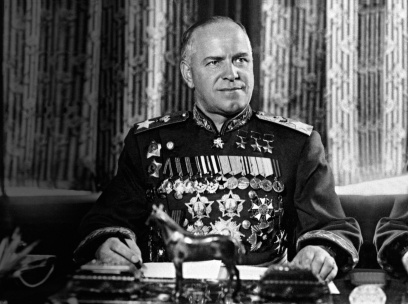
A reader sends the above image:

This portrait of Marshal Zhukov is a good illustration of earning your ostentatious medals.  This is how many you get for winning the Eastern Front.

A reader quotes another:

Give servicemembers their medals. They earn them in the service of their country.

As a Marine infantryman who served three tours in Iraq, I say: This is such a typical resort to jingoistic emotional appeal, devoid of any thought or meaning, that would not fly in a discussion about anything but military service. Notice how he refers to his award for graduating from Army basic training. It's essentially an award for being in the Army. At. All.

Below I rate nine awards I've received.  Before the invasion of Iraq, I would have been expected to leave the Marine Corps with two in four years – three if I got a Navy Achievement Medal for some fantastic job during a training event.  Here's my breakdown in order of precedence from highest to lowest:

Combat Action Ribbon: Officially, this is for taking fire and returning fire in kind. When I was awarded the ribbon, division commanders were given discretion to award the ribbon as they saw fit. I rated the CAR the moment another company in my battalion was mortared so far ahead in the convoy that I didn't even hear the explosion (although in the following deployment I did directly participate in numerous engagements).

Presidential Unit Citation: This is a "good job" to my entire unit from George Bush for participating in the invasion. To my knowledge, most units that invaded Iraq were awarded this irrespective of the details of their efforts.

Meritorious Unit Citation: After I graduated from boot camp, I was placed on "recruiter's assistance" in my hometown because the instructors at the School of Infantry, where I was next scheduled to go, were all on Christmas leave. The recruiting unit was given this award for some distinction I was never made aware of and didn't contribute to.

Good Conduct Medal: I went my first three years without being subject to formal disciplinary measures.

National Defense Service Medal: I served in the military during a time of National Service designated by George Bush. This one is for being in the military at all from 9/11/01 to a future date TBA.

Iraq Campaign Medal with four stars: For three tours in Iraq. In any capacity.

Global War on Terrorism Expeditionary Medal: For participating in the invasion of Iraq. In any capacity.

Global War on Terrorism Service Medal: This is for being in a unit that somehow contributes to the "war" effort. Even if it never deploys. It's slightly more exclusive than the National Defense Service Medal.

Sea Service Deployment Ribbon with two stars: For three overseas deployments. My deployments were all to fight in Iraq, but I'd have been awarded the same for three stints in Okinawa.

Marines in my unit who performed some exceptional act might be awarded Navy Achievement Medal, or a Navy Commendation Medal, or a Bronze Star. Lots of Purple Hearts floating around too. But that's a ribbon or two on top of the stack of fruit salad we all wear on our dress uniforms. And the Marine Corps tends to be stingier than other branches in awarding medals and ribbons.

Anecdotally, the personal awards are subject to inflation, both generally as the wars have dragged on, and toward higher rank. By the end of my enlistment, Navy Achievement Medals tended to be awarded for acts that would merely have elicited a "nice work" from one's superior when I entered the Marine Corps five years earlier. Also, a company or battalion commander might be awarded a bronze star for his collective actions throughout an entire deployment – essentially for being a good manager – while a private or lance corporal could not hope to receive such an award without charging into a hail of enemy gunfire (and even then it'd be up in the air).

The original reader email that started this mini-thread is here – an email that Peggy Noonan prominently featured in her latest column. To read the entire Dish thread on Petraeus' legacy and related tangents such as this one, go here.


Literary Longevity

Amit Majmudar attempts to define great literature, arguing that it "retains power over time and transcends its origins." In particular, he posits that a key to a work's staying power is its "excessiveness":

We tend to think of a great work as a well-made work, perfectly proportioned, not a word out of place. This is the novel as Flaubert conceived it. And yet Flaubert, too, is guilty of his own kind of excess: An excessive attention to every last word. Other lasting writers have indulged in other kinds of stylistic excesses—Shakespeare’s were rhetorical figures and metaphors, Tolstoy’s were digressive mini-essays, Goethe’s were poetic styles—but you will not find any permanent literary beauty without excess somewhere. The guarded, the cautious, the small-scale, the modest, the well-crafted—such books may be rewarded (in our own time, at the national level), but they are rarely preserved. They are not preserved because guardedness, caution, smallness, modesty, and craft can be replaced in any given generation. What is irreplaceable is excess: Of verbal kinesis, religious intensity, intellectual voracity. The 19th century Russian novel, though admittedly not chock-full of poetic firecrackers, is a drawn-out, episodic, digressive, multi-character affair, compared to the kinds of writing that went before it.

How Much Will The Water Rise?

Sea_level_boston

Combining data from the 2010 Census and the US Geological Survey, Stephen Von Worley explains his mapping of the vulnerability of 10 major coastal cities in the US:

Above, we see [Boston], with dense residential neighborhoods colored by elevation: white at the mean tide line, fading to yellow at 12 feet, orange at 25 feet, and blue at 50 feet or more above sea level, with less-populated areas represented by the same scheme, darkened proportionally.

A recent report warned the Pentagon about the security threat of rising sea levels, which currently threaten more than 30 US military bases. Meanwhile, scientists at the University of Innsbruck calculate that, between 1902 and 2009, glacier melt added around 8.6 inches to sea levels. From a forecast for the current century:

Melting glaciers will raise the sea level between [6 and 8.6 inches] until 2100. "Where we end up within this range is up to us – it mostly depends on how much greenhouse gas we will emit", says [Dr. Ben Marzeion from the Institute for Meteorology and Geophysics]. The same is true for the longer term: "Until 2300, we can expect the sea level to rise between [9.8 and 16.5 inches] due to glacier melt. With [16.5 inches of] sea level rise, most of the glaciers of the world will be gone, leaving behind only small remains in very high altitudes."

Climate change skeptics tend to counter these assessments with the observation that sea levels have stabilized – or even dropped – over the last few years, despite steadily climbing CO2 levels. However, Open Mind parses new research on the El Niño–Southern Oscillation weather pattern, which, since 2010, has transferred water mass from oceans to land via precipitation, primarily in Australia, South America and Asia:

This new understanding of the 2010/2011 sea level drop, one of the more notable short-term fluctuations in sea level, raises hope that we may finally be getting a handle, not only on the slower changes due to global warming, but the faster changes due to fluctuation effects like [the El Niño–Southern Oscillation]…. It also shows the folly of hopes that the 2010/2011 sea level drop should allay fears of continued global-warming induced sea level rise.

Recent Dish coverage on rising sea levels here and here.

Smart On Crime Is Smart Politics

Balko hopes national politicians will pay attention to Colorado, California, and Washington:

The one thing the 2012 results may do at the federal level is begin to convince some politicians that advocating reform is no longer political suicide. "This year’s initiatives in California, Colorado and Washington do indicate a changed public perception about punishment and marijuana in those states," [Julie Stewart, president of Families Against Mandatory Minimums,] says. "That should give legislators the freedom, if they choose to exercise it, to ease their tough-on-crime positions and not have to worry about surviving the next election."

The Daily Wrap

Photo-14

Today on the Dish, Andrew weighed in on the Gaza conflict as well as the IDF's macho posturing, then tore into Romney's "47 percent" redux, asserted the electoral power of gay voters, reminded us of McCain's doucheyness, and considered how a shirtless Fed might prove therapeutic for scandal-happy conservatives.

In political coverage, Adam Serwer and others got to the bottom of GOP gerrymandering, Bil Browning applauded the diversity of last week's winners, and Chait thought through the next 25 years of America's demography. Erica Grieder made it clear Texas won't become the Going-It-Alone-Star-State, Lee Drutman raised the cost of entry for future politicians, and Ramesh Ponnuru and Josh Barro analyzed the GOP's middle-class fantasies. Also, Rebecca Rosen helped us refute our whacky uncle's email forwards, Twitter users listed their #ObamaGifts, the Onion tried to out-crazy the right-wing tin-hat crowd, and we learned that, no, the auto bailout did not win Obama the election.

Looking internationally, our coverage of the violence in Israel continued as some anticipated a full ground war, while Michael Koplow and Eric Trager examined the responses from Turkey and Egypt, and Yousef Munayyer highlighted the disproportionate death toll in Gaza. Also in the Middle East, Nicholas Seeley doubted Jordan would get its own Arab Spring, while in the Far East, China went with conservatives for its new politburo.

In other assorted coverage, a number of readers contributed their thoughts on America's over-medaled service members, while other readers worked through the idea that public transit wastes resources. Energy was also Jeffrey Leonary's concern as he warned us about our fragile power infrastructure, while Dylan Matthrews tried to recalculate the real number of poor Americans, and Betsy Woodruff tried to get conservatives behind the small government potential of new legal weed laws – laws which might also be coming to the five additional states we took a look at. We went over the depressing statistics regarding women who are denied abortions, checked in on prison reform efforts, and were the view from an angry bird's window. Kevin Kelly concluded that high-tech Bond villains would definitely need henchmen, Lydia Kiesling celebrated the big C criticism of James Wood, Alex Tabarrok used his TED Talk stats to back up online learning, and 'Big Beard' Andrew declined to break bad over legal hard drugs. Lastly, eggs had it coming in our slo-mo MHB, it was a calm Vancouver dawn in our VFYW, and our FOTD enjoyed some fake snow.

– C.D.

Money Matters

Super_PAC

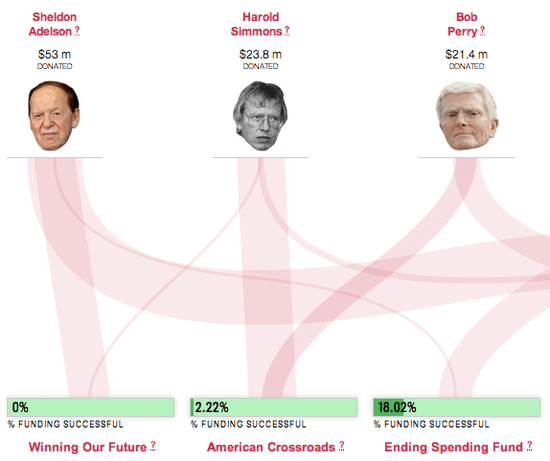
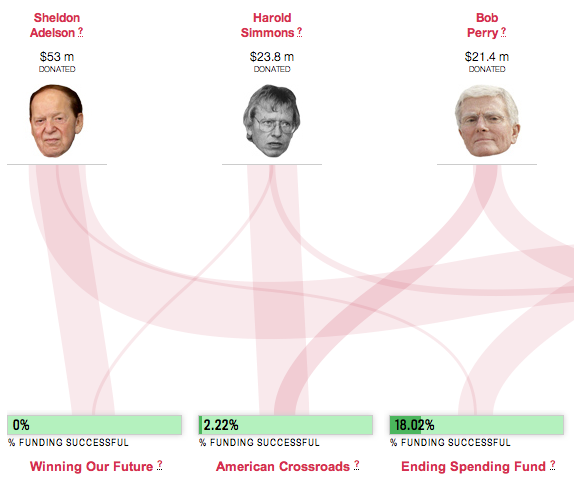
Given the poor performances of various GOP Super PACs, Lee Drutman of the Sunlight Foundation considers the role of money in politics going forward. One important point:

It’s an old story that money determines who runs for office in the first place. As Rahm Emanuel once put it: “The first third of your campaign is money, money, money. The second third is money, money, money. And the last third is votes, press, and money.” In other words, if you don’t have access to individuals willing to part with large sums of money to support your candidacy, you’ve got no business running for office.

Estimates are that incumbents now spend at least a quarter (probably more) of their time while in office raising money for their re-election. The lesson of 2012 is that it costs even more to get in the game. This further limits the pool of candidates who can run, and means that incumbents will want to build an even bigger war chest. 

Matthew DeLuca and Michael Keller created an interactive graphic on Super PAC winners and losers (detail above).

Even The Evil Genius Needs An IT Guy

Kevin Kelly theorizes that "the power of an individual to kill others has not increased over time":

A classic Hollywood trope is the evil genius madman who is using new technology he just invented to murder (or blackmail with the threat to murder) a large chunk of humanity. Always the lone evil genius works in a high tech haven, hidden from others, all by himself. At this point, the scenario is total fiction because no one can run all that technology by themselves. It is hard to keep 3 computers and a network going all by yourself. The madman's electronic door hatch probably crashes once a month, particularly if the madman just invented it. So can you invent and keep operational the death ray? No. Way. No solo genius can destroy mankind. That kind of power takes cooperation.