
Vancouver, British Columbia, 7.25 am
Vancouver, British Columbia, 7.25 am
Jeffrey Leonard wants to invest in our electric grid:
Today, the average substation transformer in the U.S. is forty-two years old—two years older than its expected life span. A recent Department of Energy report warned that 70 percent of the largest high-voltage power transformers—each weighing up to 800,000 pounds—are more than twenty-five years old, and subject to an increased risk of failure. As of now, replacing one of these enormous transformers, should it be attacked, or simply break down, can take twenty months or longer. Even without any major attacks or breakages, most of the equipment on the grid is already so antiquated that roughly 500,000 Americans lose electricity for at least two hours every single day.
That was the margin for Obama among gay voters. The generational shift is profound:
Only 1.9 percent of Americans over 65 identify as gay, lesbian or bisexual, according to the Gallup survey, while 3.2 percent of those between 30 and 49 and 6.4 percent of those between 18 and 29 do.
More to the point, among straight voters, the result was 49-49 percent for both Obama and Romney. So that kinda means gays won the election for Obama, right? Kinda. More realistically, it simply means that the era of using gays as election-bait – Rove’s and Morris’s strategies in 1996 and 2004 – is now over. We have arrived. We are winners. We make politicians winners. And more are on the way.
A map of the whitehouse.gov Texas secession petitions:

Erica Grieder isn't taking the chatter seriously:
Secession is illegal … and even if it weren't, every state is clearly better off as part of the United States than it would be on its own. I therefore understand secessionist rhetoric–in Texas and elsewhere–as a euphemism for more general frustration, rather than a serious suggestion. In fact, I would argue that it's precisely because secession is such a preposterous suggestion that it's safe to clown on about; that's why some people in Austin have started up their own petition to secede from Texas if Texas secedes from America. I'm sure you can find people here and there who are seriously pushing secession, of course, but I doubt a new secessionist movement is going to spring from an online petition on the White House's website.
He's so incensed by the Benghazi affair that he skipped a classified briefing on the matter. Why seek answers from the intelligence community when you already know them from Fox News's conspiracy theory department? But this is awesome from CNN, when McCain was confronted by a producer:
"I have no comment about my schedule and I'm not going to comment on how I spend my time to the media," McCain said. Asked why he wouldn't comment, McCain grew agitated: "Because I have the right as a senator to have no comment and who the hell are you to tell me I can or not?”
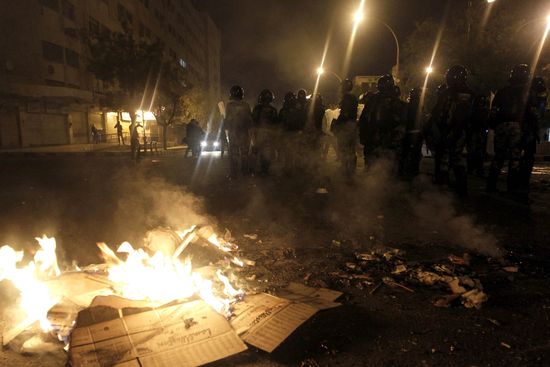
Nicholas Seeley bets that Jordan is "extremely unlikely to fall, explode, crumble, or collapse":
It is not Somalia, or Yemen: it is a middle-income country with substantial state legitimacy, large bureaucratic institutions, and a strong military apparatus. Such countries do not crumble like sand castles when a wave hits. Negative development is possible, but it takes time – and usually a lot of waves. Nor is it Iraq, Syria, or Yemen, where the state has spent years establishing massive, coercive violence as a social norm. Jordan is unique, and actually has a lot going for it.
Earlier analysis here. Update from an Egyptian reader:
You quoted Seeley saying: "It is not Somalia, or Yemen: it is a middle-income country with substantial state legitimacy, large bureaucratic institutions, and a strong military apparatus." OMG, he's right. There's no other country in the Arab Spring like this. "Such countries do not crumble like sand castles when a wave hits." Yeah, that totally never ever happened before.
I suggest that Western analysts maybe stick to reporting and analyzing events that happened instead of making fortune-telling. The thing about Jordan that is different from Egypt and Tunisia, is that it's not a republic.
There's a line in the Arab world between republics and monarchies that kingdoms in the Gulf (Saudi Arabia, UAE, etc.) are very aware of and very worried that the Arab Spring might cross that line. Very early in the Arab Spring (May 2011), the GCC (Gulf Cooperation Council) accepted the membership of Jordan (which asked 15 years earlier) and offered membership to Morocco ignoring the technicality that neither is a Gulf state. I don't know if Jordan is next or not. What I do know is, a change in Jordan will show the way for the people of those monarchies, especially Morocco.
(Photo: Jordanian riot policemen face off against protesters during a demonstration against rising fuel costs at Jabal al-Hussein in Amman on November 14, 2012. Jordan was hit by a wave of protests in mounting anger over a whopping rise in fuel prices, with rioting and clashes erupting in Amman and other cities and a police station attacked. By Khalil Mazraawi/AFP/Getty Images)
JPod was panting for it a while back. Like the entire Benghazi non-scandal (including the now clearly debunked assertion that Susan Rice was playing politics), it fizzles upon immediate scrutiny. I think it’s therapy really. And God knows they need it.
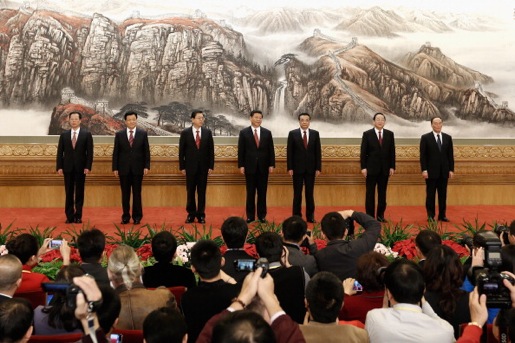
Today China's Communist Party confirmed the membership of the Politburo Standing Committee – the seven leaders who will run China for the next 10 years (with a possible minor reshuffle halfway through). Elizabeth Economy is unimpressed:
The candidates for the Politburo Standing Committee with the strongest reform credentials—Li Yuanchao and Wang Yang—were left high and dry, while those who anchor the “hold back change at all cost” wing of the Party—Zhang Dejiang and Liu Yunshan—took their place among the top seven. The remaining five—Xi Jinping, Li Keqiang, Zhang Gaoli, Yu Zhengsheng, and Wang Qishan—represent a range of relativity: relatively more or less interested in political reform and relatively more or less committed to economic reform.
Evan Osnos reflects on the picks:
[T]he Party chose some of its most ardent conservatives. One is a seasoned propagandist. Another received his economics training in North Korea. They were so faithful to precedent that all but one wore a nearly identical dark suit and red tie. After months of secretive politicking over questions of reform and legitimacy, the Party seems to have sided with what one politics-watcher called the “unwritten party rule which favored seniority over competence.”
(Photo: From left to right, Zhang Gaoli, Liu Yunshan, Zhang Dejiang, Xi Jinping, Li Keqiang, Yu Zhengsheng and Wang Qishan greet the media at the Great Hall of the People on November 15, 2012, in Beijing. By Lintao Zhang/Getty Images)
At National Review, Betsy Woodruff argues that Republicans should support the new laws in Colorado and Washington:
If the GOP is going to be competitive in 2016, it has to communicate to young people that intrusive federal government makes their lives worse. It has to communicate that it’s the party that respects personal choice and individual responsibility. And it would probably help to communicate that when in doubt, the GOP doesn’t automatically take the side of the insanely expensive branch of the federal government that breaks into people’s homes, shoots their dogs, and imprisons them because they added a funny ingredient to their brownies.
Eggs are asking for it:
(Hat tip: Cory Doctorow)
 The Dish