Obama’s Brain-Washing Secret

Okay which one of these stories is not from the Onion? First up:

President Obama is using a Cold War-era mind-control technique known as “Delphi” to coerce Americans into accepting his plan for a United Nations-run communist dictatorship in which suburbanites will be forcibly relocated to cities. That’s according to a four-hour briefing delivered to Republican state senators at the Georgia state Capitol last month.

Or this one?

As they scoured the Internet for more juicy details about former CIA director David Petraeus’ affair with biographer Paula Broadwell, Americans were reportedly horrified today upon learning that a protracted, bloody war involving U.S. forces is currently raging in the nation of Afghanistan.

The Voters Were Bribed!

142646344

Romney gives his own explanation for his loss to the only people he really cared about: his donor base. As usual with Republicans these days, there is no real personal responsibility. They do nothing wrong ever. They confess to no mistakes themselves. And we now kinda know that Romney's "47 percent" remarks were actually what he deeply believes. Get a load of this:

"I’m very sorry that we didn’t win," Mr. Romney said on the call. "I know that you expected to win, we expected to win, we were disappointed with the result, we hadn’t anticipated it, and it was very close, but close doesn’t count in this business."

He continued: "And so now we’re looking and saying, ‘O.K., what can we do going forward?’ But frankly, we’re still so troubled by the past, it’s hard to put together our plans for the future."

He's so "troubled" that he cannot plan anything. Does he mean the election was rigged? Or stolen? No – just a function of crude bribery:

"You can imagine for somebody making $25,000 or $30,000 or $35,000 a year, being told you’re now going to get free health care, particularly if you don’t have it, getting free health care worth, what, $10,000 per family, in perpetuity — I mean, this is huge," Mr. Romney said. "Likewise with Hispanic voters, free health care was a big plus. But in addition with regards to Hispanic voters, the amnesty for children of illegals, the so-called Dream Act kids, was a huge plus for that voting group."

A couple of obvious questions. Does Romney understand that he is essentially saying that Democratic voters were not interested in the common good, that they had no opinions about the issues as a whole, but were simply after getting "stuff", as Bill O'Reilly explained. Does he understand how that insults the intelligence and good faith of a majority of Americans?

And nothing is free in government. It either has to be paid for in taxes or borrowing. So is Romney's very low tax rate (compared with mine), for example, not a gift from the government? Are all the net federal transfers of wealth to red states not also, by that logic, a gift? What would Romney call getting offered a job with zero risk (Bain Capital), and a promise that if the investments did not work out, he could go back to his old job with no penalty, and retroactively get all his previous salary paid? Was that a gift as well? Or was that thriving, striving, Deseret?

The condescension and unconscious racism in all this prompted one Republican to protest. A member of both demographics, young and minority, Bobby Jindal:

No, I think that’s absolutely wrong. Two points on that: One, we have got to stop dividing the American voters. We need to go after 100 percent of the votes, not 53 percent. We need to go after every single vote. And, secondly, we need to continue to show how our policies help every voter out there achieve the American Dream, which is to be in the middle class, which is to be able to give their children an opportunity to be able to get a great education. … So, I absolutely reject that notion, that description. I think that’s absolutely wrong.

Jindal seems to get it. Which is encouraging, don't you think?

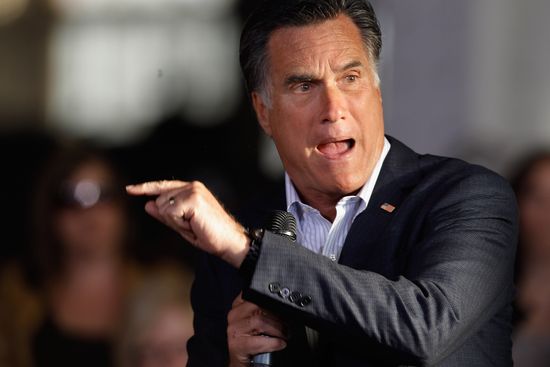
(Photo: Chip Somodevilla/Getty, from earlier this year.)

The Tweets Of War

The Israeli military’s use of social media to send chilling messages to Hamas continues:

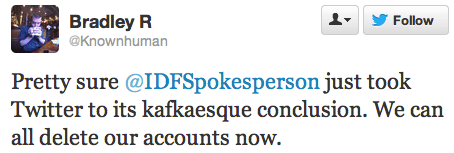
The IDF’s Twitter account is not without its dissenters:

But apparently, the better translation is “pillar of cloud” or “pillar of smoke”. And there’s this of course, put out by the IDF:

Jabarifb1-640x640

And they posted a video of that assassination, which we embedded here. I think Israel has a right to self-defense against the rockets being randomly fired toward their civilian population. But I do not recognize the Western concepts of just war and self-defense in these macho posturings about war. There is a relish about the use of disproportionate technology and force that I suppose tells us something about what living under siege can do to the psyches of human beings. The dehumanization of the enemy is also helped in part by distant electronic and video monitoring and broadcasting of deaths on the ground, as if this were a video game. It makes me think again about the question of the moral use of drone warfare.

And it’s hard to disagree with this tweeter:

Screen shot 2012-11-15 at 12.33.51 PM

A Twitter hashtag #gazaunderattack has been created as a response. And Mondoweiss is reporting from the area:

If you doubt this is a religious war, fueled in part by religious fundamentalism as well as self-defense, note that the IDF called their operation after a Biblical verse:

This operation is named in reference to a biblical passage in which a pillar of cloud protects the Israelites as they wandered in the desert after leaving bondage in Egypt.

And the Lord went before them by day in a pillar of cloud, to lead them the way; and by night in a pillar of fire, to give them light; that they might go by day and by night. Exodus 13:21

It is unseemly to invoke the protection afforded the Israelites wandering in the desert when Israel is the dominant military power in the region.

Goldblog asks the core question:

What is the strategy? The fact remains that there is no long-term military solution to the challenge posed by Gaza, but the Israeli government doesn’t want to acknowledge this.

There are enough weapons, and enough young men in Gaza ready to use those weapons, to make life miserable for millions of Israelis for years to come, barring a full-scale invasion by the IDF of Gaza that wipes out the entire military structure of Hamas. And good luck with that, by the way — good luck to Bibi getting the world to acquiesce.

Netanyahu’s failure to convince the world that he is serious about compromise (he might have succeeded, given his Palestinian counterpart’s own alternately lackadaisical and obstreperous approach to peace talks, if he wasn’t hell-bent on growing settlements) means that he has no political capital to spend.

Funny, too, isn’t it, that this is the second Gaza war launched after a US presidential election elected Barack Obama. No coincidence, right? Or a deadly message about this Israeli government’s determination to take the fight to its enemies, regardless of long-term strategic goals?

The Republican Minority Has Arrived, Ctd

How Chait understands the GOP's demographic headwinds:

[T]here is no such thing as a permanent change in American politics. What we’re talking about here is the landscape for a quarter-century or so — anything beyond that is too distant to project. In the long run, interracial marriage and cultural assimilation will make the descendants of today’s Latino voters identify much more closely with the white mainstream, which will make them more amenable to conservatism. But that long run is pretty far off. For the foreseeable future, the decline of the white population is occurring much more rapidly than the weakening identity of the nonwhite population. The Democrats have a party identity that is well suited to this environment; it is the Republicans who will have to adapt.

Earlier Dish on the subject here, here and here.

Is Poverty Worse Than We Realize?

Spm programs

Dylan Matthews analyzes what the "supplemental poverty measure" – a new Census bureau metric (pdf) that, unlike the "official" poverty rate, accounts for welfare programs – reveals about how poverty affects different demographic groups:

Overall, [the SPM is] higher than the official measure, at 16.1 percent, but for some groups, such as children under 18 and blacks, it’s actually lower. By contrast , it’s much higher for the elderly (15.1 percent in the supplemental measure, 8.7 percent in the official one) and Asian-Americans (16.9 percent supplemental, 12.3 percent official), and slightly higher for those 18-64, Hispanics, and non-Hispanic whites.

Matthews digs into which government programs have the biggest impact:

Medical expenses are the main expense contributor to poverty, followed by expenses related to work (such as transportation, supplies, etc.), while Social Security is far and away the most important program for reducing poverty….

[T]he Social Security number is especially notable given how much higher the supplemental measure is than the official one for the elderly. It suggests that even with that substantial safety net, the poverty problem among the elderly is much bigger than we thought.

Arloc Sherman, meanwhile, emphasizes the looming sequestration factor:

These figures are particularly timely given the looming expiration of two key measures that account for part of these programs’ large antipoverty impact:  federal emergency unemployment insurance and the 2009 Recovery Act’s improvements in refundable tax credits like the EITC. Letting these measures expire at year’s end could push large numbers of families into poverty.

The Medals They Carried, Ctd

128052257

A reader writes:

Yes, yes, yes! And I thought I was the only one who felt this way. I've been in the military 19 years and could – if I choose and in some cases, if allowed – wear 23 ribbons and five devices. I don't. I'm what I like to call a Top Three kind of guy; I only wear my top three ribbons. It always felt pretentious and self-aggrandizing to wear anything more. Many in the military look more like Third World dictators than servants of the people. It's just an embarrassment to see and I wish I could change that part of the system.

Another:

I hope you continue to discuss this culture of blown-up decorations in the military, but I want to add that this is not how the average soldier or officer sees their own role in the institution. Rather, this is how political men act within the military.

My father had a successful career as an Army Ranger but still to this day refuses to wear his dress blues, as did my grandfather, an Army general. There is a political culture in the military that, to outsiders, seems to be honorable and patriotic. But this culture does not represent all those who serve honorably, just the politicians who seek to bask in it.

Another great perspective from a soldier:

I wish I could say that the reader commenting on the medals was completely and utterly wrong, but I can't. The truth of the matter is many of the medals awarded to servicemembers are based on a job well done, not valor or meritorious service. In the six years I spent in the Army, six of the medals awarded to me were for exactly that: going above and beyond the call of duty to get a job done.

My Army Service ribbon was for making it out of Basic Training in one piece; my NCO Professional Development ribbon was for making it out of Primary Leadership Development in one piece. However, The National Defense Medal, The Southwest Asia Medal, and the Liberation of Kuwait medals on my uniform were for serving in Desert Storm. I'd have earned those whether I made it out in one piece or not.

There has been talk about tightening up the standards for awarding non-valor medals among the services before, for the exact reasons the reader is citing. The American military, especially in the officer ranks, look pretty ostentatious compared to their European counterparts once all the spaghetti is out on the dress uniform.

That said though: see those stripes on Petraeus's right sleeve? Each one of those equals six months spent on overseas duty. With all due respect, the reader needs to remember that while some of those medals on the general's chest are there for doing a job well, others are there because the general did that job overseas in a war zone while insurgents and enemy combatants tried to kill him.

Give servicemembers their medals. They earn them in the service of their country.

One of many readers to make this connection:

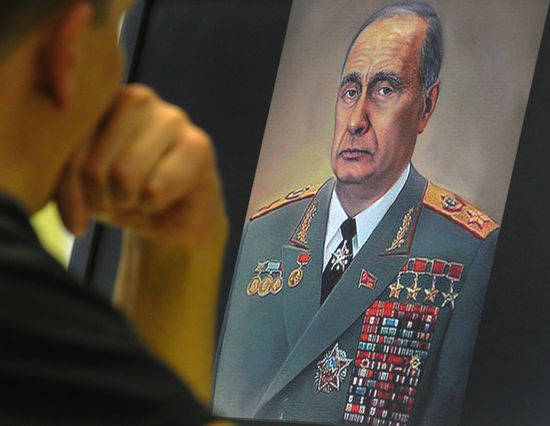
The first person who came to mind when I saw the portrait of General Petraeus was Leonid Brezhnev. (It's a close race for medals, but Brezhnev beats Petraeus in the eyebrow department.)

(Photo: A man looks at a caricature depicting Russian Premier Vladimir Putin as Leonid Brezhnev on his computer screen in Moscow on October 5, 2011. By Alexander Nemenov/AFP/Getty Images)

One more reader:

That post immediately made me think of a classic scene from the criminally under-rated I’m Gonna Get You Sucka:

To read the entire Dish thread on Petraeus' legacy and related tangents, go here.

How To Counter Your Right-Wing Relatives Before Thanksgiving

Rebecca Rosen highlights a new tool to target the forwarded BS in your inbox:

LazyTruth [link] is a plug-in for Chrome that automatically scans email for information that FactCheck.org and Politifact have deemed false. If something doesn't check out, it'll provide a few words of correction and a link to where you can find out more. You can then easily pass that verified information on to the email's sender. Down the road [developer Matt] Stempeck plans to add more kinds of rumors to LazyTruth's filter — urban myths, hoaxes, false security threats, etc. — but for now the tool is limited to political tall tales.

Are We Overselling Public Transit? Ctd

A reader writes:

Eric A. Morris states that "only" ten people on a bus is no better than "1.6" people in a car, ignoring that the grouping of people on buses alleviates the need for 10 vehicles on the road, thus making roads less congested, opens up more parking opportunities for those who do drive, and allows people without cars more flexibility in their travel plans throughout the day (not to mention freeing their income from having to purchase and expensively maintain an auto).

Another writes:

Morris completely forgot to consider utilization. A bus or subway car spends practically every day for about 19 hours per day on the road or rail. It's perfectly ordinary for 1980s vintage (or older) subway cars to be moving people in 2012. A private car, in contrast, spends the vast majority of its much shorter life sitting in a garage, driveway, or parking lot – all of which require vast amounts of energy to build and almost none of which is cleanly produced and transmitted over a grid.

Another:

The real energy advantage of transit is that it enables the higher densities in which many trips need not involve a motorized vehicle at all, and it is these trips on foot or bicycle that really are green.

The downtown worker probably walks to lunch and the ATM while the equivalent suburban office-park worker would need to drive to the next strip mall over. The argument that we've already put transit in the places where it is efficient makes the same mistake that justifies highway expansions: that there is a fixed demand for transportation between any two points, independent of the existing capacity. But just as new roads create new traffic through the well-documented phenomenon of induced travel, transit infrastructure can create its own demand as well.

Perhaps the best-known example is the Rosslyn-Ballston Metro corridor in Arlington, VA, which today provides thousands with transit-and-walking centric living, working, and shopping, but which nobody would have classified as "low-hanging fruit" when 40 years ago when construction started. Likewise, the most energy efficient light rail system (Figure 2.2 of the cited Transportation Energy Data Book) in San Diego, is also the oldest, meaning it has had the most time to reap the energy benefits of its influence on development and lifestyle patterns.

A certified transit expert writes:

Not only do I agree that we are overselling (conventional) mass transit, Eric Morris is also overselling it by claiming that the average bus has an average of about 10 passengers.  This is a gross over estimate if computed properly.  If one takes the total passenger miles traveled on buses in the US and divides it by total bus miles, then the number comes out to actually be less than 5.

Buses have a significant number of passengers on only a portion of any route in the prime of two directions during the few "peak hours" of any day.  The rest of the time and in the off-prime direction all the time, their ridership is very low, leading to the very poor average number of passengers.  The fact that buses operate on a fixed schedule along a fixed linear route with relatively little coordination between routes restricts them from adequately serving the needs of the traveling public that wishes to go between a wide variety of locations throughout most of each day, not just the peak hours.  This diffusivity of the fundamental demand for mobility is simply not adequately served by conventional mass transit systems.

This is not true for a class of new transit systems known as Automated Transit Networks (ATN). These systems (precursors of which exist in Morgantown WV, Heathrow Airport, UK and Masdar City, UAE) are small automated vehicles operating demand-responsively between any pair of stations interconnected by a network of narrow exclusive roadways.  Provided is elevator-like service. A vehicle is usually waiting for a customer and encouraged is the sharing of rides during times when there is some likelihood that some additional customers may desire similar mobility at about the same time as the initial rider.  As with elevators, doors are left open for a short while, say one minute, to accommodate anyone else. Individual vehicles need not be large, essentially that of a normal elevator, because it is very rare that large groups of people want to travel between the same stations at about the same time.  In such rare events, a group of vehicles can be used.  

More importantly, during most of the time when it is rare to have more than one person wanting to travel, these systems provide equally high-quality, elevator-like on-demand service.  Provided is 24×7  mobility that is an attractive alternative to the personal automobile for large portions of tomorrow's cities.