How Can Republicans Respond To Inequality?

Josh Barro believes that the GOP should support certain forms of redistribution:

The dirty secret about the last 30 years' rise in pre-tax income inequality is that we probably can't reverse it. Instead, we will have to rely on policies that ameliorate it on an after-tax basis — that is, the dreaded redistribution of income, or "spreading the wealth around."

Some redistributive policies are more economically damaging than others. If conservatives made peace with the need for more redistributive economic policy, they could fight to make sure it is pro-growth. For example, they could focus on minimizing poverty traps created by means-tested entitlements, and making sure the tax base is broad so progressivity can be achieved with relatively low tax rates.

Roughly, this is what right-of-center political parties in Europe do.

Face Of The Day

157162189

One of two 9-month old Cheetahs is seen after it was released into a quarantine facility at Zoo Miami on November 29, 2012 in Miami, Florida. The two sub-adult brothers who arrived today were captive-born on March 6th at the Ann van Dyk Cheetah Centre just outside of Pretoria, South Africa. The Cheetahs, after being monitored and examined for a minimum of 30 days to insure that they are healthy and stable, will be featured in Zoo Miami's Wildlife Show at the newly constructed amphitheater and will continue the work of Zoo Miami’s Cheetah Ambassador Program by making appearances off zoo grounds at a variety of venues including schools and civic organizations. By Joe Raedle/Getty Images.

The Senate Won’t Decide It

Yglesias plans to mostly ignore chatter from Senate Republicans:

To simply steal a point my colleague John Dickerson made the other day about something else, despite the press' love for quoting Senators the actions of Senate Republicans are totally irrelevant to legislative activity.

For a bill to pass, it needs the agreement of Barack Obama and John Boehner. There's no way an Obama/Boehner agreement on immigration, the fiscal cliff, or anything else is going to be sunk by John McCain. Back in 2010, Boehner was totally irrelevant and marginal Senate Republicans were the whole story of everything. But here in 2012 it's the reverse. It's all about what Boehner will and won't do, and the views of marginal Senate Republicans are irrelevant.

The End Of Gay Culture Watch, Ctd

156776753

A reader writes:

The San Francisco ban on public nudity has nothing to do with the end of Gay Culture, no more than the recent Sit-Lie ordinance aimed at homeless individuals in Haight-Ashbury has to do with the end of Hippie Culture. What has become bourgeois is San Francisco, a tech-industry boom town where business has to be very good indeed to justify paying the price to live there.  The Castro has been gradually encroached by upscale hipster-dom and all its accoutrements, namely lavish bars selling $10 Old Fashioneds instead of bottomless mimosa crawls and erotic spas.  It has been in clear decline as a "gay" area for years.  I would suggest you look elsewhere for your bellwethers of gay culture.

And shame on the city supervisors for their hypocrisy: denying those nudists at the Castro intersection who, by and large, are just out to enjoy the weather, while allowing the Saturnalia that is Folsom Street Fair.  The latter is far more invasive, far more lewd, and most notably, far more lucrative for the city.  So much for thinking of the children.

Another writes:

I'm a Castro resident (though straight, so maybe that impacts my read on things). 

Nudity's still allowed at festivals like the Folsom Street Fair, Pride Parade, Bay-to-Breakers, etc.  The issue in the Castro was really the same five or six guys (always guys, usually 40+) who would hang out on Castro and Market every sunny weekend.  They occupied a small public square with food/coffee carts and city-owned tables and chairs.  It wasn't a park either, where a lot of people were lounging/sunbathing; it was on Market in the middle of a commercial area. 

I didn't get the sense they were gay, just that they knew the Castro was generally tolerant so chose that area to set up shop.  It got to the point where you couldn't catch MUNI on a sunny day without seeing a middle-aged man's dinger, and obviously they monopolized the public space (I don't care how tolerant you are, it's tough to sit down for a cup of coffee with a spread-legged naked 50-year-old man sitting next to you).  At some point, gay, straight, bi, or otherwise, you're gonna wanna shut that down in the name of common decency.  So, for me, it seems less like an instance of a change in gay culture, more like people were tolerant of nudists, they abused their privilege, and the privilege was taken away.

Another:

I'm not sure if gay culture is ending or simply changing. I live in San Francisco's Castro district – two blocks from where the naked guys hang out. My sense is that most people here don't really object to nakedness. Instead it's the sexual activity – guys fingering themselves, leering, etc. – right at a busy subway stop that many of us can't avoid. If there were a simple way to legislate (and enforce) a "no fingering yourself while naked" law, then we could probably live with the sagging asses and the older naked dudes using their walkers. But that's a tough distinction to make, so we are left with a nudity ban.

(Photo: Protesters expose themselves at San Francisco's City Hall after the city's Board of Supervisors approved a ban on public nudity on November 20, 2012. San Francisco lawmakers voted to outlaw most public nudity, despite protests in the famously free and easy California city. The law was approved 6-5. By Josh Edelson/AFP/Getty Images)

How Grover Won

Ezra Klein argues that, even as Republican House members consider raising taxes, the legacy of Norquist's anti-tax pledge is a dramatically lowered baseline for what we consider acceptable tax rates:

The true test of Norquist’s pledge wasn’t whether a Republican ever voted for another tax increase. It was whether it held tax revenues below where they’d otherwise be. It’s whether it increased the political cost of raising taxes. And today, you can see how well his pledge has worked.

Waldman agrees:

Norquist understood this battle as one that is never actually won or lost. It just goes on forever, and that's perfectly fine with him. And even though there will probably be an increase in taxes at the end of this year, as Ezra Klein argues, Norquist has already won. Despite the fact that Democrats just won a huge victory at the polls, in the upcoming deal everyone is acknowledging that there will be dramatic spending cuts, but even the most modest increase in taxes is being portrayed as an enormous concession by Republicans, one that should naturally be met with something like a revision to the country's most cherished social programs.

When It’s Better To Go With A Translator

486149 10151345423504603 1283346618 n

Robert Mackey parses the odd interview that Egyptian President Mohamed Morsi just gave to Time:

Speaking mainly in English, a language he has a fluent if idiosyncratic grasp of, the president attempted to explain himself in terms Americans might understand — making reference in one answer to "Good Morning America," Barbara Walters, the Iran hostage crisis, Charles Bronson and "Planet of the Apes." He observed, near the start of the discussion with the American journalists: "The world is now much more difficult than it was during your revolution. It’s even more difficult. The world. More complicated, complex, difficult. It’s a spaghettilike structure. It’s mixed up."

While the reference to the world’s "spaghettilike structure" attracted some attention from readers in Cairo, more puzzling still was the question of what, exactly, Mr. Morsi intended to say about his role in international diplomacy with his long aside about the 1960s science-fiction fantasy in which apes evolved from man.

Mackey tries to understand Morsi's musings on The Planet of the Apes:

While convoluted, the simplest reading of the president’s musings is that they had something to do with the moral of the film’s end, in which the orangutan known as Dr. Zaius, who held the high office of chief defender of the faith, explained to the human astronaut Taylor that mankind had proved unfit to rule the earth and destroyed itself through nuclear warfare.

Max Fisher reminds us that "English is not Morsi’s first language" and to "try to give him a sympathetic reading in that regard." But Hicham Nasr thinks Morsi should have known better than to try and speak English:

Mr. Morsi is an official representing one of the most populated Arabic speaking countries. Each word uttered by a politician of such a level should be well weighed and there should be no place for fragments and semi-fragments in a president’s speech. Isn’t it safer to use Arabic? It wouldn’t be a demerit at all. Arabic is one of the six official languages of UN. It is the mother tongue of more than 300 million people and the 4th most spoken language around the world. Regardless of its international status, it is more respectable for a president to speak the national language of his country.

(Image via Hossam Bahgat)

Why Not Close Gitmo?

A new GAO study found that there are 104 locations in the US that could potentially house Guantanamo detainees. Ackerman reads through it:

[T]he study points to the inherent physical similarities between Guantanamo and federal prisons. Camp Six, for instance, the newest detention center and the one holding some two-thirds of the remaining Gitmo population, is "designed after the layout of a U.S. county jail, and it consists of eight indoor climate-controlled, two-story housing units that each contain 22 individual cells and one large common area." Nor is Guantanamo a hub for intelligence anymore: Since the facility hasn’t admitted a new detainee since 2006, whatever residual intelligence operations happen at Guantanamo are to "help ensure the safety and security of the detention facilities and personnel.

A few years ago, Bodenner reported on how a Michigan prison perfectly suited for detainees and courted by the Obama administration was passed over due to GOP scare tactics and demagoguing.

Mental Health Break

Christopher Jobson is taken aback:

This gorgeous time-lapse by filmmaker Jamie Scott starts off like any other video capturing the change of the seasons with the movement of the sun, but then around :30 something pretty remarkable happens. To create the effect Scott filmed in 15 locations around New York City’s Central Park, two times a week, for six months using the exact same tripod and camera lens settings resulting in the footage you see here. (via jason sondhi)

Invested In A Hobby

Felix Salmon sees amateur stock-picking as a male-dominated hobby. He figures that stocks might cost the average trader $5000 a year:

I know people who can spend $5,000 on a single bicycle. If you’re into classic cars, $5,000 is nothing. And similarly, if you’re skiing or flying around in small planes or even just taking a luxury vacation once a year, $5,000 can be a relatively modest sum for a reasonably affluent person. And none of those hobbies come with the extra thrill of dreaming that they could end up being highly profitable.

One thing I would note, though: from a financial-media perspective, you’re limiting yourself enormously if you spend too much time chasing that small group of hobbyists — especially if you’re not trying to sell them subscriptions. Look at the enormous number of websites which put stock tickers next to company names, so that the hobbyists can see exactly what the stock in question is doing that day. It makes the site seem as though it’s targeted at silly males, rather than at a broader, smarter audience.

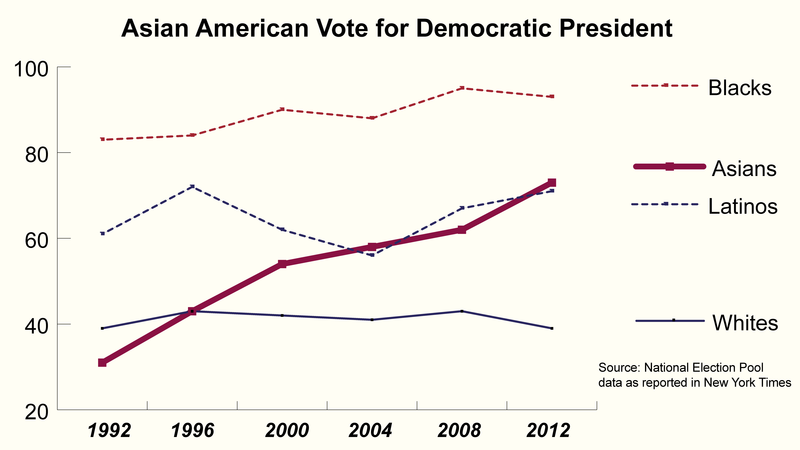
Why Do Asian-Americans Increasingly Lean Left? Ctd

Asian_Vote

Karthick Ramakrishnan and Taeku Lee's addition to the debate:

We provided some answers in a recent op-ed in the Los Angeles Times, where we largely draw attention to actions by the Clinton administration in the 1990s that appealed to Asian American voters, and subsequent “push” factors by a vocal set of Republican officials that portrayed a party as exclusionary on religion and strictly conservative on immigration.  We also show, relying on our 2008 and 2012 data, that the Obama administration enacted policies on issues such as health care, education, and the Iraq War that had overwhelming support among Asian Americans.  He also appointed a record number of Asian Americans, from Cabinet positions to the World Bank, and even his judicial nominations of people like Goodwin Liu received widespread attention and support among Asian American organizations and news media.  Thus, a variety of “push” and “pull” factors on the Republican and Democratic sides, respectively, help explain the dramatic shift in Asian American voters over the last 20 years.