How Significant Was Gerrymandering?

GOP_GerryMandering

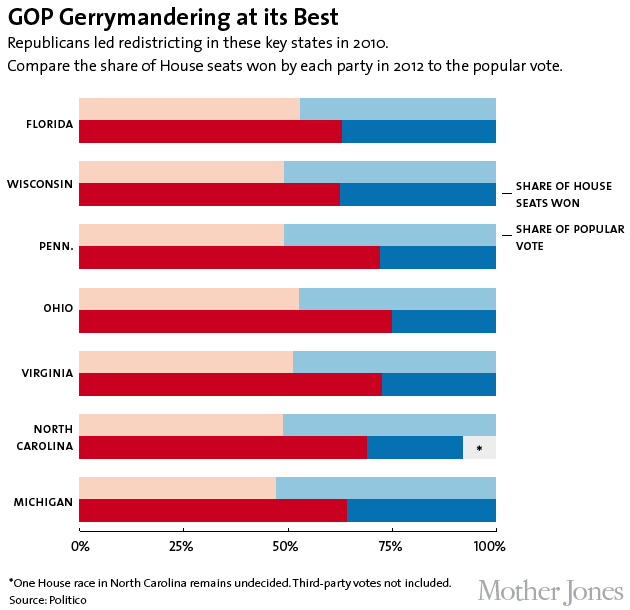
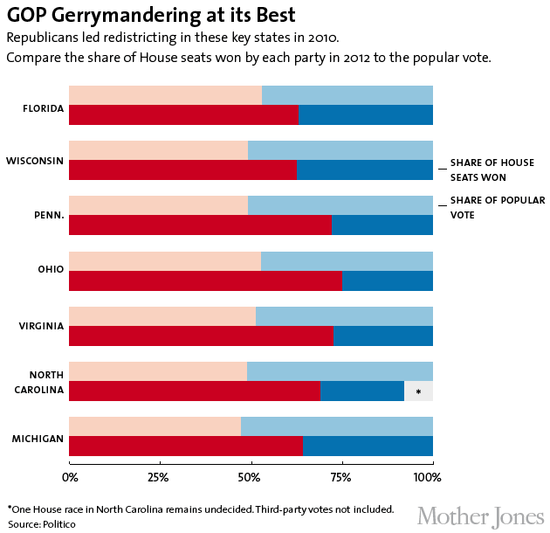
Adam Serwer compares the popular vote to House seats won in various states:

After Republicans swept into power in state legislatures in 2010, the GOP gerrymandered key states, redrawing House district boundaries to favor Republicans. In Pennsylvania, Democratic candidates received half of the votes in House contests, but Republicans will claim about three quarters of the congressional seats. The same is true in North Carolina. More than half the voters in that state voted for Democratic representation, yet Republicans will fill about 70 percent of the seats. Democrats drew more votes in Michigan than Republicans, but they'll take only 5 out of the state's 14 congressional seats.

But Bernstein says gerrymandering was less important than the above chart would suggest:

Political scientist Eric McGhee ran the numbers and discovered that Democrats probably would have done better, but not much better, using the old districts. If it’s not gerrymanders, what is it? Probably a combination of incumbency helping keep any majority party in the House in place, plus inefficient distribution of where Democrats live. As McGhee says, Democrats “?‘waste’ votes on huge margins [in cities], when the party could put many of those votes to better use in marginal seats.”

Drum reviews McGhee's analysis and Sam Wang's calculations:

The Republican gerrymander following the 2010 census has given them a permanent tailwind of about six seats, and they'll keep this for the rest of the decade. Combine that with the incumbency effect, and Democrats are unlikely to regain the majority unless they win about 52 percent of the popular vote.

Other Firsts From Last Tuesday

Bil Browning reflects:

While the media has been drooling over the success of female candidates this year, there's several other notable results. … We now have our first non-theist (Kyrsten Sinema – AZ), our first Hindus (Tulsi Gabbard – HI and Ami Bera – CA), and our first Buddhist senator (Mazie Hirono – HI). Sinema is also the first openly bisexual person elected to Congress. 

Update from a reader:

It isn't true that "We now have our first non-theist (Kyrsten Sinema – AZ)"; Pete Stark, soon to be a former congressman, is an atheist.

The Efficiency Of The Online Classroom

Ted_Teaching

Alex Tabarrok defends online education:

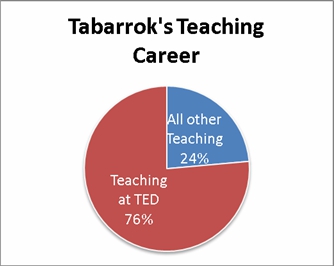
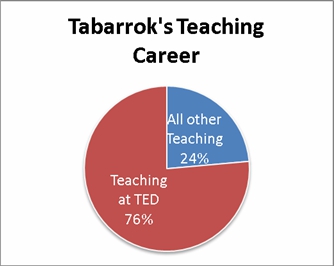
The importance of leverage was brought home to me by a personal anecdote. In 2009, I gave a TED talk on the economics of growth. Since then my 15 minute talk has been watched nearly 700,000 times. That is far fewer views than the most-watched TED talk, Ken Robinson’s 2006 talk on how schools kill creativity, which has been watched some 26 million times. Nonetheless, the 15 minutes of teaching I did at TED dominates my entire teaching career: 700,000 views at 15 minutes each is equivalent to 175,000 student-hours of teaching, more than I have taught in my entire offline career.[1] Moreover, the ratio is likely to grow because my online views are increasing at a faster rate than my offline students.

A Place On The Literary Map

Lydia Kiesling reviews James Wood's new essay collection, The Fun Stuff, and appreciates the erudition he brings to his criticism:

Wood’s writing has nothing to do with the rehashed press releases that are called book reviews and appear even, or especially, in the pages of major newspapers.  He writes Criticism, situating every book that crosses his desk on a map of literature.  …  One of the reasons that reading Wood can be depressing is that his map seems so much more detailed than your own:  A book by László Krasznahorkai features, according to Wood, “the kind of supporting cast you want in Central European comic novels.”  But everyone who reads and writes about literature has, like Keith Moon, a peculiar set of drums.  What is fascinating, if not exactly fun, about The Fun Stuff is seeing more clearly the components of Wood’s kit, how they fit together to produce his own particular kind of racket.

The Daily Wrap

GT_GAZAWOUNDEDBABY_20121114

Today on the Dish, Andrew mixed it up with some readers over the freedom of speech in private media, called out smear-mongerers who cry pedophile, admired the literate rant of a Times restaurant review, and anything-but-admired Dick Morris the self-professed propagandist.

In political coverage, we rounded up reactions to Obama’s presser, Nate Cohn explored the black voter effect on this and future elections, Razib Khan noted that Asian-Americans are trending left, and Steven Malanga reminded the GOP that class, not race, was the main reason Hispanics don’t support them. An argument along those lines earned Congressman Trey Gowdy an Yglesias as well. Massie explained how the decency of supporting marriage equality paid off with straight voters, Jonathan Bernstein broke down the chances for tax reform, and Douthat recommended that any Republicans with an eye on 2016 get their act together fast. Also, with the fiscal cliff looming, Neil Irwin worried about how the market would react if we fell.

Much of today’s best posts belonged to readers: an Iraq vet shared his personal experience with the cult of Petraeus, another offered some apt analysis of Obama’s approach to big generals, and another considered the effect of overloading today’s servicemembers with medals and ribbons. A reader also noted last week’s wide gains for progressive Coloradans while others offered myriad views on Texas’ future as a swing state. Speaking of Texas, Paul Burka profiled “the most important thing that happened on election night” down in San Antonio. In continuing cannabis coverage, Yglesias raised the price of legal weed while Kleiman and Waldman wondered about its law and new order.

In international coverage, we went through reactions to, and the IDF tweeting of, the growing violence in Gaza, Christopher Dickey checked in on the uprising in Jordan, Ryan Avent anticipated the geopolitical impacts of a shifting oil market, and Christopher de Bellaigue argued that our sanctions on Iran would remain ineffective. Some readers pushed back on the idea that it was any less dangerous for gays in Uganda.

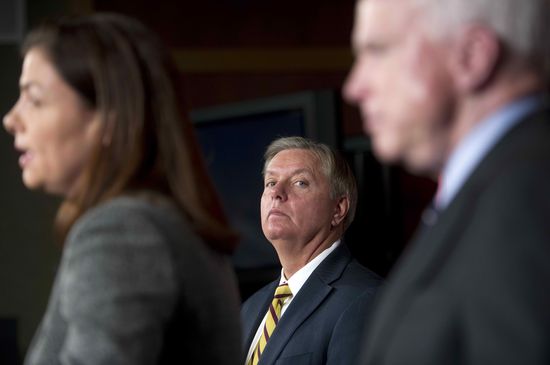
In assorted coverage, David Remnick pushed Obama to act on climate change, something that surely helped Sandy make 2012 a banner year for natural disasters. David Simon severed political greatness from sexual fidelity and Mary Beard found it hard to recognize the politics described by Cicero. Ian Leslie highlighted the productive mental difficulty of handwriting, Josh Wallaert lamented the declining shareability of online images, Christopher Mims decried ridiculous tech patents, ESPN outranked all other media properties, and we investigated the geography and possible solution to illegally-downloaded music. Archived Andrew excoriated the publishing industry while Lindsey Graham looked indignant in our FOTD. We took a geometric journey in our MHB and gazed at Philly brick in our VFYW.

– C.D.

(Photo: Palestinian medics carry a wounded baby into the al-shifa hospital in Gaza City following an Israeli air strike on November 14, 2012. By Mahmud Hams/AFP/Getty Images)

Live-Tweeting A War

Footage of the strike that killed Ahmed al-Jaabari, posted by the Israeli Defense Forces moments after he was killed: The IDF have been running a full-on marketing campaign via Twitter, complete with bluster, hashtags, graphics and videos. Noah Shachtman finds this unusual:

Once “Operation Pillar of Defense” began, the IDF put up a Facebook page, a Flickr feed, and, of course, a stream of Twitter taunts — all relying on the same white-on-red English-language graphics. “Ahmed Jabari: Eliminated,” reads a tweet from 2:21 p.m. Eastern time on Wednesday. This is a very different way of waging the war of opinion online. When an American drone strikes a suspected militant in Afghanistan, that footage is rarely made public — and, if so, only months after the fact. After the raid on Osama bin Laden’s compound, White House and Pentagon aides did start leaking details like mad. But the only live tweets from the operation were from a bystander in Abbottabad who heard the helicopters landing. And the pictures of bin Laden’s corpse were purposely kept from the public.

A few highlights from the IDF Twitter feed:

Echoes Of A Political Past

94898721

A new edition of Cicero's How to Win an Election has been hailed for its surprising relevance for our own times. (Philip Freeman, the translator, even gave it the subtitle "An Ancient Guide for Modern Politicians.") Mary Beard describes why such thinking is anachronistic, citing "our very tenuous grip on the processes of ancient politics":

[T]he apparent familiarity of the world of the ancient text is largely a matter of translation. For decades, if not centuries, Quintus Cicero's advice has been adjusted in English versions to match our own political systems and processes. Freeman’s translation is no different. Even the idea that the politician should give people hope, a cliché of modern media politics, looks different in the original Latin from the modern English. Freeman’s version has: "The most important part of your campaign is to bring hope to people and a feeling of goodwill toward you." It is, for us, an instantly recognizable thought. But what the original Latin actually says is this: "In seeking election you must take care that the state has a good hope of you, and a good opinion of you"—which is quite different from (indeed the reverse of) the modern idea of bringing hope to the people.

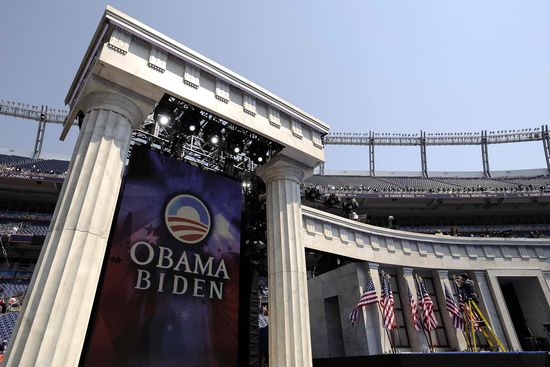
(Photo: A production crew member makes adjustments to the set on Day Four of the Democratic National Convention at Invesco Field at Mile High in Denver, Colorado on August 28, 2008. Senator Barack Obama of Illinois will accept his party's nomination for Democratic presidential candidate during his speech at the stadium tonight. By Keith Bedford/Bloomberg via Getty Images)

The Legalization Experiment

Kleiman advocates pot federalism:

[W]hy shouldn’t the federal government cut Colorado and Washington some slack? As long as those states prevent marijuana grown under their laws from crossing state lines and thereby subverting marijuana prohibition in the rest of the states, the Justice Department could step back and let the consequences of the new policies play themselves out. They might succeed, or they might fail. In either case, the rest of us could learn from their experience.

Waldman wonders whether police will like the legalization laws:

[I]t will be interesting to see whether in the coming months and years, police and prosecutors in Washington and Colorado report that their jobs have been made easier by the new laws. We may not see the full legal regime many are hoping for, with a fully functioning legal market. But we should have some new evidence that can be weighed when other states are debating their own decriminalization initiatives, which we'll certainly see in 2014.

Obama Holds His Ground

A highlight from today's Obama presser:

Ezra Klein sums up Obama's position on tax increases:

[I]f Republicans want to raise revenue while holding down rates by reforming the tax code, they have to show how they’re going to do it, prove that they’re willing to take the heat, and let it get scored by the Joint Tax Committee. If not, then tax rates are going up, either because Congress agrees to decouple the tax cuts for income under $250,000 from the tax cuts for income over $250,000, or because we’ve hit the deadline without an agreement and all the tax cuts have expired, raising taxes on everybody.

Scott Galupo's read on the game of chicken:

If my political antenna is working correctly, it sounds to me that, in calling for an immediate extension of current tax rates on the nonwealthy, Obama is signaling to Congress that we can partially go over the fiscal cliff — that is, we can mitigate the most extreme effects of an austerity shock and buy enough time to work out something comprehensive over the course of the next several months. Obama seemed to me to be suggesting that the likelihood of agreeing broadly on reforms to the tax code and the entitlement system between now and Jan. 1 is roughly nil.

Chait's view:

[A] big part of the game is for each side to blame the other for the fiscal cliff. Obama’s play is to rule out extending the Bush tax cuts on the rich, and demand an extension of the Bush tax cuts on income under $250,000. Will Republicans agree to do that? Almost certainly not. But a new poll shows Americans are predisposed, by a 53 percent to 29 percent margin, to blame Republicans over Obama for any failure to avert the fiscal cliff. And so, if Obama can’t make Republicans extend the middle-class tax cuts before January, he can at least use his platform to communicate that they and not he are responsible for the standoff.

The full press conference can be watched here.