The Medals They Carried

Petraeus-Ike

A reader writes:

You observed that so many journalists stand in the presence of men like Petraeus with "open jaws and worshipping eyes." That brings to mind the military's cultural shift in its medals, ribbons, and badges.

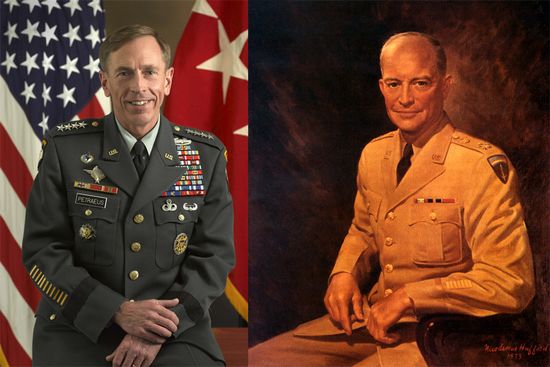
Consider these portraits of Generals Petraeus and Eisenhower. Petraeus is wearing over 30 ribbons and badges on his uniform. I'm sure he earned each of them. But of that 30, how many civilians will notice that only one item was for heroism (Bronze Star with "V")? Eisenhower earned only ten U.S. decorations (plus countless foreign ones), and – as was the custom of the day – typically wore only three or four at a time. 

So few of us have military experience. We see a solider decked out with all kinds of razz-mataz and we assume he's a modern Audie Murphy, a Rambo ten times over. But the truth is, most accoutrements merely denote successful completion of an assignment, or time spent overseas – not necessarily in combat. Servicemembers can even earn a ribbon for volunteerism in their personal lives. 

Too many in America stand in awe of the military partly because the awards and decorations system has become so inflated. We used to hesitate to adorn soldiers with ribbons, medals, and the like – it smacked of European symbols of nobility. The pendulum has swung too far toward over-recognition of service. We ought to chasten ourselves, put the brakes on this ridiculous, clown-like boastfulness where every troop looks like a Libyan field marshal. But with so many of us slack-jawed at the sight of a soldier, who among us has the political courage to scale back on the excess that creates this over-adulation of the soldier in the first place?

More Dish discussion of Petraeus' legacy here.
Could Tax Reform Happen?

Maybe:

Tax reform is never at the top of anyone’s agenda. It’s a tough sell; the benefits are broadly shared, but eliminating preferential treatments will always impose narrow costs. And one of the classic problems of all democracies, and the American Madisonian variation in particular, is that they are not very good at promoting broad, mild benefits at the expense of easily identifiable costs to easily organized factions.

Nevertheless, reform is reasonably likely over the next two years for one basic reason: Both sides fully expect divided government, and therefore policy stalemate, over the next two years — and politicians like having accomplishments, both for political (they need something to run on) and personal (most politicians actually do like getting something done) reasons.

Oh, and saving the US economy from terminal decline at the hands of lobbyists is also something worth thinking about, don’t you think?

The 2016 Black Vote

GT_MIA-LOVE_121113

Nate Cohn wonders about it:

[B]etween 3 and 4 million new black voters joined the electorate over the last two cycles, and they voted for Democrats in overwhelming numbers. If black turnout returns to 11 percent of the electorate and the next Democratic candidate only wins 90 percent of the black vote, there’s room for a shift of a net-4 million votes in the GOP’s direction. Whether those 4 million voters stay home or return to their Republican-lean from eight years ago could easily decide a close presidential election, especially in states like Ohio, Virginia, Pennsylvania, and Florida.

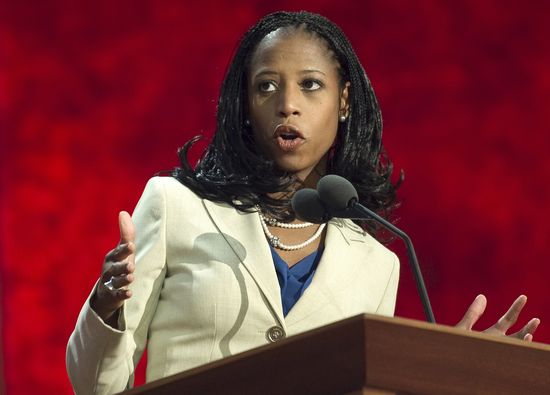
(Photo: Mia Love, the mayor of Saratoga Springs, Utah and GOP congressional nominee, speaks at the 2012 Republican National Convention at the Tampa Bay Times Forum. By Chris Maddaloni/CQ Roll Call. Love subsequently lost her congressional race by fewer than 3,000 votes.)

Lessons From The Loss

Douthat reflects on where Republicans went wrong in 2012. He concludes:

There won’t be an incumbent on the ballot in 2016. But Obama does have a debt to the Clintons to pay off, and bequeathing Hillary his campaign operation might settle it. That possibility alone should inspire any Republican who hopes to improve on Romney’s showing to internalize the lessons of this campaign as early as possible, leaving plenty of time to get ready for whatever surprises await.

“Simple Human Decency”

Massie argues that supporting marriage equality is about "capturing straight votes, not gay ones":

A person under the age of, say, 35, is surely much more likely to be aware of (and comfortable with) their gay friends than were their parents when they were of a comparable age. These gay friends and acquaintances are out today and once out cannot be shoved back into the closet. Which is why a party that is perceived to dislike gay people will also find it more difficult to win support from gay people’s heterosexual friends.

This is also true about "nod-and-a-wink racism," Massie adds:

If this is "political correctness" then what you mean by political correctness is actually simple human decency. Decency and generosity and empathy and inclusiveness are necessary parts of any Big Tent approach to politics. In Britain and in the United States the cost of failing to pass those tests is losing the votes of people who might actually be sympathetic to your economic policies but cannot reconcile themselves to a politics they find boorish, ugly and off-putting. 

The Price Of Legal Pot

Yglesias points out that, with "the application of modern efficient agribusiness methods, marijuana prices should be more like tea prices—closer to $3 an ounce of usable product than the current $300." Why that won't happen in Colorado or Washington: 

The DEA is not going to be able to police these states rigorously, but they’ll be able to spot a gigantic marijuana farm pretty easily. Even if the Obama administration takes Emily Bazelon’s wise counsel and eases off on federal interference it’s still going to be extremely challenging to raise large quantities of startup capital to finance businesses that remain technically illegal. Even if President Obama suddenly announced he wouldn’t enforce any marijuana laws, pot businesses would still be tenuous. That easing off could be reversed at the drop of a hat, making a decision to go build a marijuana drying and packaging factory quite risky.

Is Jordan Next?

Jordan_Protests_GT

Christopher Dickey covers the unrest in that country:

In one of those twists that is typical of the Middle East and common in Jordan’s history, the fact that a horrendous civil war is going on next door in Syria may actually work to Abdullah’s benefit in the short term. To be sure, some 200,000 refugees have flooded into the country of 6 million people. But the threat to regional stability is such that no Western government or Arab power wants to see the Hashemite monarchy go down right now. “The Syrian situation is most important for the outside world,” says [Labib Kamhawi, a former political science professor at Jordan University], suggesting that fact may have led the king to believe he has more room to maneuver politically and economically.

But the fates of other leaders who thought they were indispensable to Washington provide several cautionary examples, among them the fallen dictators of Tunisia, Yemen and Egypt.

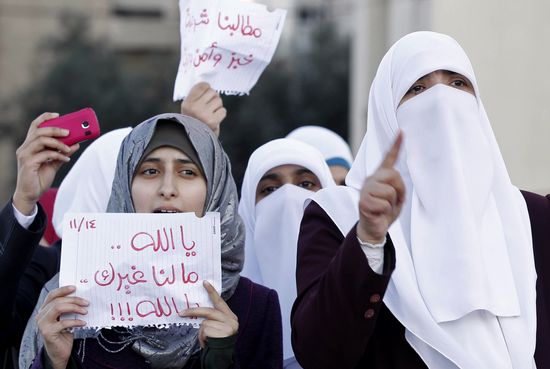
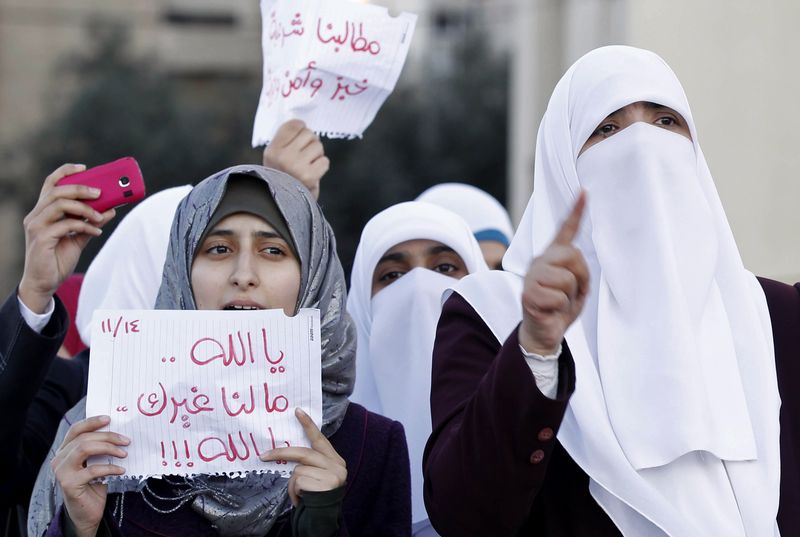
(Photo: A Jordanian woman holds a sign reading 'God, we have no one but you' as protesters block a main road during a demonstration against a rise in fuel prices in downtown Amman on November 14, 2012. Jordan was hit by a wave of protests and strikes while rioting broke in southern cities and a police station was attacked, security officials said, as anger mounted against a whopping rise in fuel prices. By Khalil Mazraawi/AFP/Getty Images)

The Pedophile Smear

Twice recently, two individuals have been falsely accused of one of the most vile crimes imaginable – the sexual abuse of children. One was libeled by the BBC, which did not even ask the victim of the smear to respond to it before broadcasting. The other was from TMZ about the actor who plays Elmo. I haven't named either innocent person even though it's a quixotic and useless gesture once these people have been dragged through the mud. But even now, the false accuser in the Elmo case, 23 years old, remains anonymous, while his target has to endure this media hazing. This story is not about the voice of Elmo being a pedophile; it's about a person anonymously smearing someone else's reputation.

The Hispanic Vote: Class, Not Race

It was striking to me that the latest manifestation of Charles Krauthammer's evolution into the Baghdad Bob of neoconservatism simply urged GOP support for amnesty for Latinos as the only policy correction needed for the GOP to win the next election. Steven Malanga disagrees for one obvious reason:

What’s more likely than race to account for Hispanic voting trends is income, a decisive factor in this election. The Obama campaign did a good job of portraying Romney as a Wall Street multimillionaire whose policies would favor the rich. Despite some conservatives’ belief that the Republican Party is capturing blue-collar America, Romney lost decisively among lower-income voters, who continue to vote Democratic in large numbers. Hispanic households fit into this demographic group: on average, their incomes are about 35 percent lower than the national average. Even more to the point is that Romney did terribly among voters who earned less than $50,000 a year, capturing just 38 percent of their votes—and over 60 percent of Hispanic households fit that income profile.

Beinart makes related points:

It’s quite normal that Hispanics, whose average household income trails non-Hispanic whites by more than a third, would seek government assistance in bridging the gap. Right now the GOP is split between commentators who deny this core motivation behind Hispanic support for the Democrats and those who demonize it. Neither attitude is likely to change the political reality that helped doom Mitt Romney last week.

Will Iran Give Up Or Double-Down?

Christopher de Bellaigue argues that the sanctions against Iran, like those before them against Iraq, aren't working:

[T]he U.S. is at pains to show that the Islamic Republic will gain a life-saving reprieve if it falls in with U.N. resolutions calling on it to stop enriching uranium. If that happens, Hillary Clinton said in October, sanctions might be "remedied in short order." But Iran’s supreme leader dismissed her words as a "lie." Khamenei and those around him believe that sanctions policy is part of a bigger American project of Iraq-style regime change.

There is some logic to this; recent western tactics against Iran include sabotage, assassination and diplomatic isolation—hardly indicative of a desire for detente. The most recent round of nuclear negotiations foundered, in part, on Iran’s growing conviction that the U.S. will make no significant concession on sanctions unless Iran drastically scales down its program of uranium enrichment. That seems unlikely to happen–not simply for reasons of image and prestige, but because, as American hostility sharpens, Iran may judge its nuclear program to be the best defense it has against the fate that befell Saddam.

There has to be a way to give the regime some face-saving if it retreats. Or the logic of war could drag us all along with it – a war we do not need and cannot afford.