Choose A Challenge

Ian Leslie investigates why our brains respond well to difficulty. One example:

You might have thought any tool which enables a writer to get words on to the page would be an advantage. But there may be a cost to such facility. In an interview with the Paris Review Hughes speculated that when a person puts pen to paper, "you meet the terrible resistance of what happened your first year at it, when you couldn’t write at all". As the brain attempts to force the unsteady hand to do its bidding, the tension between the two results in a more compressed, psychologically denser expression. Remove that resistance and you are more likely to produce a 70-page ramble. There is even some support for Hughes’s hypothesis from modern neuroscience: a study carried out by Professor Virginia Berninger at the University of Washington found that handwriting activated more of the brain than keyboard writing, including areas responsible for thinking and memory.

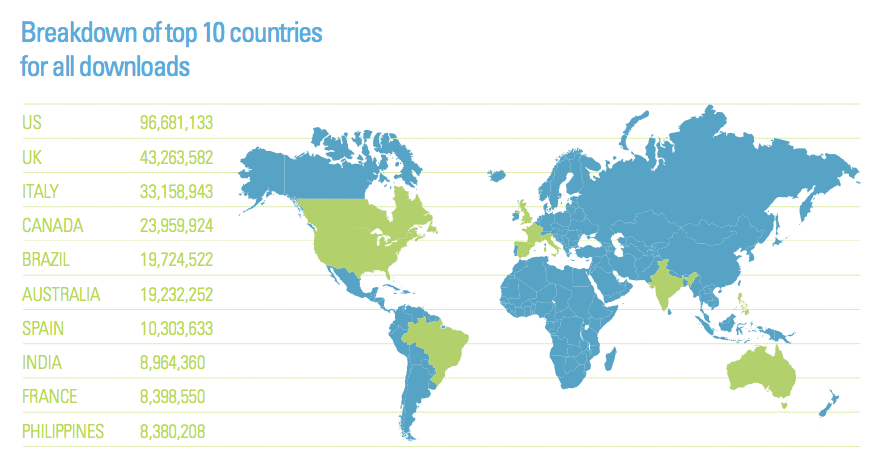
The Geography Of Stolen Music

Screen shot 2012-11-08 at 11.50.35 AM

Laura Sydell unpacks a study (pdf) on unauthorized music downloads by Musicmetric:

In the first half of 2012 Americans downloaded nearly 760 million songs using the software known as BitTorrent, which is the technology most often used for unauthorized file sharing. And most of those downloads happened in cities and towns near universities, says study co-author Marie-Alicia Chang. 

Dan Ariely considers how to stop illegal downloading:

The problem is that if someone has acquired 97% of their music illegally, why would they legally buy the next 1%?  Would they do it in order to be 4% legal?  It turns out that we view ourselves categorically as either good or bad, and moving from being 3% legal to being 4% legal is not a very compelling motivation.  This is where confession and amnesty can come into play. 

What we find in our experiments is that once we start thinking of ourselves as polluted, there is not much incentive to behave well, and the trip down the slippery slope is likely.  This is the bad news.  The good news is that in such cases, confession, where we articulate what we have done wrong, is an incredibly effective mechanism for resetting our moral compass.  Importing this religious practice into civic life was effective in the Truth and Reconciliation Act in South Africa, where acknowledging the many abuses and violations of the apartheid government allowed the South Africans to forgive past sins, and start fresh.

A satirical Youtube blames the disappearance of MTV's music videos on millennials who downloaded all their music for free – the same millennials who complain about the lack of videos on MTV.

(Chart from Musicmetric's Digital Music Index)

Patently Absurd

Pondering IP claims such as Apple's patent (pdf) for rounded iPad corners, Christopher Mims points to a particularly extreme example:

Creating a company for the sole purpose of suing other firms for violating patents you own is known as patent trolling. In a universe-twisting bit of irony, this practice has itself been patented. The owners of the aptly-titled "Patent Acquisition and Assertion by a (Non-Inventor) First Party Against a Second Party" intend to "use the patent defensively to discourage patent trolls and the like from extortionist practices." In other words, Halliburton Energy Services, owner of this patent, can threaten just about anyone who might sue them for IP infringement with a counter-suit.

In less absurd news, Michael Geist hails the Supreme Court of Canada's decision to void Pfizer's Viagra patent because the company refused to disclose information about the drug's active ingredients. Update from a reader:

The US Patent and Trademark office (USPTO) does allow some patents to issue that it should not. My firm regularly defends clients against them.  However, the "extreme example" that Christopher Mims points at is a patent application, not an issued patent, and will likely never become one.

Until a patent application issues as a patent, it is not legally enforceable.  I checked the USPTO website for the status of this application (US 11/741429). The applicant is still trying to get the USPTO to issue it, but the USPTO has so far rejected all claims of the application. The grounds for the rejections include section 101 – subject matter.  Translation – you cannot get a patent for something like that.  So far, this is an example of the patent system working as it should. And this points out a different problem: there are flaws with the patent system that need addressing, but many of the critics jumping into the debate do not know what they are talking about.

Making The Commons More Common

6285915289_5c385c0365_z

Josh Wallaert wonders why we can't easily tag images on Facebook or Instagram with a creative commons license:

For most of the last decade, the greatest repository of freely available images has been Flickr, a privately-owned public space that hosts more than 240 million creative commons images, dwarfing the 14 million items in the Prints & Photographs Division of the U.S. Library of Congress. Pick any Wikipedia article at random; if it has an image, there’s a good chance it comes from Flickr.

But Flickr has become a ghost town in recent years, conservatively managed by its corporate parent Yahoo, which has ceded ground to photo-sharing alternatives like Facebook (and its subsidiary Instagram), Google Plus (and Picasa and Panoramio), and Twitter services (TwitPic and Yfrog). An increasing share of the Internet’s visual resources are now locked away in private cabinets, untagged and unsearchable, shared with a public no wider than the photographer’s personal sphere.

Google’s Picasa and Panoramio support creative commons licenses, but finding the settings is not easy. And Facebook, the most social place to share photos, is the least public. Hundreds of millions of people who have photographed culturally significant events, people, buildings and landscapes, and who would happily give their work to the commons if they were prompted, are locked into sites that don’t even provide the option. The Internet (and the mobile appverse) is becoming a chain of walled gardens that trap even the most civic-minded person behind the hedges, with no view of the outside world.

He wonders if the government could invest in a sort of creative public works project.

(Photo by Flickr user Molbot, posted with permission)

When Will Texas Become A Swing State? Ctd

Last week, voters in San Antonio approved an initiative to fund pre-K education for poor children by levying a city-wide sales tax – a coup for Julian Castro, the San Antonio mayor and keynote speaker at the DNC. Paul Burka calls it "the most important thing that happened on election night in Texas":

We may look back on that in future years (and not too future, say 2018) and realize that it was the essential first step for a future governor or senator. Full confession: I wrote that I thought Castro was taking too big a risk too early in his career, but fortune favors the bold in politics.

Overview of the pre-K program here. Prior to the election, Burka emphasized that while Castro "has the benefit of time," the Dems face a slow path forward in Texas:

I am among those who believe that Mr. Castro is an emerging political talent who has a bright future. But … that future is more likely to be in Washington than in Texas. The state Democratic party is not capable of supporting a statewide race and will not be able to do so until the Latino vote matures. That occurrence is years away–at best, 2018 or 2020…. I see no evidence of a Democratic renaissance. Where is the fundraising base? Steve Mostyn [the largest donor to Texas Democrats in 2010] can’t do it single-handedly, and the other trial lawyers aren’t playing. The state is still overwhelmingly Republican.

Meanwhile, Julian's identical twin brother, Joaquin, won a congressional seat last Tuesday.

The Daily Wrap

GT SOLARECLIPSE 20121113

Today on the Dish, Andrew assessed the career of David Petraeus, a view that dovetailed Michael Cohen's. Bob Wright thought the militarization of the CIA was the most important Petraeus controversy, while Greenwald was outraged over the FBI overreach that brought the whole affair to light. Michael Gerson, meanwhile, continued to fall for the Petraeus BS while Podhoretz got giddy over a shirtless FBI agent.

In political coverage, Andrew and others pondered the possibility of a soonish Grand Bargain, explored the GOP's disfunctional marriage to the South, and guessed at the GOP's readiness to back down on taxes. Millman and Wick Allison questioned the math and morals of Republicans, whose campaign spending was exposed as a total debacle. Weigel pulled on the loose thread of party unity, Ryan Lizza anticipated the arrival of a purple Lone Star State, Americans continued to embrace Obamacare, and a bunch of pundits got tossed into a shame tumblr.

Lots of Yglesias nominations today: Bobby Jindal's murmurs of sanity earned one, as did Douthat for acknowledging the farce of Dick Morris, as did Gaza Gateway for critiquing some Chomsky support, as did Erick Erickson for aiming to drain the GOP's fever swamp. Archived Andrew reflected on what it's like to be gay and Catholic while JPod fired a pro-equality conservative. Noah Feldman tried to imagine how the SCOTUS would weigh legal weed, a topic Mark Kleiman worked to explain. James McGirk assembled a literature club for the far right while Daniel Foster encouraged conservatives to listen to the Boss.

Looking abroad, Tom Freston applauded the "new heroes" of Afghanistan's first professional soccer league, Hugh Sinclair shook his head at the terms and conditions of micro finance, and our FOTD celebrated Diwali. In assorted coverage, Kevin Dutton noted the surprising likelihood of psychopathy, Megan Garber watched the masculinity of pronouns decline, Eric A. Morris devalued the energy savings of rail transit, and Catherine Rampell saw young people start their own households. We visited Asthmapolis, previewed two new books on poverty, learned that plane crashes are very survivable, and gazed at the bacteria in our navels.

The Dish featured some skyscraper clouds in our VFYW from Tampa, while just to the south, two readers shared a victory in this week's window contest from Haiti. A cool ad we found blended classical art and ironing. We got to go dancing on our MHB, but nobody could top this parrot.  Veterans Day weekend wrap here.

– C.D.

(Photo: Totality is seen during the solar eclipse at Vlassof Cay in Palm Cove, Australia on November 14, 2012. Thousands of eclipse-watchers gathered in this part of North Queensland to enjoy the event, the first solar eclipse in Australia in a decade. By Mark Kolbe/Getty Images)

Escaping The Ghetto

Screen shot 2012-11-05 at 11.51.23 AM

Two recent books examine how neighborhoods affect poverty over the long term:

The first, published in February by the University of Chicago Press, is Sampson's Great American City: Chicago and the Enduring Neighborhood Effect. Among his many findings, Sampson shows that exposure to severely disadvantaged areas hampers children's verbal skills, an effect that persists even if they move to better-off places. That handicap is "roughly equivalent to missing a year of schooling," according to research he conducted with Stephen Raudenbush and Patrick Sharkey.

The second book, Sharkey's Stuck in Place: Urban Neighborhoods and the End of Progress Toward Racial Equality, forthcoming in January from Chicago, explores how neighborhood inequality spans generations. Sharkey, an associate professor of sociology at New York University, writes that "over 70 percent of African-Americans who live in today's poorest, most racially segregated neighborhoods are from the same families that lived in the ghettos of the 1970s." In other words, "the American ghetto appears to be inherited"—a finding with implications for policy.

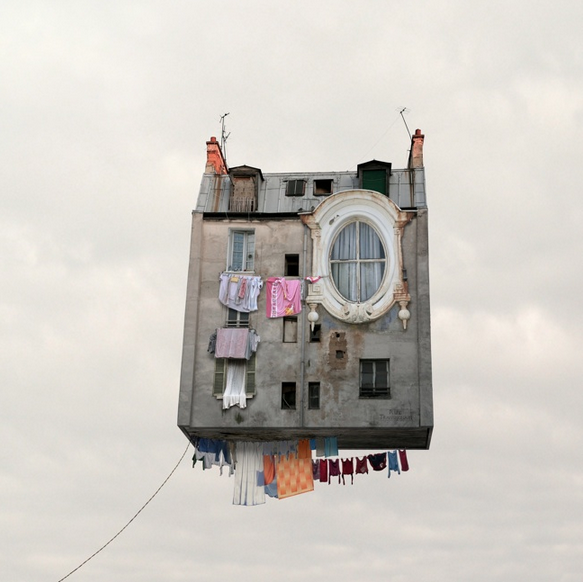
(Image from the series "Flying Houses" by Laurent Chehere, courtesy of the artist and the Paris-Beijing Gallery)

Out Of The Basement

Catherine Rampell observes that the number of new households is on the rise:

The pickup is probably related to job growth, which has enabled multigenerational households to spin off into multiple new homes. "We’re slowly but steadily improving, with more job opportunities in particular for younger households," [Chief economist at Moody's Analytics, Mark] Zandi said. "They can only live with their parents for so long. There are powerful centrifugal forces in those households, on both side. As soon as they have a chance to get out, many will take it."

Zandi notes that formation of a new household adds about $145,000 to the economy through a spending ripple effect.

Face Of The Day

GT_DIWALI_121113

Dancer Vimi Solanki waits to perform on stage as Lord Krishna during the Hindu festival of Diwali on November 13, 2012 in Leicester, England. Up to 35,000 people attended the festival of light in Leicester's Golden Mile in the heart of the city's Asian community. Sikhs and Jains also celebrate Diwali. The festival is an opportunity for Hindus to honour Lakshmi, the goddess of wealth and other gods. Leicester's celebrations are one of the biggest in the world outside India. By Christopher Furlong/Getty Images.

The Beginning Of The End Of Prohibition, Ctd

Mark Kleiman considers Washington's and Colorado's new laws:

The Colorado measure is much more radical than the Washington measure. Both intend to establish regulated markets on the alcohol model, something the federal government could probably shut down with relatively modest effort if it decided to. But Colorado also legalizes every resident to grow his or her own marijuana, and to give away as much as an ounce at a time to others. "Give away" is an interesting category; an informal market is likely to emerge, on a "Pay me $20 for this zip-lock baggie and I’ll give you the green stuff inside" basis.

While the feds could easily identify a limited number of state-licensed growers and retail outlets and shut them down with injunctions or with threats of arrest and property confiscation, identifying and cracking down on an unknown number of unlicensed home-growers would be next to impossible. So Colorado’s voters may well have let the genie out of the bottle in a way that no federal action can now reverse.

Earlier commentary on the subject here and here.