Discounted Degrees

A Florida task force created by Governor Rick Scott is exploring varying university fees based on major:

Tuition would be lower for students pursuing degrees most needed for Florida's job market, including ones in science, technology, engineering and math, collectively known as the STEM fields. The committee is recommending no tuition increases for them in the next three years. But to pay for that, students in fields such as psychology, political science, anthropology, and performing arts could pay more because they have fewer job prospects in the state.

Alex Tabarrok thinks they're on to something:

The task force has the right idea but the right way to target subsidies is not to the job market per se (let alone Florida’s job market), wages already reflect job market needs. Subsidies instead should be targeted to fields where education has the greatest positive spillovers, benefits that spill over wages and flow to the public at large.

Jordan Weissmann is skeptical:

First, you need to take it on faith that the government is capable of divining which majors are going to be the most marketable year after year. Second, you need to believe that there are a large number of talented undergrads who could hack it in these subjects, but are choosing easier majors instead. I'm not sure either of those assumptions are sound.

Elizabeth Popp Berman is on the same page:

First, the folks pushing STEM degrees clearly haven’t talked to a lot of biology majors. Or chemists. Sure, everyone knows the petroleum engineers are raking it in. But even after Ph.D.’s, many STEM folks are stuck in postdoc hell, and midcareer, the median salary of a biology major is more than $13,000 a year less than her counterpart in political science. Heck, she even comes in almost $4,000 behind the much-maligned film major. Besides, if this is about encouraging students to go into—and I quote—“high-skill, high-demand, high-wage degrees (market determined),” why give the subsidy to STEM? Why not give it to finance majors ($23,500 above the poor biologists) or economists (almost $34,000 above)?

Daniel Luzer questions another aspect of the proposal:

It also seems puzzling to charge more for people who want to major in psychology, political science, anthropology, and the performing arts. Those classes are, in general, actually cheaper for a university to teach and administer than classes in sciences, engineering, and technology, which generally require expensive materials and laboratories.

The Prison Recreation Complex

57406425

In the new issue of Tomorrow Magazine, Josh Begley beholds the "ballooning scale of America’s prison system" while visiting Louisiana State Penitentiary's golf course:

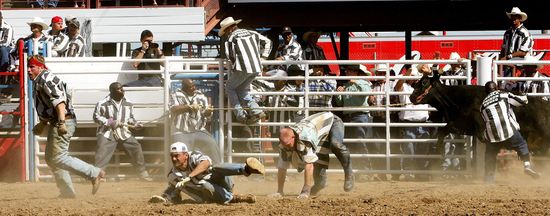
There are enough prisoners in the United States to fill every NFL football stadium at the same time, with 80,000 inmates left over. … Yet at Angola, the largest maximum-security prison in the country, more than 70,000 people a year pay to enter the gates for fun. Most go to see the Angola Prison Rodeo, where inmates have built a 10,000-seat stadium to house "The Wildest Show in the South" every Sunday in October and one weekend in April. Some go for the arts and crafts festival, where prisoners sell handmade items like birdhouses and matchstick replicas of space shuttles for as much as $500. I went to play golf. They sell a t-shirt in the nearby gift shop: "ANGOLA: A GATED COMMUNITY."

(Photo: Inmates run from a bull during the Angola Prison Rodeo at the Louisiana State Penitentiary April 23, 2006 in Angola, Louisiana. The Angola Prison Rodeo, opened in 1965, is the longest running prison rodeo in the nation. The 10,000 seat arena was built entirely by inmate labor. The prison holds approximately 5,000 male inmates, 68 percent of whom are serving life sentences. By Mario Tama/Getty Images)

Take A Number

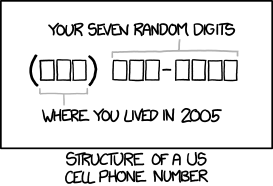
After a chuckle at the xkcd comic below, Geoffrey K. Pullum examines the "language of phone numbers":

With 10-digit strings we can distinguish roughly 10,000,000,000 phones from each other. That Cell_numberassumes someone can have the number 000-000-0000, which is probably God's number; and sure, maybe Satan has laid claim to 666-666-6666, so it's not available; but we're only being approximate here. The bottom line is that there's enough space in principle for everyone in the USA to have 20 or 30 different cell phone numbers, if we use it efficiently.

But we don't.

I have often stared at documents like gas bills and been amazed to see things like account numbers or other identification numbers as long as 18 or 20 digits. There are only about 7 × 10⁹ people in the world. Some account numbers are so long you could give separate account numbers to every member of the population on a billion planets with populations like ours. Those numbers could record the addresses and ages and incomes of the customers instead of just being random digit strings. But we don't do that. The information society that people get so worried about — the world in which The Government knows all your details and tracks everything you do — hasn't arrived yet, and probably never will. We're not that organized as a species. We waste too much time and too many of our computational resources keeping track of pointless random digit strings and being unable to relate them to each other.

The Science Of Scrambled

In a new book, Christopher Kimball and company, of America’s Test Kitchen fame, offers scientifically-tested tricks for the kitchen. Leah Binkovitz deconstructs the perfect eggs:

If you want scrambled eggs, most of us know to throw in a bit of milk or butter while scrambling. That’s because the lipids in the dairy coat the proteins in the egg (11 percent in the whites and 16 percent in the yolks) and slow down the process of coagulation, a.k.a. when the proteins are denatured and unfurl, releasing much of the water in the mixture. Adding fat helps keep some moisture in and fluff up the final product. But the same does not go for omelets. “While scrambled eggs should be fluffy, an omelet is more compact,” the authors write.  While milk works for scrambled eggs, it can add to much moisture to an omelet. The chefs recommend frozen bits of butter instead, which melt more slowly and disperse more evenly. And it turns out you can go ahead and salt the eggs before you even cook them up. Because salt affects the electrical charge on the proteins, it weakens the bonds between them, preventing overcoagulation. Bring that up at your next brunch.

Tunnel Politics

GT_GAZATUNNEL_121031

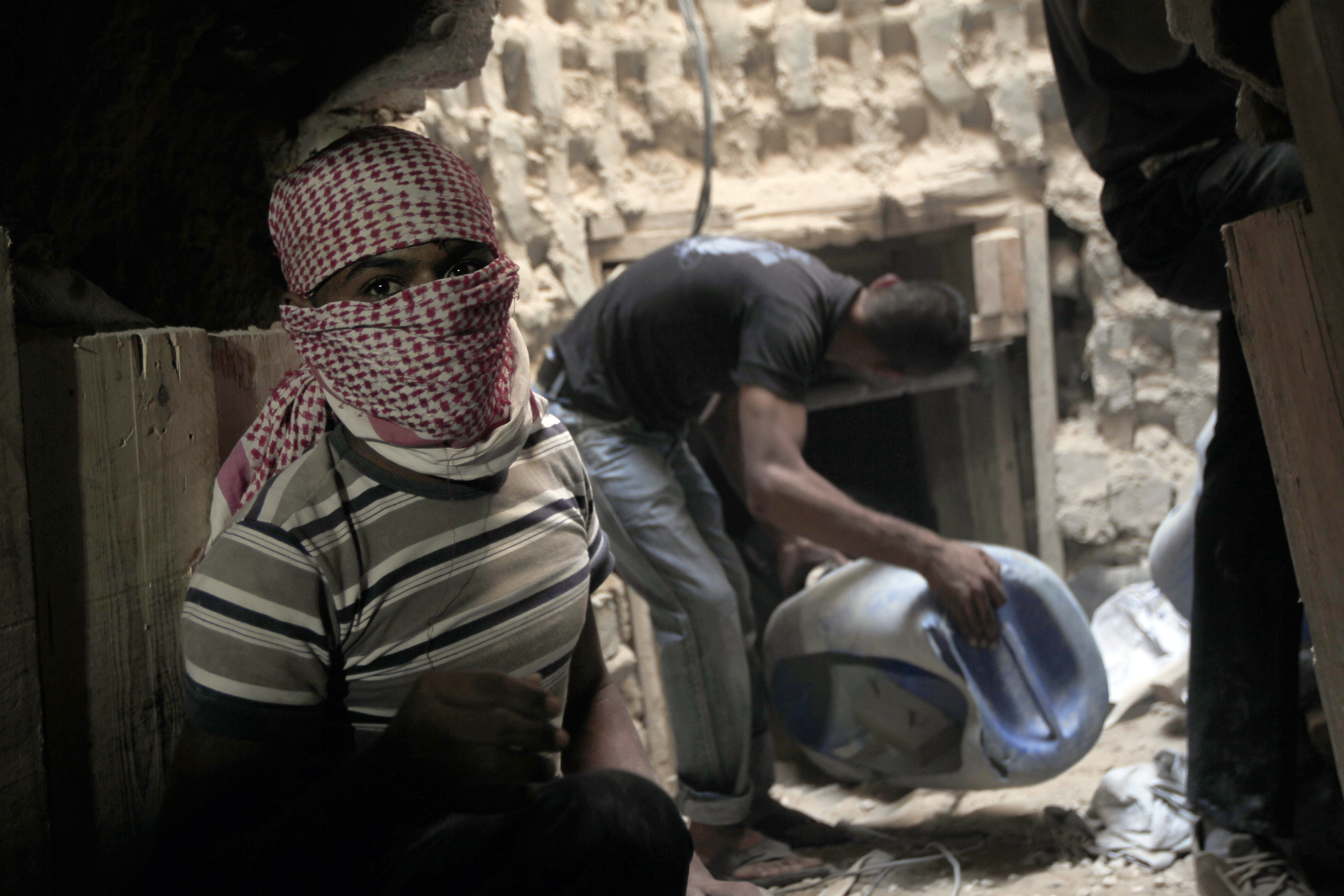
Nicolas Pelham shines some light on Palestine's vast tunnel complex and what it says about Gaza's political future:

The tunnels symbolize Hamas’s paradox: on the one hand, they have enabled Palestine’s main Islamist movement to thrive amid an external siege, and despite a Western boycott to take their place amongst the Islamist parties that have gained or strengthened their hold on power in many parts of the Middle East. Thanks to Gaza’s supply lines to Egypt, its GDP outpaced by a factor of five that of Hamas’s Western-funded rival, the Palestinian Authority (PA) in the West Bank. Further propelling Gaza’s economy, Arab governments across the region, like Qatar’s, have been shifting hundreds of millions of dollars in aid money from the PA to Hamas, signaling what may be a historic shift in Palestinian politics.

Yet the tunnels are also a reminder of just how much of a clandestine underground authority Hamas still is, and how fragile the territory’s recovery may be. Gaza continues to rely on smuggling for even basic goods, and the underground trade can be turned on and off as easily as a tap. The current restrictions, if they continue, could have devastating effects not only on the economy, but on Hamas’s own longevity. “We can’t keep ourselves imprisoned much longer,” a Hamas commander tells me as he and his patrol slouch bootless on mattresses under a makeshift tent erected between the tunnel mouths.

(Photo: A Palestinian smuggler is seen at the entrance of a tunnel along the Gaza-Egypt border in Rafah, on October 4, 2012. The tunnels are a vital lifeline for supplies of food, clothes, building materials and fuel into the impoverished Palestinian territory subjected to an Israeli blockade since 2006. By Said Khatib/AFP/Getty Images.)

Mental Baggage

Screen shot 2012-11-07 at 7.15.24 PM

Jon Crispin photographed the old suitcases and belongings of patients from New York's Willard Asylum for the Chronic Insane. The effects were left at the asylum between the 1910s and the 1960s and were eventually relegated to storage in an attic. Hunter Oatman-Stanford asked Crispin about the asylum and the project: 

Willard was a facility for people with chronic mental illness. Originally, doctors thought that all you had to do was remove people from the stresses and strains of society, give them a couple of years to get their life together, and they’d get better. Eventually people realized they needed facilities where patients could come and never leave. There’s some question as to whether or not the patients themselves packed their suitcases, or if their families did it for them. But the suitcases sent along with them generally contained whatever the incoming patient wanted or thought they might need. 

Right now, due to the Health Insurance Portability and Accountability Act (HIPAA), the project remains anonymous. But Crispin thinks names should be attached to the photographs: 

I’m still trying to figure out how I can name these people, because I think it dehumanizes them even more not to. People who’ve been in mental institutions themselves have said, “Your project is very moving to me, but I’m very disappointed that you have to obscure names.” I think the stigma of mental illness has evolved from something shameful to something that’s much more medical and much more accepted. It just happens to people. 

(Belongings from Dmytre’s suitcase above. You can see a selection of his photos next spring at the San Francisco Exploratorium. Image courtesy of Crispin.)

Inpuritans

Mark Noll reviews a new book on the politics of the Puritans, Godly Republicanism, and sees the failure of their lofty ambitions to create "a new heaven and earth" as a warning to Christians who expect too much of the world:

[W]hatever shape Christian politics now takes, it would benefit by learning from the Puritans. They were indeed heroic spiritual ancestors. But if they—even with unusual purity of heart and unusual dedication for the long haul—could not succeed, then those of us who are weaker in faith and less self-sacrificing in resolution should look first in our politics to cultivating the virtues that even these hardy pioneers sometimes neglected, including modesty, patience, gentleness, kindness, and self-control.

Faces Of The Day

More-Than-Human43-600x598

Tim Flach has a new book out, More Than Human. Marina Galperina considers the appeal of Flach's detailed animal portraits:

[T]hese glossy, carefully-composed shots show us a side of nature we’re not used to seeing — professionally studio-lit, for one thing. Yes, there’s something quite awkward about the out-of-context, artificial glamor of these animals, but then again, it’s a chance to admire each hair strand on top of this charming creature’s head and every waving tendril on the surface of that funky sea critter’s body.

(Image courtesy of Flach)

The Roots Of Epistemic Closure

K.C. Cole turns to Daniel Kahneman's Thinking, Fast and Slow to grasp why we have trouble grappling with unpleasant realities:

Essentially, we have two different thought systems that work very differently, and Kahneman refers to them throughout the book as characters he calls System 1 and System 2. System 1 is a marvel honed by millions of years of evolution that runs on automatic (and can’t be turned off). It’s a virtuoso at jumping to (usually correct) conclusions on the basis of very little information. A master at coming up with shortcuts (heuristics) that usually work, we couldn’t get through a minute of our day without it. As Kahneman points out, most of what we know about System 1 would have “seemed like science fiction” 30 or 40 years ago. Unfortunately, System 1 can’t be reflective. It can’t know what it doesn’t know, but it always knows that it’s right. And because it works so much faster and more smoothly than System 2, it almost always overrules our more rational selves.

System 2 is generally clueless about System 1’s flaws. It’s too slow and inefficient to handle immediate matters; it consumes huge amounts of energy, takes effort and time, and requires a great deal of self-control. Since “laziness is built deep into our nature,” we mostly glide along on System 1. System 2 is supposed to be the overseer, the skeptic, the doubter, but it’s often busy and tired and defers to System 1, which is gullible and biased. In fact, System 2 is often an apologist for System 1. “Its search for information and arguments is mostly constrained to information that is consistent with existing beliefs,” Kahneman explains.

Earlier Dish on Kahneman here, here, and here.