A Neurologist On Drugs

David Wallace-Wells profiles Oliver Sacks, author of the new book Hallucinations:

The drug memoir buried inside the book is eye-opening for anyone who knows the genial picture he’s cultivated for himself as a terminal wallflower. “I started with cannabis,” he writes, then moved on to LSD, morning-glory seeds, and a synthetic belladonna-like drug his friends from Muscle Beach recommended called Artane. “Just take twenty of them—you’ll still be in partial control,” they told him, and he did, then hallucinated so fully a visit from two friends that he cooked them an egg breakfast. When he realized his mistake, he ate all three plates, then heard his parents descending in a helicopter.

“The only time I feel free and happy is when I’m writing,” he tells me, using the present tense and speaking of the ferment of his life in the sixties as though it were the very recent past. “The idle times are dangerous for me. If I don’t take drugs, I brood or I lie in bed, or I eat too much,” he says. “I think Sherlock Holmes was very similar. When he wasn’t hot on the case, he would shoot up cocaine.”

In an interview with Mia Lipman, Sacks talked about the other hallucinatory conditions he writes about in the book, including Charles Bonnet syndrome:

I see lots of elderly people who are hearing impaired or visually impaired but quite articulate and intact intellectually. In general, the hearing impaired get musical hallucinations and, even more commonly, the visually impaired can get visual hallucinations of a complex and dramatic character. These were described in the middle of the 18th century by a Swiss naturalist, Charles Bonnet, and we speak now of Charles Bonnet syndrome. It used to be regarded—when I say "used to," I mean until 1990—as very rare, with only a few dozen cases reported. But it's now obvious that it affects between 10 and 20 percent of people with significant visual impairment. But like all hallucinatory experiences, people are frightened to mention it, and one may only get an account of it when there's a nice, trusting relationship between the patient and the doctor.

You can read a long excerpt from Sacks' new book here.
The Republicans Who Brought Marriage Equality To Maryland

Walter Olson draws attention to them:

In fact county-level results reveal that across wide swaths of Republican territory in Maryland, same-sex marriage actually ran well ahead of Barack Obama and the Democratic ticket. That means there were many, many Romney voters who voted for the same-sex marriage law [which passed by a narrow 52-48 margin] — enough, in fact, that without them the measure would almost certainly have lost by a mile.

Mental Health Break

From the Creators Project description of Matt Pyke's stunning project, Made by Humans:

As the founder and creative director of Universal Everything, Matt Pyke leads a creative mission to create gorgeous visual spectacles on screen that, while they will never be attained in physical reality, reinterpret the nuances of natural human motion. His effectiveness with capturing movements and transforming them into sweeping animated forms allows him to show us shapes we have never seen before while preserving the individual human element in all his creations.

“I Refuse To Cater To The Bullshit Of Innocence”

In a highly endearing interview for The Believer, the late Maurice Sendak spoke of the letters he most liked to receive from children:

When [children] write on their own, they’re ferocious. After Outside Over There, which is my favorite book of mine, a little girl wrote to me from Canada: "I like all of your books, why did you write this book, this is the first book I hate. I hate the babies in this book, why are they naked, I hope you die soon. Cordially…" Her mother added a note: "I wondered if I should even mail this to you—I didn’t want to hurt your feelings." I was so elated. It was so natural and spontaneous. The mother said, "You should know I am pregnant and she has been fiercely opposed to it." Well, she didn’t want competition, and the whole book was about a girl who’s fighting against having to look after her baby sister.

BLVR: You find the unvarnished truth consoling, even if it’s vicious and painful.

MS: If it’s true, then you can’t care about the vicious and the painful. You can only be astonished. Most kids don’t dare tell the truth. Kids are the politest people in the world. A letter like that is wonderful. "I wish you would die." I should have written back, "Honey, I will; just hold your horses."

The Need To Read

Vents

Anthony Daniels, a self-professed bibliomaniac, plumbs the depths of his obsession:

We who pride ourselves in reading much and widely forget that the printed page serves us in a similar fashion as the drug serves an addict. After a short time away from it we grow agitated and begin to pine, by which time anything will do: a bus timetable, a telephone directory, an operating manual for a washing machine. "They say that life’s the thing," said Logan Pearsall Smith, a littérateur of distinction but now almost forgotten, "but I prefer reading." For how many of us—avid readers, that is—has the printed page been a means of avoidance of the sheer messiness, the intractability, of life, to no other purpose than the avoidance itself?

Daniels also finds himself caught amidst the trade-offs of the digital age:

Perhaps there is a wider lesson here: you cannot have it all, you cannot reconcile all possible sources of pleasure. You cannot have the joys of serendipity and those of the convenience of immediate access to everything. Furthermore, it seems that you cannot choose between them as technology advances. To adapt Marx’s dictum about history slightly, Man makes his own pleasures, but not just as he pleases.

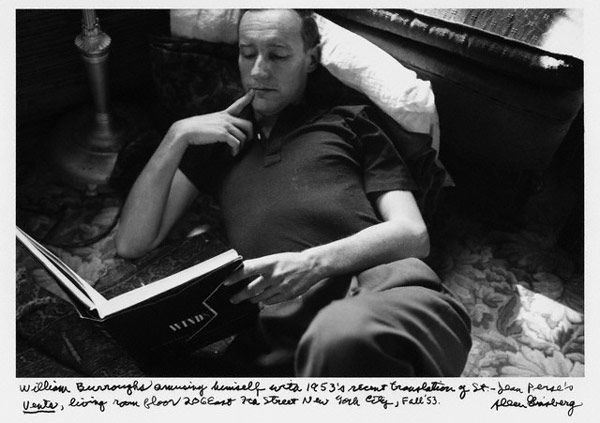
(Photo of William S. Burroughs reading Vents, New York City, 1950, by Allen Ginsberg, via Flavorwire's Photos of Famous Authors Reading Famous Books)

Bad Blood

7055676855_c1291a45e5_b

Ruth Evans reports on Japan's fascination with blood type:

Here, a person's blood type is popularly believed to determine temperament and personality. "What's your blood type?" is often a key question in everything from matchmaking to job applications. According to popular belief in Japan, type As are sensitive perfectionists and good team players, but over-anxious. Type Os are curious and generous but stubborn. ABs are arty but mysterious and unpredictable, and type Bs are cheerful but eccentric, individualistic and selfish.

The beliefs have trickled down throughout society so that the Japanese now have a term for its perjorative affects: bura-hara, or blood-type harassment:

The women's softball team that won gold for Japan at the Beijing Olympics is reported to have used blood type theories to customise training for each player. Some kindergartens have even adopted methods of teaching along blood group lines, and even major companies reportedly make decisions about assignments based on employees' blood types. … One former prime minister considered it important enough to reveal in his official profile that he's a type A, whilst his opposition rival was type B. Last year a minister, Ryu Matsumoto, was forced to resign after only a week in office, when a bad-tempered encounter with local officials was televised. In his resignation speech he blamed his failings on the fact that he was blood type B.

(Photo by Jason Milich)

The Other Side Of Paradise

Landon Y. Jones offers a fascinating glimpse into F. Scott Fitzgerald’s summer spent in Montana:

In the ensuing weeks, Fitzgerald would do what easterners visiting Montana often do:  he went native. He outfitted himself in boots, brandished a pistol, rode horses, drank bad whiskey, played cards with cowboys, flirted with daughters of neighboring ranchers, and took but one bath a week. More significantly, Fitzgerald also found in Montana a western version of the predatory capitalism and baronial lifestyles that had so fascinated him in the East.

Jones posits that Fitzgerald, born in St. Paul, the heart of the Great Plains, always "saw the East through western eyes":

If anything, Fitzgerald’s summer in Montana only reinforced his self-image as a non-easterner. In his writing, Fitzgerald reversed the westerly thrust of the American imagination. The typical Fitzgerald character is not an easterner who travels west to seek personal freedom, or renewed health, or reclaimed masculinity. Instead, Fitzgerald wrote about westerners who venture east only to wreck themselves on the shoals of status and Old World corruptions. Near the end of The Great Gatsby, Fitzgerald’s protagonist, Nick Carraway, reflects: “I see now that this has been a story of the West, after all—Tom and Gatsby, Daisy and Jordan and I, were all Westerners, and perhaps we possessed some deficiency in common which made us subtly unadaptable to Eastern life.”

The View From Your Window Contest

Vfyw

You have until noon on Tuesday to guess it. City and/or state first, then country. Please put the location in the subject heading, along with any description within the email. If no one guesses the exact location, proximity counts.  Be sure to email entries to VFYWcontest@gmail.com. Winner gets a free The View From Your Window book. Have at it.

Romney’s Bureaucratic, Bumbling Campaign, Ctd

A reader writes:

For all the big talk about their GOTV efforts, what the Romney campaign really could have used was a community organizer. Oh the irony.

Another:

Obama executed quantifiable long-term plans, adaptable short-term planning, an innovative GOTV initiative and plotted better ad strategies, while Romney had the ORCA trainwreck, inaccurate internal polling, poorly informed managers and insufficient fiscal planning (e.g. coffers too low in July to react to the Obama ad blitz seems so minor league!).  Not to mention its upper management was rewarded with bonuses in September, right after the languid convention and the embarrassing European trip.

On the macro level, if you take the entire campaign at its face value as a business – a job creator, even? – the Obama campaign had a higher return on investment, ran a better strategy, implemented better tools and metrics to achieve its targets, spent its money more wisely, had a more efficient staff org chart and better managers.  In the free market system, it was a strikingly successful example of entrepreneurial acumen.  Romney and Rove were beat at their own game.

Another makes a great connection:

Remember that the first words out of Byron York's mouth upon witnessing his first Obama Rally in 2008 were "We're going to need a bigger boat," referencing the point in Jaws where the shark first appears. Do you remember the name of the boat they used that ended up being destroyed? It was the Orca.

Another:

Thought you guys might be interested to know ORCA was only unprecedented if you ignore Houdini, Obama For America's program to facilitate volunteers digital scrubbing of lists in '08. It was exactly as ORCA has been described and like ORCA, it crashed. Around 11am if memory serves. But unlike ORCA, no one missed it. We had a back-up plan in place that worked just fine. I wasn't on staff this cycle, and was only in a swing state the last few days, so I could be wrong about this, but I heard not one peep of Houdini 2.0.

Another testimony to the success of Obama's ground game:

Watching Romney's communications person's hubris regarding what turned out to be the disastrous ORCA was something that had to be seen to be believed. The myth of Romney as business genius surely must be put to rest if every aspect of his campaign is studied.  Surely he mastered the art of pillaging honest businesses to make money for himself and his investors, but running a business? Not so much. He would have failed as a CEO of an actual company that made or sold anything.

I live in Ohio. I am a married woman in her forties who resides in Ohio. I'm a mother. I voted for George W. Bush twice. I was impressed and swayed by the Obama message and campaign in 2008 and voted for him them, much to the dismay of my husband. I can't say I was overwhelmed by Obama's accomplishments as POTUS the last four years, but given the amount thrown at him from a resistant Congress and the crazies who make up the birthers, conspiracy theorists and Donald Trump, I gave him a bit of a pass. I'd rather someone is on office I believe at least will give due consideration and thought to his decisions whom I disagree with, than someone who will decide for the most politically advantageous decision. I went into this election pretty much undecided. It didn't take long to see Mitt Romney's craven desire to win won over his faith or belief in humanity and the country.

I had very little to do with the Obama For America website this election, however, in an attempt to escape the onslaught of harassing television and radio ads, direct mail pieces and a phone that rang so may times a day I ended up unplugging it, I voted early. Low and behold, a few days after I voted I received an email from OFA thanking me for voting. It had an invitation to a get out the vote event at a neighbor's home a few blocks from my home. When I clicked the response box that I could not attend a window popped up giving me several alternatives to helping the campaign such as making phone calls. Get out the vote opportunities continued to pop up in my email the remaining weeks of the campaign.

On election day, I got several text messages from OFA asking me to make a few calls. Can you make 5 calls? No. Can you make 3 calls? No. Can you make 1 call? Yes. That's a ground game.