Buzzfeed created five maps to show "how the 2012 election would have played out before everyone could vote." The first one:
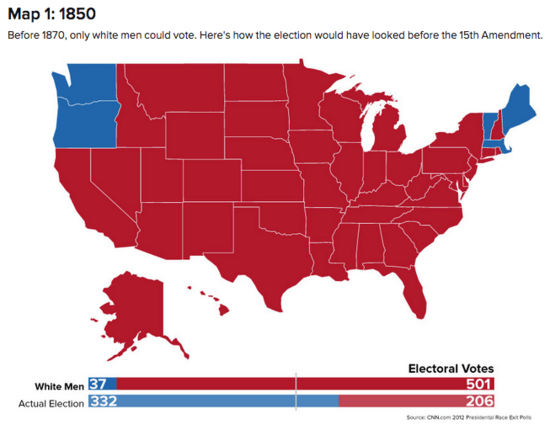
Buzzfeed created five maps to show "how the 2012 election would have played out before everyone could vote." The first one:
Josh Sanburn summarizes a new report (pdf) by the SF Federal Reserve:
You might assume that suicide rates would be elevated in lower-income neighborhoods and counties, and the study’s authors do point to findings that higher income generally lowers suicide risk. For example, an individual with family income less than $10,000 (in 1990 dollars) is 50% more likely to commit suicide than an individual with income above $60,000. The twist comes when you look at low income individuals who live in high income areas. According to the study, they face greater suicide risk than those living in low-income areas. The study’s authors call it a “behavioral response to unfavorable interpersonal income comparisons.”
This week the last episode of Anthony Bourdain's No Reservations aired. Noreen Malone credits the chef with "the most admired tongue in America: for the tasting, the talking, and the lashing it does":
The success of No Reservations has less to do with the plot (middle-aged dude eats food in locales near and far; scored by mannered voiceover and late-boomer musical preoccupations) and everything to do with his considerate personal and verbal magnetism. But, more than any kind of machismo or peacocking, the Bourdain brand, in both style and content, is premised on the idea of Tony the Truthteller.
It’s what first vaunted him into the spotlight with his memoir Kitchen Confidential—a willingness to let us behind the scenes for an unvarnished look at what really happens in a New York City kitchen, followed by his willingness to, as he might put it, shit upon the reputation of some of the industry’s biggest names, including “Saint” Alice Waters (whom he’s compared to the Khmer Rouge). That pugilism, plus the grabby, filthy frankness of his language (“Whether it’s the Rolling Stones’ ‘Let It Bleed’ or doing it doggie-style, good is simply … good”) has led many to accuse him of performing authenticity as shtick. But, as Bourdain’s editor, Daniel Halpern, wonders, does it matter if Bourdain’s become, to some, a caricature of himself publicly? “That’s what he does,” says Halpern. “That’s like saying Derek Jeter shouldn’t keep hitting to right field because that’s his schtick.”
Below is the trailer for Bourdain's next venture, The Mind Of The Chef, whose first season follows chef David Chang and premieres today on PBS:
Lorin Stein meditates on the charms of short stories, which offer "a chance to pay close attention — and have that attention rewarded because, for once, every little plot twist, every sentence, counts":
[Y]ou can't relax and lose yourself in a short story. Short stories bring you up short. They demand a wakeful attention; a good one keeps you thinking when it’s over. They take the subjects of the night and expose them to the bright light of day. They run counter to our yearnings for immersion, companionship, distraction … and for all of these reasons, in my mind they’ve come to stand for a kind of difficulty, emotional difficulty, that we are in danger of losing when we fetishize the charms of the long novel.

Havana, Cuba, 12 pm
Only one of Adelson's candidates was victorious. The day after the election, Goldblog quipped, "I want to play poker with Sheldon Adelson." But Matt Glassman argues that, for big donors, "winning isn't everything":
When you spend tens of millions of dollars trying to influence an election, you obviously want your preferred candidate to win. But the binary outcome of the election isn’t the only thing you can, or want, to influence. Your money is also going to affect: the policy issues your candidate raises, the positions on those policies that he introduces into the discourse, what issues he chooses to attack his opponent on, the way the media frames these debates, and so on and so forth. If Sheldon Adelson’s goal was to make sure neither candidate questioned the use of drones or backed the Colorado pot initiative, well, mission accomplished. It’s not like the end goal here is to get a man into the office; the goal is ultimately to influence policy.
Kerry Howley adds:
My time working for a donor-funded magazine convinced me that people often misunderstand the nature of donation and over-simplify the expected return. Sheldon Adelson wanted Newt to go all the way—mine the moon while invading Iran and lecturing all of us on fundamental transformational change, frankly. But even as he watched that beautiful dream slip away, he no doubt enjoyed the pleasure of being considered a player in a game that’s considerably higher status than casino building whilst having a Republican presidential candidate at his beck and call. Donations confer a sense of power over powerful people. Private equity manager Marc Leder, who played host to the party that led to the 47 percent debacle, got Mitt Romney to come to his own house and tell him that the rest of the country was sponging off of his estimable powers of wealth-creation. He got to watch a grown man beg, and isn’t that what we all want, really?
Obama takes a victory lap:
Ann Friedman puts the gains of female politicians in perspective:
[T]o achieve gender parity in Congress and secure women’s rights more broadly, every year has to be a Year of the Woman. And not just in the campaign headlines, but on Inauguration Day. Women have to make steady gains not just at the upper echelons of government, but in the state legislatures where candidates are groomed for higher office. Looking further down the pipeline, it’s hard to see how we get to a legitimate Year of the Woman anytime soon. Nine out of every ten states has a male governor, and women’s representation in state legislatures has been stagnant since 2007, a year that [Women’s Campaign Fund president Sam] Bennett calls a "veritable bloodbath."
That doesn’t bode well. Candidates like Elizabeth Warren, who began her political career on the national stage, are rare. Nearly every woman elected to Congress last night has served in her state legislature.
Kevin Dutton flags research suggesting that college "kids today are about 40 percent lower in empathy than their counterparts of 20 or 30 years ago." A surprising way to mitigate these tendencies:
Reading a book carves brand-new neural pathways into the ancient cortical bedrock of our brains. It transforms the way we see the world—makes us, as Nicholas Carr puts it in his recent essay, "The Dreams of Readers," "more alert to the inner lives of others." We become vampires without being bitten—in other words, more empathic. Books make us see in a way that casual immersion in the Internet, and the quicksilver virtual world it offers, doesn't.
Alain de Botton makes related points in the above video.
After acknowledging the efforts and sacrifices of LGBT activists, Dan Savage thanks the straight allies of marriage equality:
I know so many straight people in Seattle who worked unbelievably hard to approve R-74. They gave money, they volunteered their time, they reached out to friends and relatives and coworkers, all in an effort to make it possible for same-sex couples to marry. Gays and lesbians are a tiny percentage of the population. We couldn't do this on our own. A majority of the legislators who voted for same-sex marriage? Straight. The governor who signed the law making same-sex marriage legal in Washington state? Straight. The majority of the folks manning the phone banks for R-74? Straight. The overwhelming majority of people who voted to approve R-74? Straight. The president who took a huge political risk and came out for marriage equality before his reelection campaign? Straight. It has gotten better for us—better, not perfect—but it hasn't gotten better for us in a vacuum. It's gotten better for us because straight people have gotten better about us.
 The Dish