Now, Govern

I'm as amazed as everyone else by the results on Tuesday night, and they're still sinking in. The new America won; and the 1980s lost. Not everything can be solved by cutting taxes and dropping bombs, a majority of Americans have resolved; the Great Recession was not an ordinary one; the way forward not as glib or as easy for the right as Mr Iraq War would have you believe.

But it would be a huge error, it seems to me, if the president decided to bask in his stunning victory, rather than seeing it as a precious moment for the expenditure of political capital. We are facing automatic massive tax hikes and huge, crude spending cuts starting January 1 if we cannot get a bipartisan deal on Bowles-Simpson lines (of course there is room for tweaking and bargaining). A failure to get that kind of deal would tip the US and the world into a new global depression.

We need to think of the fiscal cliff as we did the Super Storm Sandy. It's unlike anything we have encountered in recent times. But when Chris Christie threw partisanship to the literal winds and embraced the president in an emergency (and vice-versa), we saw a glimpse of what can happen, of what Obama actually promised all along he could bring about, and what he has yet failed to do.

His re-election has re-capitalized him. He should use that capital, it seems to me, immediately, when it is at its peak. There are obvious contours for a deal: the 155691870parameters that both the president and the Speaker came close to in the summer of 2011. The Speaker has publicly reiterated that he is open to new revenues; the president has said he is aware of the need to cut the cost of entitlements in the future. The cost-controls in the ACA may help, and should be aggressively tested, but we have no more proof of their success than we did when Bush promised that huge tax cuts would generate growth and employment for the middle class. That's why they had a sunset on them. Some kind of premium support option or later retirement age are by no means unreasonable complements to innovative rethinking of healthcare, given the exponential growth of spending on everything we now call "health."
Tax reform along 1986 lines is obviously the most productive common ground. Get us to three simple rates; get rid of the myriad deductions, including those for mortgage interest and state taxation. End all those corporate loopholes. Some of this will hurt the middle class – but rates can stay the same even as revenues rise; and there is simply no way to get to fiscal sanity without some sacrifice from the middle as well as the top. I think Obama has every reason to put the successful and wealthy back near the tax bracket Bill Clinton left us with. But equally, doing so without radical tax reform is a non-starter for the GOP, and they have a legitimate constitutional veto.

Then take an axe to the Pentagon, as Simpson-Bowles did. The perpetual war machine has become a kind of entitlement in itself, draining the country of resources we need at home, in pursuit of global hegemony that is becoming counter-productive to actual, you know, self-defense. Then we have to consider increasing premiums for the elderly who are better off, and to put back into Obamacare that end-of-life power-of-attorney discussion for everyone on Medicare that Sarah Palin called "death panels". A mandatory discussion of power-of-attorney issues for Medicare is not a "death panel." It's a wise nudge for people to be able to control their lives in advance. To invest so many resources into extending a dying person's life by a few days (when we don't even know for sure in many cases if the person wants that extra care), is completely irrational, when we desperately need to invest in education for the young. And yes, that is a choice we have to make, and we are making it now. We are now putting the last gasps of the old over the first steps of the young. That needs re-balancing a bit.

Many Democrats will argue that they have a mandate for higher tax rates for the wealthy. I think they have a mandate for more revenues from the wealthy and a fairer, simpler tax code. The GOP retained the House and they are a part of this country's leadership. Start afresh. Bring them in fully for this deal. Reach out to Ryan as well as Boehner. Many Democrats cannot bear the idea of cutting Medicare benefits, but I want to echo Kevin Drum in saying: it's gotta happen. Many Republicans abhor the idea of drawing down from a Cold War posture in defense. They need to get over themselves too.

The only question is if the president will aggressively take the lead on this, treating it with the same urgency he did a super-storm, and fulfill his promise of breaking through the red-blue divide for pragmatic solutions to our actual problems. He deserves a brief rest, of course. Everyone does. But Americans re-capitalized their president for a reason: to govern, to forge the legislative compromises that can set our fiscal course toward sanity again. This time, he does not have the time to lead from behind. We need him out front, telling us the fiscal truth and showing a way forward.

He does not need to be elected again. He can be a mediator between both parties rather than the representative of one. He has to give the House GOP an honorable way out of their Tea Party nonsense, and tax reform is the obvious way to do it. This must be doable. And if it is achieved, Obama's true promise of getting us past these inane ideological battles toward a workable future will be secure. And contra Krugman, I do believe that renewed confidence in America's long-term fiscal standing will help investment and employment and growth again.

But the president needs to be bold; and magnanimous. And fast.

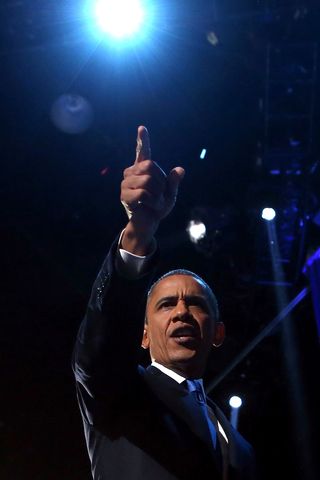
(Photo: Chip Somodevilla/Getty.)
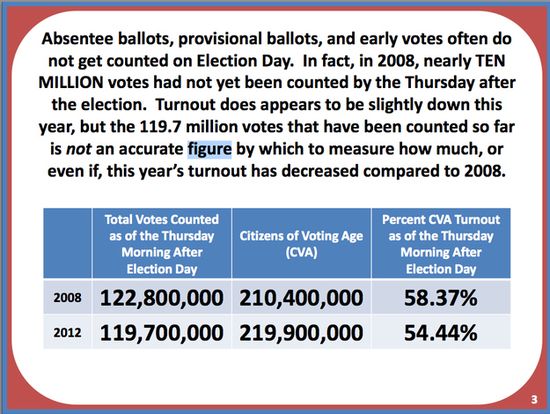
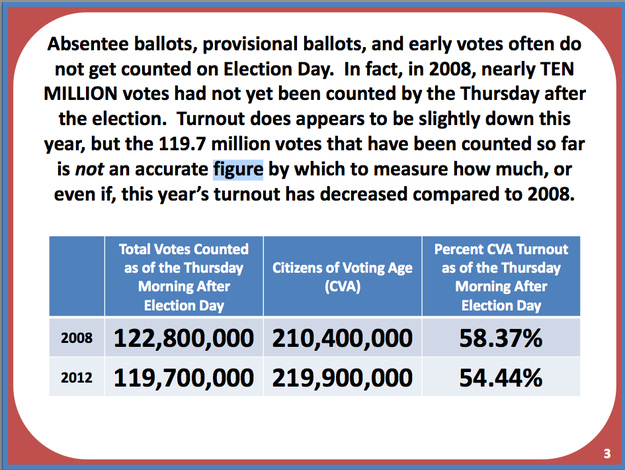
What “Missing” Votes?

Votes_Counted

Sean Trende believes that millions of white voters failed to show up:

[I]f our underlying assumption — that there are 7 million votes outstanding — is correct, then the African-American vote only increased by about 300,000 votes, or 0.2 percent, from 2008 to 2012. The Latino vote increased by a healthier 1.7 million votes, while the “other” category increased by about 470,000 votes. This is nothing to sneeze at, but in terms of the effect on the electorate, it is dwarfed by the decline in the number of whites. Again, if our assumption about the total number of votes cast is correct, almost 7 million fewer whites voted in 2012 than in 2008. This isn’t readily explainable by demographic shifts.

Republican pollster Bill McInturff, who provides the above graphic, fires back. Nate Cohn is also skeptical:

In the end, total turnout will probably approach '08 levels, although it's unclear whether it will ultimately exceed it. Romney will probably end with more votes than any candidate in history who isn't named Barack Obama, demonstrating a strong GOP turnout. Given the initial exit poll data and the current national popular vote tally, it looks like white turnout might have declined slightly since 2008. I'm holding off judging just how much until the final exit polls and results are reported, but I'd be quite surprised if it turned out to be 7 percent–especially in the battleground states.

Why Partisans Can’t Read Polls

Julian Sanchez explains:

Ideally, professional pollsters have no particular agenda beyond accurately forecasting the outcome of a race. But pundits are trying to influence outcomes, and forecasts don’t just predict outcomes, but at least partially help to determine them. There’s plenty of social psychology literature showing bandwagon effects in elections: Voters on the fence often pick the candidate they expect to triumph anyway, because it’s nice to be on the winning side. Campaign workers become demoralized if they think they’re laboring those long hours for a hopeless cause. A 20 percent chance of victory is still a chance, after all, and you don’t want people throwing in the towel prematurely.

Here as in many areas of life, when the odds are heavily against you, being a perfectly accurate assessor of your chances can actually make the odds worse. If you are rational, you will want to have some irrational beliefs. So I don’t expect supporters of a candidate who’s unlikely to win on election eve to acknowledge this, any more than I expect the coach of an underdog team to deliver out an honest read of the stats as a pre-game pep talk. We don’t make fun of coaches for this, because we all understand they’re engaged in a bit of socially appropriate bullshitting.

Chart Of The Day

Screen Shot 2012 11 08 at 3 05 16 PM

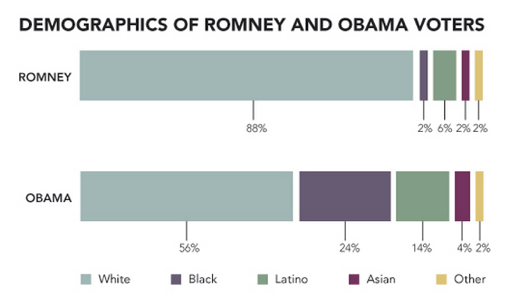
Tom Scocca notes that 88 percent of Romney voters were White:

[W]hite separatism was not enough to break up the actual Obama mandate. Obama's support was so broad that if white people had simply split 50-50, rather than favoring their ethnic candidate, the president would have won 58 percent of the popular vote.

The Anti-Gay Albatross

Ambinder examines the GOP's dilemma:

If Republicans drop their opposition to gay marriage, the chances that Democrats will continue to pick up majorities of new and young voters will diminish. Gay issues are the civil rights issue of the time. Many of these voters see the party's implacable opposition to equal treatment for gays and simply turn away. The GOP is killing itself by giving libertarian-leaning younger voters a reason to think that the party is held hostage by a loud minority.

Those voters are right.

It is hard to imagine a GOP primary where Christian conservatives don't significantly influence the vote and the platform. Until you can imagine a primary where Christian conservatives and their anxieties and fears don't dominate the process, it is hard to imagine a pro-gay, pro-immigrant candidate breaking through. (Jon Huntsman, Jr.?) The real trap is that there are plenty of Republicans who can win national elections, plenty of conservative Republicans, but that they cannot make it through the filter of the primary, which is not suited to the demography and realities of a modern society.

David Sessions rounds up social conservative reactions to the election.

Will The Right’s Fever Break? Ctd

A reader isn't optimistic:

I’m not expecting a change. In a just, perfect world, people would look at a media system that purposely lied to them and dashed their dreams and demand accountability – or leave them in droves. But I would be willing to bet that we will see widespread agreement on rationalizations rather than accountability, and that the ratings of the right-wing media outlets will go up, not down. In the last 48 hours I have seen and heard absolute vitriol and incomprehensible cognitive dissonance. I have been amazed at the number of people who believe that God controls everything in the world – down to the smallest detail – yet He is somehow powerless in the face of election results.

Another:

Mr. Levin and those like him are sounding an awful lot like the angry lefties they abhor – blindly ideological, impervious to contrary evidence and reality, absolutist in their belief that their ideas are actually truths, hating the "mainstream media" and creating their own outlets to tell the "real news." Say what you want about Clinton, but tacking the Democratic party towards pragmatism in the '90s while shutting down the extreme left wing of the party was the beginning of what happened Tuesday. The Democrats, inexplicably, have become the party of pragmatism, cohesion, and evidence.

Another ruminates at length:

One thing that is disgusting about the current GOP and something you've not touched on much since the 47% tape faded away, is that a core tenant of the GOP is that they are the makers and everyone else (the Democrats) are the takers. Look at most any of the commentary from the right since the election night and this is pushed over and over again: America is lost because now the takers outnumber the makers. This premise is patently and outrageously false.

And this is their default worldview now. Certainly the welfare state is not anywhere near as small as most everyone wants it to be, but to presuppose a Democratic voter is nothing less than a leach on society is flat out disgusting. The GOP starts with contempt for their fellow citizen and go down from there. They make it a practice to insult everyone in the middle and lower classes then wonder why nobody wants to join their team.

They insult women for caring about their personal health and freedom and viability in the workforce and wonder why there is a gender gap. They assume a successful person of color is a result of affirmative action and wonder why they don't get credit for Condi Rice and Colin Powell. They refuse to accept that an effective safety net does not create mass poverty. Jesus had a lot to say about the poor in his day, yet I don't think there was much of a safety net back then. The right wing today will demonize anyone who needs help and they demonize anyone who wants to give help. How is that American? How does any of that solve our real issues? 

The last two Democratic presidents were honest-to-goodness American Dream success stories. Men who came from broken homes and poverty only to transcend their status to become brilliant and powerful forces in America. They should be heroes to every little kid growing up in a tough neighborhood or boring suburb.

But not on the right. They degrade both Bill Clinton and Barack Obama while at the same time trumpeting the privileged soft-handed sons of power. How is that American? How is that patriotic? How does this appeal to those of us who believe in our public schools and our dart league at the our favorite tavern and our "dinner for eight" every Saturday night at our church? Just because a person decides to write code for a living or they have to wait tables or they are promoted into middle management in some shitty corporation instead of "taking chances" and "sticking their neck out" as entrepreneurs or "Job Creators" doesn't mean we are not good, loving Americans. And we vote Democratic now because we don't want to hate our neighbors for simply being normal people. 

Not to say the Dems are the best ever – they are not – but at least they seem to want to reflect the diversity of experience that is uniquely American. From that broad base they have the mandate to solve America's issues as a cohesive force in it together. The Republicans are looking more and more like quasi-apartheid rulers insistent that their ideological and racial and gender purity is the only thing that will hold this country together. Frickin stupid.

To read all of our posts on the subject so far, see our thread page.

Who’s To Blame For Political Dishonesty?

Michael Moynihan points the finger at all of us:

Americans aren’t victims of the supposed "post-truth" era, but gleeful co-conspirators. And unctuous politicians and their surrogates understand that the benefits of lying about your opponent are high (see the wholly dishonest attacks on John Kerry in 2004 by the "Swift Boat Veterans for Truth"), while voters ensure that the risks remain relatively low. … In this miasma of misinformation, Americans throw open their arms, embracing their own party’s political deceptions as the best route towards toward policies they think will benefit them. Take a look at the Facebook pages and Twitter feeds of politically engaged friends. You’ll likely come across dozens of links highlighting an egregious political lie, but good luck finding a friend who highlights whoppers from both parties. And even if political lying is unevenly distributed by ideology, as is often claimed, we could expect examples of outrageous dishonesty from their own side, just far fewer.

Obamacare Is Coming

Medicaid_Expansion

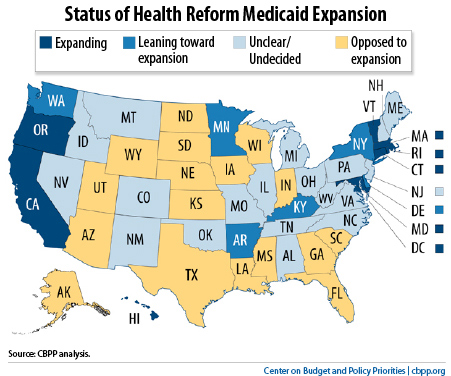
Kate Pickert outlines the next steps:

[G]overnors will soon decide whether to set up their own health insurance marketplaces to regulate individual and small business health plans. Many Republican governors had held off making this call until after the election. States that opt not to set up exchanges will open the door for the federal government to run them instead. Thanks to a part of the Supreme Court Obamacare ruling that left the law’s large Medicaid expansion as optional instead of mandatory for states, governors and state legislatures will also have to decide whether to widen eligibility for the public insurance program. (Here’s a reliable timeline of Obamacare provisions and when they are scheduled to go into effect.) As Phil Galewitz reported for Kaiser Health News, some state-based Republicans may be persuaded to get on board with such pieces of the law now that it’s definitely staying on the books.

Judy Soloman, who provides the above chart, comments:

While governors in Florida, Texas, Louisiana, and several other states have said they’ll reject the Medicaid expansion, most states are either moving forward or their governors remain undecided, as this map shows.  In many of the latter states, governors had said that they wanted to wait until after the election to decide. Now that we know the expansion will proceed, undecided governors should move ahead and governors who have opposed it should reconsider.

The Density Divide

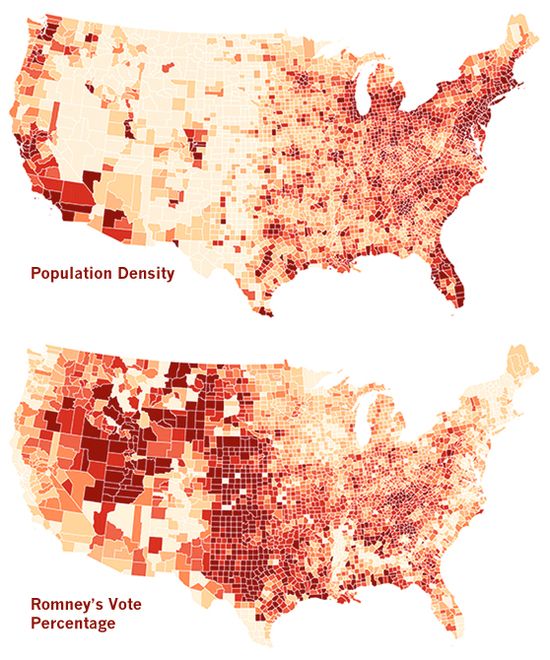
Tim De Chant looks at how election day went in relation to population density:

There are lots of reasons why the 2012 presidential election broke the way it did, but one that’s not often reported—but particularly germane to Per Square Mile—is the divide between cities and the country. I’ve been thinking for a while now about this split as a driving force behind the polarization of U.S. politics…

Below the jump is the comparison for the Romney votes, click through to De Chant's post for interactive versions of both the Romney and Obama maps (where you can slide back and forth between the vote and population densities).

Persquaremile-densitymap-romney

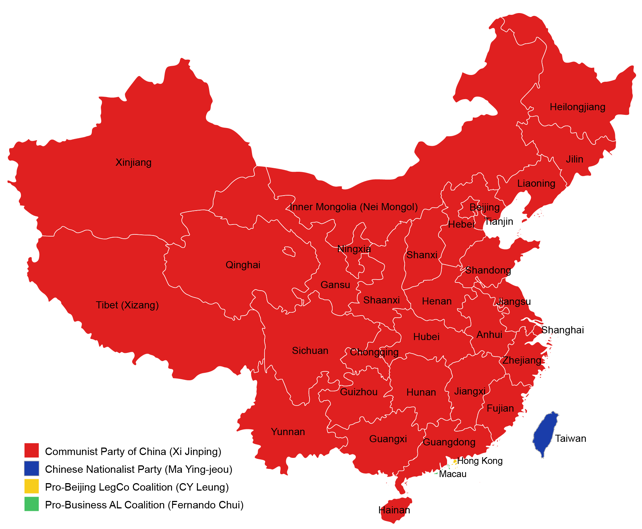
And Now, China’s Election (Spoiler Alert)

Screen Shot 2012-11-08 at 3.19.07 PM

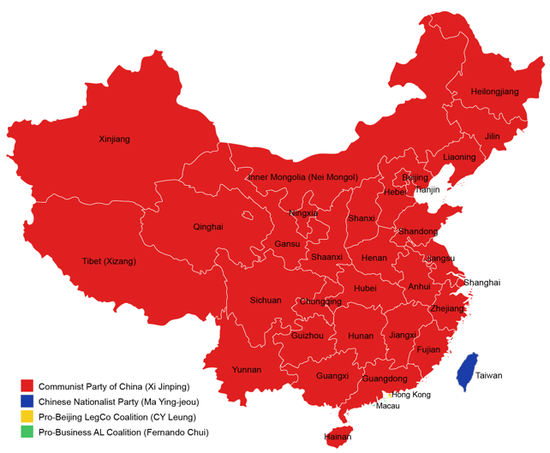
China's 18th Party Congress kicked off yesterday. Jiayang Fan summarizes:

At the end of the week, little that is not yet known will be made known. Xi Jinping will replace Hu Jintao as secretary-general of the Communist Party and Li Keqiang will take Premier Wen Jiabao’s seat as his successor. Two thousand two hundred and eighty delegates from all over the country will pour into the capital to listen to speeches and fill in assembly halls, but they will likely be as clueless as their 1.3 billion constituents about the hows and whys of the Xi ascendancy. 

Elizabeth Economy wonders whether Xi, like his predecessors, will fail to implement political and economic reforms:

Unfortunately for Xi, the Chinese people already appear to have an idea of what they want. A Global Times survey released just in time for the Party Congress reveals that 80 percent of Chinese advocates political reform; and more than 70 percent says Beijing needs to tackle healthcare, pensions, and social security in the next five years. What do people want most from political reform? According to the survey, they want more power to oversee the government for themselves and for the media.

She argues that even in a one-party state, Xi will face this mounting pressure:

The Chinese people can’t vote at the ballot box, but they do vote with their feet. The wealthiest flee the country. During Hu’s tenure, fully 27 percent of Chinese with at least $15 million in assets have emigrated and another 47 percent are considering it. They cite the quality of the educational system, the environment, health care, food safety and protection of assets as the drivers behind their desire to leave. The poorest Chinese, citing the same exact challenges, take to the streets to protest; and those protests now total more than 180,000 annually.

Kenneth Lieberthal doubts that Xi will enjoy much administrative clout:

[E]ven if Xi proves to be an ardent reformist (which is by no means clear), he may prove unable to move the system sufficiently in the directions he knows it must go. Wen has called for such changes for at least the past half decade, even as the system has in fact moved in the opposite direction. Success or even rapid progress here is far from assured.

The hurdles are high for Xi. Because he does not even get to pick most of the members of his own team, virtually no other Standing Committee member will owe his job solely to him — current and former members select the lineup of the new Standing Committee in order to achieve a balance among their interests. It may take an impending or actual major crisis, therefore, for Xi to garner the authority to drive through necessary but painful decisions.

(Image via Shanghaiist)