Tunisia’s Democracy Without Democrats

Michael Koplow diagnoses the political situation in Tunisia, and counters the idea that Salafists could or should be excluded from the country's fragile democracy:

Democracy does not just emerge from the mist, and leaders in a newly post-authoritarian state cannot just close their eyes and tap their heels together and create a democratic political system. Democracy has been aptly described as a second-best solution, because it results from a stalemate in which no side has the power to fully impose its will and thus everyone becomes willing to roll the dice and take their chances with democratic politics in order to win something. Essentially, democracy is installed by non-democrats who have no other choice, and over time democratic politics become habituated and the system (hopefully) becomes self-perpetuating. If this does not describe what is going on in Tunisia, then I don’t know what does.

Tunisia is not filled with committed democrats, but is instead a combustible mix of parties that would all like to impose their will. The Salafists would like to create a pure Islamic state, Ennahda likely wants something closer to what the Muslim Brotherhood wants in Egypt, and the secularists want Ben Ali’s Tunisia without Ben Ali. Make no mistake though; the secular parties would just as soon impose their vision of society on everyone as the Salafists would if they had the strength to do so. The fact that none of these factions are able to carry out their will unimpeded is what gives me hope that Tunisia will emerge democratic.

The Daily Wrap

South-orange

Today on the Dish, Andrew enjoyed a little Fox News Schadenfreude before diving into the Right's massive reality issues. He also wondered if George Will and his deluded brethren will ever have the integrity to find new professions, and then marveled at Romney's poor showing in CA and NY. After Massie checked on the post-election denial at The Corner, Michael Grunwald doubted the GOP would learn their lesson – not that Maddow and Heilemann didn't try to set them straight. Besides, as Larison noted, the Republicans have Chris Christie to inexplicably blame for Obama's victory.

Also, Ackerman, Sasha Issenberg, and Michael Scherer looked at the success of the Democrats' nerdiness, and Massie, Ruy Teixeira, and others dug into the GOP's big Hispanic problem. David Simon championed America's new racial and social hierarchy, while Drum poured cold water on this week's liberal glee. Then while Romney sang a ditty, Lauren Ashburn took Douglas Brinkley's temperature on Mitt's future (in short: good luck). On the rest of the ticket, Noam Scheiber let the air out of the Paul Ryan effect. Also, despite the overall accuracy of Nate Silver, #DrunkNateSilver and the other poll-aggregaters, Jason Zengerle worried that the current math-frenzy would make future elections even horse-racier. Jonathan Bernstein and Nate additionally pondered the Left's possible edge in the electoral college, which Florida finally made 332-206. Jennifer Victor broke down the spending splits of Teams Obama and Romney, while Karl "Crossroads" Rove and his ilk learned they'll have "holy hell to pay" to their disgruntled bankrollers.

Weigel and Ana Marie Cox remained happily astonished at Tammy Baldwin's victory, while efforts to bring marriage equality to Minnesota pushed forward. We also learned that – surprise – campaigning as a rape-philosopher is not the secret to electoral success. Later we loved to hate how Eric Dondero has sworn off his liberal acquaintances (except maybe Elton), and we laughed as Robert Stacy McCain posed as a grand historian to suggest "manful endurance" to the Right.

In suddenly-legal weed news, Jacob Sullum sketched the upcoming timeline for CO and WA, which Paul Campos hoped Obama would be laissez-faire about, and assuming that's the case Erik Voeten imagined American drug tourism. Remembering last week's storm, Eric Roston compared the clarion calls of Sandy and 9/11, while our Face Of The Day still doesn't have power in Brooklyn. A wistful Lauren Slater contemplated the unprovable love of pets – even a raccoon – and Quartz examined the economic implications of Brazilian dog-ownership. Radiolab explained the physics of coffee rings, Alexis Hauk visited the graves of dead writers and Josh Levin warned against the distractions of music-listening while biking.

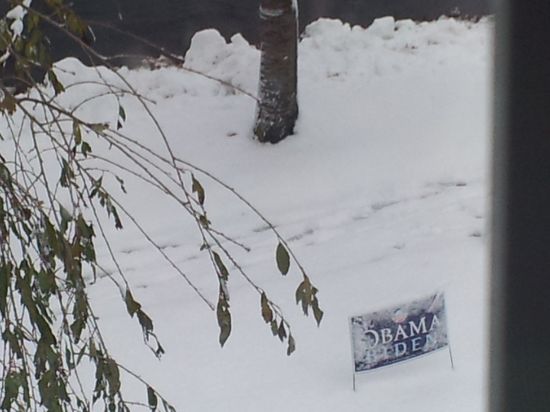
Short men could jump in our Mental Health Break and there was Jersey snow for Obama/Biden in our VFYW.

– C.D.

Reality Check

Screen shot 2012-11-08 at 6.50.02 PM

Kevin Drum provides one:

Liberals, you should rein in the triumphalism. Obama won a narrow 51-49 percent victory and the composition of Congress changed only slightly. This was not a historic vindication of liberalism, and it doesn't mean that we can suddenly decide that demography will sweep us to victory for the next couple of decades. The plain truth is that although an increasing number of voters are turned off by what Republicans represent, that doesn't mean they've become lefty converts. A lot of them are still pretty nervous about a big part of our agenda, and we have a lot of work ahead to get them more solidly on our side.

Also: No matter how much you hate to hear it, long-term deficit reduction and entitlement reform really are pretty important. Just because conservatives abuse the point doesn't mean there isn't something to it.

Face Of The Day

155813804

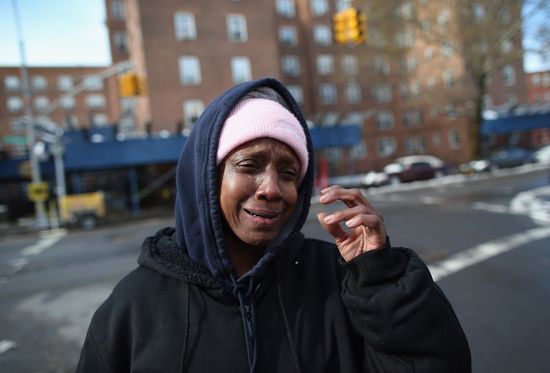
Theresa Goddard, her apartment still without electricity, is overwhelmed while discussing her living conditions in the Brooklyn borough of New York City on November 8, 2012. She and many other residents of the Red Hook public housing projects also remain without heat and running water due to Superstorm Sandy. Meanwhile a nor'easter storm plunged temperatures to below freezing. By John Moore/Getty Images.

#DrunkNateSilver

The best new meme this week:

Grading The Poll Aggregators

Daniel Terdiman ranks the poll-collecting mathletes:

Silver wasn't the only one to do exceptionally well in the prediction department. In fact, each of the five aggregators that CNET surveyed yesterday — FiveThirtyEight, TPM PollTracker, HuffPost Pollster, the RealClearPolitics Average, and the Princeton Election Consortium — successfully called the election for Obama, and save for TPM PollTracker and RealClearPolitics handing Florida to Romney, the aggregators were spot on across the board when it came to picking swing state victors. 

But, overall, Silver still reigns supreme:

In addition to picking the winner in all 50 states — besting his 49 out of 50 slate in 2008 — Silver was also the closest among the aggregators to picking the two candidates' popular vote percentages. All told, he missed Obama's total of 50.8 percent by just four-tenths of a percentage point (50.4) and Romney's 48 percent by just three-tenths of a point (48.3) for an average miss of just 0.35 percentage points. HuffPo Pollster and RealClearPolitics tied for second with an average miss of 0.85 points.

Scapegoating Christie

Larison looks on as Republicans attempt to pin Romney's loss on the New Jersey governor:

It’s a reminder that it was never Christie that these activists liked. What these activists liked was the reliable partisanship that he seemed to practice. When he didn’t act the part of the angry partisan that they were used to seeing, and instead acted as a self-interested politician and responsible state official would, they no longer had any use for him. The fact that he had been considered an effective surrogate for Romney over the last several months is quickly forgotten, and all that remains is the idea that Christie "betrayed" the cause by doing something that any other official in his position would have done.

Will The Right’s Fever Break? Ctd

Maddow's thoughts on the matter:

John Heilemann sees no alternative for the GOP:

Republicans now find themselves facing a moment similar to the one that Democrats met in the wake of the 1988 election, when the party found itself markedly out of step with the country — shackled to a retograde base, in the grip of an assortment of fads and factions, wedded to a pre-modern policy agenda. And so, like the Ds back then, the Rs today must undertake a wholesale modernization of their party, starting with, but not limited to, making real inroads with those ascendant elements of the electorate. Doing so will be a Herculean task, and one that will require not just institutional resolve but individual leadership; it will require, that is to say, that the Republicans find their own version of Bill Clinton circa 1990. But daunting as the task may be, what last night indicated is that the party has no choice but to undertake the assignment — because to forgo it would be to risk not just irrelevance but extinction.

The Electoral College Leans Left?

Noting that Obama's EC vote percentage was significantly higher than his popular vote percentage, Jonathan Bernstein wonders whether Democrats have a structural advantage in the Electoral College. Nate Silver finds reason to think so:

Two more presidential elections, 2016 and 2020, will be contested under the current Electoral College configuration, which gave Barack Obama a second term on Tuesday. This year’s results suggest that this could put Republicans at a structural disadvantage. Based on a preliminary analysis of the returns, Mitt Romney may have had to win the national popular vote by three percentage points on Tuesday to be assured of winning the Electoral College. The last Republican to accomplish that was George H.W. Bush, in 1988.