The Legalization Timeline

Jacob Sullum reports on the next steps for Washington's and Colorado's marijuana legalization laws. On Colorado:

The new law requires the department to begin processing license applications by October and to start issuing licenses by January 2014. “We say the licenses can be issued as soon as October 2013," says Brian Vicente, co-director of the Yes on 64 campaign. "Given the way government runs, we say they must be issued by January 2014. Our best guess is that it's 2014 when these stores will be opening up."

As with medical marijuana dispensaries, the new stores will be licensed not only by the state but also by local governments, which will have the authority to ban cannabis businesses within their boundaries—by a city council vote at any point or by ballot initiative in even-numbered years. "Probably the only retail marijuana shops will be pre-existing dispensaries that decide to opt in to this new system," Vicente says. "What we've found is that communities across Colorado, the ones that have not banned dispensaries, have strictly regulated these medical marijuana stores….I don't think they're going to expand the zoning. In fact, I think the pre-existing dispensaries stand to benefit from opting in to this system in 2014."

Earlier Dish on the subject here.

Will The Right’s Fever Break?

Heritage is promising to double down on obstruction:

Massie rounds up The Corner's reality-deficient responses to Obama's victory:

[W]hat these eight responses demonstrate is the extent to which too many conservatives believed their own propaganda. This is what it’s like to live in a cocoon. The apparent inability to appreciate why any sane person might contemplate voting for Barack Obama is evidence of, well, of the closing of the conservative mind.

Hence the recourse to fantasies of the sort that leave the average, sober-minded voter wondering just what kind of crazy juice you’re hooked on. Obama wants to make the United States a kind of France? Check. Obama wants to crush religious liberty in America? Check. Our colleges are indoctrinating yet another generation of sadly-impressionable young American minds? Check. (Bonus: perhaps it would be better and certainly safer if fewer Americans risked going to college!) There is a War Against Americanism and Barack Obama is the enemy general? Check. The media are hoodwinking poor, gullible Americans? Check. Universal healthcare is the road to serfdom? Check. The people, damn them, are too stupid to know any better and deserve what they get? The fools. Check.

Drum fears that the GOP won't "back down from their all-obstruction-all-the-time agenda" and we will have "four years of faux drama and trench warfare."

Chart Of The Day

Buying_Election

Jennifer Victor tallies spending, using data available on election day:

These totals represent a nearly equal game between the candidates.  However, this may not be a fair comparison. The totals for the individual candidates are money raised, not spent (as of Election Day), and the IE total includes money from the Republican primaries.  Also, money spent by the parties on behalf of their standard bearers are not included here.

Some evidence suggests that the Obama team slightly outspent the Romney team.  But for now, it is safe to conclude that the election was not "bought." 

If Nature Were A Terrorist

Eric Roston argues that Hurricane Sandy, like 9/11, sounded the alarm that "New York, as a proxy for the United States, is unprepared for anticipated 21st century threats":

The storm is different. Sandy elicits no moral shock of war, no blinding national insult, "no unified, unifying, Pearl Harbor sort of purple American fury," as a columnist put it in Time magazine after 9/11. Instead we're up against something much more elusive, an enemy we're much more poorly equipped to deal with than sleeper terrorist cells: the Earth.

"No one seems to care about the upcoming attack on the World Trade Center site," wrote Harvard psychology professor Daniel Gilbert in a provocatively titled 2006 Los Angeles Times op-ed. "Why? Because it won't involve villains with box cutters. Instead, it will involve melting ice sheets that swell the oceans and turn that particular block of lower Manhattan into an aquarium."

The Writer At Rest

3445115962_28c3ab2c7f_b

Alexis Hauk surveys the burial sites of America's most beloved writers:

Unlike the luminaries housed at more elegant cemeteries, like Pere Lachaise in Paris (Victor Hugo, Marcel Proust, Oscar Wilde, Gertrude Stein, Richard Wright), many literary stars lie for eternity in simpler, plainer spots around this country, with traditions around how to commemorate them as widely varied as the genres they comprise. Some have touching or amusing epitaphs—Charles Bukowski's is "Don't try." The flamboyant persona of Truman Capote, meanwhile, might shudder at the simplicity of his grave marker: His ashes are noted with a plaque on the wall in a cemetery in Westwood Memorial in Los Angeles. (His proximity to the graves of Natalie Wood and Marilyn Monroe might make him smile from that great Tiffany's in the sky). …

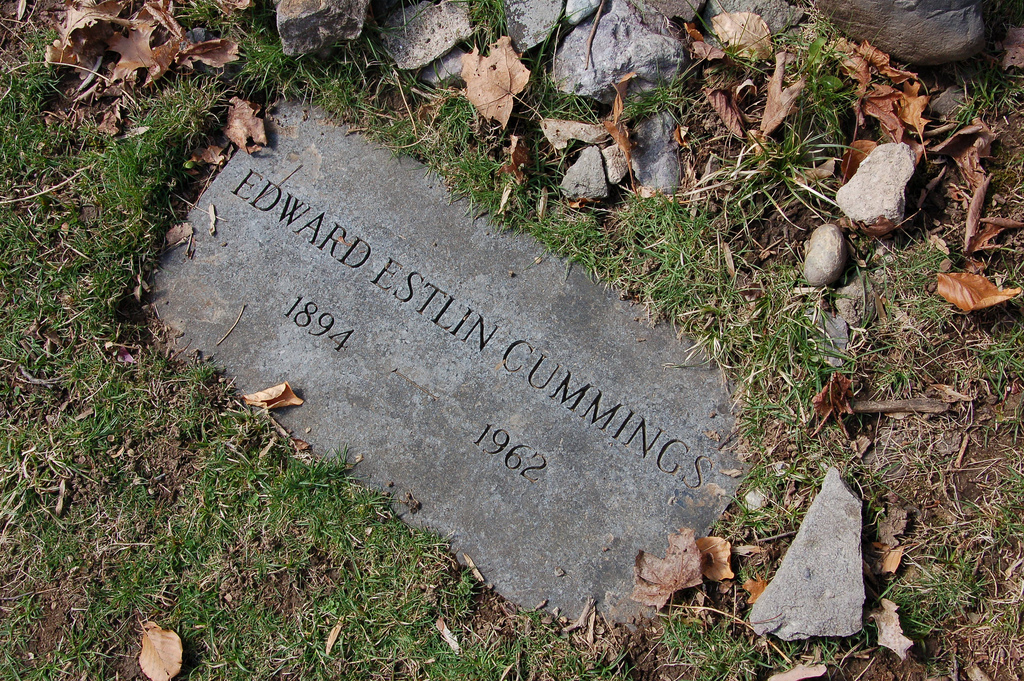
e.e. cummings is buried in Forrest Hills cemetery in Boston on a hill overlooking a lake, beneath a tiny rock that you can barely find (even with a map, depending on how many leaves have fallen that day), just a short walk from Anne Sexton's larger, more noticeable tombstone.

Flannery O'Connor's Andalusia Farm grave in Milledgeville, Ga., receives tokens ranging from coins to plastic gorillas (a reference to her story "Wise Blood"). And Sylvia Plath's grave at one time (before the lettering was changed to bronze) saw fans returning again and again to scratch out the name of her philandering poet husband Ted Hughes.

(Photo of the grave of e.e. cummings by David Day, where a commenter notes that the gravestone is in all caps.)

The Tuneless Commute

Josh Levin considers the perils, and ethics, of wearing headphones while bicycling. His bottom line:

“Like motorists who insist that they can safely text and drive,” wrote Bicycling.com’s Neil Bezdek last December, “perhaps cyclists should skip the headphones simply because it’s unfair to take unnecessary risks in other people’s road space, regardless of personal risk tolerance.” Riding a bike during rush hour is perilous. The best way to mitigate that danger is to avoid as many distractions as possible. And music is a highly avoidable distraction.

The Coffee Ring Effect

Explained:

Drop a bit of detergent, and chances are it'll dry with all the particles spread evenly throughout the area that was once a puddle. The same with a muddy pool — when it dries, you don't see the bits of mud all swept to the outer lip. But when you dissolve coffee grounds in water, then spill the suspension, a very physical rearrangement happens: the grounds go from being evenly dispersed throughout the liquid, to being clumped crustily on the edges when it dries. Scientists call this the “coffee ring effect” (though full disclosure, coffee isn't actually the only liquid to do the ring thing — you’ll know from evening cocktails that red wine will do the same to your linoleum).

How it works:

[T]he shape of the drop is like an over-turned bowl, fat in the center, sloping down to the edges. And because the edges are less packed with water molecules, the water out there evaporates more quickly. But here's the thing: when the drop hits a surface (whether it's a countertop or a page of your journal), that surface catches the rim of the droplet in a wrestler-like grasp — the rim gets PINNED to the surface, and can't move. Ever. So as the water evaporates, escaping as a gas, the pinned drop can't shrink into itself. Instead, it flattens out — keeping a constant width as it pushes water from the center out toward the stuck rim. And as the water is pushed toward the rim, it carries with it all those dissolved particles (coffee grinds!) … which stay behind after the water evaporates. Voila! A ring is formed.

(Hat tip: Dan Colman)

“The Nerdiest Election In The History Of The American Republic”

That’s what Ackerman calls it. Sasha Issenberg explains why the Democrats’ data operation excelled:

If Republicans brought consumer data into politics during Bush’s re-election, Democrats are mastering the techniques that give campaigns the ability to understand what actually moves voters. As a result, Democrats are beginning to engage a wider set of questions about what exactly a campaign is capable of accomplishing in an election year: not just how to modify nonvoters’ behavior to get them to the polls, but what exactly can change someone’s mind outside of the artificial confines of a focus group.

Michael Scherer has more details:

Rather than rely on outside media consultants to decide where ads should run, Messina based his purchases on the massive internal data sets. “We were able to put our target voters through some really complicated modeling, to say, O.K., if Miami-Dade women under 35 are the targets, [here is] how to reach them,” said one official. As a result, the campaign bought ads to air during unconventional programming, like Sons of Anarchy, The Walking Dead and Don’t Trust the B—- in Apt. 23, skirting the traditional route of buying ads next to local news programming. How much more efficient was the Obama campaign of 2012 than 2008 at ad buying? Chicago has a number for that: “On TV we were able to buy 14% more efficiently … to make sure we were talking to our persuadable voters,” the same official said.

The numbers also led the campaign to escort their man down roads not usually taken in the late stages of a presidential campaign. In August, Obama decided to answer questions on the social news website Reddit, which many of the President’s senior aides did not know about. “Why did we put Barack Obama on Reddit?” an official asked rhetorically. “Because a whole bunch of our turnout targets were on Reddit.”

The Pooch Index

Brazil-small-dogs1

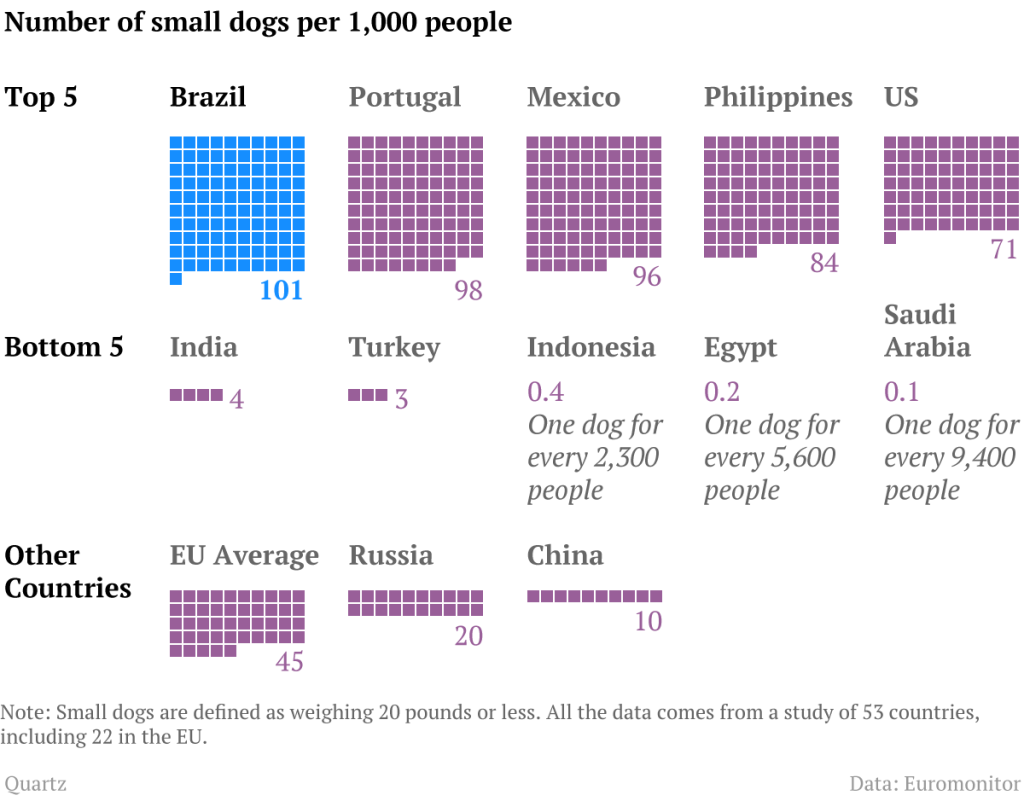
Quartz had a whole series last week on the canine economy, since "dog ownership, like cocaine use, can be seen as an economic indicator." South America is a major player:

Today, four countries—Chile, Brazil, Argentina, and Mexico—rank in the world’s top 10 for household penetration. The average home in those countries is more likely to have a pooch than not have one. Brazil tops the list in absolute terms, with nearly 36 million pups—more dogs than Canada has people. Some 55% of those dogs weigh less than 20 pounds (9.1 kilos), as tiny terriers, shih tzus, and chihuahuas fit with the lives of the 85% of Brazilians who live in cramped urban areas. Brazilian dogs are taken in droves to be blessed by priests in honor of St. Francis of Assis; a few are even ferried about in "pet taxis," taken for dog face lifts, or brought to breed in a doggie "love motel."

A subsequent post finds that Europeans, specifically Norwegians, spend the most to feed their dogs.

The Horserace Next Time

Jason Zengerle worries about it:

What’s most problematic about Silver’s and the pollsters’ triumph last night is what it may herald for the future of campaign coverage. Without a doubt, Silver’s rigorous empiricism is much, much more preferable to the lazy, gassy, vibration-sensing punditry that has made up so much of our political journalism. And yet, the biggest complaint about campaign coverage over the last twenty years has been that it’s too focused on the horse race and doesn’t pay enough attention to the substance. Silver and his fellow polling analysts and aggregators have brought a welcome degree of precision, but they’ve only made the horse race more central to the political conversation. After all, what dominated that conversation for the past month? It wasn’t a conversation about the candidate’s dueling tax plans. Rather, it was a debate about the polls. The fact that the good guys — who put their faith in the data rather than the vibrations — won that debate may turn out to be something of a pyrrhic victory.