A reader writes:
Well, someone's gotta say it: meep meep.
Another:
This morning, still on a high but starting to think clearly again, I started reflecting on the results from last night. I believe that this election is in some ways just as historically significant as the last one. You could make the case that voters in 2008 were rejecting the Bush years as much as they were endorsing Obama. The presidential contest this year, however, was all about Obama.
And while conservatives tried to attack Obama for not bringing the "change" he’d promised, it’s clear that change has come – a black president is re-elected, female candidates were winning all over the place (including all four House and Senate seats from New Hampshire now being represented by women), marriage equality won in multiple states and we have our first openly gay Senator. Turnout remained high (or went even higher) among those in the Obama coalition – the young, blacks, Latinos – who would supposedly not turn out this time. Even legal pot won!
I’m not convinced that this election will cure the GOP of their intransigence, but I hope these results help them read the writing on the wall.
Another:
One of my close friends is a dutiful Beck-Limbaugh-Fox supporter who echoed George Will and Dick Morris in predicting a Romney landslide. His confidence was so strong he contemplated not voting yesterday – and he lives in Virginia. He ended up voting and told me afterwards that while chatting to folks in line at the polls, he was stunned how many Obama supporters he encountered.
It makes me wonder if the right-wing propaganda machine didn't do more harm than good with its outlandish and unrealistic confidence in a Romney victory. Instead of his supporters being fired up to vote in a nail-bitingly close election, they believed the gasbags in la-la land who claimed there was no chance Mitt could lose. Sort of the reverse effect of the exit polls in 2004, when Kerry seemed like such a sure thing mid-day that lots of Democrats didn't bother casting a ballot.
On that note:
A caller to Bill Bennett's radio show this morning, almost in tears: "I hate to say this, but people like Sarah Palin and Karl Rove need to go away." Bennett deflected to a comment about how, if anyone is unrelatable and deeply hated by many people, it's Barack Obama.
Not one of those people:
I am an Obama-supporting Democrat living in red and rural Pennsylvania. Sometimes I feel very alone. I voted at 7:00am yesterday morning – the 3rd to vote in my precinct. The rest of the day I felt anxious and nauseous. My whole body ached for the unknown.
Oh, that wonderful feeling of knowing President Obama won reelection! I danced around my living room, laughing and drinking wine! I was one very happy American woman!
I do have one presidential election tradition that I started during the Bush-vs-Kerry year. I take a vacation day on the Wednesday following the election. Being that I live in red and rural Pennsylvania, almost all my co-workers are hardcore Republicans and now Tea Partiers. These are people whom I like, but I just can't be around them the next day. When Clinton won reelection, I remember hearing one coworker fantasizing about assassination and saying something to the effect "If I wasn't married with children, it would only take two bullets – one for Clinton and one for Gore." It completely through me off guard! I liked my coworker. I still like him. How could he possibly say something so horrible? So now I always take this day off, because if my side wins, I don't want to hear it. And if my side loses, I don't want to hear it.
So I sleep in. I read The Dish. And I rake the leaves in my yard … with a big smile on my face!
Another observes:
It occurs to me that this election bears striking similarities with Obama's primary victory over Clinton in '08. In each, he and his team dug deep into the mechanics of the how the victory was ultimately going to be decided and worked to get an edge in those places that would give them the most bang for their buck. In '08, it was targeting the caucus states where his organizational prowess could have an outsize effect, and this time around, it was targeting specific populations in the key swing states to turn them out in higher numbers using his well established, funded, and organized ground game. Well played.
Another:
As a social scientist I cannot help but feel validated by the results of this election.
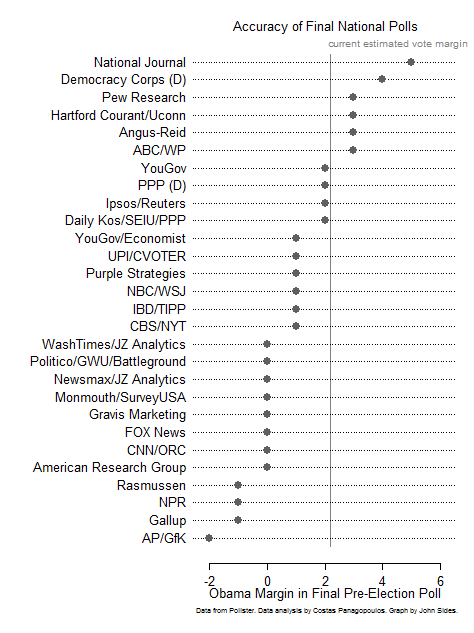
Statistical analysis of human behavior has achieved a new level of legitimacy. We have here a shining empirical example that we can measure people's thoughts and intentions and actually use that to make accurate and forceful predictions about their behavior. This makes society more democratic. Instead of elites and experts trying to guess what crowds want or what they will do, decision makers can simply ask and take action based on that.
Secondly, the strategic story of this election is that Obama won the ground game. This tells me that institutions matter. That even as technological advancement enables us to reach more people in more ways than ever before, these methods work best when they are used to augment our fundamental human need for community, collective engagement, interpersonal contact, and action. These lessons not only apply for political mobilization but have broad implications for how we accomplish things in the realm of commerce as well and I hope they're heeded.
Another:
The only place the GOP held this election was in the House. The reason for that is redistricting. Redistricting is a manipulation of the vote to protect incumbents. Republicans had more incumbents (and in many many states just finished a new round of redistricting). If the ability to redistrict was denied to the parties – in other words, if redistricting was done on a neutral basis – the GOP would have lost the House as well. So Republicans lost the presidency, the Senate, on social conservative issues, and they would have lost the House under neutral redistricting rules. It's something for Republicans to think about.
Another:
It's been the talking point from the pundits for years that the US is a "center-right" country. Can we change that now?
Another:
One positive and promising sign that I took from last night's election is that during Romney's concession speech, no one from his audience booed when President Obama's name was mentioned. That is a far cry from what happened in 2008. And when Obama said in his speech that he wants to meet with Romney to discuss how they can work together, his audience applauded.
I understand that we won't be joining hands and singing kumbaya. I know that the uber-partisans will do all they can to block and prevent bipartisan solutions. I realize the monied interests will just dust themselves off and continue to attempt to influence the agenda. And I understand there will be those who out of self-interest will continue to stoke the fires of our differences to blind us from our commonality.
But as for me, I want to use the results of this election as an opportunity to start anew. I'm willing to wipe the slate clean. Moving forward, I know that there will be heated debates on a variety of issues, but I'm hoping that we can turn down the levels of animosity and disrespect so that we can work together to address the many challenges that we face as a nation.
Another:
I wrote you about Romney's 2007 candid video. I expressed how it was the first time I'd felt sympathy for him. Last night, I saw that same Romney. My heart breaks for him. He's a good man. But his party is rotten at the core and he didn't have the courage to tell it to them straight.
Bush's tragedy was hubris. Romney's tragedy is cowardice.
Another:
I am unexpectedly emotional tonight. I shouldn't be surprised. My father died because of the healthcare law. No, not because of death panels; because a loophole allowed his insurance to drop him without an alternative being offered within six months. In that time, his kidneys failed, his heart failed, and his brain failed. In short: he died. He died, and as his 24-year old son I had to give the order to pull the plug. It is a decision that will haunt me until I die, and if there is even a trace of thought after death it will trail me there.
I supported Obama. His healthcare law, it could be interpreted, facilitated my own father's death. Not something I've admitted much before. I've contained this, I've continued to root for Obama, not in spite of this but because of it knowing that, if Obamacare could be upheld, my father's case can become an anachronism. I want no child to go through what I have; if things continue as they have, they never will.
Yes, yes I am crying tonight, and yes, it is partially in remembrance of my father (who was a stalwart Republican and would hate every word of what I wrote). Mostly it is because my suffering may soon be something of the past, and that is something which could only have happened with an Obama win.
Another looks to the next big battle:
The four victories for marriage equality last night are wonderful news, but that's not the end of it. It seems likely that there is a fifth state which will also have marriage equality in the near future: California.
Currently, the lawsuit over the constitutionality of Prop 8 is stalled at the Supreme Court, waiting to be certified (or not). In many discussions online, people have been speculating that the court is waiting until after the election to decide whether to hear the case; this seems to be the case, since just over a week ago the court scheduled it for conference on Nov. 20. Why did they wait?
Probably for two reasons: to avoid influencing the election by raising the same-sex marriage issue and to get a feel for which way the winds are blowing. Well it's clear now that the winds are blowing toward full equality, so that leaves the justices on the right in a bit of a bind. Should they simply refuse to hear the case, in which case marriage equality comes to California? Or should they hear the case and run the risk of invalidating ALL anti-marriage equality amendments and laws?
I believe that the justices will refuse to hear the case. It takes the votes of four justices to agree to hear a case and unless the four on the left really want to push this issue (which I doubt), I suspect the court will simply let Prop 8 die. We could know as early as Wednesday, November 21 if marriage equality is coming to California.
One more:
As a former Texan who started reading your blog in 2004, who grew up in Mississippi, who never had a black friend, who never knew a gay person, who drove for hours to see Obama in Seattle four years ago, who went in for the bro grab with Barack and got whiffed at the last second, who found himself leading the cheer in an Oregon pub tonight for marriage equality and not giving the tiniest shit about race, I want to thank you and your magnificent editorial team for helping me understand what this is all about. You speak for many people you will never know.
I have never been prouder to be an American.
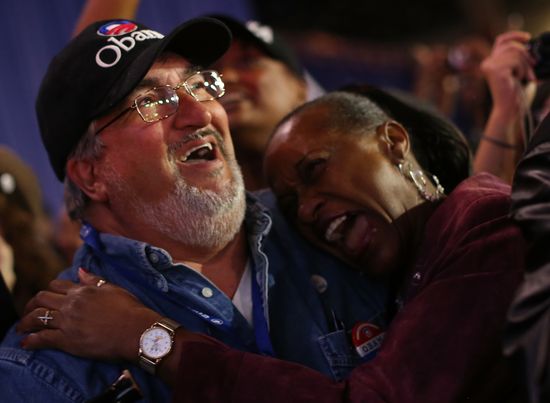
(Photo: Supporters of U.S. President Barack Obama cheer after networks project him as reelected during the Obama Election Night watch party at McCormick Place in Chicago, Illinois on November 6, 2012. By Spencer Platt/Getty Images)
 namely just how Mormon he is. He ought to have unveiled the relationship between his particular religious sensibility and his ideas for American success. He should have announced at every pit stop that he had met the world through his missionary work; that he came from a good Christian home that emphasized the principles of hard work and self-sacrifice; that he keeps a weekly calendar guided by the principles of Stephen R. Covey; and keeps a marriage because he believes those commercials are right—diamonds are forever, and so is this bond.
 The Dish