Meanwhile, In Puerto Rico

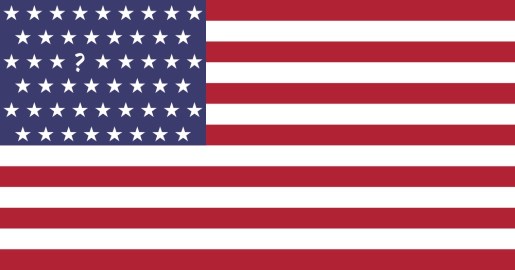
US flag 51 stars

The potentially big news:

A slim majority of Puerto Ricans voted Tuesday to approve a non-binding referendum that would make the island the 51st U.S. state. The measure requires final approval from Congress, so it means little for Puerto Rico right now. Still, nearly 54 percent of Puerto Ricans voted for a change in the island’s relationship with the U.S. — and President Obama promised to uphold their vote in the case of a “clear majority.”

Olga Khazan explains what's in it for the island:

[B]ecoming a state would allow them to benefit from an extra $20 billion a year in federal funds –  something Puerto Rico could use, given its 13 percent unemployment rate. … Puerto Rico the state would also gain two seats in the U.S. Senate and five in the House of Representatives — a major upgrade from the one non-voting delegate that currently represents the territory.  

Puerto Ricans would also have to start paying federal income and corporate taxes, as well as run the risk of adopting English as their official language. Steven Taylor looks at the political angles:

I have long thought [of] statehood for PR as highly unlikely, because Republicans would likely see PR as a new Democratic state. However, the GOP clearly needs to find a way to cultivate Hispanic votes, and this might be a way. Beyond using it as a way to cultivate votes, the Republicans might have to worry about how opposition to PR statehood would play with other Hispanics already in existing states.

One other problem: the incumbent Puerto Rican governor who supports statehood, Luis Fortuno, lost to his status-quo supporting opponent.

Paying A Price For Equality

An update on the Republican state senators who voted for marriage equality in New York:

[Last night] Democrat Ted O’Brien successfully claimed a Rochester seat previously held by Republican Jim Alesi. Mr. Alesi, facing a likely primary challenge after voting in favor of gay marriage in 2011, opted to not run for reelection. Another pro-gay marriage Republican senator, Poughkeepsie’s Steve Saland, survived a primary challenge only to have his opponent run against him on the Conservative line in the general election, allowing Democrat Terry Gipson squeak by in a 43%-to-42% plurality surprise win. This was despite Democratic Governor Andrew Cuomo providing a cross-party endorsement to Mr. Saland. (With Republican Roy McDonald losing a primary challenge of his own, only one of the four Republican votes for same sex marriage will be in the State Senate next year, Buffalo’s Mark Grisanti.)

The Single Biggest Night For Gay Rights In Electoral History

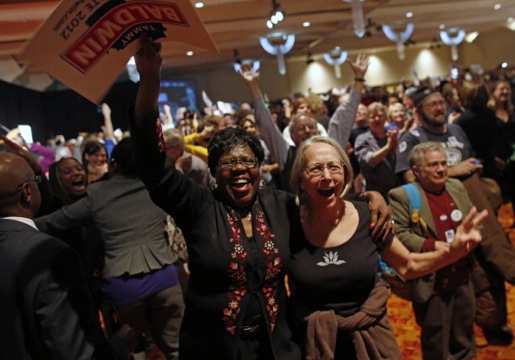
GT BALDWINVICTORY 121107 Last night, 77% of gay and lesbian voters – who made up 5% of the electorate – cast their ballots for Obama, the first president to support marriage equality, and the first sitting president to mention gays in a victory speech. The 113th Congress, meanwhile, will be a groundbreaking one: voters elected America’s first out US senator – Wisconsin’s Tammy Baldwin – and sent to the House five out gay men (two of them incumbents, and one of the first out gay person of color in Congress) and an out bisexual woman (the first openly bi member of Congress). Americans also re-elected a pro-equality justice in Iowa after three pro-equality justices were ousted in 2010. And, of course, we went four for four in the marriage equality ballot measures in Maryland, Maine, Washington and Minnesota. 


Adam Serwer summarizes a key implication of the marriage equality ballot measure results:

The National Organization for Marriage saw their path to victory in peeling off socially conservative and religious minority voters who usually vote for Democrats and enlisting them in the fight against same-sex marriage rights. Internal documents showed that NOM believed that by putting forth black and Latino spokespeople, they could discredit the idea of same-sex marriage as a civil rights cause and drive a wedge between two typically Democratic constituencies…. The results are harbingers of the future in [a] crucial way: LGBT activists’ win in Maryland, which has a large population of black voters, suggests that NOM’s racist wedge strategy is crumbling.

Dan Savage strains to follow NOM’s spin. Nathaniel Frank details Freedom to Marry’s painstaking path to victory in Maine, particularly how it used a smart, rigorous ground game to combat deceptive ads about teaching pro-gay values to schoolchildren:

The research, which even included a control group, showed which approaches worked with which groups. Older people might respond better to older messengers; pet owners might respond better to in-person conversations than to mailings. Armed with this kind of granular information, campaigners could work most effectively to shore up support among persuadable voters. In the end, the Maine campaign spoke to 250,000 people, nearly a fifth of the state’s population—and that was likely the fifth that mattered most. This sort of effort is ongoing in more states beyond this week’s election, such as Oregon, which may be next up for an initiative. 

The once-pessimistic E.J. Graff envisions the future:

In 2014, Oregon will be among the next wave of states to pass marriage equality at the ballot. I don’t know what other states are on the list, but within two years the majority of Americans will be living in equal-marriage states. By 2020, the majority of American states will be actively marrying same-sex couples. Not long thereafter, the Supreme Court will slap the remaining Southern states into line.

She adds:

When President Obama said he had come around, the rest of you came around with him. There’s no turning back. Before yesterday, the marriage-equality forces were 0 for 32 at the ballot box—voters had opted to ban gay marriage every time the issue had been put to them. But from here on, we will win—if not every time, then the overwhelming majority of the time.

Alex Ross reflects:

[M]y memories go back only to the nineteen-eighties; I can’t imagine what gay people aged sixty or seventy are experiencing. I’ve tried to piece together reasons for the great transformation, but there is no single answer…. [T]he landscape has been changing, inch by inch, for a long time. Last night, I found myself wishing that Frank Kameny, one of the pioneers of gay politics, could have lived to see the victories in Maryland and elsewhere. In 1965, he marched outside the White House with a small band of picketers, protesting the ban on “sexual perversion” in government. Kameny died last year; he did get to witness the overturning of Don’t Ask Don’t Tell. 

Ross cheers Obama’s role in ushering the sea change in American acceptance:

I recall sitting bolt upright when he reached a particular line in his 2004 speech at the Democratic National Convention: “We coach Little League in the blue states and, yes, we’ve got some gay friends in the red states.” There was an electrifying casualness, a lack of self-consciousness, in his delivery of those words. Suddenly, gays found themselves installed in a postmodern Norman Rockwell tableau, leaning over the metaphorical white picket fence. The same panorama was glimpsed in Obama’s victory speech last night: “It doesn’t matter whether you’re black or white or Hispanic or Asian or Native American or young or old or rich or poor, able, disabled, gay or straight, you can make it here in America if you’re willing to try.”

(Photo: Supporters cheer during an election night event for U.S. Senate candidate U.S. Rep. Tammy Baldwin (D-WI) on November 6, 2012 in Madison, Wisconsin. By Darren Hauck/Getty Images)

The Democrats’ Foreign Policy Advantage

Drezner digs into the exit polls:

A glance at the exit polls showed that Obama won the foreign policy question pretty handily.  Only five percent of respondents thought that foreign policy was the most critical issue in this campaign — but of those five percent, voters went for Obama over Romney by 56% to 33%.  Voters were also more likely to trust Barack Obama in an international crisis (57%-42%) than Mitt Romney (50%-46%).  This is the first exit poll in at least three decades where the Democrat has outperformed the Republican on foreign policy and national security.  

 Drum adds:

Thanks, George Bush! We like to say that Americans have short memories, and that's true in a way. On the other hand, a majority of voters still blame Bush for the lousy economy more than they blame Obama, and the Bush destruction of the Republican brand on foreign policy still seems to be going strong too.

This result, combined with the last debate when Romney all but endorsed Obama's handling of foreign affairs, should represent the dead end of neo-conservatism: another ideology in the dustbin of history, along with all the others.

The American President

155691576(1)

[Re-posted from late last night]

Romney's was, I thought, one of the most graceful and gracious concession speeches I can recall. I thought for a split-second: what if this Romney had run? And then I realized that his party would never have nominated that Romney and his ambition had trumped his integrity long ago anyway. But there was still a poignancy to that moment – the gap between what a human being can be (or still is, as a father or husband or friend) and what politics and wealth and power can do to someone.

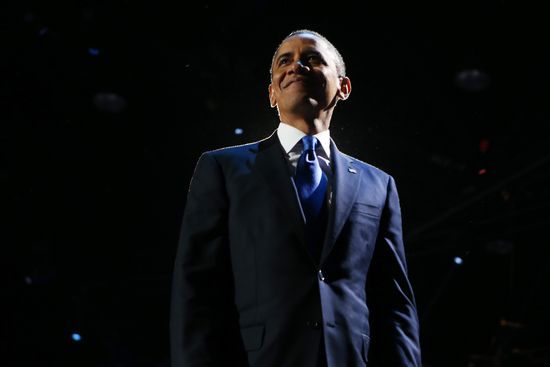
The president's oration was almost a summation of his core belief: that against the odds, human beings can actually better ourselves, morally, ethically, materially, and we can do so more powerfully together than alone, and that nowhere exemplifies that endeavor more than America. It was Lincolnian in its cadences, and in some ways, was the final, impassioned, heart-felt rebuke to all those, including his opponent, who tried to portray him as somehow un-American. How deeply that must have cut. How emphatically did he rebut the charge.

What he reminded me of was how deeply American he actually is – how this country's experiment truly is in diversity as well as democracy. And his diversity is not some cringe-worthy 1990s variety. It is about being both white and black, both mid-Western and Hawaiian, both proudly American and yet also attuned to the opinion of mankind.

As for the next four years, there is time enough for that. But I stand by these words. And one felt something tectonic shift tonight. America crossed the Rubicon of every citizen's access to healthcare, and re-elected a black president in a truly tough economic climate. The shift toward gay equality is now irreversible. The end of prohibition of marijuana is in sight. Women, in particular, moved this nation forward – pragmatically, provisionally, sensibly. They did so alongside the young whose dedication to voting was actually greater this time than in 2008, the Latino voters who have made the current GOP irrelevant, and African-Americans, who turned up in vast numbers, as in 2008, to put a period at the end of an important sentence.

That sentence will never now be unwritten. By anyone.

Hewitt Award Nominee

"What happened? A political narcissistic sociopath leveraged fear and ignorance with a campaign marked by mendacity and malice rather than a mandate for resurgence and reform. Instead of using his high office to articulate a vision for our future, Obama used it as a vehicle for character assassination, replete with unrelenting and destructive distortion, derision, and division," - Mary Matalin, NRO.

Award glossary here. Reader submissions are always welcome.

The Republican Minority Has Arrived, Ctd

Frum warns the GOP against focusing solely on immigration:

Any idea that the immigration issue – and the immigration issue alone – would enable Republicans to staple a good chunk of the Latino vote to the conservative coalition –without changing anything else - is a dangerous self-deception.

It's necessary of course to refrain from insulting Latinos, or, for that matter, anybody. But the crying need in the GOP is for a more middle-class orientation to politics, one that addresses concerns like healthcare as well as debts and deficits. But the ideas that dominated the past four years won't become more attractive if all conservatives do is translate them into Spanish.

Earlier Dish on the GOP's demographic difficulties here.