Four More Years: Blog Reax II

Douthat calls last night a realignment:

Tuesday’s result ratifies much of the leftward shift in public policy that President Obama achieved during his first term. It paves the way for the White House to raise at least some of the tax revenue required to pay for a more activist government and it means that the Republicans let a golden chance to claim a governing coalition of their own slip away. In this sense, just as Reagan Republicanism dominated the 1980s even though the Democrats controlled the House, our own era now clearly belongs to the Obama Democrats even though John Boehner is still speaker of the House.

Beinart agrees:

Four years ago, it looked possible that Barack Obama’s election heralded a new era of Democratic dominance. Now it looks almost certain. In the early 20th century, the face of America changed, and only one party changed with it. In the early 21st century, that story has played itself out again. From the beginning, Obama has said he wants to be a transformational figure, a president who reshapes American politics for decades, another Reagan or FDR. He may just have achieved that Tuesday night.

Ed Kilgore puts Obama's vote total in perspective:

Obama’s popular vote margin has grown to 2.7 million, and he’s right at the level where he may become the first Democratic presidential candidate since FDR to win a majority of the popular vote twice. Florida still hasn’t been officially called, but still looks likely to fall to Obama, but he’s over 300 in the electoral college anyway.

Ramesh Ponnuru's hopes Republicans will learn something from their defeat:

So $2 billion later, we still have President Obama, Senate Majority Leader Harry Reid, Speaker John Boehner – and some bitter lessons for the Republicans. Those lessons are, I should think, fairly obvious. Don’t think you can run up margins among whites so big that you don’t need anyone else. Offer some ideas that middle-class voters might think will help them out — especially if you’ve done really well from the financial economy. Keep the focus of any conversation about abortion on the 99 percent of cases that don’t involve rape.

David Bernstein wants the GOP to become more female-friendly:

Sure, the GOP needs to reach out to the growing Hispanic population. But the bigger problem is that single women vote overwhelmingly Democratic, and for the first time in American history there are more single women than married women. Single women are much more economically vulnerable than are married women, and want the government to be there to insure them against hard times. This is especially true of single women with kids–and the American divorce rate is still the highest in the world, and over 40% of American children born last year were born to single mothers. This isn’t good for the women, their children, or American society, and it’s not good for the Republicans. So how about spending (A LOT) less time worrying about gays getting married, and more time worried about women (and men) who aren’t? Reducing the number of what used to be called “broken homes” is a culture war worth fighting; gay marriage is not.

Walter Russell Mead finds a silver lining:

Even those who voted for Romney can take heart in one aspect of the 2012 campaign: racism continues its historic retreat in the United States.

Scott McConnell spells out his hopes for Obama's second term:

I hope to see Obama move “left” on foreign policy — wind down the drone wars, push hard for a Palestinian state (if it’s not too late; if it is, we can begin to talk about voting  rights for all the people in one state ), explore the possibility of a detente with Iran. And move to the right on fiscal issues — revisit Simpson-Bowles, see if Romney (who gave an extraordinarily gracious concession speech) really does have any good ideas on entitlement reform. Part of the very large anti-Obama vote is based on serious worry about the deficits, about becoming "like Greece". If Obama leaves office with a deficit larger than the present one, he will be failed president no matter what else he does.

I'm with McConnell and suspect the next four years will be a battle between moderates and liberals over policy priorities. Greg Sargent argues that Obama has a clear mandate:

Republicans themselves regularly said that this election was a “big choice” between “two very different visions for America.” That was also the regular refrain of pundits just after Romney chose Paul Ryan, the leading architect of the GOP’s overarching ideological blueprint for the country’s future. So by the lights of Republicans and pundits themselves, this outcome should be seen as a big choice by the American people — a big decision about the future direction of the country. Why, now that Obama has won a resounding victory, is this suddenly being talked about as a small, no-mandate election?

And Jamelle Bouie assesses Obama's legacy:

It’s still far too early to make a judgment about Barack Obama’s overall historical standing. But by virtue of winning re-election, he has become the most successful Democratic president since Lyndon Johnson, and one of the most successful of the 21st century. Not bad for the skinny Hawaiian kid with a funny name.

First blog reax here.

Rove Goes Rogue

This looks like it was scripted by Ricky Gervais. I watched with my jaw slowly dropping lower and lower (which was hard since I was smiling so widely as well). James Poniewozik calls it “one of the most spectacular things I have ever seen on cable news”:

It was a fitting moment for an election that often seemed to be a campaign over the idea of mathematical knowability itself. But it was also a glaring, and embarrassing, example of the extent to which Fox News has become an arm of the Republican Party and is expected by GOP operatives to behave as one. Rove may be a party big shot, but he’s just a guy giving analysis on Fox’s air. He does not run the network, even if his friends do.

And yet apparently no one in Fox’s studio felt empowered to tell him that, just because he’d raised a squillion dollars for his Republican SuperPAC this election, he is not entitled to have the decision desk hauled out to answer to him like chefs who sent out an undercooked steak. It’s the sort of thing that might cause you to examine your mission as a journalistic network. I’m not waiting up for that to happen, though.

In the end, Rove is a numbers guy too, and he finally had to concede to the arithmetic–but not before creating a defining image of a partisan, and a network, at war with the very reality it could not avoid reporting.

Last night, Roger Ailes’ walls came tumbling down. Because their foundations were not based in reality, just ratings. Fox deserves a great deal of credit for re-electing president Obama. Because they refused to see who he actually was, they could not effectively counter him. They countered a figment of their imagination – and it was a particularly nasty, bilious, mean figment. Their universe became a black hole last night, sucking almost all of them in.

What About Benghazi?

Last night, Fox News couldn't stop talking about how Libya should have doomed Obama. It was surreal – just a glimpse into the crazy that now defines the Ailes-Rove right. Marc Lynch provides a reality check:

In retrospect, I suspect that the intense focus on Benghazi hurt Romney more than Obama.  I suspect that most voters quickly recognized Benghazi for the Republican pseud0-scandal it always was, and received it at roughy the same wavelength as Donald Trump demanding a birth certificate.  The prospect of a hammer blow to bring down the incumbent enemy may have thrilled the base, but the very fact of its identification with Fox News and the right wing bubble limited its ability to travel farther.   So did the fact that it fairly clearly was not a "scandal" of any significance.  Yes, the tragic deaths revealed serious, relatively low-level, issues with inter-agency coordination and communication, and more major issues about intelligence and the changing nature of al-Qaeda's strategy and organization.  But it was never the scandal which Republicans so desperately wanted it to be, nor Libya the failure so many believe it to be. Hopefully the real issues can now be addressed outside of the partisan frenzy.

Go Away, Dick Morris. For Good.

The following video from yesterday is the clearest reason why the Dish decided to rename our Von Hoffman Award: The man is a buffoon. And a whore. I use that term to describe something like his current book, released in October:

Screen shot 2012-11-07 at 1.09.27 PM

Below is a chronological sample of his Twitter feed from last night:

End of transmission. How about the end of his Fox career?

The next day, Morris tweets the link to this mea culpa. It begins:

I’ve got egg on my face. I predicted a Romney landslide and, instead, we ended up with an Obama squeaker. The key reason for my bum prediction is that I mistakenly believed that the 2008 surge in black, Latino, and young voter turnout would recede in 2012 to “normal” levels. Didn’t happen. These high levels of minority and young voter participation are here to stay. And, with them, a permanent reshaping of our nation’s politics.

He says he predicted the Romney landslide based on the polls available. His job is to interpret polls. If there is any accountability in the pundit-consultant-whore class, he should apply for a job at Starbucks. Update from a reader:

Maybe it’s piling on, but in his mea culpa, Dick Morris refers to an Obama “squeaker.” So, when he predicted a Romney 325-213 win it was a “landslide,” but a 332-206 Obama win (assuming Florida holds) is a “squeaker.” No shame.

A Marriage Equality Tipping Point

TPM recaps last night’s marriage equality victories. Both Maryland and Maine have voted in favor of marriage equality. Because of its mail-in voting system, Washington state hasn’t finished counting votes but legalization of same-sex marriage is currently ahead in the vote count. And – against all the odds – Minnesota has voted against a constitutional ban on marriage equality. Josh Barro looks ahead:

Gay marriage supporters went from losing big to losing small and have now shown they can win at the ballot box. And societal shifts — increasing acceptance of gays, plus old people with anti-gay attitudes dying and being replaced by accepting young voters — mean that gay marriage will likely be able to obtain a majority vote in nearly every state within a decade.

This presents a pleasant dilemma for gay marriage advocates. For the past decade, they have made a passionate (and correct) case that gay marriage should not be subject to referendum. Minority rights should not be subjected to the will of the majority. Gays are entitled to equal marriage even over the objections of the popular will.

But what if the majority is prepared to grant those minority rights? Then a referendum goes from being an injustice to being an inconvenience — and it will be an inconvenience gay marriage advocates will increasingly have to bear in pursuit of legalization.

That has been my argument all along: because I always believed that fair-minded Americans, if they were willing to stop and really listen to the arguments, would do the right thing the right way: back equality at the ballot box. It’s so much better than court decisions, although those court decisions helped make these ballot box victories possible, by changing consciousness. Jim Burroway expects the road to equality to be long:

It will be generations, I think, before we can win marriage equality throughout the U.S. at the ballot box. In fact, there are some states where that will never happen; it will also take some key court victories before all Americans are created equal. We will undoubtedly experience more losses and setbacks in the years ahead. But every great movement moves forward one step at a time. This was a big step, but it is only the latest one in a long line of just putting one foot in front of the other. We’ve been doing that for more than half a century. But right now it feels pretty good, now that we’re starting to get the hang of it.

Let me differ. Last night was a Big Fucking Deal for marriage equality and gays and lesbians in America. And, yes, Obama led from behind. But we kicked his until he did. Keep kicking.

The Polls Win Big

Silver_Map

Blumenthal gives the pollsters their due:

We believe the success of the poll tracking model that Jackman designedfor HuffPost Pollster – predicting the winner of all 50 states plus the District of Columbia – owes in part to aggregating the polls alone with relatively little additional data or processing (save for the use of past voting data to help combine national and state-level polls and statistical corrections to help reduce the distortions produced by consistent pollster "house effects").

Harry Enten evaluates individual pollsters:

[T]here are some pollsters who are going to have to go back to the drawing board after this election. Last week, I wrote about how Public Policy Polling and Rasmussen differed on the winner in Colorado, Florida, New Hampshire, Ohio and Virginia. Rasmussen eventually found a shift in New Hampshire towards the president and a tie in Ohio. In all five cases, it seems that Public Policy Polling (PPP) had the correct winner all along. They continue a fine record of polling, despite a Democratic affiliation.

This marks the second election cycle in a row, however, in which Rasmussen has shown a serious Republican bias. They also were right-leaning in their 2008 state polls. That's a far fall for a pollster who was so accurate in 2004 and 2006.

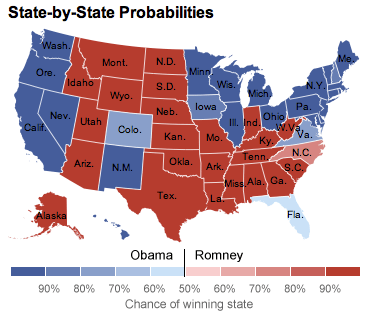
Meanwhile, it has been determined that Nate Silver is probably a witch. Map above from 538.

Obamacare Lives

Jonathan Cohn cheers the survival of Obama's signature accomplishment:

I’ve waited more than two years to write this sentence: The Affordable Care Act is here to stay. It survived the Supreme Court and now it has survived the threat of a unified Republican government determined to repeal it. Implementation of the law will present huge challenges, but, for the first time in a long while, the administration and its allies can focus on those challenges rather than on rearguard political fights to keep the program alive.

Josh Marshall has the same thought:

The most concrete thing that strikes me about this public verdict is that Health Care Reform, Obamacare, a system of near universal coverage that will provide a framework for future reform, is here for good. It withstood the challenge of the conservative judiciary. It survived a national referendum. As Bill Kristol wrote memorably back in late 1993, the reason conservatives fought this so hard is because they knew that once it was in place the public would never let it be taken away. And it won’t. It’s here for good. That alone would seal President Obama’s legacy.

Austin Frakt hopes for further reform:

The only realistic, if still uncertain, way forward for those who find flaws with part or all of the ACA (and I am among them) is to argue for incremental change. Instead of repeal and replace, consider revise and rework. I don’t expect the political climate to change such that this suddenly becomes easy. Repeal may be dead, but Kumbaya is not alive. Still, for the good of the country and those who need and deserve better and more affordable health care, we really ought to try. The people have shown us that we’re a long way from Waterloo. Isn’t it time we all started acting like it?