The Republican Minority Has Arrived

First Read looks at the demographics:

What happened last night was a demographic time bomb that had been ticking and that blew up in GOP faces. As the Obama campaign had assumed more than a year ago, the white portion of the electorate dropped to 72%, and the president won just 39% of that vote. But he carried a whopping 93% of black voters (representing 13% of the electorate), 71% of Latinos (representing 10%), and also 73% of Asians (3%). What’s more, despite all the predictions that youth turnout would be down, voters 18-29 made up 19% of last night’s voting population — up from 18% four years ago — and President Obama took 60% from that group.

Weigel weighs in:

Had Rick Perry not run for president, and been so attackable on college tuition for immigrants, the issue might have stayed dormant. But Romney opened up on Perry and touted his support of the Arizona/Alabama immigration bills. The result: Only 27% of the Hispanic vote, the lowest for any Republican in a generation. Romney won only 39% of this vote in Florida. In 2004, George W. Bush won 54% of that vote. Yes, sure, fine, it's more Puerto Rican and less Cuban than it was eight years ago. But this drop-off is untenable.

Ben Smith and Zeke Miller put it this way:

The groups on whom Obama depended are the ones that are growing; white men, the core Republican constituency, are a shrinking minority. For the first time In 2011, minority births surpassed white births in the United States, and the longer demographic trend places white Americans in the minority by 2041. The Republican party will spend much needed time in the wilderness after this election, even as the open race for unofficially 2016 kicks off today. The future of the Grand Old Party will be determined by how well it adapts to the brand new Liberal America — indeed the Obama America — that is now here to stay.

Massie's view:

Republicans will win presidential elections again – they may well be favourites to prevail in 2016 – but … the difference now is that when all things are equal in a “normal” election Democrats have a slight but important advantage whereas 30 years ago it was Republicans who enjoyed that minor but significant supremacy. And when the country is evenly divided these small things matter.

And Joyner wonders how long it will take for the GOP to wake up:

The 1980 model Republican Party will not win the White House ever again. Since 1860, when the Whigs fractured and died, our two major parties have managed to survive and even thrive by constantly re-inventing themselves. After a string of defeats, the Democrats rebooted in 1992, nominating a Southern moderate and jettisoning the more unpopular parts of their agenda, at least at the national level. At some point, the GOP will do the same. The only question is how many more elections they’ll lose clinging to a “traditional America” that’s a distant memory.
The Return Of Obama, Circa 2008

Ezra Klein analyzes Obama's speech, which can be viewed in full above:

The Obama campaign found that their key voters were turned off by soaring rhetoric and big plans. They’d lowered their expectations, and they responded better when Obama appeared to have lowered his expectations, too. And so he did. The candidate of hope and change became the candidate of modest plans and achievable goals. Rather than stopping the rise of the oceans — which sounded rather more fantastical before Sandy — Obama promised to train more teachers and boost manufacturing jobs.

What you saw [last night], however, was that Obama didn’t much like being that guy. He still wants to be the guy he was in 2008. He still wants to inspire and to unite. He still wants Americans to feel that the arc of history is bending under their pressure.  He still wants to talk about climate change and election reform and other problems that the Senate is not especially eager to solve.

Reality Collides With Spin

Friedersdorf takes Republican pundits to task:

On the biggest political story of the year, the conservative media just got its ass handed to it by the mainstream media. And movement conservatives, who believe the MSM is more biased and less rigorous than their alternatives, have no way to explain how their trusted outlets got it wrong, while the New York Times got it right. Hint. The Times hired the most rigorous forecaster it could find.   

It ought to be an eye-opening moment.    

But I expect that it'll be quickly forgotten, that none of the conservatives who touted a polling conspiracy will be discredited, and that the right will continue to operate at an information disadvantage. After all, it's not like they'll trust the analysis of a non-conservative like me more than the numerous fellow conservatives who constantly tell them things that turn out not to be true.

Better And Better


The Beginning Of The End Of Prohibition

Jacob Sullum explains what happens now in Colorado and Washington state:

The elimination of penalties for possessing up to an ounce of marijuana (if you are 21 or older) takes effect right away in both states (once the governor proclaims/certifies the results, within 30 days of the election). But the provisions allowing commercial production and sale of cannabis for recreational use require regulations that will be written during the next year. The Washington Liquor Control Board has until December 1, 2013, to adopt regulations for marijuana growers, wholesalers, processors, and retailers. The deadline in Colorado, where cannabis businesses will be overseen by the state Department of Revenue, is July 1, 2013. Colorado's law, unlike Washington's, also allows home cultivation of up to six plants and nonprofit transfers of up to an ounce, so Colorado pot smokers will have an immediate state-legal source of marijuana.

John Paul Rathbone adds:

To get a bead on what this might mean, this is further than Netherlands has gone. There, contrary to common perception, it is only the retail sale of 5 grams that is legal. Production and wholesale remains illegal, and the law is vigorously enforced. That is why the price of pot in Amsterdam “coffee shops” is “little different than the price in US dispensaries,” as the authors of “Marijuana legalisation: what everyone needs to know”, argue here.

Yglesias foresees a lot of federal and state conflict:

[B]efore you buy land to start your marijuana farm, note that the drug is still illegal in the United States of America and that Colorado is one of the United States of America. Consequently, if you try to set up a large-scale pot business you're liable to get busted by the DEA. So expect a lot of clashes around this and a sticky situation for the Obama administration.

Four More Years: Tweet Reax II

Screen shot 2012-11-07 at 8.29.26 AM

Read the first half of the reax here. Continued:

Meltdown reax here.

Screen shot 2012-11-07 at 7.40.38 AM

Four More Years: Tweet Reax I

Screen shot 2012-11-07 at 5.53.51 AM

Relive or catch up on last night’s developments, in rough chronological order:

Second half of the reax here.

Election Day Wrap

155691317

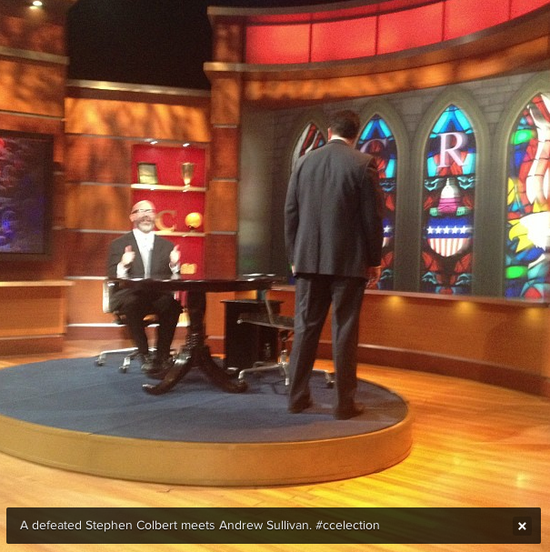
Today on the Dish, Andrew and crew live-blogged the election returns from the Colbert studio. Initial blog reax here and Fox meltdown reax here. Andrew then absorbed Romney's concession speech, Obama's victory, and what another four years signifies about America. Earlier in the day, Andrew summarized his case for the president, highlighted Obama's closing argument, urged us here and here to hold pundits accountable, noted Romney's discomfort discussing his Mormonism, rejected cynical endorsements of Mitt, hoped for victories for marriage equality. We also reported the latest on how Sandy would affect turnout, asked readers to send us the view from their election, and, of course, prayed for resolution tonight.  A final look at the ad war here.

Meanwhile, Nate Silver's projections grew more favorable to Obama, Henry Entend provided a guide for the eight swing states, Nate Cohn described how the votes will come in, Buzzfeed created a decision tree for the candidates' paths to victory, Jeff Weintraub wondered if the Democrats have lost the white vote for good, Blumenthal warned us about the exit polls, Nathaniel Rich met undecided voters in Virginia, John Heilemann checked in on how the Obama camp saw the race and pondered the likelihood of a Bush v. Gore repeat, Ruy Teixeira credited the Hispanic vote for Obama's electoral advantage, Jeffrey Toobin walked us through the mechanics of an Ohio recount, and Walter Kirn dyspeptically analyzed the Ohio electorate.

Furthermore, Ezra Klein critiqued the case for supporting Romney in hopes of divided government, Sophie Quinton betted against a mandate emerging from the election results, Kerry Howley tracked the success of female candidates in New Hampshire, Jonathan Bernstein endorsed party-line voting, Chris Kirk mapped voter clout by state, John Nelson examined gerrymandered congressional districts, Frum criticized the American voting system, Jodi Enda revealed where the party designations red and blue came from, and the question of where campaign cash goes was answered.

In matters of marriage equality and marijuana, we revisited Charles Murray's change of heart on gay marriage and a reader wrote a heartfelt paean to love that no longer is undetectable, while Matt Baume and Jacob Sullum kept tabs on the polls relating to marriage and marijuana, respectively.

The Dish also considered how and why we vote. We provided a primer on the history or voting rights, Ilya Somin defended not voting, Brad Plumer charted the reasons registered voters give for not voting, Stephen Squibb put voting in perspective, Maria Bustillos asked an expert if we should be worried about electronic voting machines, Samuel Goldman advocated making election day a federal holiday, Derek Thompson applauded America's ubiquitous voting stickers, Adam Clark Estes dissected why online voting isn't feasible, and Megan McArdle proffered an explanation of why it can be illegal to photograph your ballot.

In other assorted coverage, Bibi took Israel even further to the right, Heilemann and Larison debated what might come next for Paul Ryan, and Monty Python made an election day appearance on funny religions. Hathos Alert here, Hewitt Award here, Yglesias Award here, MHB here, VFYW here, and the latest VFYW contest results, from Tehran, here.

– M.S.

(Photo: US President Barack Obama, accompanied by First Lady Michelle and daughters Sasha and Malia, appears on stage in Chicago, Illinois on November 6, 2012. Obama swept to re-election Tuesday, forging history again by transcending a slow economic recovery and the high unemployment that haunted his first term to beat Republican Mitt Romney. By Jewel Samad/AFP/Getty Images)

Four More Years: Blog Reax I

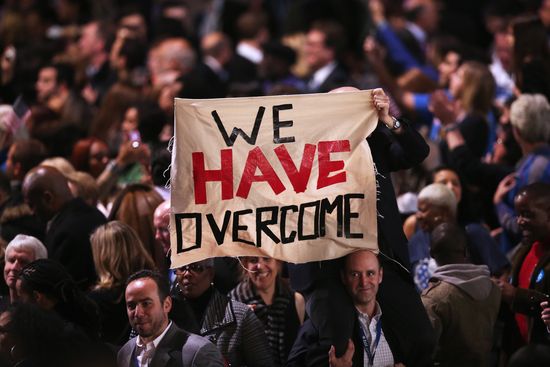
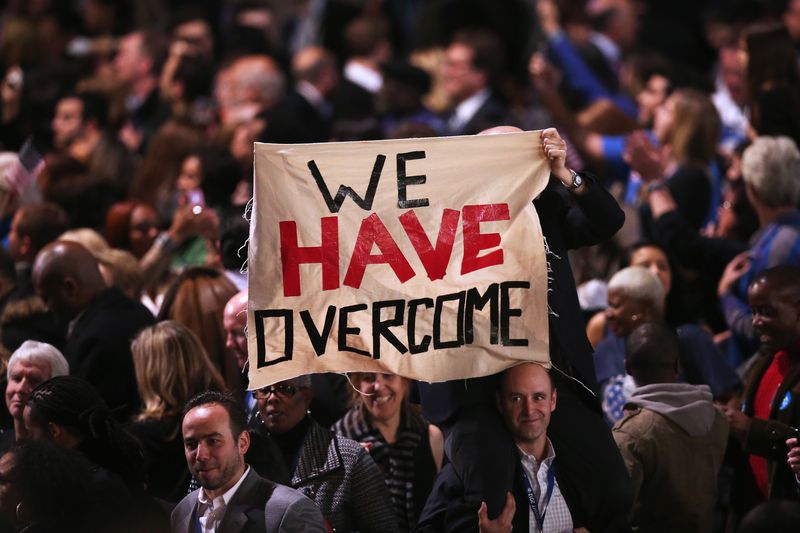
We_Have_Overcome

Chait puts Obama's win in perspective:

Democrats will not keep winning forever. (In particular, their heavy reliance on young and non-white voters, who vote more sporadically, will subject the party to regular drubbings in midterm elections, when only the hardiest voters turn out.) Eventually, the Republican Party will recast and reform itself, and the Democratic Party’s disparate constituencies will eat each other alive, as they tend to do when they lack the binding force of imminent peril. But conservatives have lost their best chance to strike down the Obama legacy and mold the government in the Paul Ryan image.

S.M. at DiA is optimistic that Obama "will have a chance to work on some challenges that eluded him during his first term":

I expect Obama will finally turn to immigration reform and climate change in earnest. I think we might see a more muscular Obama in the second term who confronts Congress assertively in pressing for his agenda. The presidential mandate might be largely a myth, but with his last campaign behind him Mr Obama will have an opportunity to make more of a mark on domestic policy without worrying about the next election — if we can move into 2013 without falling off the fiscal cliff. More generally, I'm gratified that American voters have re-elected a black president despite deep strains of racism in our society.

Dreher emphasizes the GOP's need to expand its coalition:

There really has to be some way for Republicans to connect with Hispanic voters in a big way. I don’t like what that is likely to mean for immigration policy and affirmative action, but I fear that a GOP that remains principled and purist on these issues will continue to be marginalized nationally, as the country becomes a lot more Hispanic, and a lot more liberal.

Ezra Klein celebrates the changes Obama's second term will bring:

The Affordable Care Act — the single most significant bill of Obama’s first term — is law. It’s law that mostly won’t go into effect until 2014, but it’s law nevertheless. Mitt Romney’s key campaign promise was that, on day one, he’d begin working to pass a new law that would repeal it. But Obama doesn’t have to do anything to make health reform happen. He doesn’t need 60 votes in the Senate. He doesn’t need 218 votes in the House. It’s already happening. Obama’s reelection is all that was required to for the United States of America to join every other industrialized country in having a universal — or at least very near-to-universal — health-care system.

Grover Norquist spins:

Obama won a smaller percentage of American votes in his reelection than in his win in 2008. America gave him less support after watching him govern for four years than when he ran promising hope and change.  Normally a reelected president expands his margin of support.

Adam Sorensen wonders what is next for the GOP:

If Republicans blame Romney for this election’s outcome, another conservative retrenchment could mean more gridlock and more primary bloodletting. If the fault falls on conservative candidates like Missouri’s Todd Akin and Indiana’s Richard Mourdock — a group that not only weighed down the top of the ticket but may have cost the GOP control of the Senate — things could be different. Republicans might rethink the wisdom of playing to a shrinking coalition, as Democrats run up margins with women and Latinos. More importantly, they might resign themselves to work with the President they couldn’t get rid of.

Chauncey DeVega has related thoughts:

Will the Republican Party mature, reach out, and bring in the old guard centrists who were/are the adult voices in the room so that they can be competitive and work for the Common Good? Or will the Tea Party GOP dig in, become even more extreme, and further obstruct the Common Good in order to advance their increasingly narrow partisan agenda? Does Romney's defeat lead to a more reasonable Republican Party or one that is even more extreme and intransigent? 

Stanley Kurtz hopes for the latter:

Barack Obama has won reelection. Will America now lose its distinct characteristics and be transformed into a Euro-style welfare state? Quite possibly, yet there remains one way out. At this point, only a sweeping new grassroots rebellion on the model of the Tea Party could change things. In the wake of a presidential election so discouraging for conservatives, a massive new tea-party wave may not appear to be in the cards. Yet a resurgent second-term challenge to Obama from populist conservatives is far more likely than it seems.

D.R. at DiA weighs in:

[E]verything depends on whether the GOP decides that obstructionism has failed it or not. If so, the coming years could be remarkably legislatively productive. If not, prepare for two more years of gridlock, followed by a midterm campaign in which the Democrats can make a convincing case that you now need 60 votes in the Senate to get anything done at all in a more partisan America.

And John Sides calls the race for stats geeks:

Barack Obama’s victory tonight is also a victory for the Moneyball approach to politics.  It shows us that we can use systematic data—economic data, polling data—to separate momentum from no-mentum, to dispense with the gaseous emanations of pundits’ “guts,” and ultimately to forecast the winner.

Second blog reax here.

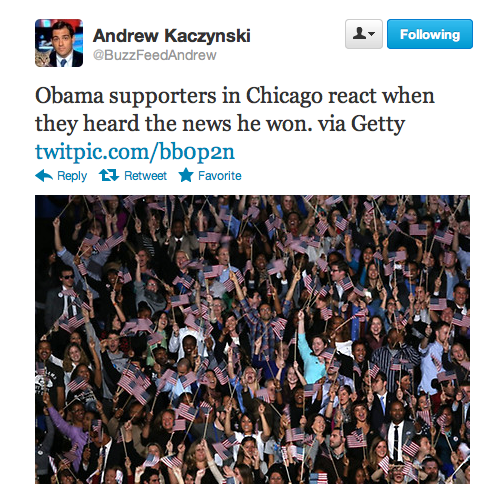
(Photo: Supporters of U.S. President Barack Obama cheer after networks project Obama as reelected during the Obama Election Night watch party at McCormick Place November 6, 2012 in Chicago, Illinois. By Win McNamee/Getty Images)

Fox Meltdown Reax

And one tweet he has since deleted:

Screen shot 2012-11-07 at 12.40.37 AM