Here Come The Women, Ctd

Kerry Howley notes an unprecedented possible outcome for New Hampshire today:

New Hampshire already has two female senators, Kelly Ayotte (R) and Jeanne Shaheen (D). If Democrats Carol Shea-Porter and Ann McLane Kuster win the state’s only two congressional seats, New Hampshire will be a matriarchal dystopia in which men are farmed out for their sexual services and immediately discarded. Kuster is winning handily, and Shea-Porter is tied, which means it is within the realm of the possible that we will soon see the country's first all-female delegation. And should you be heretofore unconvinced that men are ending in New Hampshire, I introduce you to the gubernatorial race.

Indeed, Democratic gubernatorial candidate Maggie Hassan is currently leading in most polls. And if it is a clean sweep for New Hampshire's women, the state will be better for it, at least according to Lauren Sandler:

[P]olitical scientists have proved women’s extraordinary efficacy in federal and state legislatures. Across the board, findings show that the second sex rates first when it comes to effective governance. Women in office secure almost 10 percent more federal funding than their male colleagues and introduce about twice as many bills.

Sandler says the lack of women in government isn't because they can't elected, but because women are "twice as likely as men to say they [aren't] qualified to run and half as likely to be recruited by a party leader":

When you look at the rest of the world, this crisis of confidence is madness. Five of Latin America’s current heads are women. For two decades, Argentina has maintained a quota of 30 percent female representation. Granted, Latin America is hardly a hotbed of gyno-liberalism; most of these female leaders are anti-abortion, line-toting Catholics. So let’s consider Europe, where women’s organizations met in Strasbourg this week to organize toward 50-50 parity in the next election, as the continent’s one-third representation is considered an outrage. It’s a poignant irony that when the United States helps fledgling governments outline their democracies and develop their constitutions, we emphasize the importance of full female inclusion in government; there’s a reason that, despite a close adherence to Islamic sharia, Iraq ranks about 40 slots before us on the U.N. list.

Previous coverage of the potential wave of female Senators here.
Will Ohio Pull A Florida?

Jeffrey Toobin walks us through an Ohio recount, which I worried about earlier. Weigel doubts it will happen:

Ohio won't count its provisional ballots, cast by voters who say they're legit but don't appear on the precinct list, until November 17. Not to jinx it, but there's no great reason to be worried. Ohio only recounts if the final margin is below 0.25 percent. Assuming normal turnout, that would be around 15,000 votes; if the polls are right, the winner should break that easily. Up to 250,000 provisionals could be cast, but both parties expect that vote to break for the Democrats, as it has in every election. So, unlikely that a close race with Romney down by 15,000 or so would be reversed by provisionals.

Why Don’t People Vote?

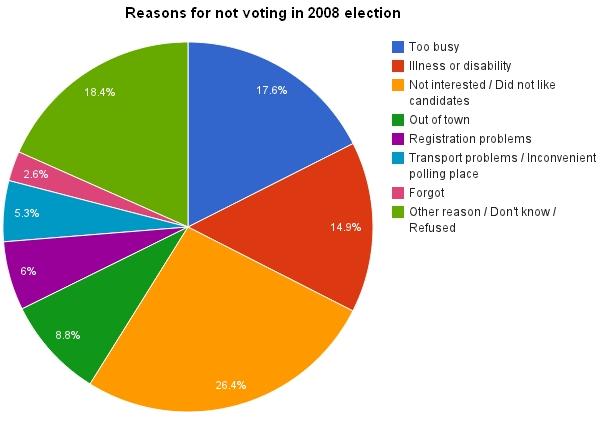
Not_Voting_Chart

Brad Plumer charts the reasons registered voters offer:

Notice that apathy was a big reason — roughly 4 million registered voters either weren’t interested or didn’t like the candidates. But polling place access was a major factor, too. Nearly a million Americans had "registration problems" while 750,000 found the polling location either too inconvenient or had transportation problems. And some 2.6 million voters said they were "too busy" to vote.

Online Voting

Why it isn't an option yet:

"Internet voting sounds like it would be so convenient and such a modern application of technology, but when we get down into the details about what it would take for Internet voting to do well, it turns out to be an incredibly difficult security problem," J. Alex Halderman, an assistant professor of computer science at the University of Michigan, told Live Science. Halderman added that the most secure networks in the world fall victim to hacker attacks all the time. And what better target for a catastrophic data breach than an election? "So protecting against that kind of threat if you’re doing Internet voting is going be very hard, especially if Google and the Pentagon can’t get this right," Halderman said.

The View From Your Election

A reader writes:

Today is for my dear friend Charles Ward. For 18 years, he (a gay black man from the housing projects of Chicago) and I (a straight white man from semi-rural Washington) have shared the draughts of life in all their bitter and sweet. We have endured disease and death, love gained and lost, and each at last in our 40s have come to a place called home. He wrote me when he and his fiancé joined their households together – “I’ve been waiting for this my whole life.”

My children (7) and (5) know him as Uncle Charles. He has always been a part of their lives. They know that today is the day that will decide if he gets to marry the man that he loves. And they love him and his future husband in the unconditional way that only children do.

Love is no longer undectable – it is undeniable and unassailable.

And it never fails.

How Likely Is Another Bush v. Gore? Ctd

John Heilemann thinks it could happen:

Please do not dismiss the possibility, because for all the confidence that Team Obama has right now about getting to 270, they are palpably nervous that Romney might still emerge with a higher national raw vote total than their guy does. This is not just a matter of the tightness of all the credible national polls; it goes to the difference between now and 2008 in the non-battleground states.

As Plouffe pointed out to me yesterday, Obama's popular-vote margin last time was inflated by the organic enthusiasm for him in deep-blue states where the campaign spent no money on advertising or organizing. This time, however, that enthusiasm does not exist to anything like the same degree, and so Obama's margins in places like New York and California will be pushed down — even as the organic anti-Obama fervor in deep-red states will be greater than it was in 2008, depressing his popular-vote performance even more.

Sam Wang, on the other hand, recently calculated that a split decision is very unlikely.

Giving In To The GOP

In response to me, Justin Green defends his endorsement of Romney:

The GOP won't return to a degree of normalcy until its most extreme members are slowly defeated. That won't happen until voters are confronted with the reality of the decisions their representatives make. So if they want hostages, give 'em to them. I'm sorry if Sullivan thinks that's overly cynical, but it's about the best way I can think of to force Republicans to deal with the consequences of their extremism.

Reward them for it? I guess this is the "be careful what you stand for" argument. I just don't want the consequences of this to be taken out on the whole American people – and I can see one of two possibilities. If Romney became an instant Keynesian tomorrow (everything is equally possible for him), he will have a very weak base in his party and some possible bitter blowback from below – like what happened to GHWB – because those big unfunded tax cuts and defense increases will increase the debt, not reduce it. If he enacts immediate austerity by spending cuts alone, then I fear entering the vicious cycle of Britain, where austerity has led to more debt, not less.

And, yes, it's too cynical. Just because one party has lost all its moral bearings – forcing the other to become more brutal in turn – that doesn't mean we have to give up on voting for the best candidate with whose policies we most agree.