The Sitting Dead

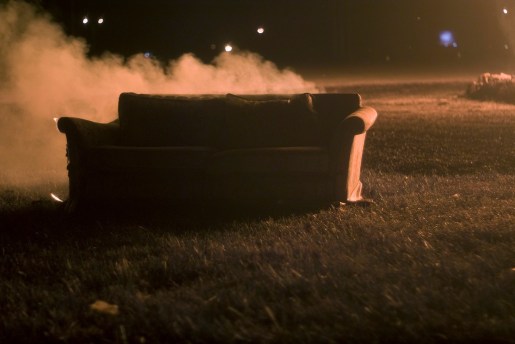
Burning couch Kalliopi Monoyios unstitches the upholstery:

[In addition to the foam and air in our couches], there is a third component very few of us know about: our couch foam is up to 11% by weight flame retardant chemicals. And according to two new studies released today in Environmental Science and Technology, these chemicals are not necessarily guests you’d have invited into your home for Thanksgiving or otherwise. One such chemical, Tris, was banned from children’s clothing in the 1970s because of concern over its ability to cause cancer, one is the globally-banned pentaBDE, a known hormone disruptor and neurotoxin in animals. And still others are completely untested for safety, despite structural similarities to known carcinogens and other toxic substances.

Also, the flame retardants don’t really work:

[The chemicals don’t] reduce risk of house fires [or] increase our safety in the event of one. In the latter case, they may actually increase our risk; most fire deaths are due to smoke inhalation, not complications from burns, and flame retardants actually increase the amount of smoke and toxic gases. 

Handy infographic here.

(Photo by Caroline Sanstead)

Can Guns Be Controlled?

Brian Doherty reviews Craig Whitney's Living With Guns: A Liberal’s Case for the Second Amendment. Doherty rejects Whitney's call for further limits on gun ownership:

Whitney is obsessed with being more stringent in using the information accessible to our existing Brady Law background check system to ensure no one labeled as psychiatrically disturbed or a drug abuser can own a gun. He ignores the reality that the vast majority of people in those categories never use a gun in a criminal way and deserve to own guns for purposes of protection or recreation the same way other Americans do. While we may agree a mass shooter is ipso facto psychiatrically disturbed, it is frequently the case that they have never been authoritatively labeled that way such that a background check would matter. Gun crimes remain mostly outside that part of life which laws or kings can cause or cure.

Are 401(k)s “A Tax On The Unaware”? Ctd

A reader writes:

As a loyal Dish reader, I feel privileged that I've finally found a post where I can add some expertise. I'm a call center manager for one of the major 401(k) providers in the U.S. I've been working there for about 5 years now, so I remember your original posts about the effect of the 2008 downturn (and subsequent downturn-around). From purely anecdotal evidence, it absolutely is the high income earners who participate the most in the 401(k) plans. Consider, too, that they have the most to gain, the most likely to be familiar with its benefits, the most able to save. The real benefit of the 401(k) for people starting out is auto-enrollment. By setting people up who would otherwise miss out on things like matching company contributions and tax savings, that's where the real savings increase.

Another writes:

Given that 401(k) plans are a very poor substitute for the retirement schemes of my parents' generation (i.e., generous defined benefit pensions, AKA annuities), it's lamentable that they are being held out as some kind of unjustifiable boondoggle of a rarified class of privileged people.  

I am privileged, but not nearly so privileged as professionals of an earlier generation who did not have to figure on market risk and plan carefully to make the most of the program.  I'm by no means super-pleased with my 401(k) – it is larded with fees for its administration (which, since I work for a bank, are fees that I effectively pay to my employer for managing my main retirement account, increasing exponentially my credit risk to my employer) and does not guarantee ANYTHING – if I am unlucky, as many are now as a result of the crisis, I will wind up having to delay retirement despite my prudence in planning and saving diligently.  

I am privileged, but not so privileged as my banker clients.  I don't mind paying more; I should.  But the closing of these kinds of loopholes will fall disproportionately on "working Wall Street stiffs" like me, and others similarly situated, and others still who are less privileged than I am, but still quite privileged compared to most.  The truly privileged, my banker clients, e.g., will barely notice.  That's where all of this loophole closing and deduction capping is going – screwing the ordinarily fortunate, like me, so that the uber-fortunate aren't troubled while they waterski behind their yachts. 

Take away my 401(k) benefit – fine, if you must.  But give me some other option.  One idea: the maximum social security withholding in 2012 was about $4,600; it will go up to about $7,000 in 2013, with the expiration of the payroll tax holiday.  The maximum 401(k) contribution for 2013 is $17,500.  In lieu of my 401(k) contribution, can I voluntarily 2x or 3x my pre-tax contribution to social security withholding in return for an increased social security benefit when I turn 67?  (Taking away 401(k), by the way, also means taking away my company's matching contributions, effectively halving my retirement savings.)  I'm willing to pay more; I want to pay my fair share; but I don't see the equity in making upper middle class / lower upper class slobs like me pay a disproportionate price for our nation's fiscal woes.

The Daily Wrap

Carrier style

Today on the Dish, Andrew responded to readers who pushed back on his steroid advocacy, shook his head at the lack of GOP sanity over tax cuts, contemplated Goldblog's idea to grant Palestinians Israeli voting rights, and joined J.J. Gould to explore the moral scope of The Walking Dead.

In political coverage, Cohn and Ezra thought through the negative side effects of filibuster reform for Democrats, Ambers guessed at Hillary's 2016 intentions, Peter Gergen pointed out the cynical politicking of Susan Rice's detractors, and Chait and Drum previewed America's liberal future via Obama's youth support. We also considered the influence of Maude's 1972 abortion, as well as dug into Lincoln's theme of compromise, while Avik Roy earned an Yglesias nod for pointing out the importance of the uninsured electorate, Rick Warren did anything but channel Jesus for a Malkin nomination, Waldman was pessimistic over Obama's drug enforcement plans, Pethokoukis and Frum mixed it up over the benefits of economic growth for Democrats, and Peter Kellner looked at conservatives' impractical uneasiness about adulterers and gays. In international coverage, Tahrir Square stood on the brink of mass violence, while Egypt's Islamists tried to rush through a new constitution and Israel added a way to discriminate against Arabs.

In assorted coverage, readers weighed in on the attractiveness of cut men, Kristen McConnell argued for letting people die instead of subjecting them to intensive care, Alyssa challenged Richard Cohen to apply his unnatural modern-man argument to women, McKibben explained the dangers of the Keystone Pipeline, Alan Sepinwall explored the origins of the TV's dramatic Golden Age, and Alexis Madrigal street-viewed with the added depth of Instagram. We also met a whacky Japanese inventor, heard Jellyfish researcher Shin Kubota opine on mankind's unnatural path, and weren't afraid to discuss the "phobia" in "homophobia", or to uncover the reality of college costs. Tom Simonite went over Google's attempts to anticipate our hidden needs, Brendan Carney Byrne tracked the end of Irish gangster-power, Ben Schwarz eulogized the Great American Songbook, and Saletan noted the bourgeois anti-nudity push of San Francisco's gays. After China launched a meme from its one aircraft carrier (as seen above), we looked at original Cambridge through the VFYW, watched stop-motion color in our MHB, and considered the plight of our Frenchman FOTD.

– C.D.
Prolonging Death

Hospice_Dove_GT

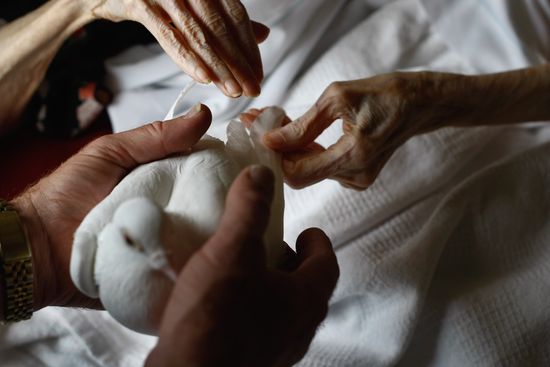
Kristen McConnell, a nurse, delivers a reality check:

It’s been said that dying is easy, and it’s living that’s painful. Not so in the world of intensive care. Patients who have a hope of recovering from their injury, genuinely surviving it, may be fighting to live. For them the torturous days as an ICU patient are required in order to surmount their injury. And there are always cases where nobody knows what the outcome may be, where the right thing to do is maintain physical function and give the body time to heal. Many patients will survive with deficits, will not return to their former selves but will be able to leave the hospital, go to rehab, begin the hard work of adjusting to another kind of life. But time and again we care for patients who are fighting to die, and having a very hard time of it, because in the ICU there are only two ways to die: with permission, too often not granted or granted too late, or in the last-ditch fury of a full code blue.

We are not helping these people by providing intensive care. Instead, we are turning their bodies into grotesque containers, and reducing their lives to a set of numbers monitoring input and output, lab values, and vital signs, which we tweak to keep within normal ranges by adjusting our treatments, during the weeks and days immediately preceding their death. This is the opposite of what should be prioritized when a person is known to be nearing the end of their life without the hope of getting well.

(Photo: Terminally ill patient Jackie Beattie, 83, touches a dove on October 7, 2009 while at the Hospice of Saint John in Lakewood, Colorado. The dove releases are part of an animal therapy program designed to increase happiness, decrease loneliness and calm terminally ill patients during the last stage of life. By John Moore/Getty Images)

The Silent Stoner President, Ctd

Waldman doesn't expect Obama to end the Drug War:

While Obama may believe that the War has been a failure and it's absurd to lock up hundreds of thousands of people for possessing, buying, or selling small amounts of marijuana, it just isn't all that high on his priority list. If making a major policy change is risky, he's not going to bother. On the other hand, he doesn't want to alienate the 50 percent of the country that now supports legalization, many of whom are his staunch supporters, so his preferred outcome would be that no one pays much attention to the issue for the next four years.

Along those lines, Mike Riggs noted a few days ago Obama still hasn't publicly discussed the Washington or Colorado legalization laws. Reader thoughts on the subject here.

Japan’s Father Of Invention

Dr. NakaMats claims to have more than 3300 patents:

Among his other creations (he will earnestly tell you) are the CD, the DVD, the fax machine, the taxi meter, the digital watch, the karaoke machine, CinemaScope, spring-loaded shoes, fuel-cell-powered boots, an invisible "B-bust bra," a water-powered engine, the world’s tiniest air conditioner, a self-defense wig that can be swung at an attacker, a pillow that prevents drivers from nodding off behind the wheel, an automated version of the popular Japanese game pachinko, a musical golf putter that pings when the ball is struck properly, a perpetual motion machine that runs on heat and cosmic energy and…much, much more, much of which has never made it out of the multiplex of his mind.

An important caveat:

Arguably, Dr. NakaMats’ greatest brainchild is Dr. NakaMats, a scientific superhero for whom exaggeration is a reflex. This is a guy who claims the stabilizer he invented for erratic model airplanes at age 5 "made autopilot possible."

The Roid Age, Ctd

Alyssa joins the debate:

Cohen dismisses the current crop of sculpted hunks that Daniel Craig represents as "some marbleized man, an ersatz creation of some trainer," but the standards for what makes a man sexy that he’s describing are no more natural or objective. And I’m curious if he’d identify the beauty of the women he cites in his column, like Ingrid Bergman and Mary Astor, as effortless and natural, rather than the product of beauty standards and the punishing regimes and restrictive clothes that helped women accomplish them. One of the earliest contradictions I understood as a young teenage girl reading fashion magazines was that I was supposed to look "natural" and "effortless," but that it took an enormous amount of work and money to recreate the looks that I was told embodied those standards.

I learned that my own lip color and texture was less natural than a glossy pink, that the blush of my unadorned cheek looked less vital than a layer of foundation, powder, and blush. I’m glad I had that education so I could see the distance and the contradiction, enjoy wearing bright red lipstick for its artificiality and sense of performance, not because I believed that my own hue was an error or imperfection. But it’s not an easy education to acquire, or to shake off in favor of truly discerning what I want to look like and feel, and I don’t envy someone like Cohen coming to his own version of it later in life, or reckoning with the work he’d have to do to meet the standards laid out for him. I feel a lot more concern, however, for teenage boys who are turning to steroids or working out more than is actually healthy to meet those standards.

The Golden Age Of TV Drama

Kate Aurthur interviews TV critic Alan Sepinwall, whose new book explores the stories behind 21st century shows like The Sopranos, Lost and The Wire:

The Sopranos was the first big hit of the “anti-hero”movement, and even rule-breaking TV takes inspiration from those who came before. (As I note in The Sopranos chapter, HBO’s choice to follow Oz came down to Sopranos vs. a Winnie Holzman show about a female business exec at a toy company, which would have made the next decade in TV very different, whether it succeeded or failed.) But I think the anti-hero thing also comes out of a sense of collective frustration most of these [show] creators had with the traditional rules of TV drama (where the worst any protagonist could be was “crusty but benign”) and then the sense of freedom they had during this Wild West period. When there are no laws for a while, suddenly everyone’s an outlaw, which translates not just into shows about criminals, but shows that don’t behave the way we’d been conditioned to expect from decades of TV before it. …. You could have both an action show (24) and a space opera (Battlestar Galactica) dealing with hot-button political issues like religious fundamentalism and torture, or even a high school drama like Friday Night Lights that was matter-of-fact in its depiction of teen drinking and sexuality, which had previously required Very Special Episodes to deal with.

James Poniewozik highlights one of the book’s Sopranos backstories, which is illustrated in the above video:

[In the book] we hear about one of the rare creative run-ins David Chase had with HBO in making The Sopranos, as former exec Chris Albrecht recalls recoiling at having Tony Soprano murder a mafia rat with his bare hands in the show’s fifth episode. “And David said to me,” Albrecht remembers, “‘If Tony Soprano were to find this guy and doesn’t kill him, he’s full of shit, and therefore the show’s full of shit.'”

Grantland excerpts Sepinwall’s chapter on Lost.