Of No Party Or Color

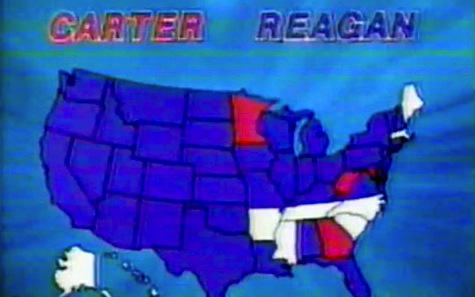
Red-state-blue-state-election-carter-reagan2-631

When did Dems become blue and the GOP red? Jodi Enda notes that before the 2000 election, "there was no uniformity in the maps that television stations, newspapers or magazines used to illustrate presidential elections." Why 2000 changed that:

[T]wo days after voters went to the polls in 2000, both the New York Times and USA Today published their first color-coded, county-by-county maps detailing the showdown between Al Gore and George W. Bush. Both papers used red for the Republican Bush, blue for the Democrat Gore.

Why?

"I just decided red begins with ‘r,’ Republican begins with ‘r.’ It was a more natural association," said Archie Tse, senior graphics editor for the Times. "There wasn’t much discussion about it."

Paul Overberg, a database editor who designed the map for USA Today, said he was following a trend: "The reason I did it was because everybody was already doing it that way at that point."

And everybody had to continue doing it for a long time. The 2000 election dragged on until mid-December, until the Supreme Court declared Bush the victor. For weeks, the maps were ubiquitous.

What’s Next For Ryan If He Loses?

John Heilemann expects big things:

[I]f Romney comes up short, Ryan almost certainly will still have a big future in the GOP. As I and others have noted, there is going to be an epic struggle for the soul of the Republican Party if Obama is reelected, with recriminations aplenty regarding Romney's failure to bring home an eminently winnable election. But no one is going to blame Ryan for that, and he will surely come through the storm with an enhanced reputation among the Randian faction of the party, not to mention nearly 100 percent national name recognition, and the invaluable experience of having played the game on the national stage. Assuming that he runs for president in 2016 — a statement akin to "assuming Heilemann quaffs a bourbon in the next six hours" — Ryan is all but guaranteed a top-tier position in the Republican nomination sweepstakes.

Larison differs:

A Romney loss on Tuesday most likely spells the end of any presidential ambitions Ryan may have had.

That doesn’t mean that Ryan’s career has to be limited to the House. The good news for him is that an increasingly likely Thompson loss creates an opening for a future Senate bid later in the decade. If Thompson were to win, Ryan’s options in Wisconsin politics would be very limited, and it is probably the case that Ryan won’t be a national contender in his own right until he is able to contest and win a statewide Wisconsin race. It’s one thing for partisans to enthuse over a House member as VP nominee in the middle of an election, and quite another to back him as a presidential candidate.

Drawing Up The Districts

Screen Shot 2012 10 30 at 1 54 24 PM

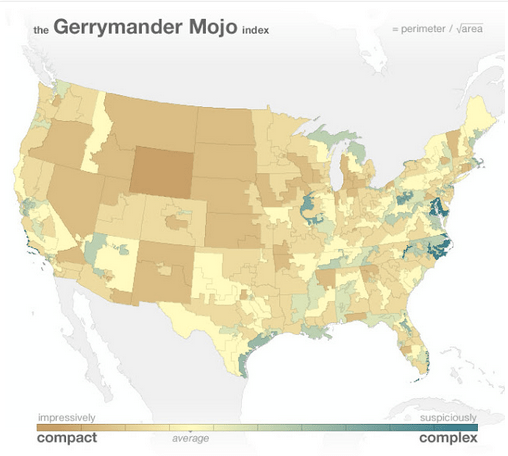
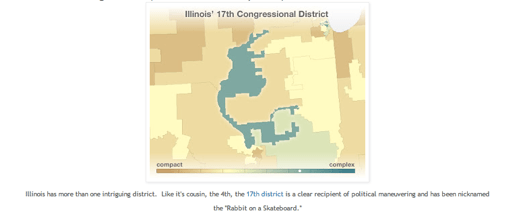
John Nelson's interactive Gerrymandering Mojo Index ranks redistricting on a scale of "Shenanigans!" to "Impressively Compact." Nelson rounds up of some of the most egregious examples, including Illinois' 17th Congressional District, which he calls "the rabbit on a skateboard":

Screen Shot 2012 10 30 at 1 59 37 PM

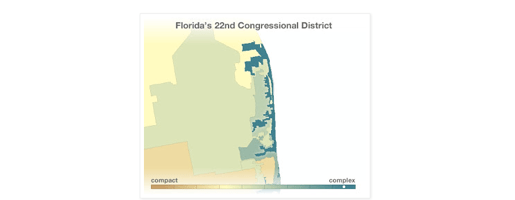
Then there's Florida's 22nd district, which figured into the 2000 recount:

Screen Shot 2012 10 30 at 2 01 20 PM

What To Watch For

Harry Enten made a guide for eight swing states. Here's what he has to say about Ohio, which closes polls at 7:30 ET:

No Republican has ever won the presidency without winning Ohio. This year will likely not be an exception. Obama is buffered by a large African-American population surrounding Cleveland, as well as old conservative Democrats along the state's eastern border. Romney benefits from evangelical support in the more rural areas in the western and southern sections of Ohio. Romney's strength with white working-class voters has been slowed in Ohio because of Obama's support of the auto bailout and Romney's lack thereof. Obama holds a small lead in the polls: don't expect the state to be called by the networks for at least four hours after closing.

The Daily Wrap

Favorite

Today on the Dish, Andrew took Peggy Noonan's feelings to task, condemned giving in to "pure partisan obstruction," and after he reminded everyone of Romney's penchant for lying, he wondered why Romney was so touchy about his Mormonism. 

Andrew Cohen then marveled at how openly GOP leaders discuss their voter suppression ploys, Steve Schmidt called the voter fraud concerns "mythology," and while Beinart bet that a Romney loss would see Republicans fight about immigration policy, Lindsay Graham pretty much backed him up. Plus, Mike Allen and Jim Vandehei broke down why the support of blacks, Latinos, single women and educated urban whites didn't equal a governing mandate.

The GOP spun Sandy, New York and New Jersey improvised on voting plans, and Matthew E. Kahn made the case against FEMA's moral hazard. Meanwhile, Nate Cohn believed Obama's odds were good and expected a wait for the popular vote. Sam Wang then ran the numbers for a EC-popular vote split, Pew analyzed media tone of the candidates, and while Maryland's marriage equality ballot measure outlook remained tight, Minnesota looked worse. Paul Ryan then spewed Christianist rhetoric, Massie derided the idea that the GOP would embrace Bloomberg in 2016, and, overseas, only fundamentalist religious state allies supported Romney over Obama. Plus, Barney Frank shared early impressions of Romney and Andrew expanded the vocabularies of many.

Romney went positive on the ad front, Jeffrey Goldberg defined pro-Israel and as the death penalty in California looked set to die, Andrew Sprung encountered a new anti-Obama conspiracy theory. The Economist then looked at public debt and summarized the threat of marijuana legalization to Mexican cartels, as Glen Weyl proposed buying votes. Plus, election FOTD here.

In hurricane discussion, Justin Fisher imagined a New York that embraces nature, Charles Kenny reviewed who dies in natural disasters and Craigslist met hurricane demand – at a price. Readers then weighed in on the marathon, Taylor Berman asked whether the funding for the 9/11 museum shouldn't have gone to flood prevention and an unemployed Floridian edited out climate change on Sandy's Wiki.

And in assorted commentary, Dina offered holiday jift tips, Michael Specter defended the safety of GMO foods, and as CK did SNL, Walter Russell Mead bet on a growing trend in part-time retail. Plus, Gangnam-style VFYW here. And tomorrow, Andrew live live-blogs.

G.G.

Face Of The Day

155579138

Supporters listen to US President Barack Obama during a campaign rally in Columbus, Ohio, on November 5, 2012. After a grueling 18-month battle, the final day of campaigning arrived Monday for Obama and Republican rival Mitt Romney, two men on a collision course for the world's top job. The candidates have attended hundreds of rallies, fundraisers and town halls, spent literally billions on attack ads, ground games, and get-out-the-vote efforts, and squared off in three intense debates. By Jewel Samad/AFP/Getty Images.

Buying Votes Directly

Glen Weyl proposed a voting mechanism where every voter can vote as many times as he or she likes but is required pay each time. The trick is "the amount you have to pay is a function of the square of the number of votes you cast." Steven D. Levitt summarizes:

Just for the sake of argument, let’s say the first vote costs you $1.  Then to vote a second time would cost $4.  The third vote would be $9, the fourth $16, and so on.  A person who cast four votes would have to pay a total of $30 (1+4+9+16=30).  Twenty votes would cost $2,870.  One hundred votes would cost you more than $300,000.  Five hundred votes would cost more than $40 million. So eventually, no matter how much you like a candidate, you choose to vote a finite number of times.

Levitt defends the idea against charges that the system favors the rich:

In our existing system of campaign contributions, there can be little doubt that the rich already have far more influence than the poor.  Presumably in our current system if a rich person spent $40 million to try to influence an election, that rich person would surely hope to change the way more than 500 people vote, whereas in this system that is all the votes you get to cast for $40 million.  So restricting campaign spending, in conjunction with this voting scheme, might be more democratic than our current system.

Levitt acknowledges that "it is much cheaper to buy the first votes of a lot of uninterested citizens than it is to pay the price for my 100th vote," and is unlikely to be implemented any time soon. That's putting it mildly. 

Bringing Back New Amsterdam, Ctd

Justin Davidson imagines a New York that "learns to embrace nature" instead of simply damming up the harbor:

The streets of low-lying areas are paved with permeable surfaces, allowing floodwaters to seep through rather than slosh into basements. Tall grasses dance in a spongy buffer zone of marshland, stretching from the built edge out into the waterways. Scattered in the Upper Bay are archipelagos of tiny artificial islands and floating piers — speed bumps for a storm surge. Beneath the waves, submerged reefs made of old subway cars and oyster beds help diffuse hard-charging currents, and at the same time host an abundance of marine life. In that New York, we will watch the sea come in, serenely confident that it will make an orderly retreat, leaving our vital systems unmolested and our streets unbesmirched. 

Why Label Genetically Modified Foods?

California's Proposition 37, if it passes, will require labels on GM foods. Michael Specter defends the safety of such foods:

The safety of genetically engineered foods has been studied hundreds of times over the past two decades. The National Academy of Sciences, the British Royal Academy, and scores of other scientific bodies have concluded they are no more dangerous than other foods. There has never been a single case of a person becoming demonstrably sick as a result of eating genetically engineered food. The American Medical Association has said that G.E. crops “pose no new or different risks than any other crop, and there is no scientific reason to believe they would be any more risky.”

The board of the American Association for the Advancement of Science released a letter in which it stated that “the science is quite clear: crop improvement by the modern molecular techniques of biotechnology is safe.” The letter also quotes from a recent report issued by the European Union, where the use of genetically engineered foods causes violent opposition. “The main conclusion to be drawn from the efforts of more than 130 research projects, covering a period of more than 25 years of research and involving more than 500 independent research groups, is that biotechnology, and in particular GMOs, are not per se more risky than e.g. conventional plant breeding technologies.”

Plumer adds:

So what’s the best argument against GM labeling laws? What can they hurt? Critics of Proposition 37 have argued that the law is poorly crafted and would unfairly burden small businesses and retailers. Here’s Kevin Drum: “This initiative, as with so many initiatives, is sloppily written; it can’t be changed after it’s passed; and it imposes expensive state labeling burdens on interstate commerce.” Drum also points out that California went through a similar experience with toxic-chemical labeling laws. “In the end, so many warning signs got posted that they became essentially useless.” 

Meanwhile, U.C. Berkeley’s David Zilberman worries that labeling laws will “create a stigma effect” that will hinder future research into using GM foods to improve nutrition or tackle climate change. Remember, genetic modification is a tool that can in theory be used for a variety of purposes — not just bolstering Monsanto’s bottom line. See this essay by Pamela Ronald for how plant genetics could play a key role in sustainable agriculture. Note, though, that this is currently a very tiny slice of actual, existing research into GM foods.