Epistemic Closure Watch

For nearly a week, the Wiki page for Hurricane Sandy did not contain a single mention of climate change, thanks to Ken Mampel, an unemployed Floridian:

In an unpaid but frenzied fit of news consumption, editing, correction, aggregation, and citation, Mampel has established himself as by far the most active contributor to the Wikipedia page on Hurricane Sandy, with more than twice the number of edits as the next-most-active contributor at the time this article was written. And Mampel made sure that the Hurricane Sandy article, for four days after the hurricane made landfall in New Jersey, had no mention of "global warming" or "climate change" whatsoever. …

Without my prompting, Ken mentioned that New York City's Mayor Mike Bloomberg had endorsed Obama for president based on his handling of the hurricane. This is true, and Mampel planned to add this to the Wikipedia entry. "But I don't believe that climate change bullcrap," he said. Bloomberg had specifically mentioned climate change in his endorsement speech, but Mampel wouldn't add that to the Wikipedia entry. That's despite dozens of articles pointing out the connection–not a causation, necessarily, but certainly a connection worth exploring. I myself spoke to a hurricane expert about three hours before I spoke to Mampel who told me that the roughly two-degree increase in the water temperature in the Atlantic could have had a major effect on Hurricane Sandy's strength in the northeast. Mampel doesn't care. He wasn't going to mention climate change.
The Meanstream Media

Ne of Conversation about Candidates in Blogs 0

Pew has a new study regarding the tone of the media's coverage of the presidential candidates. Benjy Sarlin digs in:

Both Obama and Romney received overwhelmingly negative treatment in the press over the general election, according to Pew. From Aug. 27 to Oct. 21, a period that encompassed both conventions and three out of four debates, just 19 percent of stories about Obama were “favorable” in tone versus 30 percent that were “unfavorable. For Romney the ratio was 15 percent favorable to 38 percent unfavorable.

The gap between those numbers is largely accounted for by Obama’s relative frontrunner status for much of the observed period. For stories that didn’t concern the horse race aspect of the campaign, the two received near identical (if still negative) coverage: 15 percent positive to 32 percent negative for Obama verus 14 percent positive and 32 percent negative for Romney.

Dylan Byers looks at the cable news wars:

From August 27 through October 21, 71 percent of MSNBC's coverage of Mitt Romney this year was negative, far outperforming Fox News's negative coverage of President Barack Obama, which came in at 46 percent… The negative-to-positive ratio on MSNBC was roughly 23-to-1; the negative-to-positive ratio on Fox News was 8-to-1.

Alex Fitzpatrick notes that social media coverage was more negative than traditional media coverage:

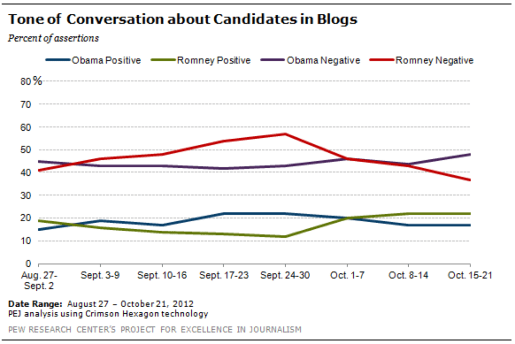
[The study] found that the conversation on social media “has been relentlessly negative and relatively unmoved by campaign events that have shifted the mainstream narrative” compared to mainstream media election coverage. How bad is it? Across Twitter, Facebook and blogs, neither Obama nor Romney had a single week of more positive than negative chatter. 

The tone of the blogosphere is illustrated in the above chart.

Counting The Popular Vote

Nate Cohn expects it to take a while. He writes that if "Obama ultimately wins the popular vote by a narrow margin, as suggested by the current average of national polls, Obama won’t lead the popular vote on Election Night and might not for weeks":

With the West Coast providing the margin of victory for any Democratic candidate in a close election, Republican presidential candidates outperform their eventual share of the popular vote until the West Coast reports its results. In 2008, California, Washington, and Oregon voted for Obama by a 4 million-vote margin, representing nearly half of his national popular vote victory.

But the time zones are not alone in delaying results from Washington, Oregon, and California. In most eastern states, the overwhelming majority of votes are counted by the end of Election Night, since only a small share of absentee or overseas ballots arrive after the election. But elections in Washington and Oregon are now conducted entirely by mail and 41 percent of California voters voted by mail in 2008. In some states, ballots only need to be postmarked by Election Day and it can take days before all of the votes arrive and weeks before they get counted, usually in modest batches once or twice a day.

How Will Sandy Affect Turnout?

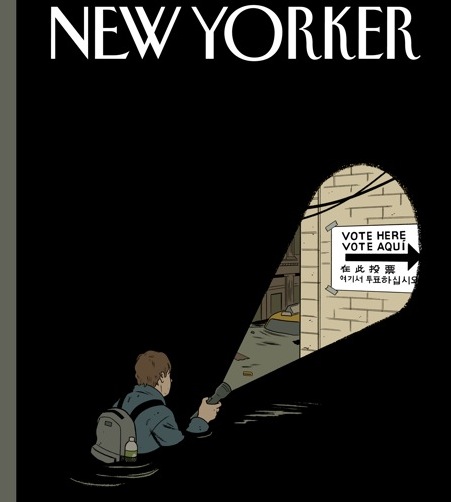
Undeterred

The hurricane is colliding with Election Day:

Election officials across the storm-ravaged region have been very concerned about the possibility of voter disenfranchisement — particularly over the prospect that relocated polling sites will confuse voters who don’t receive proper notice of the move. … In New York City, election officials are relocating 28 polling sites in Queens, 24 in Brooklyn, three each in Manhattan and the Bronx, and two on Staten Island. See the full list here [pdf].

Other problems include power outages at polling sites, gas shortages, and voters without transportation. If the turnout is bad enough, New Yorkers could get a second day of voting:

County election officials could ask the New York state Board of Elections to allow polls to reopen for another day if Tuesday's turnout is less than 25%, according to state board spokesman Thomas Connolly said. "To my knowledge this has never happened in New York," Connolly said. "Will the turnout be low? It's hard to say — probably, it all depends if people have other priorities." The state board would consider the request and, if approved, a second day of voting would be scheduled within 20 days of Tuesday, he said. Polls would be open for 11 hours on the second day, with only those who were eligible to vote on Tuesday allowed to cast ballots.

Meanwhile, displaced residents in New Jersey will have the option to vote by fax or email. Mataconis considers that "an interesting last minute solution, but as one computer security blogger notes, it presents its own problems":

Email, of course, is not at all authenticated, reliable, or confidential, and that by itself opens the door to new forms of election mischief that would be far more difficult in a traditional in-person polling station or with paper absentee ballots. If we worry that touchscreen "DRE" electronic voting machines might be problematic, email voting seems downright insane by comparison.

Joe Coscarelli looks at the electoral implications of Sandy's wake:

Although the states most affected are thought to be comfortably blue when it comes to the presidential race, President Obama's popular vote total could suffer from low turnout. The real concern, however, is with local races, where every vote really does count. With all of the obstacles in play at the moment, these election stresses seem unlikely to end on Tuesday.

Downsizing The 9 To 5

The NYT recently noted the growth of part-time work in retail. Walter Russell Mead bets that this trend will continue, but he doesn't necessarily see that as a bad thing:

Assuming a strong labor market in which part time workers are decently compensated, a world of part time and flexible jobs can make a lot of sense for workers. The daily ritual rush hour commute of tens of millions of people moving in lockstep toward nine to five jobs over gridlocked transit and highways systems is very far from the best possible way to organize our lives. Parents, children caring for elderly parents, handicapped workers, older people looking to supplement fixed incomes, artists and entrepreneurs launching their careers: all of these people can benefit from a more flexible working world.

McArdle is concerned:

The entire workforce cannot be–like most students, housewives, and retirees–supported by someone else's full time job.  Fifteen or twenty hours a week on a retail salary is not enough to support anyone.  And because the shifts are so variable, you can't do what people used to, and string two or three part time jobs together.  Retailers penalize those who block off a lot of time as unavailable by giving them fewer hours.

Killing The Death Penalty

It's a possibility for California tomorrow:

This year, California's death row will cost taxpayers $184m. What will the state get for that price? The same number of executions as last year, and the year before that, and every year since 2006: zero. 

A solution has been offered: the state's worst offenders would die in prison of natural causes, just as they are doing on death row today – only now, taxpayers would save $130m a year. That is Proposition 34, the ballot initiative to replace the death penalty with life in prison without the possibility of parole as the state's maximum sentence for murder.

Maurice Possley points to another problem with California's death penalty: the state has more exonerations than any other state in the nation, "indicating significant risk of putting an innocent person to death":

In May, the National Registry [of Exonerations] released a report describing the first 873 exonerations it identified – including seventy-nine state exonerations and one federal exoneration in California. The Report emphasized that the 873 were only a beginning—that the true number of exonerations still is unknown because there is no formal system for recording such cases as they occur.

Ian Millhiser notes that "though death sentences remain legal in most states, actual executions are very rare in most of the country":

According to a 2011 study by the Death Penalty Information Center, 32 U.S. jurisdictions — including California — executed no one in the previous 5 years and more than half of those jurisdictions executed no one after the Supreme Court reinstated the death penalty in 1976. Just 12 states executed someone in 2010, only 7 of which executed more than one person. Over one-third of all U.S. executions took place in just one state — Texas.

Despite that, the California initiative looks unlikely to pass:

Forty-two percent said they would vote for Proposition 34, with 45% saying no. In September, the gap was 38% to 51%, a 13-point difference. … "There is no question there has been a sharp shift," said Dan Schnur, who heads the Jesse M. Unruh Institute of Politics at USC. The results suggest that passage is "not impossible" but still "very difficult," Schnur said.

Even if the death-penalty ban doesn't pass, California will need to address dwindling supplies of a chemical needed for lethal injection:

Companies that manufacture the fast-acting anesthetic sodium thiopental—a key ingredient—no longer produce it in the United States. European manufacturers, citing moral and political concerns with capital punishment, have refused to sell the drug to prison administrators in the United States. Now state executioners are in a desperate scramble to obtain supplies from other foreign sources. U.S. hospitals are experiencing collateral difficulties, reporting shortages of the drug. And earlier this year, Federal Judge Richard Leon ruled that the Food and Drug Administration could not allow sodium thiopental to be imported. The judge also ordered all states to hand over for such screening any sodium thiopental they’d already imported. The FDA has challenged that ruling, as have attorneys general from 15 states. A few states publicly refused to give up their supply, California included. By 2014, by some estimates, the death-penalty drugs California has on hand will expire anyway.

Earlier Dish on the initiative here.

The Case Against FEMA

Matthew E. Kahn makes it:

For a minute, imagine that there was no FEMA and each geographic location was on its own, forced to use private insurance and state-level funds to rebuild after disasters. Such constraints would likely encourage less risk taking before a disaster. When coastal states saw that their own resources would be used to repair flood damage, for instance, [then] political leaders would have stronger incentives to discourage housing development in flood-prone areas and to encourage greater investments in precautions like tree trimming to reduce storm damage. The net effect of such a shift in the rules of the game could be a significant reduction the cost of natural disasters. Without FEMA, states and municipalities would have better incentives to make direct investments in protecting their territory. That seems to be a clear call to do away with the agency.

Reihan adds:

Kahn is well aware of the fact that FEMA cannot and should not be wound down over night. But he makes a compelling case that we should seriously rethink how we manage risk.

The Weekend Wrap

Romney

This weekend on the Dish, Andrew tracked the latest developments in the presidential horse race. He declared that Tuesday will be a reality check for pollsters and pundits here and here, noted the "chaos" that marked absentee voting in Florida, highlighted the views of Romney supporters in Ohio, asked if independents were moving back to Obama, reiterated Romney's uabashed support for torture, and provided election-related quotes of the day here, here, and here. Andrew also asked if Iran blinked, appreciated Michael Signorile's apology to a gay Republican, ran a reader's thoughts on the NYC Marathon cancellation, pointed to a photograph of another reader's post-Sandy cleanup efforts, and aired a debate over price-gouging in the wake of natural disasters.

It wasn't all politics at the Dish, though. In literary news, Dorian Lynskey resisted the tyranny of the must-read, Ian McEwan extolled the novella, Frank Cassese remembered writing advice from David Foster Wallace, and Stephen Marche pondered Google Books and the digitization of literature. Jane Martinson explored India's new wave of gay writers, Richard Russo divulged the origins of his new memoir, Drew Toal reviewed the letters of Kurt Vonnegut, and Patrick Ross lamented the arrival of Frankenwords. Read Saturday's poem here and Sunday's here.

In matters of faith, doubt, and philosophy, Theo Hobson described what he learned from Rowan Williams' theology, Clancy Martin reported on the schisms among gay evangelicals, Maria Popova recommended another recording of Alan Watts, George Scialabba considered the meaning of progress, and William Deresiewicz worried about the loss of solitude and privacy in the modern world.

In assorted coverage, Jerry Saltz summarized the devestation Sandy caused to the New York art world, Dominique Browning provided tips on growing safer trees, Michael Specter wondered about geoeningeering our survival of climate change, Matthew Teague profiled a repo man, Meehan Crist and Tim Requarth documented the ambiguities of rising IQ scores, Eric Barker explained the effects of sleeping pills, Robert Ito fretted about social robots, Heidi Julavits contemplated love and lust on reality matchmaking television shows, and Ben Reininga culled a list of strange sex advice from Cosmopolitan. MHBs here and here, FOTDs here and here, VFYWs here and here, and the latest window contest here.

– M.S.

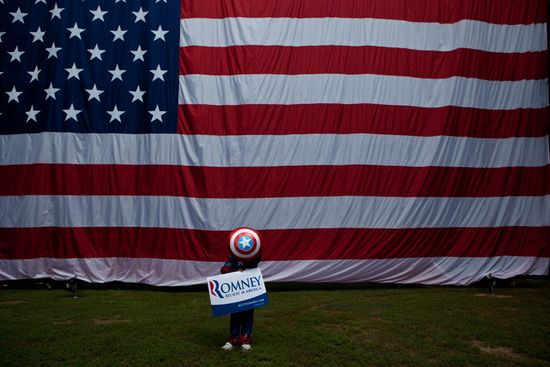
(Photo: Captain America comes to Romney's rescue on Halloween. By Jez Coulson, whose full portfolio of Americana can be found here.)