The Data On Daylight Savings

If the time change doesn't save us money, does it at least make us healthier?

"In a nationwide American time-use study, we're clearly seeing that, at the time of daylight saving time extension in the spring, television watching is substantially reduced, and outdoor behaviors like jogging, walking, or going to the park are substantially increased," [environmental economist Hendrik Wolff] said. "That's remarkable, because of course the total amount of daylight in a given day is the same."

But others warn of ill effects. Till Roenneberg, a chronobiologist at Ludwig-Maximilians University in Munich, Germany, said his studies show that our circadian body clocks—set by light and darkness—never adjust to gaining an "extra" hour of sunlight at the end of the day during daylight saving time. "The consequence of that is that the majority of the population has drastically decreased productivity, decreased quality of life, increasing susceptibility to illness, and is just plain tired," Roenneberg said.

For more, nerd out with the physics of Daylight-Savings.

The Psychology Of Shortages

Felix Salmon addresses it:

There’s something self-fulfilling about gas shortages: they’re the crisis equivalent of a bank run. So long as everybody just goes about their day in a normal manner, refilling their tank only when they get low, everything goes smoothly. But when people start thinking that there might not be enough to go around, everybody panics and rushes to the stations: while shortages in New Jersey have real Sandy-related causes, shortages in places like Westchester are essentially the product of self-fulfilling fears.

Anthony Randazzo talked to a taxi driver about the shortage:

A cabbie told me today that he probably had three more rides left after dropping me off before he’d have to park his car and wait for service to return: "The lines are too long to wait for the gas. There are a hundred cars at every station with fuel left. And many of those people will just fill up their tanks and go home and not use the gas!"

He was clearly upset about the shortage because it meant he was going to lose work hours, which would lower his take home pay, and it was totally unnecessary because the gas he needed was going to sit idling in cars in parking garages along the Upper East Side. This was not a 1 percenter looking to fill his Maserati. Here was a lower- or middle-class guy needing to feed his family hurt because of the law preventing price gouging. If the price rose high enough, perhaps many of those filling up just to make sure they had it–because many people in the aftermath of a disaster gasoline rushes look like bank runs–then the people who really need the gas would consume the majority of it.

But the run on gasoline isn't just for cars:

[Natasha Lizunova] had waited two hours earlier in the morning and now wanted another fill-up. "We don’t know when the power is coming back, so we need to fill up our generators," she said.

And that becomes more of a pressing problem with the expected drop in temperatures:

The citywide death toll from the superstorm had reached 42 fatalities by Saturday and could rise with the cold weather, Bloomberg said. The city has not received any reports of hypothermia-related hospitalizations, but as the temperatures dip into the 30s over the next days, the mayor warned of grave health risks.

The city has opened heating centers in areas that still don’t have power and will be distributing 25,000 free blankets to people who have chosen to remain in their homes. There is also free fuel for generators in some locations, Bloomberg said. Residents can board buses to heating centers at five locations: two on Staten Island, two on the Rockaways section of Queens and one in Brooklyn’s Coney Island neighborhood.

An update on the fuel shortage: "New York Gov. Andrew Cuomo said Sunday that it will be a "couple of days" before the regional gas shortage is fully resolved."
The Reality Check Election, Ctd

George F Will joins Michael Barone in predicting a landslide for Romney – 321 – 217, with even Minnesota backing the Republican. Money quote:

I guess the wild card in what I've projected is I'm projecting Minnesota to go for Romney. Now, that's the only state in the union, because Mondale held it — native son Mondale held it when Romney was — when Reagan was getting 49 states — the only state that's voted Democratic in nine consecutive elections. But this year, there's a marriage amendment on the ballot that will bring out the evangelicals and I think could make the difference.

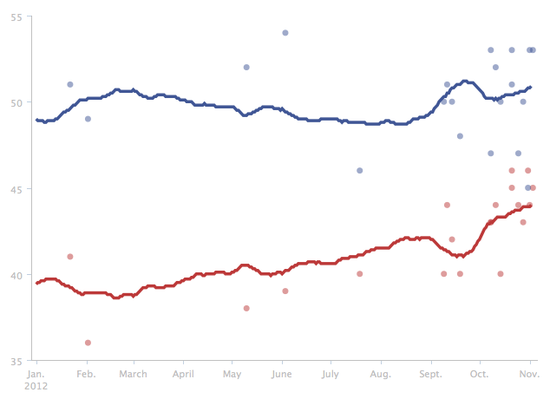
Here is the current chart for the poll of polls in Minnesota:

Screen shot 2012-11-04 at 4.01.56 PM

George Will believes none of the data. Which is why the results will be interesting.

Independents Moving Back To Obama?

Screen shot 2012-11-04 at 3.46.31 PM

Probably a Sandy-effect, but there are some straws in the psephological wind to back it up:

A Zogby poll finds Obama has picked up five points among independents, perhaps because of how he has handled the federal response to Hurricane Sandy. Meanwhile the latest national Public Policy Polling tracking poll shows Obama turning a longtime disadvantage with independents into a 49% to 44% advantage. Furthermore, a new national ABC News/Washington Post tracking poll shows Obama and Romney deadlocked with independents, at 46% each, matching Obama's best showing among that group in that survey and coming after Romney had reached a high of 58% just a week and a half earlier.

Finally, the Politico/GWU tracking poll finds the two men essentially tied with independents just a week after Romney held a double-digit lead with them.

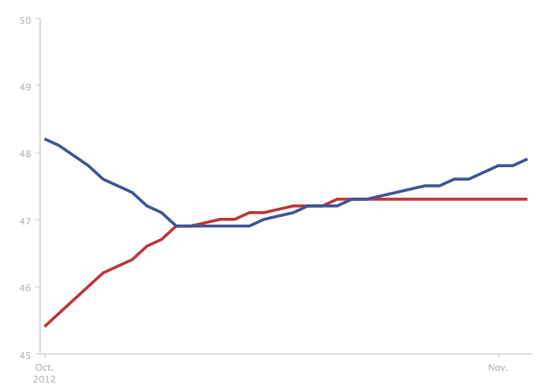
(Chart: the national race right now since October 1, sans Rasmussen, from Pollster)

Face Of The Day

155462148

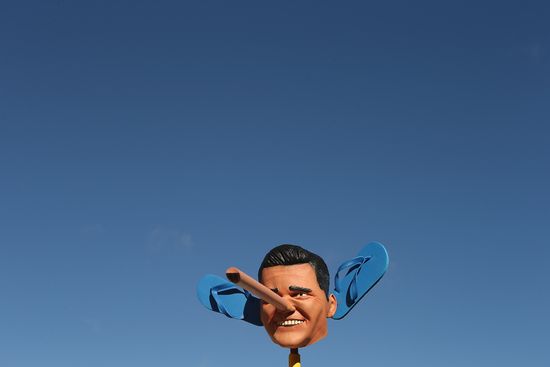
A rubber mask of GOP presidential nominee Mitt Romney is adorned with flip-flops and a long nose by a supporter of President Barack Obama outside an Obama campaign rally at State Capitol Square November 4, 2012 in Concord, New Hampshire. With only two days left until the presidential election, Obama and Romney are stumping from one 'swing state' to the next in a last-minute rush to persuade undecided voters. By Chip Somodevilla/Getty Images.

Romney On Torture

An unequivocal endorsement of returning to the years of Bush-Cheney and leaving the Geneva Conventions in the dust:

Q: Waterboarding: do you think it’s torture?

Romney: I don’t. … We will have a policy of doing what we think is in our best interest. We’ll use enhanced interrogation techniques that go beyond what’s in the military handbook right now.

It's important to understand that there is only a debate about whether "water-boarding" is torture in this country because it's a war crime for which members of the Washington elite would have to be prosecuted for under the Geneva Conventions. Waterboarding has always been a form of torture, in US and international law, and used to be punished by execution. Life imprisonment for Cheney would be enough for me. Just the rule of law. No more; no less.

Falling For A Robot

Robert Ito worries that social robots are bad for us:

[Sherry Turkle, director of the MIT Initiative on Technology and Self,] wonders if such human–robot relationships are inherently deceptive, because they encourage people to feel things for machines that can’t feel anything. Robots are programmed to say I love you when they can’t love; therapeutic robot pets, like aibos and Paros, feign pleasure they don’t feel. Are programmers deluding people with their lovable but unloving creations?

"People can’t help falling for these robots," says [Matthias Scheutz, a computer science professor at Tufts University]. “So if we can avoid it, let’s not design them with faces and humanoid forms. There’s no reason that everything has to have two legs and look like a person.”

To Gouge Or Not To Gouge?

Reason checks in on the New York area gasoline shortage:

Like Perry and Zwolinkski, Matt Yglesias advocates price gouging:

[W]hen it comes to things like gasoline and bottled water, neither the short-term nor the long-term supplies are genuinely fixed. Transportation routes into the area have been severely disrupted and many gas stations' supplies are hard to access due to power outages, but it's not impossible to transport this fuel from where it is into people's cars and generators. It's just much more annoying and difficult than usual. But the possibility of windfall profits is exactly the lure we need to get people to start making extraordinary efforts to get more fuel to the people who need it. There are things people will do to sell gasoline for $10 a gallon that they won't do to sell gasoline for $3.40 a gallon (note that in Norway this is what gas costs all the time) and that's what we need.

He follows up here. Alec Liu disagrees with Matt:

[T]rying to milk victims of a natural disaster in need is an asshole move. Which undermines the sense of togetherness we need during times of human tragedy. Trying to make a few extra bucks off your neighbor kills the good vibes we’re all collectively trying to harness. There are also risks to planting the seeds of ill will during a crisis. The art of price gouging is by no means scientific. A wily businessman could have great success raising prices 300 percent. Another entrepreneur in another neighborhood might incite a riot with an increase of only 30 percent. Who knows?

The View From Your Hurricane Cleanup

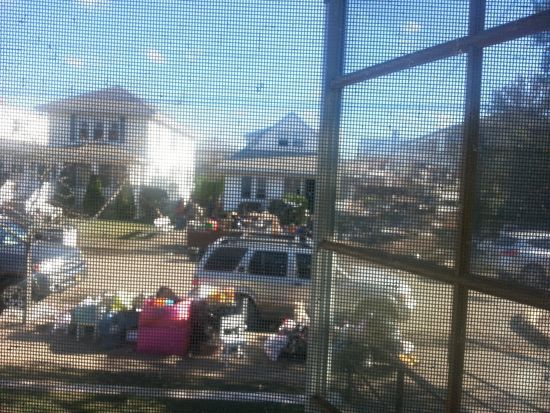
Rockaway Park, NY-12pm

A reader writes:

I went to Rockaway Park, Queens yesterday to help a friend's cousin with the huge task of emptying out the first floor of his house, garage, shed, etc. I had never met him before and may never see him again. To me he was just a nice guy with four kids and a whole house full of ruined toys.

Spirits in the neighborhood are remarkably high, and as I arrived with my wife and our friend, FEMA was already in the house. The FEMA guy was really nice; he had driven up from Texas. The neighborhood was just filled with houses with enormous piles of trash out front. And as we left in the afternoon, we saw the makeshift trash dump the garbage trucks were creating. Impressive. The whole experience has reminded me of the intense coming together after 9/11 – which is the time I began reading your blog.

Here is the picture I took, before we really got to task. I was just opening the windows to air out the disgusting smell permeating through the house. I wish I had remembered to take another picture after we were done for the day, because the trash piles are now far bigger.