Proximity Makes The Heart Grow Fonder

Heidi Julavits contemplates love and lust on the television shows The Bachelor, The Bachelorette, and Bachelor Pad:

I honestly believe that people fall in love on these shows. I do. Here is why: Crushes thrive in small spaces. Humans must be programmed to respond in a certain way when faced with a small sampling of other humans in, say, caves. You’re stuck in a cave with three other people—all mankind, presumably, was hidden away in such tiny groups during the winters until the thaw—and so, in order for the species to thrive, you must biologically be compelled to fuck at least one person in your cave, despite the fact that, when surrounded by a plenitude of Neanderthals at the Neanderthal summer barbecue, none of them struck your fancy. Without the element of choice, and in conjunction with captivity, you find love, or at least you find lust.

She describes how she isn't immune to the phenomenon:

This is also why I get nervous going to art colonies, especially now that I am happily married to a man I met at an art colony. I don’t want to fall for anyone else—I am pointedly not looking to fall for anyone—but these situations conspire against our best intentions. Art colonies, often located in remote woods or on beautiful estates, are communities that sever all ties to the real world within hours of arrival; they are like singles mixers for the married or otherwise spoken for. (I was married when I met my now-husband, who was otherwise spoken for.) When I arrive at a colony these days, I take a measure of the room, I identify the potential problems, I reinforce my weak spots, and then I relax.

India’s Gay Lit Takes Off

Jane Martinson takes stock of a new wave of publishing in the three years following the decriminalization of homosexuality:

Since then an anthology of queer erotica has hit the shelves, HarperCollins India has published a novel with a gay protagonist, and this month sees the release of Out! Stories from the New Queer India, an anthology of 30 contemporary stories about being queer and Indian from publisher Shobhna Kumar and editor Minal Hajratwala, both lesbians of Indian descent…. Queer writing was published in India before section 377 of the Indian penal code – a colonial law banning homosexuality – was overturned in 2009. But the tone of these new stories is very different says Kumar, who began her company Queer Ink by posting imported gay novels to customers in brown paper envelopes. "After 377, writers feel a lot more empowered to write their stories – even if some remain anonymous," she explains. "They're saying: 'I'm here, I'm queer, and there's nothing wrong with that.' They are not victims."

Sex Oys

Ben Reininga culls a list of the most ridiculous "non-FDA approved things Cosmopolitan magazine wants you to fuck yourself with." Dish fave:

"Put a bunch of (clean!) loose change in the freezer for an hour. Tell him to slick your vulva with warming lube, then cover it with coins (outside only!). The cold against the warm? Incredible."

This remains one of my favorites for sheer inventiveness. On the plus side, if you actually are the aforementioned sex-hobo, you'll have change on hand. Also, language here is — as always — incredibly important. Make sure you use the exact phrase, "Slick my vulva with warming lube, [term of endearment]." I always think "babe" works well.

One more for a late Halloween scare – a vacuum cleaner:

"Remove the attachment so it's just a plain hose. While you're wearing your underwear, have him turn it on low and hold it over your clitoris for a sexy sucking sensation. If the sensation is too much (or your vacuum has serious sucking power), have him hold it an inch above your underwear."

… Anyway, in seriousness, please don't do this. The trial-and-error that's going to be involved in figuring out if your vacuum cleaner has "serious sucking power" isn't worth thinking about. Don't turn into a summer-camp urban legend about the girl who Hoovered her vagina off.

Personal Progress

 Looking through his own family history, George Scialabba considers the meaning of progress:

In Notes Toward the Definition of Culture, T.S. Eliot wrote: "The primary channel of culture is the family; no man wholly escapes from the kind, or surpasses the degree, of culture which he has acquired from his early environment." As far as I know, neither of my parents ever read a novel, saw a play, or heard a concert. Nevertheless, their son has two Ivy League degrees, has written books, and has seen the world, in person and at the movies. I spend hundreds of blissful hours each year listening, on splendid but inexpensive equipment, to splendid but inexpensive recordings of the complete works of Bach and Mozart. Durable, inexpensive paperbacks furnish my rooms and my life. Even across one generation, this seems like progress. When I imagine my great-grandfather's great-grandfather, sunk in the immemorial poverty, ignorance, and humiliation of the Sicilian peasantry, the conclusion feels irresistible: I, at least, am the lucky beneficiary of two or three centuries of progress. And since the carbon footprint of classical music, great novels, independent film, and most of my other chief pleasures is fairly low, it seems like sustainable, universalizable progress.

Reading By Algorithm

While pontificating about the dangers of digitizing the world's literature, Stephen Marche drops a great anecdote about the Google Books process:

[Larry Page's engineers] crowd-sourced textual correction at a minimal cost through a brilliant program called reCAPTCHA, which employs an anti-bot service to get users to read and type in words the Optical Character Recognition software can’t recognize. (A miracle of cleverness: everyone who has entered a security identification has also, without knowing it, aided the perfection of the world’s texts.)

But he doesn't trust the instinct to treat literature like data:

Algorithms are inherently fascistic, because they give the comforting illusion of an alterity to human affairs. "You don’t like this music? The algorithms have worked it out" is not so far from "You don’t like this law? It works objectively." Algorithms have replaced laws of human nature, the vital distinction being that nobody can read them. They describe human meanings but are meaningless.

Which is why algorithms, exactly like fascism, work perfectly, with a sense of seemingly unstoppable inevitability, right up until the point they don’t. During the Flash Crash of May 6, 2010, the Dow Jones lost nine percent of its value in five minutes. More recently, Knight Capital lost 440 million dollars at a rate of about 10 million dollars a minute due to what it called "a rogue algorithm." Algorithms cannot, of course, be rogue. But rogue is the term we have invented for algorithms that don’t do what they’re supposed to, which is as much as to say that their creators don’t comprehend what they’re doing.

We'll go digital, he acknowledges, but "insight remains handmade."

Face Of The Day

Raskols

Irina Dvalidze showcases a powerful project on gangsters:

The Raskols are one of the most dominant gangs in the Port Moresby, New Guinea. Sydney-based photographer Stephen Dupont‘s first encounter with the gangs was during the ‘Kips Kaboni’ (Scar Devils) tribal conflict, following a murder of a Motu woman. The murder led to a rampage avenging her death and further violence. Dupont was given an opportunity to document the events which earned him the trust from the community, consequently enabling him to produce the portrait series.

How Dupont described his process:

My aim was to show the face behind the facelessness of gang culture really. An expose of a dark side of the human condition.

(Image: from Raskols: The Gangs of Papua New Guinea by Stephen Dupont, published by powerHouse Books)

Write For Purpose, Not People

As a struggling young writer, Frank Cassese asked David Foster Wallace to read his novel. DFW kindly declined by postcard, and encouraged him to keep at it, writing "Lots of us don’t publish, though—it doesn’t mean we’re wasting our time." Cassese treasures the sentiment today:

I think Wallace truly believed that we are not wasting our time, even if our words are never seen by the world at large. The world has never been the best judge. It has never equitably distributed recognition to all those deserving. It sometimes gets it right, as I think it did with Wallace, but more often than not it fails us. So what he was telling me was not that publishing is not a good thing, but that it isn’t everything. It does not bestow value or worth on one’s work or on one’s self.

It does not make a published book better or worse than an unpublished one. And while the failure to achieve it may be no cause for despair, its attainment is certainly no cure. He was telling me what I already knew but had forgotten during my struggle for acceptance and societal validation, that creation is its own reward, that the project of writing is its own gift, provides its own consolation. Half a century before in The Myth of Sisyphus, Albert Camus claimed that despite the absurdly futile and hopeless task with which the condemned king was punished by the gods, "the struggle itself toward the heights is enough to fill a man’s heart. One must imagine Sisyphus happy."

The Bigness Of The Novella

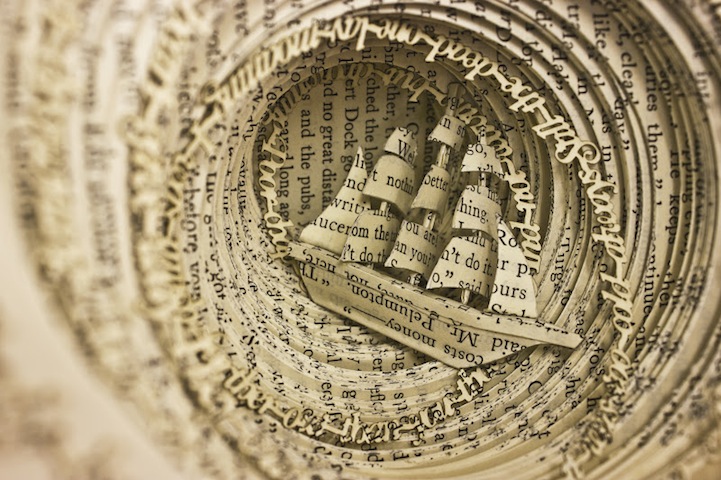
Thomaswightman3

Ian McEwan extols it:

I believe the novella is the perfect form of prose fiction. It is the beautiful daughter of a rambling, bloated ill-shaven giant (but a giant who’s a genius on his best days). And this child is the means by which many first know our greatest writers. Readers come to Thomas Mann by way of “Death in Venice,” Henry James by “The Turn of the Screw,” Kafka by “Metamorphosis,” Joseph Conrad by “Heart of Darkness,” Albert Camus by “L’Etranger.” I could go on: Voltaire, Tolstoy, Joyce, Solzhenitsyn. And Orwell, Steinbeck, Pynchon. And Melville, Lawrence, Munro. The tradition is long and glorious. I could go even further: the demands of economy push writers to polish their sentences to precision and clarity, to bring off their effects with unusual intensity, to remain focussed on the point of their creation and drive it forward with functional single-mindedness, and to end it with a mind to its unity. They don’t ramble or preach, they spare us their quintuple subplots and swollen midsections.

Let’s take, as an arbitrary measure, something that is between twenty and forty thousand words, long enough for a reader to inhabit a world or a consciousness and be kept there, short enough to be read in a sitting or two and for the whole structure to be held in mind at first encounter—the architecture of the novella is one of its immediate pleasures. How often one reads a contemporary full-length novel and thinks quietly, mutinously, that it would have worked out better at half or a third the length. I suspect that many novelists clock up sixty thousand words after a year’s work and believe (wearily, perhaps) that they are only half way there. They are slaves to the giant, instead of masters of the form.

(The Medium is the Message by Thomas Wightman via My Modern Met)