Face Of The Day

157071050

Christine Jambart comforts her husband, Didier Jambart, who cries in the courthouse in Rennes, France, on November 28, 2012, after hearing the judgment of the appeal court. The court upheld a ruling ordering pharmaceutical giant British GlaxoSmithKline to pay 197,000 euros to Jambart, who claimed that the drug Requip to treat Parkinson's turned him into a gay sex and gambling addict. By Frank Perry/AFP/Getty Images. Update from a reader:

I know that the caption might elicit a few chuckles from readers.  And understandably so, to some extent.  But the side effects suffered by this man were likely very real and devastating. Here's a link to a Mayo Clinic study on the topic. I used to work in the legal department for a generic pharma company and was researching the potential product liability risk of marketing a related drug – pramipexole.  That's when I came across this history.  One doctor remarked that regarding the extremely compulsive hypersexuality and gambling, stopping the drug was like turning off a faucet.

Reforming The Filibuster, Ctd

Nate Cohn believes that filibuster reform could hurt Democrats in the near-term:

For now, the biggest partisan items on the two major-party platforms lie on the GOP side of the ledger, and that seems likely to represent the new norm. Republicans are unified around a series of large and controversial measures that possess little Democratic support, like reshaping the tax code and reducing entitlement programs. Persistent budget deficits, an aging population, and rising health care costs will make it more difficult for Democrats to propose expensive new programs, while ensuring sustained GOP pressure on entitlement programs. And after Bush's push for Social Security privatization or the Paul Ryan budget, there shouldn't be much question about whether Republicans are likely to act on these issues if the opportunity arises. To the extent that Democratic support for filibuster reform is motivated by the prospect of partisan gain, perhaps Democrats should think twice before disarming the filibuster. And perhaps Republicans should revisit their opposition to reforming it.

Ezra has a different view:

Senate Republicans have thrown away two prime opportunities to retake control of the chamber (2013 and 2012), and there’s a dawning sense among the GOP that the demographics might be tilted against them for the foreseeable future. If that’s true, then McConnell is wise to fight this out as if he’ll be in the minority forever, rather than tempering his concern as minority leader with his incentives as a future majority leader. A world in which McConnell’s only tool will be obstruction is a world in which it’s a real problem if Senate Democrats feel empowered to change the rules with 51 votes. Sure, the reforms Reid’s proposing now are modest, but what about the reforms that he’ll propose three years from now?

Hertzberg's case for killing the filibuster is here.

What’s The Real Cost Of College?

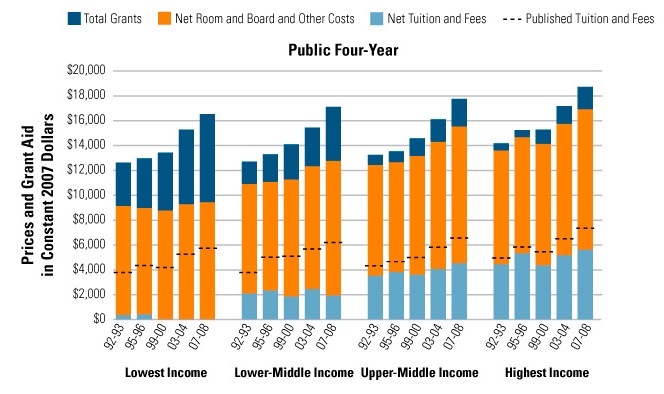
Public_Four_Year

Evan Soltas argues that, overall, college costs haven't increased very much in the past 20 years. What has happened:

Wealthier families now pay more than ever to send their children to college. But for much of the middle class, the real net cost of college has not changed significantly; for much of the poor, the expansion of aid has increased the accessibility and affordability of a college education. Data from the College Board show effectively no change in real net tuition and fees for dependent students at four-year public or private universities whose families are in the lower-two income quartiles. There also have been some increases in the real cost of room and board, but for families with below-average income, the rise has been on the order of 20 percent over 20 years.

Kevin Carey has a different perspective:

[T]he odds of additional huge investments of federal money to offset future increases in college spending and state disinvestment are long indeed. Even the federal government doesn’t have enough money to bankroll the combination of constant college-spending increases and perpetual state-budget cuts forever. All of which means that net price will prove to be a temporary palliative to the college-affordability crisis. Structural changes in the industry’s underlying cost and revenue structures remain as needed as ever before.

Malkin Award Nominee

"Here’s what we know about life. I have all kinds of natural feelings in my life and it doesn’t necessarily mean that I should act on every feeling. Sometimes I get angry and I feel like punching a guy in the nose. It doesn’t mean I act on it. Sometimes I feel attracted to women who are not my wife. I don’t act on it. Just because I have a feeling doesn’t make it right. Not everything natural is good for me. Arsenic is natural," – Pastor Rick Warren, on same-sex attraction.

Gay marriages are the equivalent of violence, adultery or poison. Keep channeling Jesus, Rick. Update from a reader:

Rick Warren's conclusion: "Not everything natural is good for me."  So … homosexuality is natural? Isn't the Christianist argument that homosexuality is not natural?? So I guess Warren is making progress …

If The Economy Booms, Ctd

James Pethokoukis throws cold water on Frum's prediction that four years of economic expansion will strengthen Democrats' policy rhetoric:

[E]mployment and output would still be way below their pre-Great Recession trend lines. Income growth would be no great shakes. Indeed, Ben Bernanke said recently that U.S. GDP potential growth pre-recession was 2.5% vs. the 3.4% average since WWII. So message #!1 would be “We can do a lot better” with specific pro-growth ideas from taxes to immigration to basic research. A focus on competitiveness and productivity with a goal of returning to 3-4% growth. Message #2 would be “We care about middle-class families” with pro-parent policy tilt. One example: A great expanded child credit. And a specific healthcare reform plan would be helpful.

Frum wonders whether this will be enough:

After 2013, Democrats will be able to tell the following story: "The Bush tax cuts were in place from 2002 through 2012, ten years. In the first half of the decade, we experienced the weakest economic expansion since the war. In the second half of the decade, we suffered the worst economic crisis since the Great Depression. Then the tax cuts expired. And since 2013, we've seen accelerating economic growth and rapidly decreasing unemployment. Tax cuts didn't help. Tax increases didn't hurt."

He adds:

Republicans will need a better answer to that claim than the pure assertion that tax cuts will lead to 4% growth.

Phobiaphobia

Recent changes to the Associated Press’ online style book remove the use of “-phobia,” notably “homophobia” and “Islamophobia”. AP Deputy Standards Editor Dave Minthorn explains the rationale:

Homophobia especially — it’s just off the mark. It’s ascribing a mental disability to someone, and suggests a knowledge that we don’t have. It seems inaccurate. Instead, we would use something more neutral: anti-gay, or some such, if we had reason to believe that was the case.

George Weinberg, the psychologist who coined the word in 1972, disagrees with the AP’s new position:

It encapsulates a whole point of view and of feeling. It was a hard-won word, as you can imagine. It even brought me some death threats. Is homophobia always based on fear? I thought so and still think so…. We have no other word for what we’re talking about, and this one is well established. We use ‘freelance’ for writers who don’t throw lances anymore and who want to get paid for their work.

Zack Ford weighs in on the historical arc of “homophobia” and its implications for “Islamophobia”:

[T]he journey of the word “homophobia” emphasizes the current need for the word “Islamophobia.” As a different concept, it might very well be true that people “fear” Islam, Muslim people, and Muslim culture as a threat to physical safety. Muslim people are unfairly cast as terrorists just as gay men have been cast as pedophiles. While education has opened up new language to describe anti-gay attitudes, rhetorical options for the wide-spread efforts to demonize the Islamic faith remain limited. And like “homophobia” did four decades ago, “Islamophobia” effectively captures the intensity of these vitriolic campaigns. 

Patrick Strudwick concludes:

It is commendable to strive for accurate, neutral reporting and “homophobia” or “Islamophobia” are not ideal, as they denote solely the fear motivating prejudice. But they are the best we have. While fear may not be the only force behind such attitudes, it is invariably a chief component.

John Aravosis zooms out:

Of course, what the AP is afraid of is picking sides. Using the word “homophobia” is to suggest that there isn’t a rational basis for thinking that the marriage of gay couples will somehow make hetero marriages fall apart. And the word “Islamophobia” suggests that Republicans who are afraid that the greatest threat to Topeka is the Sharia aren’t bat-s crazy, when they actually are.

I will say that it’s not entirely clear when AP would use the word homophobia (or Islamophobia for that matter), in any case.

I don’t like the word myself. There’s a smugness to it that doesn’t sit well with me. And it also implies that a religious or moral position against homosexuality is inherently irrational. It may be highly rational in the context of wanting to maintain a social hierarchy, or a coherent theocracy. I also think that a lot of anti-gay feeling is fear-driven, but it is also contempt-driven. Why not replace homophobia with fear and hatred of gay people. Orwell would approve, I suspect. Use shorter words when possible; avoid Latinate constructions; keep language real. So I guess I have no real problem with the AP’s decision as long as it does not lead to ignoring stories of anti-gay fear and loathing that need to be told.

Will Hillary Run?

Ambers reads 2016 tea leaves:

If I had to bet, I'd bet that she decides to run, if only because she will feel that destiny and circumstance have put her in the right place at the right time. She may feel that she owes it to young women and those who supported her to finish the marathon of American politics. But she might well decide that her legacy is secure, her popularity is intact, her financial prospects are bright, and her future lies with advocacy from the outside and grand-mothering.

Anyone who says they KNOW what she'll do is lying, either to you, or to themselves.

An Uncompromising President

Although he praises the film, Adam Gopnik finds one element of Lincoln misleading:

The movie is inspired by Doris Kearns Goodwin’s much and justly praised “Team Of Rivals.” But good books often cast strange shadows, and Goodwin’s account of Lincoln’s enormous instinctive shrewdness in managing his stroppy cabinet of prima donnas has been confused with the idea that Lincoln’s genius was for conciliation and compromise. This leads, in turn, to the notion that Lincoln was a kind of schmoozemeister, reaching out across the aisle, a sort of Tip O’Neill on the Atkins diet.

It can’t be said too often, or too clearly, that the whole point of Lincoln is that he—and the Republican Party he then represented—marked the end of the policy of conciliation and compromise and cosseting that had been the general approach of Northern Presidents to the Southern slavery problem throughout the decades before. When the South seceded, Lincoln chose war—an all-out, brutal, bitter war of a kind that had never been fought until then. “Let the erring sisters go in peace!” the editor Horace Greeley recommended, and Lincoln said, “Lock the doors and make them stay.”

Joe Klein's view:

I think Greg Sargent gets it a bit wrong when he writes that David Brooks, Al Hunt and other take the movie as a celebration of “compromise.” Lincoln doesn’t compromise his principles to win passage of the 13th Amendment. He compromises his morals, a little. He trades jobs for votes. He pulls a Clinton–lawyering the truth–over the question of whether he’s about to commence negotiations with a rebel delegation. That’s the miracle of Lincoln. He practiced the high art of moving history forward via patronage and patronization. Indeed, in a democracy, it is the highest art, the only way great deeds are done.