
Corvallis, Oregon, 12 pm
Corvallis, Oregon, 12 pm
Goldblog sounds the alarm. Greater Israel really is in danger of becoming an outlier among Western democratic nations.
Reid Cherlin believes it's still young people:
Peter Levine, an expert in this stuff who runs CIRCLE, a youth engagement research program at Tufts University, figured out that if in 2008 the voting age had been 30—if you'd cut out 18-29-year-olds entirely—Obama would have lost North Carolina, Virginia, and Indiana altogether. "I was running the numbers," a strategist affiliated with the campaign told me, "and it was like, holy shit. If these guys don't turn out, that could be the ballgame."
Prospects don't look good, according to Zoë Carpenter. She found "the percentage of young Americans who are registered this year is the lowest of the past five presidential elections":
The race will hinge on turnout, and millennials—some 64 million eligible voters—have emerged as the main question mark among the constituencies the candidates have been courting. Romney won’t win the youth vote: The fall survey from the Harvard Institute of Politics, which polls young Americans twice yearly, shows Obama leading Romney by a 19 point margin among millennials who say they are likely to vote and by 22 points among young adults in general. For most millennials the choice is between voting for Obama, and not voting at all.
But Cherlin argues the ground game has shifted online:
Log into Twitter or Facebook or Pinterest and you can watch the gears of the reelection effort turning.
That's what you're seeing when your 19-year-old cousin shares yet another schmaltzy Obama paean, the tearjerker video of the 106-year-old lady pledging to vote for the president because he's honest, or the one of the 10-year-old whose dad came home from Iraq. It's what's happening when a friend likes an Instagram photo of rows of glistening buttons saying "Ohio Votes Early," all matching in that perfect Gotham typeface. There's the "For All" campaign, specifically targeted at the 18-29 set, asking every supporter to write on her hand "what progress means to you," put her hand over her heart, and upload the shot. Or the Lena Dunham video where she compares voting for the first time to losing your virginity; it's funny, semi-dirty, hated by conservatives, and though it may not have the power to physically transport a 20-year-old to his local polling station, it keeps him talking about Obama for another couple of dining hall meals.
Daniel Gross considers the logistics:
The marathon can?’t work without a fully functioning transit system. On no day in New York is the underground transportation system more vital. Several bridges are essentially closed for the day—the Verrazano-Narrows, the 59th Street Bridge, the Willis Avenue Bridge, and the Madison Avenue Bridge. In many areas of the city, it is impossible to get across certain streets above ground. And the street closures and huge concentrations of people in Manhattan have huge ripple effects. With the region?’s train and subway systems not yet completely operational, getting around will be very difficult for everybody, from? marathon runners and spectators to New Yorkers who have no interest in the race.
A reader writes:
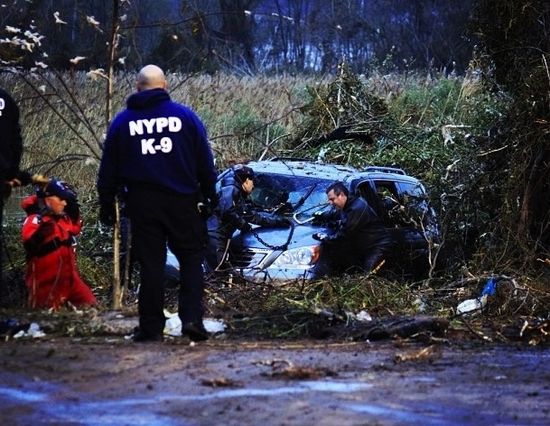
I was happy to see you finally feature Staten Island on your blog. I have a good friend who lives out there and she says the devastation is unbelievable. She just about started crying when she found out that policemen were getting sent to supervise the marathon, while her own neighborhood is experiencing looting and with no one out patrolling the streets and with people from the area still missing.
I heard the Red Cross didn't get into Staten Island at all under yesterday, and she said she's personally seen no sign of them. My friend is okay – she's lucky, with minimal damage and power back on. But she's worried about her neighbors and I think we should be, too.
Another:
The next few days are crucial for Bloomberg, Cuomo, and even Obama to get ahead of this thing. If the marathon goes on and power is still not restored to most/all of NYC, there will be a backlash. People are starting to get pissed. And it's only the beginning. The next few days could be the difference between Sandy becoming another Katrina.
I know a lot of people read your blog. And people that have Obama's ear read your blog. You need to start a movement asking officials to postpone the marathon. Maybe it's too late. But it would be the wise and prudent thing to do.
Above image from Buzzfeed's collection of "21 Pictures Of Staten Island Near The NYC Marathon Starting Line." Earlier backlash here.
Making schedule-making fun:
While expressing his fears about legalization, Tony Dokoupil wrote that every "year about 375,000 people end up in the ER with marijuana-related 'averse reactions,' more than any drug other than cocaine." Mike Riggs counters:
According to the National Hospital Ambulatory Medical Care Survey (NHAMCS), the 375,000 instances in which marijuana is noted in an ER visit are not necessarily instances in which marijuana caused an "averse reaction." Rather, the survey tells us that in those 375,000 cases, marijuana was "commonly involved in an emergency department visit." So, if you smoked a joint on Tuesday, and on Thursday you blew a tire in your work vehicle and careened into a guard rail, then had your blood drawn at the ER, marijuana was involved in your emergency room visit. While people do ocassionally get so high that they call for an ambulance, the NHAMC survey doesn't distinguish between people who go to the ER with drugs in their system, and people who go to the ER because of the drugs in their system.
Riggs also tosses grains of salt at the marijuana rehab numbers Dokoupil cites. Kleiman pushes back here.

A reader writes:
Staten Island got hit very hard. Half the reported deaths were there, and the damage has been very, very heavy. A disproportionate number of the really awful human stories, like children being swept away from their mothers and drowning, etc., have come out of Staten Island. It has been really awful out there. Lots of people are without power and basic staples like food.
But they haven't been getting very much attention. On NY1, there are many more stories about the Rockaways and sections of Queens. Staten Islanders feel that the focus of bringing power back to Manhattan has been misplaced. People in Manhattan are basically OK, even if they don't have power, while Staten Island has people who are in real distress.
There are holes in that argument (we need power to bring the transit routes that glue the city together back, etc.). But the focus on getting the marathon up and running is a really big sore spot for Staten Islanders. They feel very strongly that it's a mistake to put work into preparing for the race while so many of them are suffering. I've heard that hotel people on the island are refusing to evict locals who lost their homes in order to honor reservations for runners who are traveling to the city for the race.
I don't know if they have a point about resources, although they might. I doubt the people rebuilding substations are the same people who fix downed power lines – they seem like different kinds of jobs to me. But on TV we've seen a constant stream of updates from politicians like Bloomberg and Cuomo, and Staten Island has been mostly absent from those discussions (in my opinion), and from the news coverage. I suspect that's mostly because it's harder to get to Staten Island than it is to get to Queens.
Every now and then, in other contexts, there is talk about Staten Island seceding from the city. I haven't heard that in this context, but would be very surprised if that talk doesn't resurface.
Anyway, I think that upping the coverage of this on your blog would be a good thing. It's good journalism, I think, and it's also helpful to people on a human level. Much, much less significantly, it would probably give you some New York cred – most people who move here and live in the Manhattan bubble wouldn't tune into the larger picture in the city as a whole very well.
(Photo: Water continues to flood a neighborhood in the Ocean Breeze area of the Staten Island borough of New York City on November 1, 2012. Most homes in the seaside community were inundated by the ocean surge caused by Superstorm Sandy. By John Moore/Getty Images)
James Kwak makes the case for it from a cost perspective:
There’s a strong case to be made that hurricane research is one area where a small amount of taxpayer spending has had huge public benefits. That argument is made by Jeff Masters of Weather Underground … [A]s I discussed in a previous post, it is highly likely that more accurate forecasts have saved tens or hundreds of millions of dollars in unnecessary evacuations for each large hurricane.
Noam Scheiber evaluates it:
If, as the polling averages anticipate, Obama carries Ohio on Tuesday (and, in effect, the election), it will be Romney who made a colossal miscalculation in the end, not Obama. Team Romney believed most voters would eventually dismiss the plutocrat portrayal of their candidate, and so they didn’t spend much time refuting it. And they were right—most voters did dismiss that portrayal. What the Romney folks missed was that Obama didn’t need to sell the portrayal to most voters. He just needed to sell it to several hundred-thousand Ohioans. And he appears to have succeeded.
Todd Akin just rolled out an ad featuring a rape victim:
Rachel Wiener adds:
In a video posted on Akin’s website, Burrell elaborates, saying she regrets her abortion. "Todd is advocating for women so that women don’t have to do what I’ve had to do, and that’s grieve every year," she says. It’s not clear whether her pregnancy was the result of rape.
Meanwhile, Washington congressional candidate John Koster is the latest Republican to venture out on thin ice:
"Incest is so rare, I mean it's so rare. But the rape thing…you know I know a woman who was raped and kept her child but gave it up for adoption, she doesn’t regret it. In fact, she’s a big pro-life proponent…But on the rape thing, it’s like, how does putting more violence onto a woman’s body and taking the life of an innocent child that’s the consequence of this crime, how does that make it better? You know what I mean?"
Margaret Hartmann tallies it up:
Fortunately for Koster, his comments aren't likely to cause as big a controversy as other Republicans candidates' remarks on the subject. "Rape thing," may be flippant, but it pales in comparison to Todd Akin's "legitimate rape," Richard Mourdock's belief that pregnancy from rape, "is something that God intended to happen," or Tom Smith's contention that the situation is similar to "Having a baby out of wedlock."
New polling shows Mourdock's campaign in a freefall from his rape comments. Weigel weighs in:
[Attacks against Republicans on their rejection of rape exceptions] work because voters are also skittish about the question of when life begins. Just this week, a national YouGov poll asked Americans when abortion should be legal. A full 67 percent favored some restrictions or total restrictions. A full 74 percent wanted to keep it legal in cases of rape or incest. Republicans are better off when then this distinction never gets explored.
Ed Kilgore makes a keen observation about the evolving debate over abortion:
More broadly, the antichoice movement has spent much of the last decade or so shrewdly guiding the policy debate to topics involving possible exceptions to a general regime of legalized abortion: so-called "partial-birth abortions," sex-selection abortions, abortions "of [sic!] convenience, denials of public funding for abortions, and most recently, second-trimester abortions at a stage where antichoice "scientists" claim the fetus can feel pain. This is why the percentage of Americans self-identifying as "pro-life" has gone up gradually over time.
But now, with state legislatures busily enacting anti-abortion legislation and the prospect of a Supreme Court majority overturning Roe v. Wade tantalizingly close, the debate over abortion, at least on the Right, is suddenly about exceptions to a regime where abortion is illegal. And so you get arguments between the "personhood" supporters and the "no-exceptions" supporters on the one hand, and those who while generally favoring an abolition of the right to choose, might consider, in their enormous compassion, exceptions for rape and incest victims, or perhaps the use of contraceptives the serious antichoice activists consider "abortifacients" (basically, all of them other than barrier methods or coitus interruptus).
 The Dish