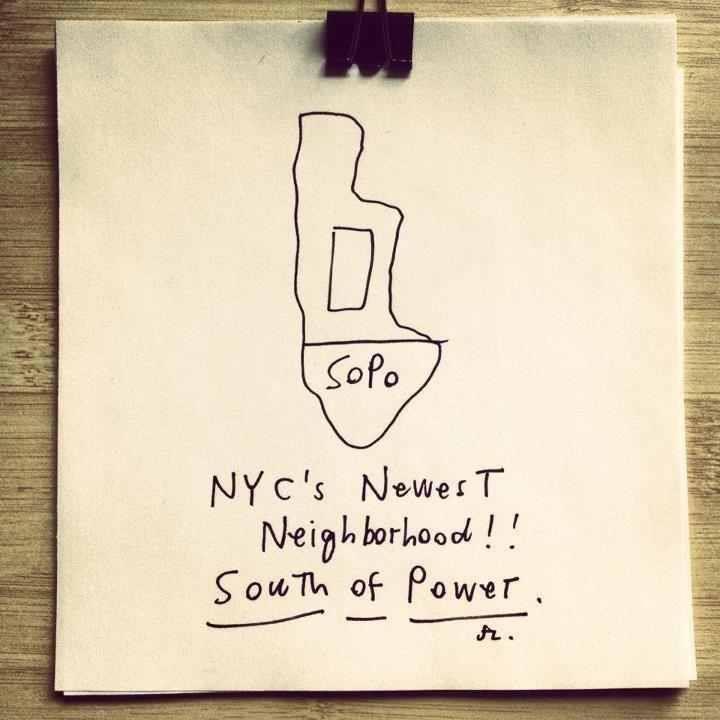
According to Sakis Meliopoulos, a professor of electrical energy, systems and controls at Georgia Tech, it takes a lot of time to restore the power in every part of the grid after such a damaging disaster, because before turning on the switch in the affected areas, "each circuit has to be checked" to make sure it’s in good shape.
Gov. Andrew Cuomo said on Friday that about half of the 2 million homes in New York that lost power during the storm now have it restored. Some power may return to downtown Manhattan today, Cuomo said, adding that he will hold power companies accountable for their performance.
Nate Cohn analyzes them. He notes that one reason "Romney performs well in national polls of early voters is the composition of the states with substantial early voting":
Many of the large, Democratic-leaning states in the northeast and Midwest, like New York, New Jersey, Massachusetts, Pennsylvania, Minnesota, and Michigan don’t permit in-person early voting.
Illinois now allows in-person early voting, but the state still prefers to vote on Election Day, as just 10 percent voted early in 2008. The only blue states with more than 10 electoral votes casting an above average share of their votes in early voting were Washington and California. In contrast, the three largest red states of Georgia, Texas, and Tennessee each cast an above average share of their ballots early. So far in 2012, each of those states has reported higher early voting turnout than California or Washington, where millions of ballots will be cast by mail. As a result, "red states" are beating "blue states" in early voting by an 8.5 million to 4.9 million vote, according to figures taken [Wednesday] from Michael McDonald's indispensable site on early voting.
.@joenbc: If you think it’s a toss-up, let’s bet. If Obama wins, you donate $1,000 to the American Red Cross. If Romney wins, I do. Deal? — Nate Silver (@fivethirtyeight) November 1, 2012
NYT public editor Margaret Sullivan tsk tsks Silver for the above tweet:
When he came to work at The Times, Mr. Silver gained a lot more visibility and the credibility associated with a prominent institution. But he lost something, too: the right to act like a free agent with responsibilities to nobody’s standards but his own.
Sullivan’s piece is almost a parody of smug old media. She actually believes that Nate Silver gained “credibility” because of an association with an “institution.” No wonder she’s on the Pulitzer board. She represents all that is brain-dead about the legacy MSM. To their credit, the NYT has moved on, and their reputation has benefited from Nate’s presence there – as, I’m sure, has their traffic. But bow down to smell the jealousy:
Silver is closely associated with The Times and its journalism – in fact, he’s probably (and please know that I use the p-word loosely) its most high-profile writer at this particular moment.
And he came from the blogosphere! The horror! Josh Marshall defends Silver:
Silver is not really reliant on the Times at all. He’s his own brand. In the political realm he built it in the 2008 cycle (he obviously had a baseball sabermetrics rep before that). I don’t think there’s any question the Times gained considerably more than he did in the bargain. That’s why I suspect they’re paying him quite a lot of money and he was able to negotiate a deal in which the entire 538 franchise is still his. He’s just leasing it to them.
Amen. At the Beast, as at every other institution I have blogged at, I insist on total editorial independence in every respect. It’s in my contract. And notice the Sullivan assumption – again – that writers for the NYT cannot have opinions outside the op-ed page. Why not? In some ways, it’s refreshing that Nate told Scarborough to put his money where his mouth is – for charity. Alex argues that “the NYTimes should require that Silver, and other pundits, bet their beliefs”:
Overall, I am for betting because I am against bullshit. Bullshit is polluting our discourse and drowning the facts. A bet costs the bullshitter more than the non-bullshitter so the willingness to bet signals honest belief. A bet is a tax on bullshit; and it is a just tax, tribute paid by the bullshitters to those with genuine knowledge.
Amen. Nate fights back against his critics here. Presumably Ms Sullivan will approve.
At least one environmental organization is trying to make sure Sandy has an effect on the race – here is the new ad that ClimateSilence.org is running in Ohio and Virginia:
Ari Berman reports on another way Sandy could affect people's votes :
[While the states hit by Sandy should have their power mostly restored by Tuesday, many] will still experience the potential for serious problems, either on Election Day or the days proceeding (early voting has already begun in a number of states affected by the storm). Problems could include: electronic voting machines without power and a shortage of backup paper ballots; polling places without power, damaged or moved; voters unable to reach their polling place or unable to mail in an absentee ballot by the deadline; election administration unprepared to deal with a multitude of new, unforeseen complications.
Check the Google Crisis Map to see which states still have power outages. Previous coverage on whether Sandy should affect people's votes here, and how the storm might split the electoral college and popular votes here.
So here I am, perched in a Dunkin Donuts, just north of the Dark Zone in NYC, blogging for as long as my mifi hangs in, with 53 minutes left on my laptop.
Last night was pretty chilly: one of the hounds crawled under the bed covers, the other buried herself under a blanket on the sofa. Still total darkness at night; punctuated by the occasional flash of police car lights. I cannot imagine how the elderly or those in high rises are managing.
It remains astounding to me that the power can go out for the lower half of New York City for five whole days. We’re now told that we will have power by tomorrow night at 11 pm. I believe that the way I believe Mitt Romney. But almost as astounding as the developing world infrastructure here is the way in which New Yorkers – so rude and oblivious most of the time – have rallied, helped each other, smiled, and carried on. What a welcome. The best of New York and the worst – hidden in unfathomable darkness from dusk onward.
The country's most pressing economic problem IS the break-down of the old middle-class economy. Wages are stagnating at the middle, class lines are hardening, and more and more of the benefits of growth are claimed by the very wealthiest. President Obama delivered his answer to this problem in his important speech in Osawatomie, Kansas, a year ago: more direct government employment (at higher wages), more government contracting (to enforce higher wages), and more government aid to college students (in hope that expanding the number of degree holders will raise their average wage).
Obama is following a path explored by the British Labor governments of 1997-2010, when the majority of the net new jobs created in northern and western England, Scotland, and Wales were created in the public sector. That approach pushed Britain into fiscal crisis, when the recession abruptly cut the flow of funds from south-eastern England to pay everybody else's government salary.
So far, under Obama, private sector job growth has vastly outpaced the public sector. And the big public unions, like the teachers', have been directly challenged. They're losing in the states. And in so far as inequality is driven by globalization, public investment in education has to be a key part of the answer. I agree with David on the benefits of a carbon tax, but which party is likelier to enforce that? I agree with him on the need for a balanced Grand Bargain – but I don't believe Obama wants to end the Bush tax cuts on those earning more than $250,000 because he wants more government. He's proposing that to help balance the budget over time.
But my real objections to David's endorsement are the following. The premise of his argument is that Romney is a liar of massive proportions whose campaign David accurately describes as "one long appeasement of the most selfish and stupid elements of the Republican coalition," but who actually, in private, doesn't believe a word of it. So not to worry. The "real" Romney will emerge – compassionate, moderate, practical and data-driven, as in Massachusetts – the day after he is elected.
Some questions. First off, he worked in Massachusetts with an 85 percent Democratic legislature. That's a guide to how he'd run the entire country with a Republican Congress? Not buying it. But secondly, if Frum is right, then Romney does not have the character to be president of the US. Someone who lies his way to the top will have no credibility with the American people and no mandate from his party. I do not believe we should elect a fathomless cynic to the White House. David's argument for Romney is even worse than David Brooks': Brooks predicts that circumstances will force Romney into pragmatism. Frum simply says that nary a jot of what Romney said in the primaries is what he actually believes.
To wit:
I don't want to see Obamacare repealed. I don't believe it will be, not even if the Republicans retake the Senate, which I don't expect either.
And yet Romney has said it will be his first priority on Day One to end the program despised by every element of his far right party. He says this almost every day. David thinks Romney is cynical enough to make that clear, binding pledge day after day, ad after ad, and then instantly renege on it, even with a Republican majority in both Houses. Again, if David's right, Romney lacks the character to be president. If he's wrong, he's voting for the wrong presidential candidate.
The question of what would better help get the GOP back to sanity and concern with solving the actual problems we face is a real one. David thinks that Romney would help. Given that he has surrendered at every single point in this campaign to the furthest right in his party – all the way from firing Ric Grenell to endorsing Richard Mourdock – I fail to see the logic. He Etch-A-Sketched as late as October because of this, which reveals his weakness with respect to his own party. (Compare his father's courage and candor to Mitt's cravenness and salesmanship.)
My own view is that the only way to rehinge an unhinged party is for it to lose badly. And because Romney put Ryan on the ticket, and endorsed the entire Tea Party shebang, it will be hard for the wingnuts to blame defeat on running a moderate. I think the likeliest combination for a Grand Bargain is Obama, a Democratic House and a Republican Senate. That won't happen. But the second likeliest is Obama, a Democratic Senate and a GOP House with a smaller majority. I cannot see Romney compromising on revenues at all if he is president, with a GOP House, which kills the chance for a deal. When Jim DeMint says that an Obama victory would force a GOP retreat on their no-revenue-increase-ever theology, I believe him.And when the left starts fretting that Obama really will cut a Grand Bargain that tackles entitlements, I think they have every reason to.
As for war, there is a clear difference between a candidate advocating pre-emptive war on a country for merely having the technological capability of having a nuclear bomb, and one advocating war as a last resort if a nuclear bomb is actually made and able to reach outside the borders of the country. One is a violation of just war theory and would make the West the aggressor in a global religious conflict. The other is the least worst option, given the power of the Greater Israel Lobby and US public opinion. The other difference is that Romney would launch a trade war with China at a very precarious moment in the global economy, and whose election would be greeted with dismay by every ally, except Israel's. Why? Because Romney will put the settlement policy on steroids and permanently end the chance for a two-state solution in Israel-Palestine. Romney will also bring back torture as an instrument of government policy in America. That's a huge moral difference.
There are many common areas between my views of where we are, and David's. And I too want a more vibrant and sane conservatism that can indeed reform Obamacare, scour government for waste, tackle Medicare's costs, radically reform taxes, and focus on inequality as a scourge of democracy. But that conservatism no longer exists in the GOP. And, in my view, only a thorough thumping of the extremists at the polls can bring it back.
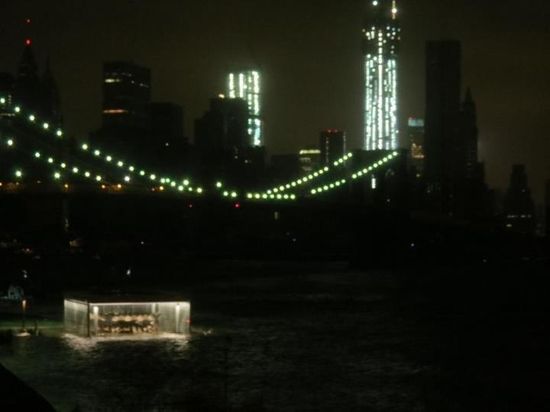
Turns out that iconic photo from Hurricane Sandy was also a View From Your Window. A reader writes:
I took the photo of Jane's Carousel you wrote about. (My girlfriend posted it to Instagram.) I've read the Dish from the early days and actually sent you a couple photos for View From Your Window. This was the view from my window that night. Here's what I wrote about the photo. I've attached the original in case you want to run it. I have some others from that night too.
One of them is seen above. Our reader Brian Morrissey, whose name we got permission to run, writes in his piece:
I took the photo at 8:30, near the height of the storm.
Soon after, my girlfriend posted a copy of it to Instagram and sent out a link on Twitter. Almost immediately, the photo got spread all around. We were forced to evacuate our building shortly after posting, reaching safety at a nearby family member’s apartment a half hour later to find requests from news outlets worldwide to run the photo. It was apparently a top trend on Twitter. By the next morning, it was on CNN and published by the UK’s largest newspaper. All told, it was shared nearly 20,000 times, appeared on The Huffington Post, HLN, The New Yorker, The Atlantic, among others. …
There are a few others of Jane’s Carousel that night, but Brooklyn Bridge Park was closed off. We happened to have an apartment with a good view of the carousel. And then there’s timing. The picture was shared at the height of storm anxiety — not something I thought of at the time — and captured that moment.
Pollsters on both sides try to persuade public surveyors that their voter-turnout models are more accurate reflections of what's going to happen on Election Day. This year, GOP pollsters and strategists believe those nonpartisan pollsters are adopting Democratic turnout models en masse.
Regardless of the cause, strategists on both sides acknowledge the difference in their internal polling. Republicans believe Democrats are counting far too much on low-propensity voters and a booming minority turnout that isn't going to materialize on Election Day. Democrats believe Republicans are hopelessly reliant on an electorate that looks far more like their party than the nation as a whole. The day after Election Day, somebody's pollsters are going to be proven seriously wrong.
Some partisan groups aside, pollsters have every incentive to get things right, and the fact that there are more polls in the field predicting the kind of turnout Democrats want is good evidence that such turnout might well be forthcoming. But it isn’t dispositive evidence. As Dan McLaughlin has pointed out, both Gallup and the similarly Romney-friendly Rasmussen have a pretty good track records when it comes to projecting the likely final breakdown of a presidential-year electorate, and the other national polls (Fox, Pew, Washington Post/ABC) showing the race tied are presumably using demographic projections closer to Gallup/Rasmussen than to the state polls showing Obama with a slight lead. Factor in the evidence, from surveys and state-level data, that the president is underperfoming relative to 2008 in the early voting, and there’s a coherent, plausible, data-driven case — not just a ranting, emotive, “it feels close” pundit’s case — that the state-level polls are projecting a liberal-tilting electorate that won’t actually turn out.
Because of Hurricane Sandy, we have been unable to process new videos this week. So we dug into the new “Ask Andrew Anything” archive page to find this one from January 9, 2012:
If he were not as rigorous as he is but was producing the same results, liberals wouldn't be as taken with him as they are. There are Democratic polling outfits out there, and while liberal blogs might cite them fairly often, none of them have produced the same devotion Nate has. On the other hand, would liberals be as interested in Silver if his analysis consistently predicted a Romney win? Probably not.
In other words, it took both to make Silver a liberal hero. His projections had to make liberals feel optimistic, and he had to be going about things in the kind of nuanced, detailed way he is. Liberals are pleased as punch that the thing they want to be true can be supported by a highly complex and sophisticated analysis. They want to feel good, but they also want to feel smart.

 The Dish