Obama’s Paths To Victory

Pollster_Virginia

Nate Cohn sees several:

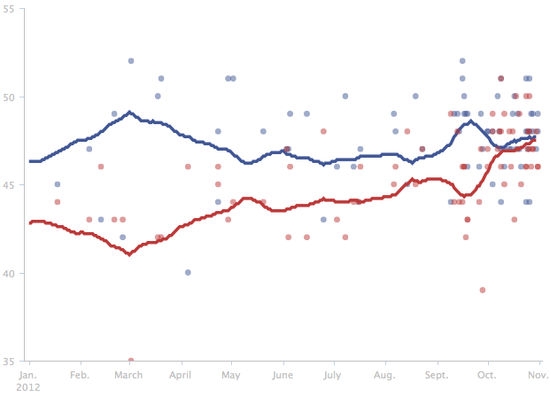
With Obama’s most straightforward path to the 270 enduring with five days to go, the last thing Romney needs is a weak southern flank. But Romney spent all of yesterday in Florida, and it’s not hard to see why. CBS/NYT/Quinnipiac and other polls released yesterday pointed toward a slight Obama edge in Virginia and a tied race in Florida. On average, Obama leads by .7 points in Virginia and trails by .8 in Florida in polls conducted since the final debate. Unlike the other battleground states, Romney’s standing in these averages may be inflated by outlying polls from second-tier pollsters showing Romney ahead by 5 points.

(Chart: Pollster's Virginia poll of polls)

Should Sandy Affect Your Vote?

155061375

Frida Ghitis thinks not. Seth Masket differs:

[W]hy dissuade voters from evaluating the candidates at a time like this? This is a moment when action by the federal government is (nearly) universally regarded as being necessary. Is it not appropriate to consider how the president is actually administering it? And what would be better to consider? Debate performance? Likability? "Vision"? I'd say that the economy would be important, and voters actually do consider that, but the president has a far greater direct impact on disaster relief than he does on economic growth.

The issue certainly helped sway Mayor Bloomberg's vote, who, like The Economist, is endorsing the president:

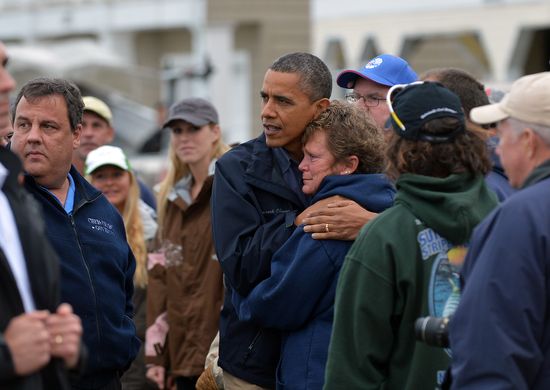
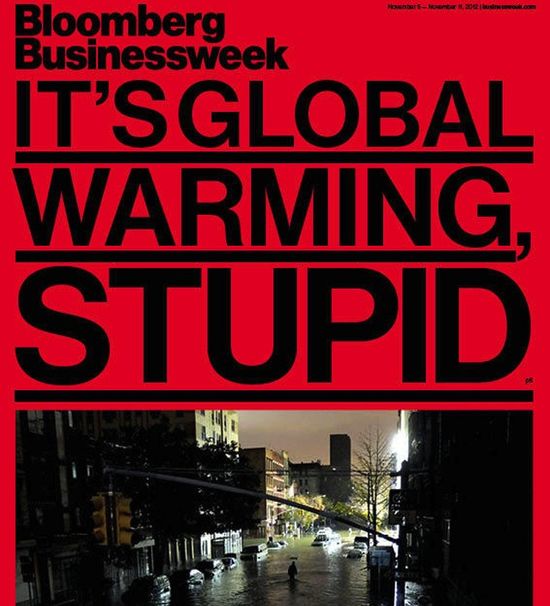
The devastation that Hurricane Sandy brought to New York City and much of the Northeast – in lost lives, lost homes and lost business – brought the stakes of Tuesday’s presidential election into sharp relief. The floods and fires that swept through our city left a path of destruction that will require years of recovery and rebuilding work. And in the short term, our subway system remains partially shut down, and many city residents and businesses still have no power. In just 14 months, two hurricanes have forced us to evacuate neighborhoods – something our city government had never done before. If this is a trend, it is simply not sustainable.

Our climate is changing. And while the increase in extreme weather we have experienced in New York City and around the world may or may not be the result of it, the risk that it might be – given this week’s devastation – should compel all elected leaders to take immediate action.

Here in New York, our comprehensive sustainability plan – PlaNYC – has helped allow us to cut our carbon footprint by 16 percent in just five years, which is the equivalent of eliminating the carbon footprint of a city twice the size of Seattle. Enhanced-buzz-7374-1351797754-1Through the C40 Cities Climate Leadership Group – a partnership among many of the world’s largest cities – local governments are taking action where national governments are not.

But we can’t do it alone. We need leadership from the White House – and over the past four years, President Barack Obama has taken major steps to reduce our carbon consumption, including setting higher fuel-efficiency standards for cars and trucks. His administration also has adopted tighter controls on mercury emissions, which will help to close the dirtiest coal power plants (an effort I have supported through my philanthropy), which are estimated to kill 13,000 Americans a year.

Mitt Romney, too, has a history of tackling climate change. As governor of Massachusetts, he signed on to a regional cap- and-trade plan designed to reduce carbon emissions 10 percent below 1990 levels. "The benefits (of that plan) will be long- lasting and enormous – benefits to our health, our economy, our quality of life, our very landscape. These are actions we can and must take now, if we are to have ‘no regrets’ when we transfer our temporary stewardship of this Earth to the next generation," he wrote at the time.

He couldn’t have been more right. But since then, he has reversed course, abandoning the very cap-and-trade program he once supported. This issue is too important. We need determined leadership at the national level to move the nation and the world forward.

I believe Mitt Romney is a good and decent man, and he would bring valuable business experience to the Oval Office. He understands that America was built on the promise of equal opportunity, not equal results. In the past he has also taken sensible positions on immigration, illegal guns, abortion rights and health care. But he has reversed course on all of them, and is even running against the health-care model he signed into law in Massachusetts.

If the 1994 or 2003 version of Mitt Romney were running for president, I may well have voted for him because, like so many other independents, I have found the past four years to be, in a word, disappointing.

In 2008, Obama ran as a pragmatic problem-solver and consensus-builder. But as president, he devoted little time and effort to developing and sustaining a coalition of centrists, which doomed hope for any real progress on illegal guns, immigration, tax reform, job creation and deficit reduction. And rather than uniting the country around a message of shared sacrifice, he engaged in partisan attacks and has embraced a divisive populist agenda focused more on redistributing income than creating it.

Nevertheless, the president has achieved some important victories on issues that will help define our future. His Race to the Top education program – much of which was opposed by the teachers’ unions, a traditional Democratic Party constituency – has helped drive badly needed reform across the country, giving local districts leverage to strengthen accountability in the classroom and expand charter schools. His health-care law – for all its flaws – will provide insurance coverage to people who need it most and save lives.

When I step into the voting booth, I think about the world I want to leave my two daughters, and the values that are required to guide us there. The two parties’ nominees for president offer different visions of where they want to lead America. One believes a woman’s right to choose should be protected for future generations; one does not. That difference, given the likelihood of Supreme Court vacancies, weighs heavily on my decision. One recognizes marriage equality as consistent with America’s march of freedom; one does not. I want our president to be on the right side of history. One sees climate change as an urgent problem that threatens our planet; one does not. I want our president to place scientific evidence and risk management above electoral politics.

Of course, neither candidate has specified what hard decisions he will make to get our economy back on track while also balancing the budget. But in the end, what matters most isn’t the shape of any particular proposal; it’s the work that must be done to bring members of Congress together to achieve bipartisan solutions. Presidents Bill Clinton and Ronald Reagan both found success while their parties were out of power in Congress – and President Obama can, too. If he listens to people on both sides of the aisle, and builds the trust of moderates, he can fulfill the hope he inspired four years ago and lead our country toward a better future for my children and yours.

And that’s why I will be voting for him.

(Photo: US President Barack Obama comforts Hurricane Sandy victim Dana Vanzant as he visits a neighborhood in Brigantine, New Jersey, on October 31, 2012. By Jewel Samad/AFP/Getty Images)
Busting Newsbusters

I tend to ignore the crazies on that site, but when you're called a liar, you have got to respond. Here's Noel Sheppard's accusation:

How does Sullivan create the appearance of a "remarkably successful, historic first term" despite the President's failures? By lying about Obama's record, of course. "Unemployment is lower now than it was when he took office?" No, it's actually the same as when he took office at a rather dubious 7.8 percent rate that likely won't be the case when the Labor Department reports October's numbers Friday.

And how about this doozy later in the piece: "But take his second term away? Back to ballooning, rather than shrinking deficits." Is that what we've seen in the past four years? Shrinking budget deficits? Quite the contrary, Obama has presided over the largest budget deficits in history. As such, how much of a shill must one be to put in print verifiable lies?

Technically 7.8 percent is the same unemployment rate Obama inherited in January 2009, but in his first full month in office, February 2009, it was 8.4 percent and soaring. Compare that with the UK, which has adopted Republican-style austerity. Its unemploymment rate in February 2009 was 7.1 percent; it's now 8.2 percent. In February 2009, Eurozone unemployment was at 8.2 percent; it's now 11.6 percent and rising. The IMF predicts that the US will grow faster next year than any other developed country. Given the implosion the GOP gave Obama, his economic record is the best in the world, even as the GOP in the states and at the federal level did all they could in the last two years to intensify unemployment by laying off state workers at staggering rates.

Second, the deficits have been shrinking, even though that's an incredibly hard thing to do when your revenues are in the toilet because of the recession. Check this graph out. If Obama can get the GOP to deal on revenues, we could easily get a Grand Bargain to lower them much further in the long term. But Romney's plans – as the Economist notes – would balloon the deficit and increase the debt because his huge new tax cuts and ludicrous plans for increasing defense spending cannot be matched by ending even every tax deduction in the code (which he has said he won't). So I hereby request a correction from Newsbusters – on the second question at least. They can nitpick the first one, but my core point remains.

The Economist Backs Obama

And the right-of-center magazine homes in, most of all, on his reckless, Bush-Cheney economics:

Far from being the voice of fiscal prudence, Mr Romney wants to start with huge tax cuts (which will disproportionately favour the wealthy), while dramatically increasing defence spending. Together those measures would add $7 trillion to the ten-year deficit. He would balance the books through eliminating loopholes (a good idea, but he will not specify which ones) and through savage cuts to programmes that help America’s poor (a bad idea, which will increase inequality still further). At least Mr Obama, although he distanced himself from Bowles-Simpson, has made it clear that any long-term solution has to involve both entitlement reform and tax rises. Mr Romney is still in the cloud-cuckoo-land of thinking you can do it entirely through spending cuts: the Republican even rejected a ratio of ten parts spending cuts to one part tax rises. Backing business is important, but getting the macroeconomics right matters far more.

Prevention Isn’t Good Politics

8145159827_37cc9626bc_o

Adam Serwer observes that politicians "get much more credit for their reaction to disasters like Sandy than they do for trying to ensure disasters don't cause so much damage in the first place":

That dynamic sets up some "perverse incentives," according to Stanford professor Neil Malhotra, who co-authored a 2009 study with Loyola Marymount professor Andrew Healy on the politics of natural disasters. "The government might under-invest in preparedness measures and infrastructure development in exchange for paying for disaster relief, since there are no electoral rewards for prevention," says Malhotra. "Since 1988, the amount of money the U.S. spends on disaster relief has increased 13 times while the amount spending on disaster preparedness has been flat."

Post-Storm Poetry

In the wake of Hurricane Sandy, Sasha Weiss revisits the work of Wislawa Szymborska:

Her poems often have a post-apocalyptic flavor—she’s a lone archeologist digging around long after humans have abandoned the planet, whistling to herself as she comes upon artifacts like these: "…plates but no appetite. / And wedding rings, but the requited love / has been gone now for some three hundred years…The crown has outlasted the head. The hand has lost out to the glove” (from "Museum").

And yet, the poems have no use for despair or gloomy thoughts; even when they seem to be written by the last person left on earth, they are purposeful, hilarious, and hopeful. She is always posing the question of how the world might be rebuilt from minimal, coarse materials—"Show me your nothing / that you left behind,” she writes in “Archeology," "and I’ll build from it a forest and a highway, / an airport, baseness, tenderness, / a missing home." In another poem, "Autonomy," she admires a sea creature that splits itself into two when threatened, and regenerates—it can “grow back just what’s needed from what’s left." With an almost uncanny prescience, her poems are instructions for a day like today.

What The Hurricane Exposed

154983735

The wealth gap, argues David Rohde:

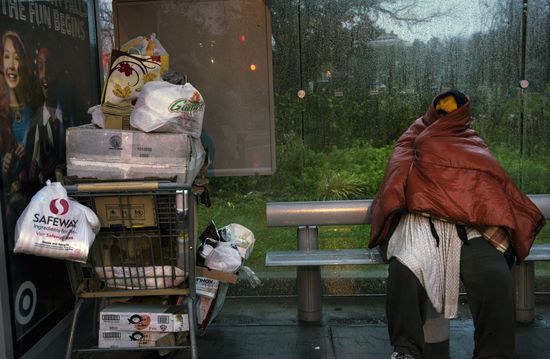
Divides between the rich and the poor are nothing new in New York, but the storm brought them vividly to the surface. There were residents like me who could invest all of their time and energy into protecting their families. And there were New Yorkers who could not. Those with a car could flee. Those with wealth could move into a hotel. Those with steady jobs could decline to come into work. But the city’s cooks, doormen, maintenance men, taxi drivers and maids left their loved ones at home.

Zack Beauchamp, meanwhile, points out that income inequality is "the single most important predictor of vulnerability to storm damage." He adds:

Other sorts of related inequalities also make the impact of storms worse. [Three experts at the University of South Carolina] found that black, Hispanic, and Asian communities in the United States were also more at risk from storms, as were communities dependent on one industry (like mining or fishing), ones with high percentages of residents living in mobile homes, and ones with high population density. The most vulnerable place in the country, in their analysis? Manhattan Borough.

(Photo: John Edgecombe II, who is homeless, takes refuge from the rain and wind at a bus stop on October 29, 2012. By Brendan Smialowski/AFP/Getty Images)