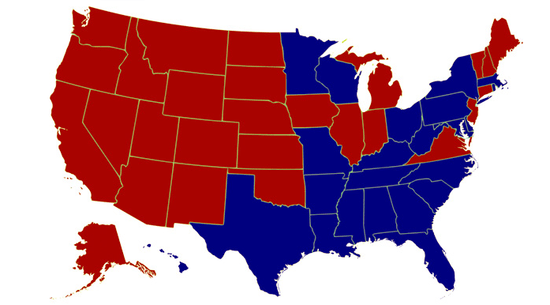
[Map of Electoral College States in the presidential election of 1976. Blue is Democrat, Red Republican.]
There have been many moments during this campaign when I wondered what the late George Romney would have thought. No doubt whom he'd vote for, but the GOP his son now leads? Romney Sr refused to campaign for Barry Goldwater, and the bitterness lasted long after. The following are some things said by George Romney to Barry Goldwater about the direction of the party and the Southern strategy that now looks as if it could bear final fruit in Romney's Dixie firewall.
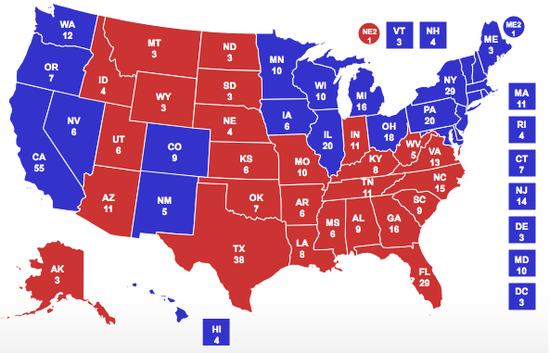
It's a fascinating letter and well worth reading if you are a moderate or independent thinking of voting for the Ailes-Atwater-Rove GOP that Mitt Romney panders endlessly to. Its warnings about the Southern strategy just emerging in Goldwater's opposition to the Civil Rights Act of 1964 are perhaps best illustrated by the maps above, where you can see how in three decades or more, the parties have switched positions geographically. In 1976, the Democrats under Carter won the whole South and lost the entire West and large swathes of the Northeast. By today, the GOP is the inheritor of the Confederacy geographically, and the West and Northeast – previous GOP strongholds – are now the Democratic base.
With that context, check out George Romney's disdain for the idea of ideological parties of the European kind:
Tell that to Hugh Hewitt. Romney then complained to Goldwater about the 1964 GOP Convention platform and had wanted to meet Goldwater in person to convey his concerns. The meeting didn't happen. Back to Romney:
Below the fold is the full, prescient letter, Dec. 21, 1964 and published on November 29, 1966, in the New York Times. The shift from the father's Republican principles to the party the son leads is, well, striking.
First, as to your remarks in Jamaica concerning the possible realignment of the Republican and Democratic parties into “conservative” and "liberal" parties. Whatever the circumstances of the statement, you have indicated that you believe that might be "a happy thing." I disagree.
We need only look at the experience of some ideologically oriented parties in Europe to realize that chaos can result. Dogmatic ideological parties tend to splinter the political and social fabric of a nation, lead to governmental crises and deadlock, and stymie the compromises so often necessary to preserve freedom and achieve progress. A broad based two party structure produces a degree of political stability and viability not otherwise attainable.
I believe, therefore, that we should exert every effort to broaden and strengthen our Republican party, as a means of preserving a strong
two-party system, which is an essential element of a free country.
Next, you state that you are "confused" about the language of the Denver statement that "we need to become inclusive rather than exclusive." It seems to me that the arithmetic of the election should make this unmistakably clear.
A political party which drops from 35,000.000 votes in 1960 to 27,000,000 votes in 1964 has certainly narrowed its orientation and support. The party's need to become more broadly inclusive and attractive should be obvious
to anyone.
Then, and I suppose this is the point which really prompted your letter, you repeatedly indicate that I was at fault for not "backing," "supporting'' and "cooperating 100 per cent with" the top of the national ticket. I suppose I could give you a short and summary answer to this but, to try to resolve misunderstanding, I will cover the point in some detail.
Cites Michigan Vote
First, let me point out that, based upon careful analysis, I'm satisfied that, without changes in your campaign, an endorsement from me would not have made any significant difference in the results of your election.
In Michigan, it would have shifted the state campaign from our Republican record of state progress to the national issues and candidates. Your 33% of the total Michigan vote included about 70% of the Republicans, 30% of
the independents and .5% of the Democrats. Reliable polls show that these percentages remained relatively constant from well before the San Francisco convention all the way through to the election.
The figures appear to have become fixed without regard to any comments or positions of mine. The Presidential campaign dominated Michigan's political consciousness, as I'm sure it did elsewhere. People made up their minds based upon your public positions and your campaign.
I don't make this point to duck responsibility. It's just a fact that should be recognized and you appear to recognize it when you say that "I don't claim for one moment that had you (and others) supported me I would have won."
Second, I believe I made every reasonable effort to bring about circumstances under which I could have "backed" and supported the national ticket. Long before San Francisco–going back to the fall of 1963, I expressed concern about my lack of understanding of your views on several matters which I regarded as vitally important.
In September of 1963 I requested, through your representatives, an opportunity to meet with you to discuss these matters privately and in depth.
(You refer in your letter to the meeting we had at my request much earlier in 1963 in your office in Washington. That discussion was largely limited to three points: (1) The fact that I had a commitment to the people of Michigan that I would not be a candidate for national office in 1964; (2) my invitation to you, as to other candidates, to appear in Michigan; and (3) my concern that your campaign in Michigan avoid, if possible, the involvement of individuals who might make it difficult to preserve party unity and harmony.
At that time I was inclined to support your possible candidacy because the issues that subsequently became of grave concern to me were not then particularly apparent. As a result, I didn't even mention them and discussed a few other matters only incidentally in that meeting.)
At any rate, the meeting I requested in September of 1963 did not occur.
No Meeting Arranged
During the winter of this year, after my earlier requests had been repeatedly renewed, your Mr. Clifton White did tell me he had had talked with you and that you would meet with me after the California primary. However, the meeting did not materialize.
Instead, at the Cleveland Governors' Conference, shortly after the California primary, where I had hoped to be able to meet with you, Paul Fannin handed me a copy of a statement of your positions on some issues, printed for use in the California primary.
In the newspapers I read that when you were questioned about our getting together for what by this time was my well-publicized desire for a discussion in depth, you said you had sent me a printed statement of your positions, and if I didn't understand it, I could get in touch with you.
Let me interject that that time the need for such a meeting had become all the more important. You were just about to take a position the 1964 Civil Rights Act contrary to that of most elected Republicans in and out of Congress, and there were disturbing indications that your strategists proposed to make an all-out push for the Southern white segregationist vote and to attempt to exploit the so-called "white backlash" in the North.
The delegates' mail was beginning to contain much of what I'm sure you would regard as "extremist," "hate” literature, backing you. A clear understanding of your position was needed, and I persisted.
I invited you to Lansing to meet with the Michigan delegates. You accepted. I then telephoned, inviting you through Mrs. Coerver because you were attending a meeting, to come early enough for dinner at my home and a thorough private discussion.
This was first accepted by telephone and then canceled because I was told "the boy said" you could not leave Chicago in time. I then indicated, in writing, my willingness to come to Chicago and fly back with you, so that we could visit on the plane. This was rejected and several days later reproposed by you but unfortunately, only after I had made other unbreakable commitments.
Phone Call Promised
You will then recall our chance meeting at the Washington Butler Airport on June 29. You indicated you could come to Lansing earlier than expected on the following day and that you would call me when you left Chicago.
The next day I not only received no call but you arrived half an hour late for your meeting with our delegation. We talked pleasantries with others present riding in from the airport and briefly in your suite before the meeting of the delegation. I conducted the meeting on the basis of written questions previously prepared by the delegation and used in a similar meeting with Governor Scranton. In my personal view some of your comments in response to delegates' inquiries particularly on civil right and extremists, raised more questions than they resolved. However, I did not regard that relatively open meeting as an appropriate place for me to express to you my concerns. The meeting ended and without saying anything about your failure to arrive on time or of our long sought “discussion in depth," you left.
Following this all-out effort at such a discussion, I decided it was futile to try further before San Francisco.
Sound Platform Sought
However, my efforts to bring about circumstances under which I could support the ticket continued. In my public statements and actions, I placed heavy emphasis on the vital importance of a sound platform.
In a memorandum submitted to Congressman Laird at his request a week before the convention, I spelled out some recommendations of my own, and some offered on behalf of the Republican Governors. This memorandum dealt importantly with positive steps to avoid centralization in Government, emphasizing state, local and individual responsibilities. It also included the points on civil rights and extremism which were later to be the basis for my proposed amendments to the platform.
I presented this memorandum in person and in writing to the entire platform committee on July 8th in San Francisco. My testimony specifically urged, among other rights, that the platform pledge Federal, state, local and individual action to promote the civil rights of all Americans. I also urged the repudiation of extremists who might attach themselves to the party or its candidates. My proposals were subsequently presented in written form to the Platform Committee in debate and were rejected.
Contrary to your statement, my amendment on extremists was offered to the Platform Committee by Richard Van Dusen, the delegate from Michigan and was rejected. Both amendments were next presented, and before the convention consideration of the platform, to your Platform Committee representative, Congressman Rhodes, and he rejected them. I personally discussed the importance of such amendments, briefly and separately, before their being offered on the floor with Congressman Rhodes, Paul Fannin and Richard Kliendienst.
These were not amendments which called for any compromise of your principles, if in fact you find no quarrel with the Denver statements on civil rights and extremism. But they were essential if the party was to be soundly positioned for the campaign on the basis of principles I am convinced are essential to the future of freedom in America and around the world.
Further a platform whose basic emphasis was on state, local and individual rights and responsibilities but which failed to pledge state, local and individual action in the civil rights field was clearly vulnerable to charges of inconsistency, and more important, of bowing to the segregationists in the South. With respect to the extremism amendment, as I said at the time:
"Experience shouts the differences between success and failure are small. I do not believe our country will survive present perils unless the Republican party provides the program and the leadership that will recapture the interest, respect and support of a majority of voting Americans.”
"With extremists of the right and left preaching and practicing hate, and bearing false witness on the basis of guilt by association and circumstantial rationalization and with such extremists rising to official positions of leadership in the Republican party, we cannot recapture the respect of the nation and lead it to its necessary spiritual, moral, and political rebirth if we hide our heads in the sand and decline to even recognize in our platform that the nation is again beset by modern 'know nothings.’"
Private Discussion
The failure of your representatives to accept these concepts left the party in an exposed and vulnerable position. A leading Southern delegate in a private discussion with me, opposing my civil rights amendment after it was introduced but before it was offered, made it clear that there had been a platform deal that was a surrender to the Southern segregationists, contrary to the entire tradition of the party. And it appeared that there was a willingness to accept, perhaps even welcome the support of irresponsible extremists such as those you clearly reject in the Dec. 21, 1964, U.S News interview.
Serious as this weakness was, you could still have corrected it by speaking out clearly and unequivocally. Unfortunately, your acceptance speech moved in precisely the opposite direction, seeming to approve the platform as adopted and to throw down the gauntlet to those who had dared to suggest it could be improved. Then the replacements made on the national committee executive committee by your appointee, Dean Burch, added to the evident intention to restrict direction of the campaign and the party to those who had supported you before the convention. The very ones needed to give the campaign broad and inclusive direction were replaced.
Despite these developments, I still keep the door open for an endorsement of you. On July 15, 1964, as the convention ended, I said:
"As the national campaign progresses in a . . . responsible manner free of hate-peddling and fear spreading and devoted to the issues of the day, I will be happy to support it."
Reviewed Amendments
Just ahead of the Hershey conference, you invited me to Washington for the type of "discussion in depth" I persistently sought for most of the nine months before San Francisco. At that meeting I reviewed the reasons behind the proposed platform amendments on civil rights and extremism, only to be told by you that you had only read a few sections of the platform and didn't know what amendments were being offered.
On that occasion I told you of a leading Southern delegate's revelation that a deal had been made on the platform's civil rights language which our Michigan amendments violated. I also urged you to recognize the need to overcome the effect of Governor Wallace's withdrawal and some Ku Klux Klan endorsement.
You cited your personal dedication and action to eliminate discrimination and human injustice as you did many times before and during the campaign—a personal attitude I do not question now and did not question then or at any time. However, I did my best to point out the inconsistency between your personal record and public record including the arbitrary rejection of my San Francisco amendment which was offered separately from the Rockefeller-Scranton amendment because it dealt only with principle and was not related to the candidacy fight.
While this made no apparent impression on you, at the end of our conference, which also included a shorter discussion of the extremism issue, you asked me to let you have any suggestions before the Hershey conference. This I did in writing, urging a public statement by you at Hershey that would include this key language:
"The enduring solution must be a personal solution in the hearts and minds of individuals. That is why we must encourage civil rights actions by individuals, in families, in neighborhoods, and at the community and state levels of government.”
"The rights of some must not be enjoyed by denying the rights of others. Neither can we permit states' rights at the expense of human rights. The basic principles of individual rights and states' rights are indivisible from individual responsibilities and states' responsibilities."
Extremism Suggestion
My extremism suggestion recommended this statement on your part:
"Extremism in defense of liberty is not a vice but I denounce political extremism, of the left or the right, based on duplicity, falsehood, fear, violence, and threats when they endanger liberty."
"A political extremist in my view is one who advocates overthrow of our Government through either peaceful or violent means; one who uses threats or violence or unlawful or immoral means to achieve political ends; or one who believes that the political end justifies the use of any means, regardless of the effect on others."
"Such political extremism destroys liberty, and is a vice."
"With one or two exceptions, I cannot condemn groups as groups. Guilt by association is contrary to American principles of justice."
In the subsequent inadequate opportunity for discussion at Hershey it was apparent you were not planning to make such strong clarifying statements. As a result, three times in the group meeting I tried to point out your need to recognize and correct the conflict between your personal and public record, My final plea was voiced in essentially these words:
Barry, in essence what I'm urging is that you urge others to do in the field of civil rights what you say you have done at the private, local and state levels. To advocate it with such conviction that everyone will know you mean exactly that.
Notes Campaign Actions
In one response, you said that I was questioning your honesty.
As far as the campaign itself was concerned, I ran as a Republican on a record of state progress built with the assistance of Republican legislators. I endorsed statewide and local Republican candidates and appeared with hundreds of them. I instructed the G.O.P. State Central Committee to extend full support based on Republican accomplishments. I ran as a Republican and I won as a Republican.
Despite our landslide losses in local and state offices, we have stopped the progressive membership shrinkage of the Republican party in Michigan and have started to broaden its base. We are now in the process of taking steps in Michigan similar to those recommended in the Denver Governors' statement designed to broaden and strengthen the party nationally. To the extent I can, I want to help in this effort.
I cannot accept the blame for the divisiveness in the party when you, your representatives, and your campaign strategy refused to encompass those of us who had reservations based on basic American and Republican principles. My reservations I voiced privately to your representatives and publicly on many occasions for some months before the San Francisco convention. Dick Nixon, since you draw the analogy, was astute enough to reach understandings with you and Governor Rockefeller in 1960.
At no time before or during or immediately following the convention did you move effectively to restore the unity of the party. You certainly knew the Hershey conference had failed to do so. Points of principle raised in discussion were not resolved nor did the conference have any apparent influence on the campaign.
Acceptance Speech Cited
Many in the party detected intransigence in your attitudes before, during and after the 1964 convention, culminating in your acceptance speech which, among other things, said:
"Any who join us in all sincerity, we welcome. Those who do not care for our cause we do not expect to enter our ranks in any case."
Indeed, the conduct of the campaign and the Nov. 3 election results demonstrated that your campaign never effectively deviated from the Southern-rural-white orientation. Preconvention discussion and postelection discussions with some who were active in your campaign brought to my attention distressing evidence that this was part of the strategy.
Now, Barry, I do not assert you were aware of this strategy or the author of it. I frankly can't believe you shaped it. You didn't read the platform adopted in San Francisco and you didn't know what amendments were being offered on the floor so you were obviously leaving many vital things almost entirely up to others, vital things about which you were not personally informed. This may account for your inability to see the inconsistencies I tried so hard to help you recognize.
However, for these philosophical, moral and strategic reasons, I was never able to endorse you during the campaign. Of course, millions did because they believed your leadership would inspire a rebirth of Americanism and a strengthening of constitutional government.
I, too, am one dedicated to these objectives, but I know they cannot be realized if foundation principles of American freedom are compromised. The chief cornerstone of our freedom is divinely endowed citizenship for all equally regardless of pigmentation, creed or race.
Unwilling to Compromise
It is true I said on the "Face the Nation" television interview that I did not endorse you because I was not willing to compromise one iota the principles I fought for in San Francisco. But this did not make it "rather clear that you expected me and others to compromise theirs" as you assert. I have never suggested that to you or anyone else.
One reason I was so anxious to talk with you in depth before the convention was because I felt sure we would be in agreement in principle on the above issues and others, providing there was adequate opportunity to discuss them, but I was denied this opportunity until it was too late.
Now, I realize that our busy schedules contributed to the problem, but I sincerely tried over a nine-month period to arrange a discussion. Our relatively public meetings were hardly appropriate "to bury our differences " as you put it. So, if our positions were really closer than it appeared, all I can say is that I made my position known on many occasions and did my best to discuss them with you personally and in depth.
As to the governmental centralization, we do share a common apprehension and concern. But, then you ask me, "Where were you, George, when the chips were down and the going was hard?" Well, Barry, for a long time I've been right on the firing line.
All Republicans (and, I believe, most Americans) are increasingly concerned about constant centralization, but many of us believe we must have a positive rather than negative approach to this increased Federal control.
At San Francisco, I offered a detailed program for stronger state and local government cooperation and activity, plus recommendations that could result in a recovery of certain functions from Federal control. On behalf of the Republican Governors' Association, I urged the Resolutions Committee to adopt these proposals. For the most part the recommendations were ignored by the committee and in your campaign.
In Michigan, I entered public life to help modernize Michigan state and local government as an essential step in slowing and reversing the constant flow of responsibility to Washington. It is futile to talk about stopping centralization and the eventual nullification of our constitution without removing the antiquated obstacles at the state and local level that prevent meeting the needs of the people effectively in the right place.
Urges ‘Sound Solutions’
I do not believe we can prevent unsound solutions to current problems by sheer opposition. My experience convinces me we must present sound solutions based on applying our proven principles to current problems in the development of specific, positive programs.
Only in this way can we stop the adoption of unsound national programs to fill personal, private, local, state and national vacuums. For instance, talk about states' rights will not be an adequate substitute for state responsibility. We are beginning to prove in Michigan, and in some other states, what it takes to deal with centralism.
In light of your recent public statements joining me with Nelson Rockefeller, may I point out that at no time did I publicly or privately say or do anything to create "the bomb scare or Social Security scare." I never discussed them. Nor was I part of any stop-Goldwater effort before or at the convention.
Finally, this has been a difficult letter to write. It is all too apparent that we have differing interpretations of the events of this hectic year. What I have tried to do is to answer your questions about the past. Having done so, I—as I believe you are—am much more concerned with the party's future than its past.
Early Meeting Favored
Just as I believed in full and frank discussion of intraparty differences (and agreements) before the election, I believe in it now. The sooner we can get together and discuss the recovery of the G.O.P., the better. The sooner we can get together with others, as well, the better.
Your agreement with the statement of principles and unifying recommendations adopted by the Republican Governors' Association bodes well for productive future conversations. I urge your early direct public endorsement of it.
I also urge you to take the initiative in calling the leadership planning group meeting that is recommended instead of fighting the implementation of that hopeful aggreement. This would be constructive and a big step in the right direction.
The real challenge for us lies in the expansion of voter support for the Republican party in all parts of the country, urban or rural, North or South, colored or white. Without common dedication to this fundamental, our rehash of 1964 positions may become of interest only to the historians of defunct political institutions.
Intraparty Talks Urged
I believe an intraparty leadership conference representing all elements of the party is essential to unifying and strengthening it. Based on our experience at the Denver Governors' Conference, I know it will take a schedule that provides adequate time for the frank, sincere, searching discussion that is essential in resolving misunderstanding and hammering out agreement on principles and programs.
The Denver conference is the only one in which I have participated involving representative party leadership from any party segment where such a procedure was used and such a result achieved.
It was a significant accomplishment to arrive at unanimous agreement in a group representing the diversity in viewpoint of a Paul Fannin and Nelson Rockefeller.
It was also significant that a preponderant majority exercised restraint and did not force their position into the approved statement contrary to the views of a significant minority.
I hope you will actively support the Denver recommendations designed to achieve needed national leadership agreement and understanding. I regret such a leadership conference could not be convened ahead of the Chicago meeting of the National Committee. This I advocated but reluctantly abandoned as being impossible considering the time problem.
You may be sure I am prepared at any time to meet with you or other party leaders to increase our effectiveness in strengthening our party for the essential task it faces of arousing the nation to the developing national crisis and providing the programs that will get us back on the road to realizing America's divine destiny.
Barry, from a personal standpoint as well as party standpoint, I wish the past year had turned out differently so I could have followed my personal attitude toward you as a friend and endorsed you.
Lenore joins me in wishing the new year will be one of health and happiness for you and Peggy and your loved ones.
Sincerely, ?GEORGE ROMNEY

 The Dish