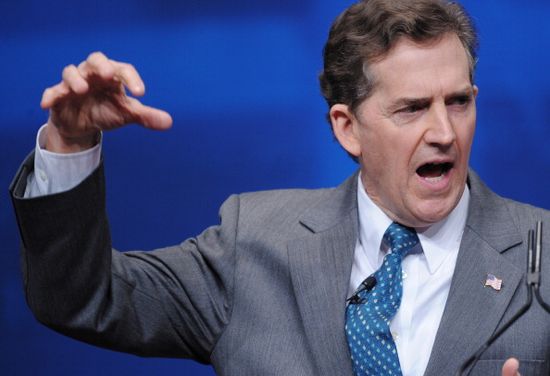
Senator Jim DeMint announced today that he’ll end his eight-year stint in the Senate to lead the Heritage Foundation, despite having four years remaining in his tenure. South Carolina Governor Nikki Haley will name his successor. Weigel weighs in:
Maybe we should have seen it coming. Earlier this year, DeMint set loose the Senate Conservatives Fund, the inside-outside Republican PAC that encouraged conservatives to run, and even to primary moderates. He blew a few races, but he succeeded in marshalling through a group of reliable, energetic, media-savvy conservatives, like Mike Lee, Rand Paul, Ted Cruz, and Marco Rubio. DeMint was the first to talk down his own political skills and talk up the people he’d recruited. His work here was done.
Doug Mataconis considers the implications of DeMint’s departure:
[This development] sets up an interesting situation in South Carolina, where speculation was high that Lindsey Graham would face a tough primary fight from the a candidate on the right. With two Senate seats now open in the Palmetto State in 2014, though, that is likely to reduce the pool of candidates that would take on Graham and may end up making him far less vulnerable.
John Stanton disagrees and argues that DeMint can now “play kingmaker” in both of South Carolina’s Senate races, making Graham all the more vulnerable. How Tomasky sees the move:
I don’t know if it was even possible for Heritage to move further to the right, but if it was, it just did so. Heritage is the preeminent conservative policy shop; the AEI people might argue with me, but Heritage is certainly the biggest, anyway. The conservative intellectual/policy class right now faces a choice: lead the party they exist to support in some new and interesting directions, or double down on all the extremist and unpopular positions they currently hold. Heritage just chose.
Noting that DeMint is likely to receive more than $1-million in salary at Heritage, Yglesias wonders if we’re not seeing the emergence of a larger migration trend:
[G]uys like Billy Tauzin and Evan Bayh have been blazing a trail that was formerly dominated by Hill staffers, namely moving voluntarily out of the public sector and into the lobbying space. When Representative Heath Shuler (D-NC) announced plans to resign at the young age of 40, for example, that naturally prompted questions about whether he was planning to become a lobbyist. He said no at the time but on November 26, Duke Energy announced that he’ll be their new Vice President of Government Affairs.
The reaction on the right side of the blogosphere is mixed. Ed Morrissey laments DeMint’s decision:
Frankly, I’m disappointed by the move…. [C]onsidering the fights ahead of us, it would have been much better to have DeMint as a stalwart on the inside rather than an activist on the outside.
Erick Erickson likes the news:
Jim DeMint is, like [current Heritage Foundation president] Ed Feulner, not indispensable. But his ideas are. It is time for the tea party senators he brought to the Senate to stretch their legs and prove they are Jim DeMint’s ideological heirs. In the meantime, he will be on the outside providing them the support and intellectual ammunition they need.
Jennifer Rubin says good riddance:
DeMint has been a destructive force, threatening to primary colleagues, resisting all deals and offering very little in the way of attainable legislation. He has contributed more than any current senator to the dysfunction of that body. He has worsened relations between the House and Senate, as he did in the budget fights in recent years, by meddling and pressuring his home state representative. His departure leaves other senators who seemed impressed with his brand of politics free to find their way to a more constructive position in the body.
John Podhoretz hopes Heritage continues to produce policy ideas:
The temptation for DeMint will be to stress the institution’s role in opposition, which is his stock in trade as a senator, and to downgrade its policy role, which has had its major “up”s (welfare reform) and its blind-spot “down”s (advocating a health-care mandate in 1994). But if ideas do not play the central role, Heritage will hollow itself out, and that would be a great shame.
(Photo by Mandel Ngan/AFP/Getty Images)
 The Dish