Searching For The Star Of Bethlehem

XKCD wonders just what star, or planet, the wise men were following: 

There aren’t very many good astronomical candidates for the Star of Bethlehem (Chinese records don’t show a supernova at the right time, and none of the other obvious candidates check out) and, furthermore, there’s a lot of historical and theological debate over Jesus’s date of birth ("4 BC" seems to be the closest thing to a historical consensus date). These charts are all calculated for a somewhat arbitrary departure date from Jerusalem of December 25th, 1 AD; different departure days would lead to different paths, but the overall picture would be the same.

Christmas Without Christ

Akim Reinhardt underscores the secular way to appreciate the holiday, taking a cue from his immigrant friends:

Three generations’ worth of Indian immigrants and their progeny would decorate a tree, wrap and exchange gifts, and even sing overtly religious songs like "Oh Holy Night."  They were Hindus.  Not only weren’t they Christian, a number of them didn’t even really know all that much about Christian theology.  Yet there they were, not only "doing" Christmas, and not being threatened by it at all.  Hell, they were enjoying it as much as the next guy. …

Because in a nation where citizenship is based on a political ideal instead of an ethnicity, and where where national ethnicity itself, "American-ness," is an incredibly dynamic and flexible thing, celebrating the secular, pop-culture version of Christmas is a fast track to actually being accepted.  It’s a harmless (though potentially expensive) form of assimilation. That’s what my Gujarati friends understood. Celebrating the birth of Christ is a way to be Christian.  But decorating a tree, eating gingerbread cookies, exchanging gifts, and even singing "Fa La La," is a way to be American.

Bruce Feiler also considers whether God is necessary to enjoy the holidays:

Yes, the Hanukkah story, like many in religion, has a strong streak of violence, intolerance and paganism. (Christmas, for the record, has similar streaks.) I get a perverse pleasure out of dropping hints about that with my kids, puncturing the pristine version they learn at our synagogue. But it’s also a story of deep devotion, of standing up for your beliefs, of maintaining a tradition for thousands of years, even as those around you wanted to kill you for a small dose of honor to the past. I once participated in lighting a menorah at the base of the Western Wall. It was deeply emotional, even though I have profound ambivalence about the Maccabees.

To me, that’s what the holidays are about — relating the past to the present. Changing views of God are a central part of that story. I wrote about kids and God in The Times a few years ago, and the one vow I made to myself is that I won’t lie to my children. I tell them what I believe (as does my wife). I tell them that most people disagree with us. And I refuse to tell them fairy tales about men in white beards. I try to tell them age-appropriate versions of the sometimes messy, sometimes beautiful truth. And when all else fails (as it eventually does), I ask them, "So what do you believe?"

Map Of The Day

Pew's report on major world religions contains some eye-opening graphics. Among them:

Majority_Religions

Fisher contrasts this chart with Bill O’Reilly's "war on christmas" rhetoric:

The global reach of Christianity is pretty hard to miss. The entire Western hemisphere is majority Christian, as is virtually all of Europe, much of sub-Saharan Africa, even small parts of Asia. If you lived in one of those green or yellow countries, do you think Christianity would look threatened to you? Asia, of course, is the big exception to Christianity’s otherwise common status as majority religion. But there are huge numbers of Christians even there.

The Real Rudolphs

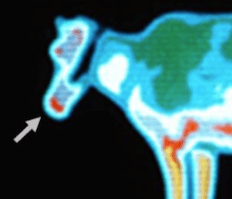
Just in time for the holidays, researchers in the Netherlands and Norway published a study showing that some fraction of reindeer actually do have red noses, due to "an extremely dense array of blood vessels, packed into the nose in order to supply blood and regulate body temperature in extreme environments." Joseph Stromberg summarizes the findings:

They discovered that the reindeer had a 25% higher concentration of blood vessels in their noses, on average. They also put the reindeer on a treadmill and used infrared Rudolfimaging to measure what parts of their bodies shed the most heat after exercise. The nose, along with the hind legs, reached temperatures as high as 75°F—relatively hot for a reindeer—indicating that one of the main functions of all this blood flow is to help regulate temperature, bringing large volumes of blood close to the surface when the animals are overheated, so its heat can radiate out into the air.
The Chocolate Connection

Vaughan Bell remembers Black Magic chocolates, familiar to British shoppers and "produced by Rowntree’s who were a pioneer in using empirical psychology to design products." He excerpts a fascinating article on the marketing scheme:

The National Institute of Industrial Psychology interviewed 7,000 people over six months on their conception of the perfect chocolate assortment. In another survey, 3,000 preferences for hard, soft, and nut centres exactly determined the proportions of chocolate types in the assortment. Retailers were consulted and their recommendations on margins and price maintenance were followed carefully. Shopkeepers, moreover, supplied information on buying behavior, and it was discovered that most assortments were purchased by men for women and that they were influenced entirely by value rather than fancy boxes. The now familiar, simple black-and-white box was distinctive and chosen from fifty similar designs.

The marketing was then focussed not on the qualities of the product, but on its potential use in developing relationships.

The Worst Christmas Song

Patton Oswalt has one nomination:

Jonathan Coulton chooses a more conventional tune:

"Jingle Bell Rock," for me, exemplifies succumbing to your worst impulses as a songwriter. It’s one of those Christmas songs that mostly feels like it’s trying to cash in on a couple of things, one of them being the popularity of the Christmas song "Jingle Bells," which no one will deny, and the newfound popularity, at the time, of rock music. You can almost hear the discussion. They’re like, "You know what we should do? We should combine two things that America loves: ‘Jingle Bells’ and rock music." Then it’s "ka-ching" from there. 

What you end up with is a song that, first of all, most modern listeners would hear this song, and say, "Well, where is the rock, exactly?" Mostly it sounds like jingle bell jazz. I recognize rock was young, but it’s sort of the equivalent of if I decided today that I was going to do a song called "Jingle Bell Rap." [Laughs.] It would be about as good. "Jingle bell rap. Shop at the Gap." That’s half the song right there.

It’s The Happiest Day Of The Year

Statistically speaking:

As part of my research, I've collected data from more than 20,000 people who report how happy they feel at randomly selected moments during daily life. These data reveal that we actually are happier than usual on holidays. In fact, Christmas Day, though not celebrated by everyone, is the happiest day of the year by a significant margin. Thanksgiving and New Year's Eve are not too far behind. While it's easy to call to mind spoiled children fighting over toys or distant relations making awkward conversation, the holidays are, relatively speaking, quite happy.

A Poem For Christmas Eve

Fireplace

"The Oxen" by Thomas Hardy (1840-1928):

Christmas Eve, and twelve of the clock.
"Now they are all on their knees,"
An elder said as we sat in a flock
By the embers in hearthside ease.
We pictured the meek mild creatures where
They dwelt in their strawy pen,
Nor did it occur to one of us there
To doubt they were kneeling then.
So fair a fancy few would weave
In these years! Yet, I feel,
If someone said on Christmas Eve,
"Come; see the oxen kneel
"In the lonely barton by yonder coomb
Our childhood used to know,"
I should go with him in the gloom,
Hoping it might be so.

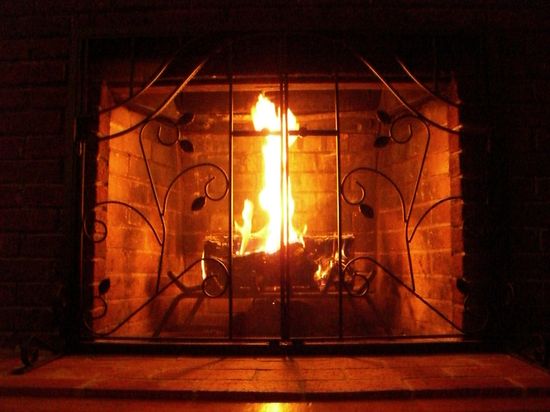
(Photo by Aaron Gustafson)