The Markets Yawn At The Fiscal Cliff

Neil Irwin notes that Wall Street hasn't tanked today:

So what’s going on here? First, global investors clearly aren’t viewing this as an end-of-the-world doomsday scenario that they did in 2008 when the House rejected the bank bailout bill in 2008 on its first pass (that day, the stock market fell 8 percent). That will likely change if it starts to look like the nation is not only going over the fiscal cliff, but poised to stay there. It could also change if the brinksmanship shifts from the relatively manageable risk of an austerity-induced recession toward the more existential one of a debt ceiling showdown and possibility of a U.S. government default.

Smearing Hagel, Ctd

Barney Frank calls Chuck Hagel “aggressively bigoted” in his opposition to the nomination of James Hormel:

“I cannot think of any other minority group in the U.S. today where such a negative statement and action made in 1998 would not be an obstacle to a major Presidential appointment.”

But that obscures the point, doesn’t it?

Does Barney know of any other minority group whose image has shifted so quickly since 1998? Gays were still among the last despised minorities back then – which helps explain why president Clinton signed the Defense of Marriage Act, enforced the ban on HIV-positive tourists and immigrants, and doubled the rate of discharges from the military on grounds of homosexual orientation. But Clinton – who ran ads in 1996 bragging of his opposition to marriage equality – is a civil rights hero now, because he has evolved. And the president is congratulated for evolving as well. Whereas Hagel, a Republican, cannot even have an apology accepted, and is penalized for his past views.

Why Is The Pentagon Off The Table?

Screen shot 2012-12-31 at 1.11.30 PM

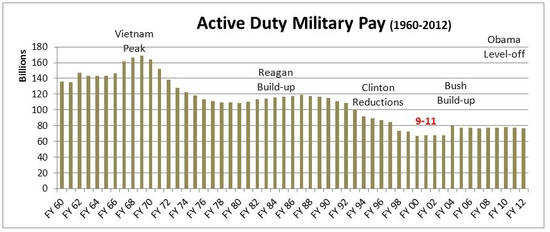
The Pentagon now spends more money than it did confronting the Soviets under Reagan or at the peak of fighting in Vietnam. Yep, those are real inflation-adjusted dollars. So why are we hearing nothing in Washington about a huge part of the spending binge that, along with the Great Recession, has bankrupted the country? Some say it's because no one wants to force sacrifices on the troops, which is an admirable position, given their extraordinary sacrifices over the past decade. But here's the spending on the troops for the same period, as outlined by "simple serf" at the Daily Kos:

Screen shot 2012-12-31 at 1.16.04 PM

I should say I don't agree with simple serf that entitlements should be left alone. They are the core driver of future debt. But I do not see why the Pentagon is immune from real sacrifice, when we have no serious military rival in the world and are spending more in real terms than we did when Reagan out-spent the Soviets.

So let's stipulate no pay cuts for troops. We still have almost 90 percent of the most expansive war budget since the Second World War intact. And we cannot touch any of that? The sequester crudely cuts $500 billion from war spending over ten years, and that is regarded as obviously unworkable. But if we simply retained the war spending we did in 1960 – at the height of the early Cold War – we'd be cutting the decade budget by a few trillion dollars. Eisenhower was onto something, wasn't he, when he spoke of an unstoppable military-industrial complex that threatens democratic life? Not to say: the country's entire fiscal health.

History is replete with examples of great powers who undid themselves by spending on war and empire – in the end often with debt – while neglecting the core concerns of the domestic economy. Hegemonic America is following imperial Spain and imperial Britain into the same morass. But it is a choice, not a fate.

Quote For The Day II

"If Republicans think I will finish the job of deficit reduction through spending cuts … then they have another thing coming," – president Obama an hour ago. Update from a reader:

I heard Obama's statement live and then doublechecked by listening to it again on replay." He did NOT say "thing"; he said "think." The use of "thing" in this cliche is an American illiteracy perpetuated all too often by the U.S. media. Obama is much too skilled a user of the language to commit this blunder.

The White House’s Logic On The Tax Compromise

Sargent passes along what he is hearing from a “White House ally”:

The idea is that it’s better to lock in a deal on rates now, at, say, $450,000, extend unemployment benefits, and pocket those gains and continue the fight next year. Raising the income threshold is obviously not desirable, but Dems will have broken the decades-long GOP opposition to raising tax rates on the rich, pocketed hundreds of billions in revenues, made the tax code more progressive, and extended unemployment benefits — all without agreeing to any spending cuts yet.

In so doing, will Dems squander their leverage next year? I and others have argued that they would. But the alternate interpretation is that Republicans, even next year, after a cliff dive, won’t have their options as limited as we might hope — they might not have to support the $250,000 threshold, after all. And Dems may still retain leverage in another way, even with the rates locked in by a deal this year. Republicans will use the debt ceiling to extract spending cuts, but Dems might counter by demanding more revenues via tax reform that closes loopholes and deductions for the wealthy.

That last point was presumably what the president was referring to in his speech when he said this deal on taxes does not mean that the only thing left is cutting spending. He means tax reform that will make the system more progressive.

Cliff Notes, Ctd

158835690

Well this looks to me like a win for the White House and the economy:

Taxes would rise in some sense on the top 2 percent of earners, as Mr. Obama had wanted. That is because the deal would reinstate provisions to tax law, ended by the Bush tax cuts of 2001, that phase out personal exemptions and deductions for the affluent. Those phaseouts, under the agreement, would begin at $250,000 for single people and $300,000 for couples.

The estate tax would also rise, but considerably less than Democrats had wanted. The value of estates over $5 million would be taxed at 40 percent, up from the current 35 percent. Democrats had wanted a 45 percent rate on inheritances larger than $3.5 million. Under the deal, the new rates on income, investment and inheritances would be permanent.

Mr. Obama and the Democrats would be granted a five-year extension of tax cuts they won in the 2009 stimulus law for middle-class and working-poor taxpayers. Those include a child credit that goes out as a check to workers who do not earn enough money to pay income taxes, an expanded earned income credit and a refundable credit for tuition. Democrats also secured a full year’s extension of unemployment insurance without strings attached, a $30 billion cost.

The sticking point now is how to stop the spending side of the equation from taking effect immediately. The Dems want a one-year sequester pause; the GOP apparently doesn't. I'm with the GOP on this. The only way to get the kind of momentum we need to cut entitlements and defense is the pressure of the sequester. I do not believe it should be suspended now – when a grand bargain has not yet been reached. It should, instead, be reformed as soon as possible to make it a much less crude instrument – and as part of a larger reformist deal. If the tax hikes are neutralized and unemployment insurance extended, as appears to be the case, the immediate threat to the economy is lifted. I see no reason to surrender on spending cuts over the next decade now. It would mean that the US still cannot get a grip on future spending. And I want to see the Pentagon finally face the music.

As for Obama's just concluded speech, it was remarkably jovial and a little tart when it came to dissing Congressional inaction. It contained one key threat, it seemed to me. Obama is not going to simply enforce the sequester or serious spending cuts without further give from the GOP on revenues and tax reform. At least, that's what I inferred from his statement. This is the middle of a titanic struggle, not the end.

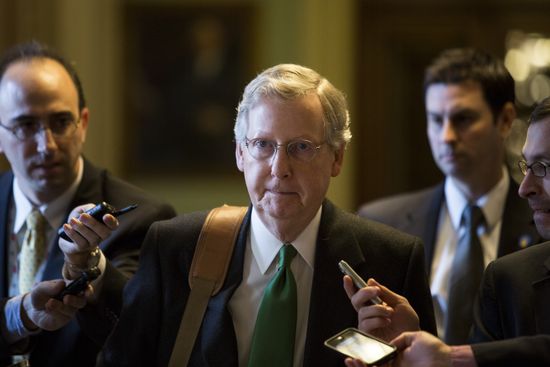
(Photo: Senate Minority Leader Mitch McConnell (R-KY) walks to his office on Capitol Hill December 31, 2012 in Washington, DC. The House and Senate are both still in session on New Year's Eve to try to deal with the looming 'fiscal cliff.' By Drew Angerer/Getty Images.)

Who Paid For The Log Cabin Republican Ad Against Hagel? Ctd

A reader writes:

Think about it this way: Republicans who want to smear a guy are saying that he's insufficiently devoted to gay civil rights.

Sure, they're being hypocritical. But it's still kind of an extraordinary thing. It's been only a few years since gay marriage was cynically used as a bogus wedge issue — something that would gin up fear and mobilize the GOP base. Now they're taking the opposite tack in their cynical use of homosexuality for political ends. People who aren't 100% on board with civil rights are unfit for high office.

The party is still awful and cynical. But it does show real progress.

Another:

I remember being glued to your blog when you were covering Richard Grenell getting booted from the Romney campaign. But I may have missed this, but where was Log Cabin then? What was R. Clarke Cooper saying then?

Here's what he said:

Ric was essentially hounded by the far right and far left. The Romney campaign has lost a well-known advocate of conservative ideas and a talented spokesman, and I am certain he will remain an active voice for a confident U.S. foreign policy.

Hounded by the far right and the far left? You mean: like Hagel?

By the way, this piece in the Washington Blade has some helpful context. Cooper announced his resignation from Log Cabin Republicans the day after the ad came out. They have not found a permanent replacement. Meanwhile:

Asked by the Blade to explain why the Gay City News comments were different from the content of the anti-Hagel ad, Cooper said at that time Log Cabin hadn’t yet reached a final decision on Hagel. "What is consistent is where I’ve been on non-proliferation of nuclear capability in Iran, or Iran writ-large," Cooper said. “When I talked with a reporter from Gay City News a while back, he said, ‘Where are you on this?’ I said, ‘We’re looking at a lot of things with our coalition partners, I worked with Chuck Hagel, but we’re going to be putting out something soon.’”

Who are the "coalition partners"? And did they play a role in this ad?

Again, it reminds me of the NGLTF on the far left, constantly muddying gay issues with other ideological fixations to placate their "coalition partners." Or HRC's long obsession with abortion rights as integral to gay equality. The only similar LCR ad in recent history was one backing marriage equality in the Republican Convention. That made sense. Going out on a limb to torpedo a Republican nominee doesn't.

Clinton’s Clot

158835562

A reader writes:

I am a practicing general/trauma surgeon here in Cleveland. Hillary Clinton's blood clot (or "deep venous thrombosis") is almost certainly related to her recent closed head injury. Trauma patients, particularly those with significant head or spinal trauma, are considered high risk for the development of these clots. The fact that Mrs Clinton developed a clot a few years ago additionally raises her risk portfolio. We see this all the time in medical/trauma practice. Head injuries alter the coagulation parameters of the body in unpredictable, potentially deleterious ways. As a result of this, I would expect her to require anticoagulation therapy for the rest of her life.

The Althouse response is hysterical on so many levels. The part where she writes – " Was it her brain (recently concussed)? Was it her leg (where she had a blood clot back in 1998)? The former is a big deal, the latter, not so much. Why not specify the site, since it make such a big difference, medically? " – is about as ignorant as it gets. A blood clot in the leg is extraordinarily dangerous. Those clots have a propensity for breaking off and traveling to the main arteries supplying the lungs where you can, you know, die instantly.

(Photo: A view of New York Presbyterian Hospital, where US Secretary of State Hillary Clinton has been hospitalized, on December, 31, 2012. The latest health scare for the globe-trotting Clinton will likely keep her out of the public eye a bit longer, just as she prepares to step down after four years as America's top diplomat. Clinton, 65, fell ill with a stomach bug on her return from a trip to Europe earlier this month that caused the former first lady to become severely dehydrated and faint, suffering a concussion. By Mehdi Taamallah/AFP/Getty Images)