A Book Worth Dumping Someone Over

Kate Hakala nominates Kerouac's On The Road:

I understand that it's romantic — this notion of endless wanderlust, searching high and low for the beauty and wonder in new life experience. But it's like that line in "Psycho Killer:" "You're talking a lot, but you're not saying anything." Sal, Dean, and the gang don't speak with people, but rather, past them. They do not understand the nature of experience, only the idea of experience. There's a lack of connection, a neglect of any deeper side to humanity than what you can get on a road trip. …

So, maybe I'm not a fabulous yellow roman candle burning quickly across the heavens. But, you know what else burn burn burns fast? Chlamydia, like the kind you get from worldly travelers without insurance policies. Same with the romance of transience, or a junkie's need for purely novel experiences. It gets old, because there's no depth to wandering. For true experience, or value in really anything, you've got to put in the time, not just breeze through and write a run-on sentence about it.
Tragedy Mangles Your Memories

Onnesha Roychoudhuri contemplates that idea in the context of Newtown:

Sandy Hook: The school’s baseball field where I first learned how to hit a ball and mean it. Where my brother had his tenth birthday party and I wore a pair of pink shorts printed with gray kittens. Where the outsized, green footprints of our mascot, the Green Giant, formed a path to the entrance of the school. Where my mother taught off and on. Where I wrote a sequel to The Hobbit for Mrs. Toomey, who was seriously unimpressed. Where, on a stormy day, Mrs. Hansen-Bolt let us gather at the front of the room and huddle together as she opened up a book and began to read. Where we felt safe.

I wrote these memories feverishly while, in the background, I listened to the continuous coverage of the Sandy Hook shooting. It felt like a compulsive and involuntary act, a race to commit to memory images on an old filmstrip that might, at any moment, melt away. And in some ways, they will, the richness of these memories co-opted by a horror, a redrawing of a psychological map. The library where I sat with Harold and the Purple Crayon now the library where teachers hid their students, supplying them with paper and crayons. Telling them to color while twenty of their schoolmates were shot and killed.

This is the geography of grieving, where a place of life becomes a reminder of death, a reminder that threatens to eclipse the memories that came before. It’s a strange thing to watch a small hometown transformed into a monument, a memorial.

Quote For The Day

"Roy looks up at him with frightened inky eyes. "Will they put us in jail?" he asks, his voice high and precise, like wind chimes.

Harry laughs. "Where'd you get that idea?"

"Daddy hates jail."

"Well who doesn't!" Harry says, wondering if the child is quite right in the head. Roy doesn't understand you should loosen the string of bathing trunks to pull them on, and while he fumbles and struggles his little penis sticks straight out, no longer than it is thick, cute as a button mushroom. He is circumcised.

Rabbit wonders what his own life would have been like if he had been circumcised. The issue comes up now and then in the newspapers. Some say the foreskin is like an eyelid; without it the constantly exposed glans become less sensitive, it gets thick-skinned and dull rubbing against cloth all the time. A letter he once read in a skin magazine was from a guy who got circumcised in midlife and found his sexual pleasure and responsiveness went so far down his circumcised life was hardly worth living. If Harry had been less responsive he might have been a more dependable person.

Getting a hard-on you can feel the foreskin sweetly tug back, like freezing ream lifting the paper cap on the old-time milk bottles. From the numb look of his prick Roy will be a solid citizen. His grandfather reaches down a hand to lead him out to the beach," – John Updike, Rabbit At Rest.

Thanks to a reader.

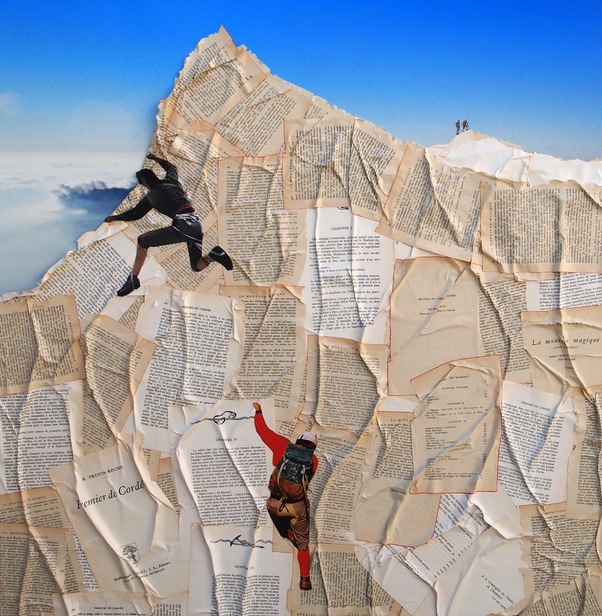
Experiencing A Book

Erwansoyercollages1

How we read is a growing area of scholarship:

Did a reader's encounter with a book or newspaper happen in daylight or by candlelight? Was the book read out loud or in solitude? On the move or in bed? [Simon Eliot] talks about a kind of punctuated reading dictated by stagecoach travel, in which a reader jolted along rough 18th- or 19th-century roads might snatch a few minutes with a book at inns whenever the coach stopped to change horses, kind of like how travelers now might read in the airport lounge before boarding.

Today's readers, at least in the West, tend not to fret about having something to read and light enough to read by, "because books are so cheap and light is so cheap," Eliot says. British readers of earlier eras were not so lucky. Unless they could afford oil lamps or beeswax candles, they had to deal with messy, smelly candles made from tallow. Those imperfect sources of light required frequent trimming and were a fire hazard. Under such circumstances, "reading has to be choreographed," Eliot says. "You have to stop and trim" the wick as well as avoid setting yourself on fire.

(Collage by Erwan Soyer via My Modern Met)

Is The Internet Creating New Languages?

Jane O'Brien suggests so:

In previous centuries, the convergence of cultures and trade led to the emergence of pidgin – a streamlined system of communication that has simple grammatical structure, says Michael Ullman, director of research at Georgetown University's Brain and Language Lab. When the next generation of pidgin speakers begins to add vocabulary and grammar, it becomes a distinct Creole language. "You get different endings, it's more complex and systematised. Something like that could be happening to English on the web," he says.

Robert Lane Greene disagrees:

Many non-natives write online in English. Some of them have distinctive varieties of English, but none are creolising the main body of English. … Singaporeans use (usually quite good) standard English with non-Singaporeans. Many other non-natives are simply writing English full of the typical mistakes of a non-fluent speaker. But there are no children learning their first language from this broken English and regularising the mistakes into a new creole. The reason is obvious: children do not learn their first language from the internet.

Culture Flash

Giles Harvey urges modern man to slow down:

These days, the shorter a book is, the more likely I am to read it. The prospect of being finished with something, soon, is enticing. I am always eager to be moving on to what’s next—the next book, the next film, the next performance. I feel "the dread of not getting out / Before having seen the whole collection." The thought of spending a month, or several months, with a single work—a "The Magic Mountain" or an "In Search of Lost Time"—is somehow enervating.

Of course, there is a pernicious logic at work here. Why read a long novel when you can read a short one? Why read a short novel when you can watch a movie? Why watch a movie when you can watch a TV show? Why watch a TV when you catch a minute-long video of a kitten and a puppy cuddling on YouTube? As soon as we start to think of art simply as something to be consumed, discarded, and replaced, we rob it of one of its greatest powers: its capacity to free us from the grip of easier but shallower pleasures.

A Poem For Saturday

Toysoldier

"Little Boy Blue" by Eugene Field (1850-1895):

The little toy dog is covered with dust,
  But sturdy and staunch he stands,
And the little toy soldier is red with rust,
  And his musket moulds in his hands.
Time was when the little toy dog was new, 
  And the soldier was passing fair;
And that was the time when our Little Boy Blue
  Kissed them and put them there.

“Now, don’t you go till I come,” he said,
  “And don’t you make any noise!”
So, toddling off to his trundle-bed,
  He dreamt of the pretty toys;
And, as he was dreaming, an angel song
  Awakened our Little Boy Blue—
Oh! The years are many, the years are long,
  But the little toy friends are true!

Aye, faithful to Little Boy Blue they stand,
  Each in the same old place—
Awaiting the touch of a little hand,
  The smile of a little face;
And they wonder, as waiting the long years through
  In the dust of the little chair,
What has become of our Little Boy Blue,
  Since he kissed them and put them there.

(Photo by JD Hancock)