“It went well,” – Speaker Boehner, after even his ludicrous Plan B could not pass the foam-flecked loonies who run his party.
Month: December 2012
Frum On Pot, Ctd
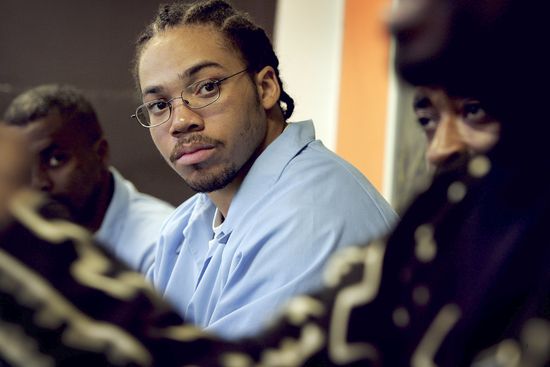
In response to my debate with Frum, Kleiman pens thirteen "theses on cannabis policy." Number seven:
Among the consequences of cannabis use under current conditions among poor minority youth, being arrested is more common than developing a chronic substance abuse disorder.
Friedersdorf makes a related point:
It is incontestable that the War on Drug's burdens fall most heavily on the poor, and it makes no sense to discuss how marijuana legalization would affect inequality in America without grappling with the specific ways that marijuana prohibition exacerbates inequality, especially since its costs — years spent in prison, police intrusion into private homes, bullets flying in one's neighborhood, etc. — are often so much more life-altering than all but the most unusual recreational use.
Over to you, David. No rush. It's the Holiday Season. But it would be great to hash all this out.
(Photo: Hasan Cunningham listens to speakers during a self-help group session focusing on life outside of prison at Sheridan Correctional Center November 14, 2005 in Sheridan, Illinois. A dedicated center for the treatment of inmates with drug and alcohol abuse problems, the state opened Sheridan in January 2004 to combat a recidivism rate of 54% in its penal system. Nearly 69 percent of all inmates in the Illinois prison system are serving time for drug or alcohol related offenses. The recidivism rate for prisoners who have served time at Sheridan is only 7.7 percent. Cunningham, whose drugs of choice were marijuana and alcohol, is nearing the end of a four-year sentence for drug conspiracy. It is his fourth time in prison. By Scott Olson/Getty Images)
How Accurate Is Zero Dark Thirty? Ctd
David Sirota wants to know whether the CIA or Pentagon edited Zero Dark Thirty's screenplay, noting that such a practice has been commonplace in the past:
When it comes to movies, the collaborative process is a straightforward bargain. Directors want access to Pentagon and CIA hardware and logistical assistance at cut-rate, taxpayer-subsidized prices. Those agencies, through the military and CIA film liaison offices, are typically happy to oblige, as long as directors submit their screenplays for thematic editing of a prospective film’s overall storyline and granular line-editing of the script’s dialogue. That editing, which is only vaguely disclosed in the fine print credits of films, often ends up making films more ideologically pro-military and pro-war. But according to film liaison officials, the objective of the whole review process is simply to make sure a film accurately represents military history and operation.
If a filmmaker refuses to make the script changes demanded by the Pentagon or CIA, those agencies typically bar access to government hardware and property and do not cooperate in information requests. This often makes a film physically impossible — or prohibitively expensive — to produce. On the other hand, if the Pentagon and CIA are actively cooperating on a movie, it ostensibly means the national security apparatus has reviewed the film’s screenplay and affirmatively approved its substance.
You can read through all our Zero Dark Thirty coverage here.
Plan B Goes Down In Flames: Reax
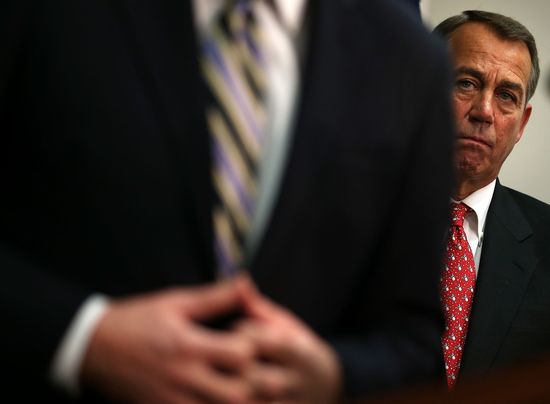
Last night Boehner failed to get enough Republican votes to pass Plan B. Tomasky is dumbfounded:
[S]tep back and think of last night in this context: Plan B was a conservative plan with one little tiny dash of compromise, one small and mostly symbolic feather step outside the safe zone of hard-right ideology and toward…not even the center, but the far-right fringe of the center. And the Republicans could not vote even for that.
Rich Lowry sighs:
If part of what President Obama was after was Republican humiliation and disarray, it’s going better than even he could have hoped.
Avlon piles on:
A new CNN poll shows that for the first time, a majority of Americans view the Republican Party as “too extreme”—up 17 percentage points since the fall of 2010, before the Tea Party election. Moreover, 53 percent of Americans say Republicans should be willing to compromise more in fiscal-cliff negotiations—but that’s the opposite of the message conservatives are sending to their leadership. Theirs is a worldview where any compromise on taxes equals death. By putting ideological purity ahead of the good of the country or the good of their party, they are revealing a streak of nihilism—“some men just want to watch the world burn” as Republican strategist Rick Wilson tweeted after the vote.
Kevin Drum considers what comes next:
One possibility is that this makes falling off the fiscal cliff much more likely. If the loonies won't even vote for Plan B, what are the odds they'll vote for a compromise bill along the lines that President Obama has offered? A second possibility—and I honestly don't know how likely this is—is that Boehner now knows he can't get the tea partiers to vote for anything, so he'll give up on the idea of bringing them into the fold. Instead of trying to craft a bill that can get 218 Republican votes, he'll round up fifty or a hundred of the non-crazies and pass a compromise bill along with 150 Democrats. On this reading, today's failure actually makes a fiscal cliff compromise more likely.
Daniel Gross believes a "deal may yet still happen":
It might be that it was necessary for the Republican leadership to fall on its face, to confront the utter unwillingness of a large number of Republicans to sign off on a tax-raising deal before it goes and tries to make a deal with House Democrats. That’s what happened with the passage of the TARP bill in the fall of 2008. Republicans revolted against Boehner and the Bush administration. In the end, Treasury Secretary Henry Paulson had to get down on his knees and beg House Minority Leader Nancy Pelosi for assistance. It ultimately passed with Democrats voting 172–63 for the bill, and with Republicans voting 108–91 against the bill.
Yglesias argues that a deal has become more likely:
[W]e learned something important about Republicans last night. What we learned is that though the clutch of die-hards is too big to let Boehner pass bills that lack Democratic support, these die-hards are not the majority of the caucus. Most House Republicans were prepared to back Boehner. Which is to say that most House Republicans, at the end of the day, endorse a pragmatic rather than a metaphysical view of tax politics.
Sarah Binder has doubts:
I am (perhaps too) slowly coming to the position that it might be impossible to avert the fiscal cliff. That will certainly be the case if Boehner refuses to bring a deal to the floor that requires Democratic votes for passage. That wasn’t his position in the spending and debt ceiling showdowns in 2011. But neither did those bargains require Republicans to vote directly or indirectly to raise anyone’s taxes. Indeed, House Republicans have steadfastly avoided such votes since they voted against George H.W. Bush’s 1990 “Read my lips” budget agreement. Old anti-tax habits die hard. This is probably especially so when the Club for Growth threatens to “primary” Republicans who vote to raise anyone’s taxes. This dynamic—at once electoral and ideological—may be sufficient to detonate the short fuse left on the exploding can of sequestration and tax hikes.
Noam Scheiber's view:
In the end, what Obama failed to understand is that, appearances notwithstanding, he was never negotiating with Boehner. He was always negotiating with the majority of the House GOP, which is obviously well to Boehner’s right. Making concessions to them didn’t make a deal more likely. It just undermined his own position. (It’s also why the suggestion that it may get easier for Obama and Boehner to strike a deal over the next few days, in the relative calm afforded by the House’s adjournment for Christmas, seems to miss the point.) It's also why going over the cliff always looked more or less inevitable. Whatever Boehner’s desire to avoid that outcome, he was never the relevant decision-maker. It was always his conservative rank and file, a group that can’t be reasoned with, and which only understands the language of total victory or defeat. As luck would have it, it looks like they’ll be getting an outcome they comprehend.
David Kurtz wonders whether Boehner's speakership can survive :
It is easy to overreact to these things in the moment, to overread them. But Speaker Boehner just put it all on the line. The entire nation was watching, and he was exposed. He knows it. His conference knows it. Anyone left in Washington who had doubts about this speaker’s clout now knows it, too. In a parliamentary system, he would resign and his party would elect a new leader. We don’t do it that way here … usually. But it’s hard to see how Speaker Boehner continues from here — or why he would want to.
Ezra Klein's related thoughts:
A significant number of Boehner’s members clearly don’t trust his strategic instincts, they don’t feel personally bound to support him, they clearly disagree with his belief that tax rates must rise as part of a deal, and they, along with many other Republicans, must be humiliated after the shenanigans on the House floor this evening. Worse, they know that Boehner knows he’ll need Democratic support to get a budget deal done. That means “a cave,” at least from the perspective of the conservative bloc, is certain. That, too, will make a change of leadership appealing.
What Philip Klein is hearring:
Speaking to members today, the sense I got was that rank and file Republicans understand the difficult position Boehner has been put in, with the tax cuts expiring automatically, Obama as president and Democrats in control of the Senate. So, many conservatives may have felt they needed to oppose “Plan B” so they didn’t get their hands dirty voting for what they saw as a tax increase (or perhaps they just feared how it would play in a potential primary challenge). But, these same members could still give a pass to Boehner, recognizing that he’s in a tough spot. Just as long as they get to keep their own hands clean and campaign as true conservatives who stood up to Obama.
Joyner thinks the GOP shot itself in the foot:
Politically, Boehner’s Plan B would have been a massive win for the Republicans. It would have put a bill passed by the Republicans out there to compete against mere negotiating proposals. It would have had quite a bit of support from Democrats, including prominent coastal senators like Chuck Schumer, who prefer the $1 million definition of “rich” over Obama’s $250,000 mark.
Erick Erickson differs:
Many on the right liked John Boehner’s Plan B. The conservative media, which craves access to Republican leaders at the expense of their values, fell all over itself to support Plan B. Their argument is very simple — without this, we go over the fiscal cliff and the GOP gets blamed. The fact is the GOP is going to get blamed no matter what. The fact is, if the GOP signaled to the American public it was willing to raise taxes on anyone, Barack Obama would have still rejected their deal and the GOP would still get blamed.
Chait's perspective:
Without Boehner’s fallback strategy, the bulk of his membership if left totally exposed to Obama’s withering January attack. If they were hoping to fight it out with the president after the New Year, their hopes of victory look even fainter now.
And Scott Galupo wishes the far-right wing of the GOP House would come to its senses:
These conservatives—well-intentioned, perhaps, but tactically foolhardy—are steering the Republican party and the movement into an iceberg that’s been in plain sight for weeks. I’d say I’m in disbelief, but this clown show has been going on too long now to say that.
(Photo: Alex Wong/Getty Images)
Crazy Poets Society
Michael Dirda reviews Kathleen Spivack's With Robert Lowell and His Circle, a remembrance of the remarkable 1959 seminar the poet taught at Boston University, whose students included both Sylvia Plath and Anne Sexton. An anecdote about his idiosyncratic classroom mannerisms:
Lowell’s teaching was eccentric and largely "rhetorical, as if the class were a frame for the expansion of his own opinions." He would repeatedly ask, "What does this poem really mean?" There would follow "long, agonized silences, while the class held its collective breath and hoped to come up with adequate answers." Again and again, Lowell would bring up living poets and then quiz: "Major or minor?" Even his close friend Elizabeth Bishop was sadly declared "minor," but "almost major." Sometimes, when on the verge of one of his periodic breakdowns, Lowell could turn incredibly mean: "Don’t ever write again," he told one young woman, after "decimating" her poem. She burst into tears and ran from the classroom.
Irene Koronas points to the following excerpt on the precocious talent of the young Miss Plath:
On a particularly lucid day, Lowell passed out copies of Sylvia's poem "Sow." I can still recall his somewhat nasal Southern-Virginian- New England voice, oddly pitched, as if starting to ask a question, saying to Sylvia and to the class "This poem is perfect, almost." A slight breath-gasp, nasal and out-ward, as if clearing his sinuses silently, "There really is not much to say." A kindly but bewildered look. Long, struggling silence. Lowell looks down at the poem, brow furrowed. The class waits. Sylvia, in a cardigan, does not move. She listens. No one else moves either. "It appears finished." Long silence. Lowell looks agonized, but then he always does. Anne fidgets. Realizing that her arms draped with charm bracelets are making noise, she stops. Sylvia leans forward, dutiful, expressionless, intense, intelligent.
The Hobbit’s Unexpected Violence, Ctd
A reader writes:
So I guess Gandalf decapitating the goblin chief in the Misty Mountains doesn't happen in Berlatsky's copy of the book? Or Beorn killing a goblin and warg scout team, skinning the wolf and nailing the skin and goblin's head to his door (hmm, there seem to be a lot of decapitations in the book). Or mention of Gollum liking a nice, tasty goblin when he can get them. Or Gandalf, again, burning wolves to death with flaming pine cones. Or Smaug laying waste to Laketown. Or Bilbo slaying numerous Mirkwood spiders when rescuing the dwarves from their webs. Or the body count at the end of the Battle of Five Armies. Or maybe Berlatsky just hasn't read the book in a long while and has rose-colored memories. Because there is absolutely an awful lot of violence and death in Tolkien's "kid's" book.
I did find the juxtaposition of that post and one on what kids should be told about Newtown very interesting, however. Kids, and childhood in general, have always been less sheltered than adults seem willing to admit.
Another is on the same page:
Having just finished re-reading The Hobbit a couple hours before reading your post, I have to wonder if Berlatsky read the same book I did.
The book obviously doesn't relish violence, but it certainly doesn't spend much time dwelling on the importance of mercy either. Goblins and orcs are dispatched by the hundreds and thousands, and descriptions of their bloody corpses lying in piles after a battle are relatively graphic for a fantasy story. Beyond that, Gandalf's killing of the Goblin-king is treated as little more than a casual affair, and even after the goblin army is crushed, the noble men hunt the hapless and scattered goblins throughout the region, slaughtering them and bringing peace to the land.
In fact, the violence is in some ways the point. It is not the mercy present in the overarching story, nor in most of the characters, that we should pay attention to, but rather the mercy of Bilbo (and Frodo, later). It provides a welcome counterpoint to the violence, but the violence is still ever-present. All Jackson seems to be doing is taking the many scenes of violence that are given relatively little space in the book and creating fully-formed action sequences. This is exactly what he did in the LOTR trilogy as well.
Another adds:
Bilbo's non-violence is part of the Christianity of the story and also part of the reluctant hero archetype – an innocent is introduced, against his will, to the harsh reality of the world outside his hobbit hole and somehow manages to maintain his integrity.
Beating Twitter To The Punchline
Paul Myers looks at how Twitter affects comedy show writing. Here's SNL "Weekend Update" writer Alex Baze on the fear of a planned joke getting scooped on Twitter:
"We were doing a run that scolded global warming deniers that used the line 'If you’re still denying global warming, you’re the mayor from Jaws.' I was pretty happy about that joke, written by Pete Schultz, and then about an hour before show time, Gary Janetti tweeted that exact joke, pretty much word for word. We ended up having to cut the whole run for other reasons, but yeah, sometimes you write a joke you really like and then you nervously scan Twitter all day, hoping you don’t see it."
But Twitter helps out as well:
According to Kimmel Live’s [Molly] McNearney, Twitter is currently the best way to track the pulse of the popular culture that her show parodies on a nightly basis. "You can spend a few minutes on Twitter and know instantly what everyone is talking about," says McNearney. "It’s the modern-day water cooler without the awkward small talk. We aim to cover the popular topics in our monologue each night and Twitter is a great indicator of relevancy."
(Hat tip: Bradford Evans)
When Storage Was A Stage
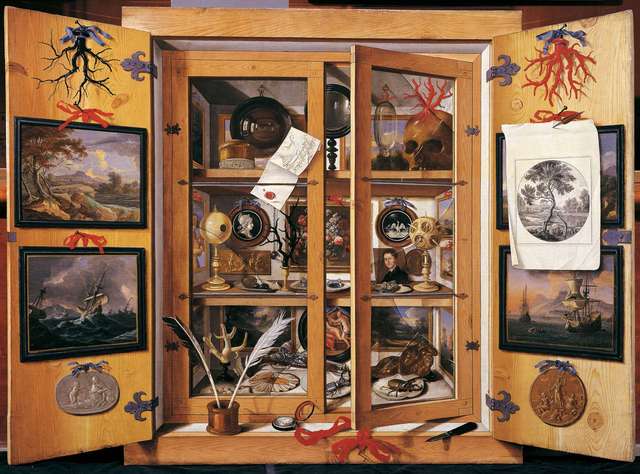
Writing for an eclectic new history blog, "The Appendix", Benjamin Breen remembers the age of the curiosity cabinet:
We moderns tend to associate boxes and cabinets with the mundane. They hold a single type of item. They order and sort. They serve as metaphors for the banal, the ordinary, the pedestrian. Our public figures frequently endeavor to "think outside" them and occasionally offer to blow them up.
Yet imagine a cabinet that contains rubies, "unicorn" horns, and Hindu sculptures. Pocket watches, pocket portraits, guns, silk ribbons, saints' relics, and perfume bottles. Deadly poisons, Amazonian drugs, powdered mummies, fossilized bones, and bezoar stones. A cabinet that contains a world in miniature. This was the curiosity cabinet, or Wunderkammer, one of the defining creations of the tumultous era that historians call the early modern period.
Breen compares the cabinets to the visual culture of the Internet:
In the ecosystem of Pinterest we find the same organic arrangement of contrasting items, grouped poetically (rather than rationally) around a nebulous theme.
The eclectic and exotic are prized; color and visual interest win the day. And the context for each item? Virtually nonexistant. The objects that made up a curiosity cabinet followed circuitous pathways (from Sri Lankan beaches and Amazonian jungles, say, to Parisian salons), in the course of which they lost their original contexts, names, meanings.
Objects that had once embodied human culture, like sculptures and coins, became mere ephemerata. Natural treasures — corals, gems, ambergris, bezoars — likewise functioned as mere "curiosities." Did that horn come from a unicorn or a narwhal? was a question few early moderns ventured to ask, because the items in curiosity cabinets did not invite speculation into origins. They had no labels, after all. No narratives. No "memories" as objects or images. So, too, with Pinterest and its ilk.
(Domenico Remps, A Cabinet of Curiosity, 1675, via Wikimedia Commons)
Set It And Forget It, Ctd
A reader writes:
One potential drawback of IUDs (or similar Intrauterine Systems, or IUSs) is that they have potentially sharp-ended strings which rest in the vaginal canal. The strings are used in removal of the devices, but they can be sharp enough to irritate vaginal walls, and they could also compromise condoms. When my wife got an IUS, neither of these issues were mentioned as a possibility, perhaps because the doctors assumed that we were monogamous, but I also doubt that unmarried women would be informed of this drawback. Therefore it's possible that having an IUD/S can put a woman at a higher risk of contracting an STI even if her partner is using a condom.
Another writes:
In response to the person who said that having an IUD is like being a man: it's certainly convenient, but that first year of unbelievably piercing cramps during Lady Time (after a painful insertion procedure) was a constant reminder that men don't have to do things like this.
Another:
I went to read the article you quoted, and saw the price tag of $1,000 and almost fell over, so I just thought I'd add my 2c on how this is yet another example of how Americans are paying way too much for health care.
I currently live in Israel for my husband's work, and so I went to an ob/gyn here that was recommended to me. They have universal health care here, but this woman was a private insurance provider; aka, the most expensive you could get in Israel. My universal health care refused to pay for the service as an "optional" one (bastards) so I paid the total cost myself: $250 total, appointment and IUD both. How can they justify a $1000 price tag for the same thing back home? Really?!
Another:
We are HUGE fans of the non-hormonal IUD and it has been our BC of choice, especially given the fact that my wife is extra sensitive to the various hormone filled options. By the time we got to the IUD we had tried various types of the Pill, the shot (Depoprovera), and one of the rings. The shot was by far the worst in terms of side-effects.
But, like the pieces you link to today, we did get pregnant while using the IUD. According to the doctor the chances of that happening over the 10-year life is 0.18%. We also got pregnant while on the Pill and the shot. At this point it's been 5 years since the birth of our last child and the IUD has worked without fail, but it is something we keep in the back of our minds, especially when her period is late. Since we're finished having children it's now my turn to step up to the plate and I'll be getting snipped soon.
The Daily Wrap
Today on the Dish, Andrew believed the country was in the middle of a constitutional crisis at the mercy of an irresponsible GOP, responded to the new and apparently-damning report on CIA-led torture that we're not allowed to read, and tore into Bill Kristol for spreading yet more of his poison, this time about Chuck Hagel. Andrew also challenged Obama to use a possible Hagel nomination as a demonstration of his second-term backbone (as did Beinart), noticed that Obama's high approval ratings appear to mirror Reagan's, and explained how Robert Bork's confirmation hearing helped lay the foundation for today's partisan rancor.
In continuing coverage of the Sandy Hook shooting, Adam Gopnik, Douthat and Ponnuru debated the potential effectiveness of gun control, Lisa Lambert explained how the parents the mentally ill often hide their concerns from others, Christopher J. Ferguson added more evidence to the argument that video games don't lead to violence, and Jeff G was sarcastic about his gun collection. Also, we investigated the Congressional chances for new gun control laws, Molly Redden debunked John Lott's case for higher gun ownership, more readers thought through whether or not to rush an active shooter, Cillizza pointed out the NRA's massive spending, and Aaron Carroll sounded the alarm over insufficient mental health services for children.
In political coverage, we looked at the latest analysis of the fiscal cliff negotiations, while David Kuo shared his feelings about the Bush Administration, Michael Moynihan dismantled Joe The Plumber's Holocaust facts, Bob Wright highlighted the bigotry of ADL head Abe Foxman, Clyde Prestowitz reminded us that America shouldn't let Israel drive drunk, and Susan Crawford lobbied for better American internet access. Also, Greta Van Susteren rebuked those who have questioned Hillary Clinton's concussion, Patrick Sharma drew out a game plan for filibuster reform, a reader in the military alerted us to how DOMA is screwing them out of benefits, and looking overseas, Stuart Staniford caught us up on the Eurozone crisis.
In assorted coverage, Chris Kelly compared Zero Dark Thirty to Legally Blonde II, David Michael explained the origins of Norway's Swedish workforce, Thomas Rogers got sick of the over-advanced computers in TV shows, Simon Garfield showed us a map of America's literary giants, Gabe Habash shared a playlist of literature-inspired songs, and Megan Gambino told us about a mummy's possibly-therapeutic tattoos. We also tried to figure out if eagles actually could steal babies or not, learned pollution from cars and obesity were the fastest growing causes of death, saw Dubai's extravagance through the VFYW, met a therapy dog in our FOTD, and there was lots of added %$#@ in our MHB.
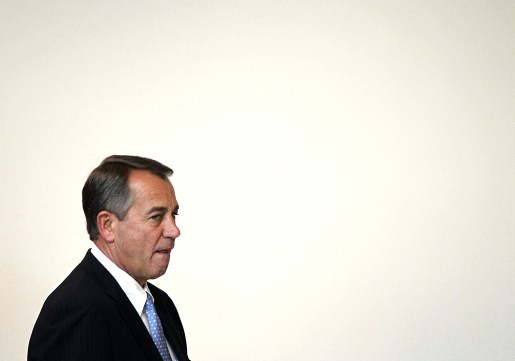
(Photo: U.S. Speaker of the House Rep. John Boehner (R-OH) arrives at his weekly news conference December 20, 2012 on Capitol Hill in Washington, DC. Speaker Boehner spoke on the latest development of the fiscal cliff issue and the 'Plan B' that the House failed to pass this evening. By Alex Wong/Getty Images)
 The Dish
