What Are Gun Control’s Chances In Congress?

Alex Koppelman has an in-depth analysis:

Anything is possible, especially in the wake of something like the Newtown shooting, but it’s difficult to see the political calculus that leads to a few dozen Republicans switching sides on this. Just as the makeup of the House Democratic caucus has changed, becoming more liberal, the G.O.P. side has become filled with members who don’t have to fear a Democratic opponent but need to be concerned about a primary challenge from their right. Still, many Democrats remain optimistic that something can get done, that Newtown has altered the congressional math on this issue. 

He also notes an outside-spending wrinkle:

In a post-Citizens United world, the N.R.A.’s coffers, which had once seemed so threatening, could easily be matched by a few rich supporters of gun control—or even just one.

Margaret Talbot hopes people will take to the streets to keep the pressure on Congress:

On Monday, demonstrators for gun control gathered outside the N.R.A.’s lobbying headquarters in Washington. They read aloud the names of the children who died in 158472106Newtown, and they read aloud the talking points that the N.R.A. uses in its lobbying. There were only about two hundred people there, and I saw some gloating about that turnout in the blogs and Twitter feeds of gun-rights advocates.

Maybe they’ll be proven right, and the movement will sputter out again. But if it doesn’t, the value of it is clear. By the time Congress is back in session and ready to take up gun control, Newtown will be fading a little in the public memory. It’s hard to imagine it now, but that’s what’s happened after every mass shooting of the last several years. The gun-rights advocates will be as single-mindedly impassioned as they always are, and the rest of us will be thinking of other things.

But rallies and marches and demonstrations could remind those who’ve forgotten of what happened, serve to back up the members of Congress who want to do something about guns, and signal that there are numbers and votes on the other side as well. It’s simple—but it matters.

(Photo: Protesters on December 17 with the social activist group CREDO descend on the offices of the NRA's Capitol Hill lobbiest's office demanding the pro-gun lobby stand down in reaction to the shooting at Sandy Hook Elementary School. A leading Democratic senator launched a bid Sunday to ban assault weapons in the wake of the latest deadly US school shooting, announcing that she will put a bill before Congress on January 3. Dianne Feinstein, the influential chair of the Senate Intelligence Committee, said she believed President Barack Obama would support her legislation, also aimed at outlawing magazines carrying more than 10 bullets. By Paul J. Richards/AFP/Getty Images)

Our Learned Silence On Mental Health

Lisa Lambert, who has a mentally ill son, discusses how, even though the "best way to get help for your child with mental health issues is to talk about what’s going on," most of these parents keep relatively quiet. She has experienced this herself:

When this first began, I told other mothers about it. They were the parents of his friends and had known him since he was a baby. Some of them would try to make me feel better. “All brothers fight” they’d say, “Yours are just more intense.” Some would look at me with horror or, worse yet, tell me to try things that I’d done long ago and found pretty worthless. It was clear that they thought it was either my skills or persistence that needed shoring up. I learned to avoid these discussions and got pretty good at deflecting questions. I learned to be quiet.

It isn’t just friends you are careful with. It’s your child’s teachers, his pediatrician and many others in his life. We all live in a society where the stigma around mental illness can stop us in our tracks. It’s far more serious than a lack of understanding. People repeat things to you that cut you to the quick and you learn not to tell them what you are going through. Instead, you talk about the Red Sox and gardening.

Face Of The Day

158603425

Therapy dog Chilly from Richmond, Virginia gets a pat from his owner Jake Pasternak on December 20, 2012 in Newtown, Connecticut. Therapy dogs have been brought in from around the country to provide comfort to Newtown residents following last Friday's massacre at Sandy Hook Elementary School. Six wakes and funeral services were held Thursday in the Newtown area for students and teachers who died in the tradegy. By John Moore/Getty Images.

Video Games Are Not The Problem, Ctd

Christopher J. Ferguson rounds up research on gaming and violence:

As a video game violence researcher and someone who has done scholarship on mass homicides, let me state very emphatically: There is no good evidence that video games or other media contributes, even in a small way, to mass homicides or any other violence among youth. Our research lab recently published new prospective results with teens in the Journal of Youth and Adolescence indicating that exposure to video game violence neither increased aggressive behaviors, nor decreased prosocial behaviors. Whitney Gunter and Kevin Daly recently published a large study of children inComputers in Human Behavior which found video game violence effects to be inconsequential with other factors controlled. And as for the notion of that violent media “desensitizes” users, recent results published by my student Raul Ramos found that exposure to violence on screen had no influence on viewer empathy for victims of real violence. (A study published by Holly Bowen and Julia Spaniol in Applied Cognitive Psychology similarly found no evidence for a desensitization effect for video games.)

Earlier analysis here.

Treating Guns Like Alcohol

Candles_Newtown

Adam Gopnik argues that gun control "will eliminate gun massacres in America as surely as antibiotics eliminate bacterial infections." In response, Douthat compares gun bans to prohibition:

An experiment in making America the kind of “gun-free society” that Gopnik favors would probably run into some of the same problems that bedeviled Prohibition — alcohol is easier to manufacture, but there’s a high demand for guns and a large enough supply already to sustain a black market more or less indefinitely. On the other hand, a sweeping gun ban would probably save lives, just as Gopnik argues — but then the original Prohibition, for all its unintended consequences, probably saved lives overall as well.

Note that this parallel doesn’t make a case against any of the specific gun control options that are currently on the table.

For alcohol and firearms alike, there’s room for sensible restrictions in a non-prohibitionist world. I don’t think the Assault Weapons Ban was remotely effective as public policy, but I don’t think it was a severe blow to liberty either, and maybe there’s a better version waiting to be crafted. The chance, however small, that an experiment in restricting high-capacity magazines might reduce the deadliness of massacres could make such a restriction worth trying. There’s nothing wrong with encouraging gun safety in the same way that we try to limit underage drinking (though those efforts are sometimes counterproductive) and discourage drunk driving.

Ramesh Ponnuru is unsure what can be done:

Guns are everywhere in our country. A ban on civilian handgun ownership would be unenforceable even if it were constitutional and popular. I am reading a lot of anguished op-eds from people who want gun control. Many of them claim, very plausibly, that other countries show that a less armed society would be a more peaceful one. What they don’t show is that our country can get there from where it is now. That’s the hole in the argument for greater regulation, and it may be a bigger problem for its political prospects even than the NRA.

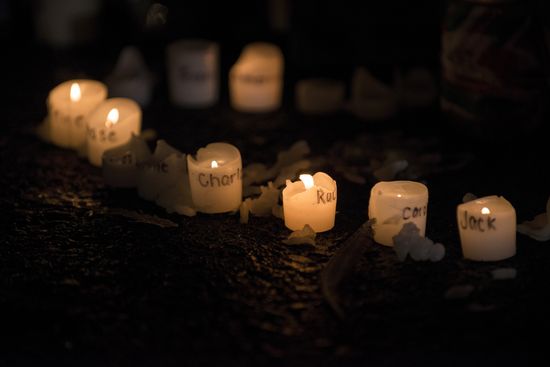
(Photo: Candles with the names of victims of the Sandy Hook Elementary School shooting written on them are seen at a makeshift memorial near the entrance to the grounds of Sandy Hook Elementary School on December 18, 2012 in Newtown, Connecticut. By Brendan Smialowski/AFP/Getty Images)

The Relationship Between Guns And Crime

Molly Redden dismantles the work of John Lott, a major advocate of concealed-carry laws:

Lott’s research, as the title of his book suggests, is dedicated to proving that more guns in more hands reduces violent crime. In the wake of Newtown, that means guns in teachers’ hands, and an end to the gun-free zones that he says make schools "a magnet for these attacks." But Lott’s research has always been problematic. For starters, he's a lousy data analyst. Lott allowed Professors Dan Black and Daniel Nagin to reevaluate his data for their 1998 inquiry into the effects of concealed-carry laws on violent crime rates. Their findings, published in the Journal of Legal Studies in 1998, blew a hole in his: "Our reanalysis of Lott and [co-author David] Mustard’s data provides no basis for drawing confident conclusions about the impact of right-to-carry laws on violent crime,” they wrote. "As a result, inference based on the Lott and Mustard model is inappropriate, and their results cannot be used responsibly to formulate public policy." Four years later, Ian Ayres of Yale and John J. Donohue III of Stanford Law gave his scholarship an even more vicious debunking. (Media Matters summarizes the many challenges to his research here.)

Reality Check

Screen shot 2012-12-20 at 5.07.19 PM

As TPM notes, Obama is riding a wave of new support since the election. The Gallup poll is particularly striking. It shows the highest level of approval since August 2009. I have to believe the uptick is in part because of his pitch-perfect response to Sandy Hook, and the reasonableness of his fiscal cliff proposal. And his ratings mirror one other president’s most closely – albeit with higher lows and lower highs: Ronald Reagan.

Europe’s Jobs Crisis

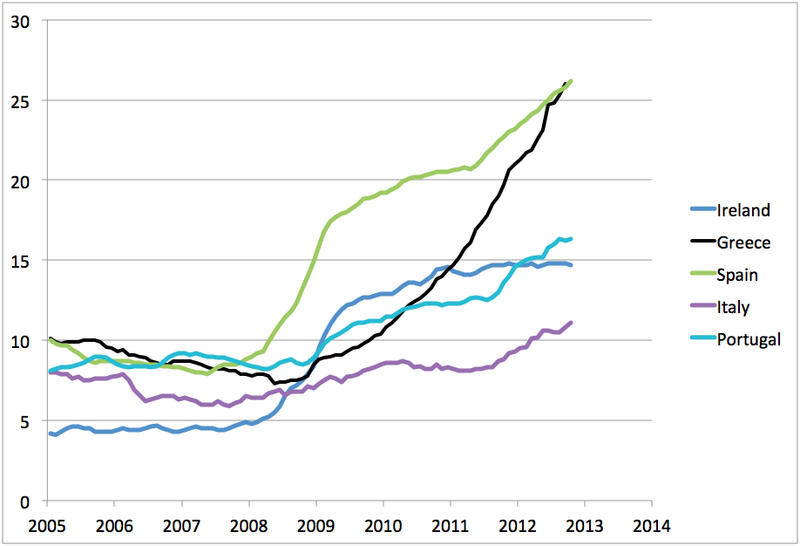
PIGGS_Unemployment

Stuart Staniford checks in on the Eurozone:

The above shows the latest data on unemployment in the distressed Eurozone countries. Ireland seems to have at least stabilized, but not started to recover. Everywhere else still seems to be actively getting worse. Greece and Spain in particular are vying for who can dive into the abyss faster.

Is A Deal Still Possible?

Suderman is optimistic:

There are still subtle signs that this is just a final round of posturing before a last-minute deal shapes up. A number of House Republicans have signaled that while they aren’t thrilled with the direction things are going, they want to make a deal, and will probably ultimately support whatever final plan Boehner gives them. And while the White House isn’t budging form its previous offers right now, they’re also not saying they’re done. President Obama is still urging Republicans to accept his offer. Indeed, lines of communication are still open. And both sides still seem to want to make a deal. If they don’t, it’ll be because they stopped here and never got any closer. But with more than a week left before the deadline, I wouldn’t count on that just yet.  

I'm staggered by Boehner's complete capitulation to the extremists. Obama campaigned very clearly on restoring Clinton tax rates for those earning over $250,000. He won decisively. The Democrats won the Senate. Only ruthless gerry-mandering managed to turn a popular vote defeat for the GOP into a majority in the House. Obama already made a concession on rates: agreeing to a limit of Lostelephant$400,000. Boehner's response? Not to take the compromise but to unilaterally hold a vote on a limit of $1 million and a reversal of the sequester only on defense spending.

I wish I could feel as sanguine as Peter. But I'm not. Not just the country's fiscal standing, but the global economy rests on getting to a reasonably balanced big deal. But the GOP appears incapable of acting for the public good. They cannot operate responsibly within the constitutional framework of this country. Their absolutism even in the face of stinging electoral defeat and hefty public opposition is a function of their existing in a hermetically-sealed ideological universe where the only thing they care about is not being primaried by someone even further to their right. That's right: the only thing. Not the country; not the debt; not the global economy; not the voters; not the American economy. They are vandals, not representatives, a rogue threat not just to this country but to the wider economic system in the world. They have already been prepared to abuse the debt ceiling and the filibuster in their adolescent anarchism. And now they propose this ridiculous Plan B – whose actual impact on the fiscal crisis can be seen in the graph here.

We have a constitutional crisis: an opposition party so ideological and so bent on its own power at the expense of everything else, that the system cannot work. Only public opinion has a chance of swaying them. But when you're as fanatical as these zealots, public opinion is about as relevant as the thought that they should actually exercize basic responsibility.