Depolarizing Gun Control

Nate Cohn thinks Obama should let other politicians lead on gun control:

Passing even a limited gun-control measure during this session of Congress would require splitting the House Republican caucus, and if that’s the goal, then Obama should stay on the sidelines. The White House can’t force Republicans to compromise, and associating Obama with such a measure isn’t likely to broaden its base of support. After all, 94 percent of House Republicans represent districts that supported Mitt Romney, and although the president commands the support of a majority of the electorate, he’s a polarizing figure who triggers reflexively partisan responses from a deeply conservative Congress. If the president took the lead, it would become even harder for the GOP to entertain the tightening of gun control—at a moment when some House Republicans might actually consider it.

Cockfighting

150402295

Grant Cogswell recounts the history of the bloodsport:

Cockfighting was once legal in the United States (and it still is in Guam and Puerto Rico): Last holdout Louisiana outlawed it in 2008. The federal Animal Fighting Prohibition Enforcement Act carries a three-year sentence for moving fighting equipment, though enforcement focuses on the crueler practice—I would argue—of dogfighting.

Cockfighting is practiced all over the world, nearly: It came with the chicken from the tip of India, where fights go back 2,000 years. Banned in Britain in 1835, it spread to Europe from Reunion Island, a département of France in the Indian Ocean, and is preserved as a kind of folk art in the gallodromes outside Lille. It's still legal in France when practiced in a "traditional setting."

(Photo: Two roosters begin to fight during a cockfight in Managua, on August 12, 2012. Bloody cockfighting with spurs, a tradition inherited from Spain, makes Nicaraguans passionate as thousands of roosters fight each week for their lives. In the audience, screaming women abound, full of adrenaline for the combat and bets. By Hector Retamal/AFP/Getty Images)

The Reality Of Global Warming

It may finally be sinking in:

A new AP-GfK poll recently found that 78 percent of Americans believe the earth’s temperatures are rising. Even among the third of Americans who are skeptical of scientists, 61 percent say global temperatures have been rising over the past 100 years. This percentage is up significantly since 2009 when less than half (47 percent) of these scientist-skeptics agreed. However, it remains to be seen whether this is a permanent change in public opinion, or an ephemeral reaction to particular events such as Hurricane Sandy. For instance, after Hurricane Katrina, 85 percent of Americans thought temperatures were rising, while that number stands at 78 percent today. Nevertheless the median voter is likely becoming persuaded that climate change is in fact occurring.

Remote Control Carnage

Nicola Abé tells the story of Brandon Bryant, who logged 6,000 flight hours as an Air Force drone operator before deciding he had to quit. An unsettling example:

[Bryant] remembers one incident very clearly when a Predator drone was circling in a figure-eight pattern in the sky above Afghanistan, more than 10,000 kilometers (6,250 miles) away. There was a flat-roofed house made of mud, with a shed used to hold goats in the crosshairs, as Bryant recalls. When he received the order to fire, he pressed a button with his left hand and marked the roof with a laser. The pilot sitting next to him pressed the trigger on a joystick, causing the drone to launch a Hellfire missile. There were 16 seconds left until impact.

"These moments are like in slow motion," he says today. Images taken with an infrared camera attached to the drone appeared on his monitor, transmitted by satellite, with a two-to-five-second time delay.

With seven seconds left to go, there was no one to be seen on the ground. Bryant could still have diverted the missile at that point. Then it was down to three seconds. Bryant felt as if he had to count each individual pixel on the monitor. Suddenly a child walked around the corner, he says.

Calling All Cartels

Screen shot 2012-12-12 at 12.28.30 PM

Olivia Solon investigates the rise of criminal communication technology:

Last year, Mexican police raided the drug cartel Los Zetas three times. They weren’t looking for cocaine or marijuana; they were targeting the homegrown radio network that stretches across the northeastern chunk of the country, where the Zetas control drug and migrant smuggling routes. Los Zetas—comprised of former members of Mexican special forces—have been building the system of radio towers and receivers since 2006. The cartels divide up their territory into plazas, each with a boss responsible for buying and maintaining equipment and distributing handheld radios. By controlling their own mobile network, the Zetas can rapidly inform its members about an imminent raid by police or a rival cartel in a controlled and encrypted fashion.

Transmission technology is cheap. The Zetas can easily upgrade and maintain infrastructure, despite the raids. No sooner than masts, transmitters, and receivers are confiscated, they are replaced again. Just as mobile and web technologies have transformed business, education, and society, so too with crime.

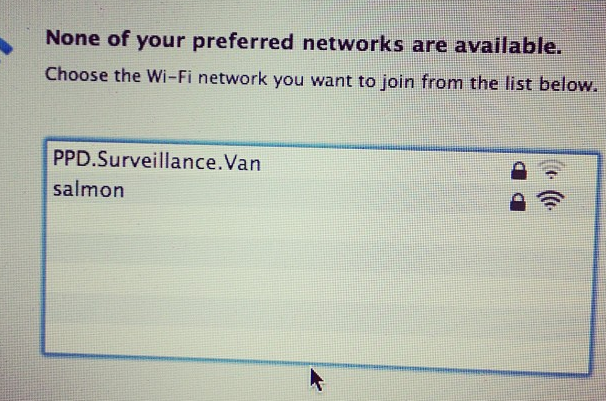
(Screenshot from Jon Benjamin: "Philly Police Dept, way to be discrete. How's your undercover surveillance team doing?")

Journalism Fail, Ctd

Buzzfeed lists 9 things the media intially got wrong about Newtown. How Shafer understands the misinformation:

Mistakes have always been made by the press because there are so many ways to get a story wrong and so few to get it right. As the Washington Post‘s Erik Wemple notes, the source of much of the bad Newtown information the press retailed to the public was the police. Anyone who has ever covered crime will tell you that the police can be just as confused in the early going at a crime scene as anybody. Their information is provisional, and it should be treated as extra-provisional if police don’t want to be named individually or identified by the police force they work for. For that reason, when a reporter attributes his crime scene information to a “source,” it might be true. Or, as we’ve seen in the Newtown massacre, it might not be true.

The more cops on a crime scene, the more confusing things can get, and lord knows that every law enforcement officer with a badge within driving distance of Newtown made an instant effort to work on this crime. I doubt that the local police were accustomed to working with such a ferocious and demanding press horde within hours of a big crime.

Earlier Dish on the subject here and here.

No Brother Of America’s

Egyptian_Police

Eric Trager's understanding of Egypt's Muslim Brotherhood:

My own view is that the administration is correct in seeing no real alternative to Morsi, but wrong in believing that Morsi or the Muslim Brotherhood can be partners on foreign policy in the long run. In recent months, the Muslim Brotherhood has signaled repeatedly that it intends to move against our interests: the group's Supreme Guide has called for jihad for Jerusalem twice in the past two months, including right after the Gaza ceasefire; a top foreign policy official declared in November that Morsi is ending normalization with Israel slowly; and the Brotherhood's political party has been drafting legislation for the next parliamentary session on unilaterally amending the treaty.

Moreover, it's worth noting that the Brotherhood repeatedly turns on its allies. (Consider, for example, the case of April 6th Youth leader Ahmed Maher, who prominently supported Morsi during the second round of the presidential elections but, after opposing Morsi's power grab, was accused by the Brotherhood of leading "thugs" in demonstrations.) If the Brotherhood has no qualms about turning on its most prominent non-Brotherhood supporters within Egypt, it will have even few qualms about turning on America.

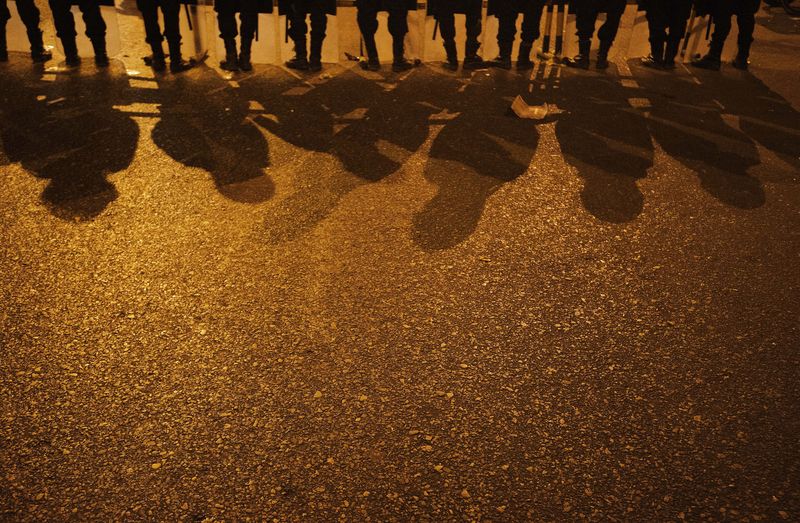
(Photo: Egyptian riot police cordon off all access to the road leading to the police station in Cairo's Doqqi neighbourhood on December 16, 2012. Islamists backing a new constitution for Egypt claimed victory in an initial phase of a referendum, but the opposition alleged polling violations and said it will await the results from the final round in a week's time. By Gianluigi Guerica/AFP/Getty Images)

Bullet Control? Ctd

Weigel explains the current state of affairs:

One of the NRA’s greatest legislative successes, the Firearms Owners’ Protection Act, let dealers sell ammo without recording vital information about the buyers. That law eventually facilitated the online ammo market, which allows sites like CheaperThanDirt to sell 30-round extended clips for $8.99.

Ambers explains why ammunition control could work:

If you frequent "Survivalist" websites, you'll find that one of the most pressing topics discussed is gingerly called ammunition life span management. Ammo has a shelf-life. Even good ammo. Guns are forever, but ammo degrades, even if stored in precisely proper conditions and humidors that criminals don't often have. 

His proposal:

Subject ammunition purchases to the same scrutiny that goes with gun purchases. An instant background check. Slow down the process. Obviously, the more lethal a bullet is, the higher the justification to regulate.

Earlier Dish on bullet control here.

Market-Led Gun Control?

Kevin Roose explains how growing scrutiny of the private-equity firm Cerberus Capital Management, which owns Bushmaster and several brands of firearms, has convinced them to get out of the gun business. Roose puts the surprising decision in perspective:

A private-equity worker once told me that his business was neither moral nor immoral. It was simply amoral. It made decisions about where to allocate capital based on financial returns, regardless of what the optics were or who stood to gain or lose.

Cerberus's decision to exit the gun business is different. It's proof of the power of pressure, applied from both investors and the general public. And it shows that today, whether in anticipation of a PR backlash or simply a moral awakening, one private-equity firm has decided it can't turn a blind eye to the outcome of its investments any longer.