Video Games Are Not The Problem

Video_Games_Guns

Fisher charts gun violence and video game use:

[V]ideo game consumption, based on international data, does not seem to correlate at all with an increase in gun violence. That countries where video games are popular also tend to be some of the world’s safest (probably because these countries are stable and developed, not because they have video games). And we also have learned, once again, that America’s rate of firearm-related homicides is extremely high for the developed world.

How Do You Solve A Problem Like Obesity?

Ambers tackles the question:

We know that a bunch of things contribute to early on-set obesity, but we don't really know in what proportion they contribute, and it probably varies considerably from individual to individual. For a plurality, though, obesity appears to be locked in to a lot of kids by the time they are 3 years old. Think about that. If you believe, as I do, that obesity is a problem that implicates all of us, and therefore requires some sort of a collective solution, that in and of itself is cause for despair. What it means is that smaller changes like expanding recess or building more public parks or adding fruit to a diet won't amount to anything.

Marc explored the subject at length in his May 2010 personal essay, "Beating Obesity."

Chart Of The Day

Gun_Ownership_Rates

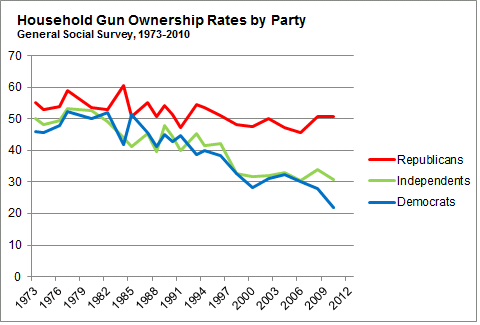
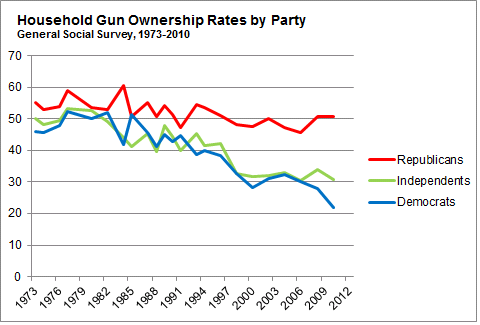
Nate Silver breaks down gun ownership by political affiliation:

In 1973, about 55 percent of Republicans reported having a gun in their household against 45 percent of Democrats, according to the General Social Survey, a biennial poll of American adults. Gun ownership has declined over the past 40 years — but almost all the decrease has come from Democrats. By 2010, according to the General Social Survey, the gun ownership rate among adults that identified as Democratic had fallen to 22 percent. But it remained at about 50 percent among Republican adults.

He writes that demographic data "suggest that gun ownership will continue to decline among Democrats while holding steady among Republicans, further increasing the partisan gap." Relatedly, Enten takes a closer look at Democrats' gun control views:

Those in favor of fewer gun restrictions are winning the battle because they are breaking into demographic groups that normally vote Democratic. Romney took only 36% of the vote in urban areas, but 46% of urbanites were for minor or no gun restrictions. More tellingly, Romney took only 18% of the vote among non-whites, but 32% of non-whites were for minor or no gun restrictions. This finding is confirmed in an April Pew poll. So, Democrats also have to reckon with a base that isn't as anti-gun as you might think.

Don’t Blame Asperger’s, Ctd

A reader writes:

My son who went to elementary school in Newtown many years ago has Aspergers. He was horrified by what happened on Friday. He was afraid to go to school yesterday because he thinks people will assume that because he has Aspergers he is a potential mass murderer.

Parents of children with Aspergers have mercifully risen to the occasion. Another writes:

My 12-year-old son was diagnosed with Asperger's when he was seven. After the shootings at Sandy Hook, I found myself reading obsessively online to find out how journalists were accounting for the horror.  Once I read that Adam Lanza had been considered a socially awkward loner, I feared he would be identified as having Asperger's.  (I recalled that after the Jeffrey Dahmer killings, an African-American friend told me that she was so glad he was not black.) I have talked to my son about how he may be perceived differently in the wake of Sandy Hook.  I have told him he should never participate in the violent joking rhetoric so popular among 12-year-old boys because it could be misconstrued.

Another:

I am a child and adolescent in-home therapist who works with children with severe emotional and behavioral problems. As one of the only male, community-based mental health therapists in my county, I have a caseload mostly made up of very "aggressive" males (often also shy, awkward, insecure, creative, funny once you get to know them, deeply wounded and at their core – human). For them to be eligible to see me, they typically have been hospitalized for serious threats to other people, which are often times family members.

Needless to say, much of what we know about Adam Lanza's story resonates with me on a profoundly personal level. Ditto for the mother who penned the beautiful and heart-breaking essay "I am Adam Lanza's Mother". These are my kids. I spend my days at their kitchen tables, on their porches and at their schools. Working with them and their families to understand and try to manage unspeakable feelings and impulses.

In most them, Asperger's has either been suspected or diagnosed. We need to be extremely cautious in how we view causality in this case, but one of the possible theories out there is that part of Asperger's involves an impairment in "mirror neurons", which some suspect are the neurological basis for empathy. Exploratory research has established that children with conduct disorder, often a childhood precursor for people diagnosed with anti-social personality disorder, may also suffer the same impairment.

Perhaps this is a way for grieving families and a broken system to rationalize the cold and calculating way in which they can sometimes navigate the world. Maybe. But just as we know of people with anti-social personality disorder, most of them are not violent, or at least learn ways in which to control their impulses. They may be CEOs, politicians, lawyers, artists, or janitors. Same can be said for individuals with Asperger's. However, when you have an individual who has difficulty reading social cues, relating to others, empathizing AND combine it with violent impulses, among other important risk factors such as traumatic history, early attachment issues, limit resources and social support, it can really become a horrific situation for that individual and those who love them.

We all want to make sense when tragedies happen, and have an almost existential need for a "primary cause". Asperger's or any other mental health issue is not going to be it in this case. We don't even know if it was ever diagnosed yet. But as is the case with the dialogue about gun control, we need to honestly examine all of the underlying causes with grace and sincerity. Only then can we begin to understand and hopefully prevent these future horrors from happening.  

Earlier discussion here.

A Milder “Hunger Games”

Tricia Romano investigates the sudden rise of redneck reality shows:

[T]here’s an uncomfortable gawking-at-the-scene-of-the-accident element to watching these shows. Call it rubbernecking, or shame watching; in a way, redneck reality-television shows are a sort of travel channel for the cultural elite.

"There is a sense of discovery. One thing people don’t talk about with reality television—the cultural snapshot that reality television takes," said [reality TV-star coach Robert] Galinsky. “Like, wow! As much as we can travel around the world with our digital devices and we get on a plane and go anywhere, a lot of people still don’t travel. A lot of people don’t see the world. There’s a sense of discovery and delight to seeing these stereotypes that we may have heard about and read about. That they are real. They are not that small percentage of what people think that population is like. They are just as powerful as so called ‘normal’ middle-class people."

In a country of rising inequality, something troubles me about this. We watch reality shows about the absurdly rich ("Real Housewives"); and watch them about the cultually and educationally poor ("Honey Boo-Boo"). The equally dysfunctional overclass and the underclass are both products of a disintegrating middle. And yet the middle watches. Maybe treating an unraveling social compact as entertainment is an inevitable response. But there is something empty about it. Something too voyeuristic to be anything but a symptom of surrender, rather than renewal.

Another Alternative To Gun Control

Douthat suggests more police:

[O]bviously a push to hire more cops, no less than a new push for gun control, would run into political opposition in our age of tight budgets and public-sector layoffs. But shifting state budgets from incarceration to enforcement makes long term fiscal sense, and between the Republican Party’s affinity for cops and firefighters and the Democratic Party’s affinity for aid to state and local governments, it’s arguably easier to imagine a post-Newtown coalition forming around, say, a new version of Bill Clinton’s COPS program — which was mainly criticized after its expiration, as I recall, for subsidizing too many extra cops in sleepy small towns — than around a return to his ineffective gun control efforts. And based on the public policy record of the last twenty years or so, it’s much easier to imagine such an effort actually making a difference on the ground.

Smearing Hagel

Like a kabuki dance, here it comes: the usual vile insinuations; the usual call for the Greater Israel Lobby to kill a nomination because a US Senator actually believe his job is to care first about the security and interests of the US, not Greater Israel; the reflexive equation of opposition to the Netanyahu administration or the settlements or the Gaza wars with pure bigotry. The phrases – "the odor is especially ripe" – are as preeningly self-righteous as they are toxic. You are not allowed, for example, to note that well-financed organized Washington lobbies "intimidate" lawmakers:

the word "intimidates" ascribes to the so-called Jewish lobby powers that are at once vast, invisible and malevolent; and because it suggests that legislators who adopt positions friendly to that lobby are doing so not from political conviction but out of personal fear.

It's interesting to read this familiar, exhausted, ridiculous whine in the context of our current discussion about the NRA. The NRA is routinely called the gun lobby and it is described in exactly the same terms as AIPAC: "vast, invisible and malevolent" – because it is precisely as effective and relentless and as fanatical as AIPAC in wielding money, networking and political pressure in attaining its legislative goals. But we are forbidden from calling AIPAC what it is the way we call the NRA what it is – because telling the truth about it has been stigmatized as anti-Semitism.

It's a useful ruse for bullies like the Greater Israel Lobby. It's also an insult to those who have suffered and been murdered by actual anti-Semites. But for utopian fanatics, if casually calling honorable public servants anti-Semites helps them retain their dream of a Greater Israel, so be it. Which is why the president, if indeed he is contemplating an appointment for the Nebraska Republican, should not listen to the AIPAC thugs. He should what is right for this country, and not any other's.

The Fiscal Cliff Deal Begins To Take Shape

Boehner_Plan_B

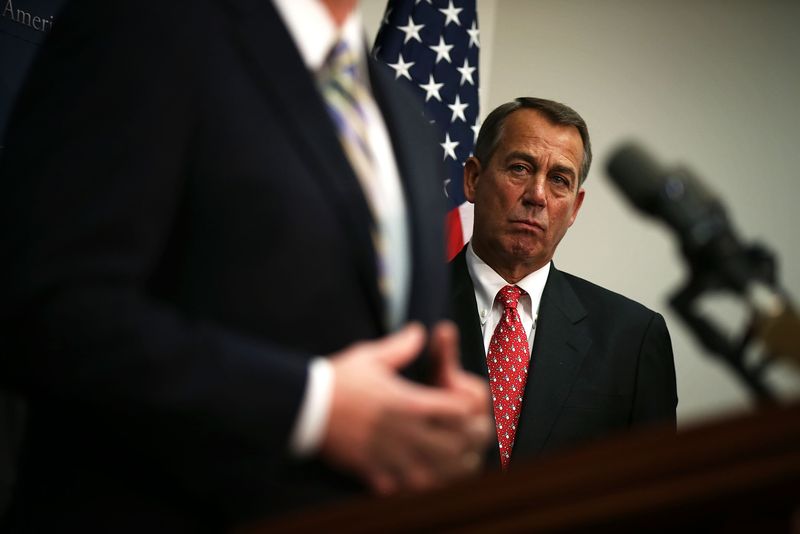
Lori Montgomery and Paul Kane have details. Krugman has mixed feelings:

I understand that Obama prefers not to go over the cliff and face the political and economic uncertainty that this opens up; maybe my assumption that he can still get the middle-class tax cuts is wrong. On the other hand, cutting Social Security, even modestly, is a very big concession, especially because, as I said, it’s cruel and stupid viewed purely as policy. One thing is for sure: any further concession on Obama’s part would make this a total non-starter. And I’m waiting for clarification on capital gains and dividends. But even as it stands, it’s not a deal to be happy about.

Sargent is more positive:

With this deal Obama will have broken the GOP’s fundamentalist opposition to raising tax rates on the rich (albeit only on income over $400,000) something that would have been deemed very unlikely a year ago. He will have held the line against the GOP demand for two years of Medicare — a victory. Debt ceiling hostage taking will have been deferred for two years, meaning it won’t get tied up in the next elections. He will have obtained stimulus spending — on infrastructure, and in the form of an extension of unemployment benefits — and as Paul Krugman notes, that wouldn’t happen if we go over the cliff. (I’m told the talks have not focused on the exact sum of stimulus spending the White House wants.) The price: The expiration of the payroll tax cut and the cut in Social Security benefits. That’s bad, but the damage could be limited, if the White House insists on it.

Galupo looks at the deal from the GOP’s perspective:

This deal-in-the-making, it seems to me, accomplishes about as much as Republicans could reasonably have hoped: it would make the Bush tax cuts permanent for almost all Americans, and reports indicate that it includes a one-year fix on the creeping alternative minimum tax. It doesn’t give Obama all the revenue he wanted and forced him to the table on a cherished entitlement program. This will not be the last word on U.S. fiscal policy. Republicans will not always find themselves in such a weakened position. And in the meantime, Grover Norquist can go pound sand.

Beutler explains chained CPI, which would “make the Social Security cost of living adjustment formula less generous”:

Chained CPI differs from the way the government currently calculates inflation by taking a broader view of the behavioral changes consumers make when prices rise. It factors in a propensity to substitute cheaper, but similar products for ones that have become more expensive. And it has been criticized by advocates for being a less accurate measure of inflation for the products seniors rely on than Social Security currently uses. But Obama allies and and some liberal economists have identified it as the least-bad entitlement benefit cut and have given it their blessing provided it’s one piece of a broader, balanced debt reduction plan, and includes protections for poorer seniors.

Mike Konczal dislikes chained CPI:

The elderly face a higher rate of inflation since their spending is so dependent on health care, which is difficult to adjust or comparison shop for (the idea behind chaining the inflation rate). More importantly, of the three legs of the stool of retirement security – Social Security, private savings and employer savings plans – the two that aren’t Social Security are struggling. Employer pensions will become less secure and less available going forward. Housing wealth was wiped out in the crash. 401(k)s appear to have been a great way to shovel tax savings to the rich, but are in no shape to take over for a lack of pensions. Median wages have dropped in the recession, and are likely to show little growth in the years ahead, which makes building private savings harder. Social Security will become more important, not less, in the decades ahead. Its benefits should be expanded, not cut.

Yglesias wants more details:

[W]hen you look at chained CPI proposals it’s important to pay attention to what happens to the poor and the very old. The latest White House proposal apparently does something to shelter the “most vulnerable” from the bite of the cuts here, but what does it do and how are the most vulnerable defined? Similarly, the detailed timing structure and sequencing of the proposed tax changes is relevant. The headling idea is to stick with Bush-era rates on everyone with less than $400,000 in AGI, but return to Clinton-era rates for those richer than that. But that doesn’t get you nearly $1.2 trillion in revenue. The logic of the situation seems to be that the gap will be made up by capping itemized deductions at the 28 percent rate, but I haven’t seen that on paper. The bullet points on spending cuts outside of Social Security also leave a fair amount of room for interpretation.

Patrick Brennan notes what isn’t in the deal:

[T]he president’s counteroffer continues to assume that the payroll-tax cut will expire come January 1. Various Wall Street banks predict that the expiration of this policy alone will reduce growth by about 0.5 or 0.6 percent of GDP in 2013, via a $100-plus billion reduction in consumer spending. Meanwhile, the Tax Policy Center has found that it would (or rather, will) hit the incomes of the middle class the hardest … Neither the president nor Speaker Boehner, apparently, has appetite for a crucial piece of short-term stimulus which most benefits the middle class (in favor of which NR’s editors have editorialized).

Kevin Drum’s view:

Overall, this doesn’t sound like it’s the worst deal in the world. So far, though, I’m with Krugman: it doesn’t sound all that great either, and it’s not clear if it’s better than what Obama could get if he simply waited a bit and went over the cliff. But I guess that was never in the cards. He seemed intent from the beginning on avoiding that.

Jonathan Cohn’s bottom line:

In the end, evaluating the debt ceiling proposal—and the deal as a whole, should one emerge—depends a lot on your perception of the political environment, including public opinion and the mindset of House Republicans. There’s no clear consensus on that, at least among the sources I usually consult.

The White House has already rejected Boehner’s Plan B deal, which we covered earlier today.

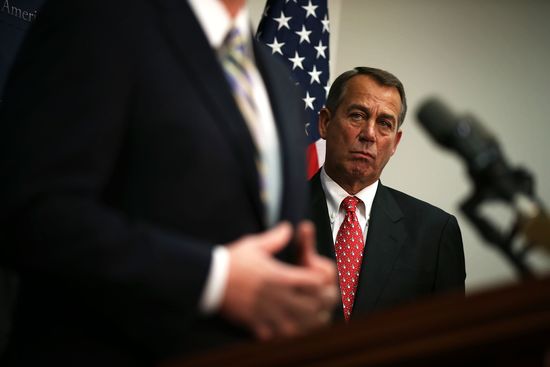
(Photo: U.S. Speaker of the House Rep. John Boehner (R-OH) listens during a media availability after a House Republican Conference meeting December 18, 2012 on Capitol Hill in Washington, DC. Speaker Boehner announced that he is moving to a plan B to solve the fiscal cliff issue and he will put a bill on the floor that increases taxes for people whose incomes are more than one million dollars. By Alex Wong/Getty Images)

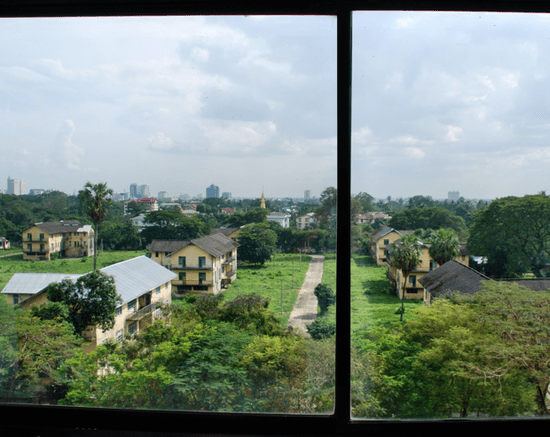
The View From Your Window Contest: Winner #133

Vfyw_12-15

A reader writes:

Tropical setting, looks like either a church or temple spire in the background. Identical buildings with corrugated tin roofs suggest military or some other kind of organized housing for some kind privileged or protected class of worker. Moss on the roofs suggests year-round humid conditions. Large buildings distance are widely dispersed, so it's a large and/or sprawling city, but we're probably not seeing the main part of town. It's very green, which it makes me think of south India, so I'm going with Ernakulam, Kerala.

Another:

It killed me to read that last week's contest turned out to be Sierra Vista; I was on the right track (looking up general aviation airports in Arizona) but got distracted by my job and never followed through.  This week, the landscape, vegetation, and buildings in the foreground immediately reminded me of Hoi An, Vietnam, one of my favorite places in the world. However, there are no skyscrapers in Hoi An. Looking at skyline pictures of nearby Da Nang … well, I can't quite nail it for sure, but it seems plausible. So I will say Da Nang, knowing that someone will win with a hotel room number anyway.

Another:

Compared to last week, this one was super-easy.  This is obviously Hoboken, looking east from the Frank Sinatra Soccer Field in the direction of the Hudson, toward NYC. It appears that things have grown back quickly and lushly after the damage from Hurricane Sandy. Thanks as always for an interesting challenge!

And interesting entries. Another:

Last time I went with my gut instinct, I actually got the town right, so, to continue with my "wild guesses are okay, spending my Saturday on this is not" rule: Panama City.

Another:

What seems to be a golden Buddhist stupa/pagoda/wat (not too sure what the distinction is between them), along with the foliage, indicates south-east Asia. The skyscrapers make Bangkok or Yangon likely, although the houses in the foreground remind me of Phnom Penh. So without being too specific, I'll go with Phnom Penh, let's say 15km or so south-west of downtown.

Almost had it. Another pins down the right city:

This was a tough one. I initially narrowed it down to Thailand, Laos or Cambodia, thinking the gold statue was a Buddhist Wat or Stupa. But the more I looked at it, I realized it was a Buddhist gold pagoda. It didn't take long to determine that these types of pagodas are far more common throughout Myanmar (Burma).

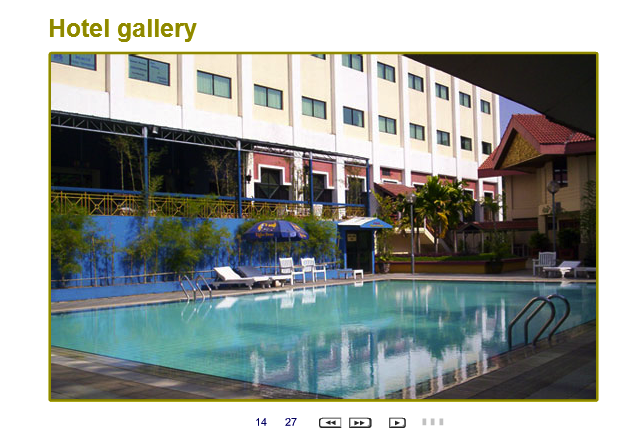
Now after much study, I think I was able to identify the Yangon Traders Hotel and a couple of the other high to mid-rise buildings far away in the background. The orientation led me to the area to search in Google Earth. I was finally able to narrow down the location of the photographer to be either the Yangon International Hotel at No. 330 Ahlone Road or The Summit Parkview Hotel at 350 Ahlone Road, Dagon Township, Rangoon, Burma. For my final answer, I am going with the Summit Parkview Hotel, Room 342.

Correct hotel as well. Another sends an aerial diagram:
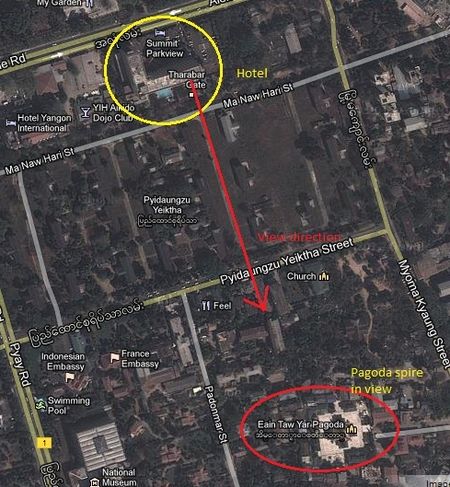
Yangon VFYW

Another:

I guess like a lot of your readers, it seems like every weekend, after the kid has gone to sleep and the wife's watching Downton Abbey, I settle down to try and guess the location of the VFYW contest. 90% of the time I spend a few hours frantically searching through Google for topography, flora, fauna and cloud formations that match up to those in the photo. In the end, I'll narrow it down, confident that I've got the right city but just can't find the right street, only to discover on Tuesday that the window in question is actually several continents away from my painstaking deduction.

But once a year on average, I think I do better. In January this year, I got the right street in Budapest and spent the rest of the day with such a grin on my face that my wife thought I might be having an affair. 

Anyway, my guess is that this week's view was from one of the windows at the Summit Parkview Hotel in Rangoon, Burma. (I prefer to call it Rangoon because I think I read somewhere that it was the military government that changed its name to Yangon for political reasons, and they're not very nice people.) My reasoning was as follows:

The landscape is flat as a pancake and obviously tropical (there's a palm tree in the foreground). That made me think it was somewhere in South Asia, probably the Ganges delta, so first I googled the Kolkata skyline, but there were too many tall buildings. Then I tried Dhaka, but again the same thing. Given the dilapidated nature of the buildings, it seemed less likely to be anywhere else in India, so I thought I'd check out Rangoon. One of the photos on Google had buildings that looked remarkably similar to the two high-rise buildings in the centre left of the photo. That made me think that the spire in the foreground was actually a pagoda and not a church as I had first assumed. I then found a map of Rangoon on Google, found the two tall buildings and the pagoda in the foreground and then triangulated the position of the window (actually I just looked for a hotel in the general vicinity, luckily found a swimming pool next to a big building and found it was called the Summit Parkview Hotel). Then I googled the hotel and found a picture that was taken from the hotel roof:
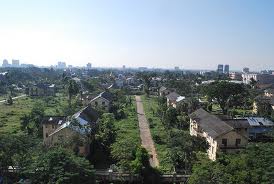
Imgres

So there you go; it's the Summit Parkview Hotel, 350 Ahlone Road, Dagon Township I've no idea as to the actual window. I'm sure many of your more enterprising, energetic and intelligent readers will provide that answer, but those people are likely to get it right every second week. I would humbly suggest you award the prize to me as this would send a positive message to the millions of your readers, average Joes and Janes who, like me, will only get it right once in a blue moon, and who, in these tough economic times, need something to look forward to every weekend, while their partner is watching the TV and the kids and pets have gone to sleep.

Excellent pitch, but there several average Joes and Janes this week who submitted slightly more precise entries. Another reader sends a different angle from the Summit Parkview roof:
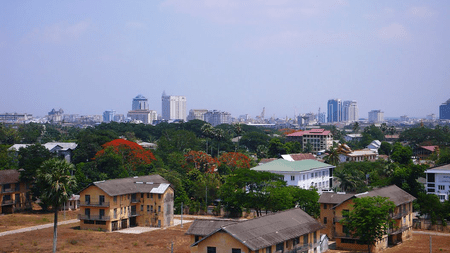
Yangon from Summit Park View hotel's roof

Another nails the right floor:

The palm trees suggested we were in the tropics (okay, they can indicate California, too, but that golden pagoda at center screen says not this time). So it's most likely Burma. I plugged away a bit in Google maps on Sunday, trying to check out the neighborhoods near every pagoda in Yangon, but the place is awash with them, and with no Streetview, little time and less faith in my guess, I gave it up pretty quickly.

But on Monday: a second wind, another try, and bingo! Just a bit north of the second pagoda, there were what had to be those yellow houses in the foreground and the narrow lane between them, leading up to what I was hoping to find: an international hotel. It's the Summit Parkview Hotel, apparently a serviceable if not overly charming business-oriented hotel, whose web site offers the address 350 Ahlone Road, Dagon Township, Rangoon, Burma:
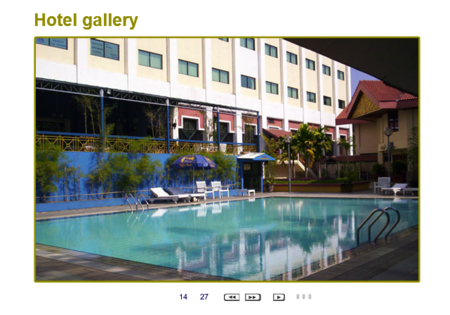
Summit_Parkview_Hotel-Yangon

If I had to guess, I'd say, fifth floor, fifth room from the end of the east wing. Either that or we're looking out of the north wing of the Louvre overlooking the Jardin des Tuileries catching a bit of La Defense but somehow missing the Eiffel Tower off-screen to the left. But I'm betting Burma.

According to photo's submitter, it was indeed taken from the 5th floor. Of the readers this week who guessed that floor and haven't already won a book, only one has correctly answered a difficult city in the past without breaking the tie ("difficult" is defined as cities that are only correctly guessed by 10 or fewer readers). So that reader wins with the following entry:

The photo screams Southeast Asia. Where was the tricky part. After some searching, I narrowed it down to Yangon, Myanmar, based on the blue glass building in the distance on the left. At first I thought the photo was taken at Yangon University where President Obama (perhaps submitted by the POTUS himself?!) visited last month based on the campus like setting. The buildings didn't match though. After more looking around, the photo was taken further south in town. The pagoda in the middle is the Eain Taw Yar Pagoda. The photo was taken at the Summit Parkview Hotel, 350 Ahlone Road, Dagon Township, Yangon, Myanmar, facing south. I'll guess 5th floor, room 512.

Congrats, we'll get a book prize out to you shortly. Another reader notices something:

Less than a year into America's new relationship with the country and I'm beginning to think that half the Dish's readership has already taken a trip to Yangon, Myanmar (Burma). I say so because this week's view was taken only one mile to the northwest of, and looks in the same direction as, the one featured in Contest #118 on September 1st:
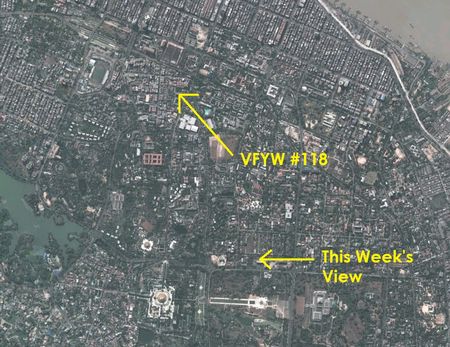
Yangon VFYW 2 Overhead Comparison Marked 2 - Copy

That contest took me nearly the whole weekend to get; this one went a mite faster. The picture itself was taken from roughly the 5th floor of the Summit Parkview Hotel looking south, southeast towards the river.

One more reader:

In reference to Sunday's "Munich, Germany, 10.50 am" VFYW – wow, I have that one exactly.  (I realize that this is not a contest picture and this wins me absolutely no points.  Bear with me while I rant, please.)

That is taken from the GHotel in Baaderstrasse, and shows the lovely (but COLD – keep your overcoat on) Sankt Maximilian church. My wife and little 9-month-old and I were just a few weeks ago. It was our first visit to my parents, who retired overseas and are now too old to travel much. Lovely place.  

The church itself is noteworthy for its activist pastor. When first we walked by, they were rigging up a gigantic red ribbon on the main entrance for World AIDS Day. The Mass we attended also was the occasion for inaugurating a photo exhibit of a day in the life of three HIV+ men. The hotel and street and church are on the edge of the neighborhood called the Glockenbach, a longtime focal point of Munich's gay culture, now rapidly gentrifying.

That photo was like a jolt of electricity – I instantly recalled both the church experience and the visit, watching my parents hold their granddaughter for the first time.  Thank you so much for this quirky little feature.

(Archive)