Santa Claus coming to Tinseltown:
Month: December 2012
The Australian Example On Guns
Will Oremus explains Australia's sweeping 1996 gun control law, which banned semi-automatic and automatic firearms after a mass shooting in Tasmania that resulted in 35 deaths and 23 injuries:
At the heart of the push was a massive buyback of more than 600,000 semi-automatic shotguns and rifles, or about one-fifth of all firearms in circulation in Australia. The country’s new gun laws prohibited private sales, required that all weapons be individually registered to their owners, and required that gun buyers present a “genuine reason” for needing each weapon at the time of the purchase. (Self-defense did not count.) In the wake of the tragedy, polls showed public support for these measures at upwards of 90 percent.
Dylan Mathews goes through the available research on the law's effects:
It seems reasonably clear [that] the gun buyback led to a large decline in suicides, and weaker but real evidence that it reduced homicides as well. Such a buyback isn’t in the cards in the U.S. anytime soon — an equivalent buyback here would entail the destruction of 40 million guns …
The View From Your Window

San Francisco, California, 10.30 am
Guns Not Everyone Can Fire
Joyner proposes one way to limit gun violence:
One intriguing possibility is mandating some technological solution to make it harder for people other than the registered owner to fire the gun. Various “smart gun” technologies exist or are in the works which rely on RFID chips and biometric devices; cruder devices, which rely on complicated rings to activate the trigger, have been available for decades. If effectively implemented, they could conceivably greatly reduce the number of crimes committed with stolen weapons, including cases such as this one where a teenager steals a weapon from a parent. They’d also, presumably, cut down on gun suicides and accidental shooting deaths of children.
Will Washington Respond To Newtown?
One good omen: Senator Joe Manchin – the same Joe Manchin who shot the cap-and-trade bill with a rifle – wants saner gun laws:
On the other hand, Chait doubts that much of any significance will be done:
I fully share the utter emotional devastation that is naturally metastasizing into broad hopes of political reform. It is natural to think that the emotional magnitude of the massacre must therefore have some proportion to its magnitude as a political event. But this is just as untrue as the comforting fallacy that every great tragedy must do some good. Some things have changed since Friday, but most have not.
The first obstacle still standing is that the vast bulk of American gun violence would not be stopped by banning military-style weapons, but would require not only halting the sale but probably also confiscating regular handguns. (Rifles of all kinds accounted for just 323 of the 12,664 murders victims last year.) Such a step would run into a wall of massive opposition from the public, which opposes a general handgun ban by about a three to one margin, but also the Supreme Court, which has interpreted the Second Amendment not as the preservation of militias but as a right to private gun ownership, and has thus struck down handgun bans.
I share Jon's realism on this. Which is why we may perhaps have a more productive conversation if we focus on mental illness and the need for more resources to understand and treat it.
Does Gun Control Work?
Dish alum Zack Beauchamp finds reason to believe it does:
Scholars Richard Florida and Charlotta Mellander recently studied state-to-state variation in gun homicide levels. They found that "[f]irearm deaths are significantly lower in states with stricter gun control legislation." This is backed up by research on local gun control efforts and cross-border gun violence.
Josh Marshall asks for counter-evidence:
There have been a number of ‘studies’ I’ve seen purporting to substantiate the claim that widespread gun ownership will actually reduce violence. But the ones I’ve seen either come from disgraced amateurs or think tank hacks with zero peer review. Are there any methodologically sound, peer-reviewed studies which show anything like this?
Chart Of The Day

Max Fisher posts a chart showing "the 10 countries with the highest per capita gun ownership rates in the world":
It’s a pretty motley bunch. Recent war zones such as Yemen, Serbia, and Iraq are on there, but so are relatively developed (and peaceful) Switzerland, Finland, and Sweden. The fact that Swiss gun murder rates are much lower than Iraq’s are a reminder that, yes, there is a lot more to determining a national rate of gun-related homicides than just firearm ownership. Still, as we saw in a previous post, Switzerland also has an unusually high rate of gun-related murders. It’s not as high as America’s, but then again neither is their gun ownership rate.
Ezra Klein talks to Janet Rosenbaum about Switzerland and Israel, two countries with high gun ownership often compared to the US. Rosenbaum:
Both countries require you to have a reason to have a gun. There isn’t this idea that you have a right to a gun. You need a reason. And then you need to go back to the permitting authority every six months or so to assure them the reason is still valid. The second thing is that there’s this widespread misunderstanding that Israel and Switzerland promote gun ownership. They don’t. Ten years ago, when Israel had the outbreak of violence, there was an expansion of gun ownership, but only to people above a certain rank in the military. There was no sense that having ordinary citizens [carry guns] would make anything safer.
When Heroism Beckons, Ctd
A reader writes:
I had mostly been ignoring this thread, but the previous post got me. I am in the unfortunately position of having survived a drowning incident while one of the people who came to rescue me didn't make it. In this case it wasn't a stranger, but a friend of mine. I was 14 and leading a group of friends across a river in Northern California. I got stuck in a current draining a pool and reached out my hand to my friends for help. I really don't think they understood the danger at all, but did the natural thing trying to help their friend. Three of them got pulled in also. One got pulled under and emerged in the next pool okay. One's head I was able to hold above water until a stranger did come and help us and pulled her out. And a third got stuck up against a log under the water.
Luckily I have never felt guilt for the death of my friend. Because I know it was just something that happened and I would have done the same for her. I have no idea if I would feel differently had it been a stranger who died trying to help me.
The stranger in this case was unable to help me out. My head was above water, but I was stuck. After the second friend was saved (at this point I didn't know about the others), I just gave up fighting. I didn't know what was going to happen, but I just let go of caring. And then I had this amazing experience. From somewhere I got this burst of energy and determination and I was able to climb up the side of a rock face. To this day I don't know if it was internal, some other power, or if it came from my friend dying beside me – whether in fact her last act was to save me.
After I was out, I saw the first friend crying hysterically downstream and learned that the third friend was stuck under the water. Both the stranger and I went around to try to get her out. I could see her and put my hands on her body, but could not dislodge her. The (slightly drunk) stranger at this point started praying for God's help. To which my 14-year-old self responded by cussing at him that God wasn't going to help us; he had better do something. But there was nothing to be done. It took the fire department to get her body out.
It has been 18 years, and sometimes I wonder about that stranger and feel bad that I never did thank him. I doubt he reads your blog, but for the first time publicly, "You did the best you could in the situation and we were lucky that you were there. Sorry I unloaded on you. Thanks."
Don’t Blame Asperger’s
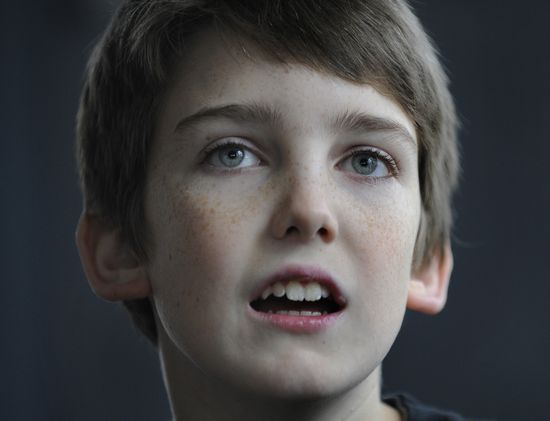
Ron Fournier talks to his 15-year-old Aspie son about the possibility that Adam Lanza may have had the syndrome:
“If you meet somebody with Asperger’s,” he said, “you’ve only met one person with Asperger’s.” Tyler’s point is worth us all noting: Don’t overgeneralize. Don’t stigmatize in a rush to explain inexplicable evil. Autism didn’t cause this tragedy: Asperger’s is a blip on the far-reaching autism spectrum and no two cases are the same. Just as no “typical” person deserves to be tar-brushed with the evil acts of another, Aspies don’t deserve the bad press they’re getting.
Tyler’s form of autism makes it difficult for him to relate to people – to read social cues and easily express empathy. He is not prone to violence nor is he “missing something in the brain,” as so-called autism experts are claiming in the wake of the Connecticut tragedy. He is a gentle, loving 15-year-old who, like millions of others on the spectrum, is destined for a happy, successful life: college, marriage, a career and kids – whatever he wants.
Adam Martin adds:
“There really is no clear association between Asperger’s and violent behavior,” psychologist Elizabeth Laugeson, an assistant clinical professor at the University of California, Los Angeles, told the Associated Press. Another psychologist, Eric Butter of Nationwide Children’s Hospital in Columbus, Ohio, explained that aggressive behavior such as pushing, shoving, or shouting occurs with higher frequency among people with autism. “But we are not talking about the kind of planned and intentional type of violence we have seen at Newtown.”
Emily Willingham, also a parent of an Aspie, points out that missing social cues is nowhere near the same thing as being a sociopath, and that “autistic people are far more likely to have violence done against them than to do violence to others.”
(Photo: Will Gilbertsen, 11 years old, has Asperger Syndrome. His mother Kathleen Atmore is a neuropsychiatrist who specializes in therapy for autistic youth. She recently pulled him out of public school when he was being teased and said he wanted to die. He will start private school for children with Asperger Syndrome, which includes deficiency in emotional and social skills. By Carol Guzy/The Washington Post/Getty Images.)
How Accurate Is Zero Dark Thirty?
Peter Maass had trouble suspending his disbelief:
Unlike Lincoln, about a man who was killed a century and a half ago, Zero Dark Thirty portrays recent events. We know pretty much everything there is to know about Lincoln—all that's left is to interpret the historical record—but precious little about the hunt for bin Laden. That's why I was not only riveted by the "Bring me people to kill" line, but curious. Did it really happen? Did the film's heroine, who is called Maya, really tell the CIA director, during a meeting about bin Laden's compound, "I am the motherfucker that found that place"? I had fact-or-fiction questions about nearly every scene in the movie.
He doesn't fault the filmmakers for their fictional constructions, but still worries that, for the most part, the film allowed the government to get its story told uncritically, possibly as a natural byproduct of giving the filmmakers so much access – an issue he himself is familiar with having spent time as an embedded journalist:
[T]he new and odd rub in the case of Zero Dark Thirty is that the product of this privileged access is not just-the-facts journalism but a feature film that merges fact and fiction. An already problematic practice—giving special access to vetted journalists—is now deployed for the larger goal of creating cinematic myths that are favorable to the sponsoring entity (in the case of Zero Dark Thirty, the CIA). If the access that Boal and Bigelow received was in addition to access that nonfiction writers and documentarians received, I would be a bit less troubled, because at least the quotes in history's first draft would be reliable, and that means a lot. But as it stands, we're getting the myth of history before getting the actual history.
 The Dish
