“I Love My Son. But He Terrifies Me.”

Memorial_Stuffed_Animals

Liza Long shares her experience raising a violent, mentally ill child:

A few weeks ago, Michael pulled a knife and threatened to kill me and then himself after I asked him to return his overdue library books. His 7 and 9 year old siblings knew the safety plan—they ran to the car and locked the doors before I even asked them to. I managed to get the knife from Michael, then methodically collected all the sharp objects in the house into a single Tupperware container that now travels with me. Through it all, he continued to scream insults at me and threaten to kill or hurt me. That conflict ended with three burly police officers and a paramedic wrestling my son onto a gurney for an expensive ambulance ride to the local emergency room. …

In the wake of another horrific national tragedy, it’s easy to talk about guns. But it’s time to talk about mental illness.

Sy Mukherjee examines mental health services in Connecticut:

The National Alliance on Mental Illness (NAMI) reports that Connecticut’s public mental health system currently provides coverage for less than one in five Connecticut residents with a serious mental health problem. The other four may not be able to afford to pay for those services on their own, particularly since mental health issues tend to disproportionately affect poor people. Many states do require mental health evaluations and background checks before allowing their residents to purchase a gun. But doing an evaluation isn’t the same thing as actually treating people with ongoing mental health conditions.

We do not fully know what the killer's psychological profile actually was yet. Perhaps we never will. There are some hints and guesses here. But that we need a broader and deeper discussion of mental illness in American society seems undeniable to me, along with a much more aggressive attempt to treat those many people hovering at the edge of compulsion and violence. The salient debate only begins, it seems to me, after we have rejected the easy extremes – that such a person is inherently evil or somehow blameless. And every case will be different, because every human life is different. To infer anything general about an individual case like this – especially the hideous, reckless and grotesquely unfair generalizations that have been made about people dealing with autism or Asperger's – would be deeply wrong.

But at what point does mental illness require action? I saw my own mother taken away from me and sent to a mental hospital when I was four. She was admitted several times again as I grew up – and since. She was put through electric convulsive treatments several times – a fact my young mind simply could not fully handle. They're electrocuting my mummy's head? And then she was there again – my beloved mother, the same but fragile, living her life for many years as if she were crawling naked on broken glass in the dark.

Was her disease intensified by her own personal history and situation? Sure. The first breakdown came during post-partum depression with my younger brother. Was it also something beyond her control? Absolutely as well. Did its ripple effects come to overwhelm all of us in different ways? I'd say – after a lot of therapy – that I was obviously traumatized at an early age by this kind of experience. It defined my emotional development. It wiped out my sister's retention of an entire year at elementary school. Mental illness does not usually massacre children, as just happened. But it wounds and hurts countless others because treatment is not there, and stigma still endures.

My mother, to put it baldly, never harmed a soul. Her illness was the greatest threat to herself. But it changed the lives of all those around her – and the families with people with mental illness have issues to deal with as well. And by chance, this weekend, I saw Silver Linings Playbook, which for the first two-thirds of the movie, really does courageously explore the edge between disease and wellness, sanity and madness, truth and social expectations that dealing with such illness exposes. For that alone, it's a movie whose humanity and depth surpasses the morally neutered Zero Dark Thirty.

It also establishes, it seems to me, a clear and defensible line: the illness that can lead to spasms of violence is the one we need to control and treat first. This is an incredibly hard call for a family with a mentally unwell human being in its midst to arrive at, as the story above shows, and as my own memories echo. But it is important. In a less grave instance, I realize now that the mother I was sobbing for at four years' old (and multiple times thereafter) was not a mother who could adequately take care of me until she got care herself. She needed help. And so did those around her.

We need to take that truth more seriously than we now do. Not just because we can help prevent mass death. But because we can also prevent lives that are living deaths of the spirit, and because we can now appease and effectively treat many of the torments whose turmoil spreads ever outwards. I hope Sandy Hook takes us further in that direction of policy adjustment. The issue of mental illness seems to me as equally relevant here as gun control. And we seem sadly often incapable of having a mature, and, above all, humane conversation about it.

(Photo: Teddy bears, flowers and candles in memory of those killed, are left at a memorial down the street from the Sandy Hook School December 16, 2012 in Newtown, Connecticut. By Spencer Platt/Getty Images)

The President’s Pot Priorities, Ctd

I was heartened by Obama's recent remarks about his administration's response to legalized marijuana in Colorado and Washington. Erik Altieri analyzes Obama's statements:

This is a great start and an encouraging sign that the federal government doesn’t intend to ramp up its focus on individual users. Though considering it is extremely rare for the federal government to handle possession cases (only a few percent of annual arrests are conducted by the federal government), and that this is the same stance he took on medical cannabis before raiding more dispensaries than his predecessor, his administration’s broader policy will be the one to watch and according to his Attorney General Holder that pronouncement may come soon.

Yglesias is more downbeat:

The actual question on the table isn't whether the federal government is going to be able to replace state and local law enforcement, the question is whether the federal government will do everything in its power to subvert the new frameworks in CO and WA. The president's statement to Walters is entirely consistent with a posture of maximum subversion.

Pete Guither's view:

So after a month, the President comes out and says … absolutely nothing. After all, feds going after users has never been a top priority, because they don’t have the resources to go after that many users. But this says absolutely nothing about distribution methods, or even the possibility of going after some users (it just wouldn’t be a “top priority”).

Drum agrees:

This is basically a non-response and probably shouldn't be taken as an indication of what federal policy is likely to be going forward.

Ask Kuo Anything: First Thoughts On Your Diagnosis?

I’ve known David Kuo since he worked in the Bush White House as Deputy Director of the Office of Faith-Based and Community Initiatives. When he was working there, he suffered a brain seizure while driving and, without his extraordinary wife, Kim, taking the wheels from him, they might both never have survived. But they have. David was diagnosed with brain cancer and left the Bush administration, reflecting in his conscience on his work there. The result was a book, Tempting Faith, that came out at almost the same time as The Conservative Soul. We found ourselves estranged from modern Republicanism and united by faith in Jesus. Thus a friendship was born, and it’s one I have treasured deeply. We have talked together, joked together, laughed together and prayed together. And the cancer has come and gone and come back again. When I saw him last, he had difficulty walking very far. And then I got an email from him eleven days ago with the following news:

In the last four weeks two new tumors have grown. Both are in the same area as previous tumors. One is located directly on the motor pathway that controls my left leg. The other is at the front of the cavity created by previous surgeries. The news knocked the wind out of us, gave us vertigo. Frankly we are still spinning. In all the scenarios we could come up with this wasn’t one of them. My physical state, even taking into account the blood clots and bleeding brain, was on the upswing. Those sensory seizures had stopped. We were crushed. All the suffering from the surgery and it did nothing but weaken me? All the hope for the viral treatment and nothing?

He has helped me so much over the years in my own spiritual journey; and it would be true to say simply that I love him and am proud to have him here. You can watch my answer about first hearing my diagnosis here and my own experience of God during seroconversion here.

Quote For The Day

Bm_90289

"Something needs to be done, these are not normal guns, that people need. These are guns for an arsenal, and you get lunatics like this guy who goes into a school fully armed and protected to take return fire. We live in a town, not in a war,” - Joel T. Faxon [NYT], Newtown resident, hunter and member of Newtown's police commission, which had been working to restrict assault weapon shooting in the town prior to the tragedy.

(Photo: A Bushmaster .223 semi-automatic rifle with a 30 round mag.)

The Zero Dark Debate

Glenn Greenwald argues that Zero Dark Thirty "absolutely and unambiguously shows torture as extremely valuable in finding bin Laden":

[T]o depict X as valuable in enabling the killing of bin Laden is – by definition – to glorify X. That formula will lead huge numbers of American viewers to regard X as justified and important. In this film: X = torture. That's why it glorifies torture: because it powerfully depicts it as a vital step – the first, indispensable step – in what enabled the US to hunt down and pump bullets into America's most hated public enemy.

The fact that nice liberals who already opposed torture (like Spencer Ackerman) felt squeamish and uncomfortable watching the torture scenes is irrelevant. That does not negate this point at all. People who support torture don't support it because they don't realize it's brutal. They know it's brutal – that's precisely why they think it works – and they believe it's justifiable because of its brutality: because it is helpful in extracting important information, catching terrorists, and keeping them safe. This film repeatedly reinforces that belief by depicting torture exactly as its supporters like to see it: as an ugly though necessary tactic used by brave and patriotic CIA agents in stopping hateful, violent terrorists.

As if to prove Greenwald's point, Kyle Smith claims that the film "is a clear vindication for the Bush administration’s view of the War on Terror":

Does "ZD30" glorify torture? No, because no one is tortured in it. The worst procedure shown is waterboarding, and while this is an extremely unpleasant process (it’s not even easy to watch a movie simulation of it), it isn’t torture. Any reasonable definition of torture must exclude procedures that sane people would undergo on a lark. Journalists such as Kaj Larsen and Christopher Hitchens have volunteered to be waterboarded in exchange for nothing more than a cocktail-party anecdote and some copy.

And both did so knowing they could stop it at any point and subsequently had no hesitation in calling it exactly what it is: torture. I may be naive. But I do not think anyone but a sadist or a fascist could watch the torture scenes and be able to say they were not torture. Which is to say that Smith is either a sadist or a fascist, who has contempt for the rule of law and Western civilization. A man is beaten to a pulp, effectively crucified by stress positions, and then waterboarded. If that were done to an American by an Iranian intelligence agent, the same people now exonerating it would be the first to condemn it as evil. And the way in which the laws against torture are written, everything depicted in the movie is illegal, was illegal and in any democracy will always be illegal. It makes the case for prosecution of war crimes very vividly to me, especially when contrasted with the heroine's determined and effective intelligence work of the most traditional and ethical kind.

Glenn sees a crucial scene differently than I did:

Sitting at a table with his CIA torturer, who gives him food as part of a ruse, that detainee reveals this critical information only after the CIA torturer says to him: "I can always go eat with some other guy – and hang you back up to the ceiling." That's when the detainee coughs up the war name of bin Laden's courier – after he's threatened with more torture – and the entire rest of the film is then devoted to tracking that information about the courier, which is what leads them to bin Laden.

A couple of things. You can see the interaction at that meal as evidence that traditional intelligence – simple bluffing – can work. I only saw the movie once and took notes throughout, but no one gives up the truth while being unambiguously tortured in the movie, which is how most people understand torture. And Glenn does not note that after all the torture, in 2008, we discover that there has been nothing but failure – according to the CIA itself – in tracking down bin Laden, or in preventing future terror attacks. It was only in the post-torture period that old-fashioned guess-work, fresh data analysis, painstaking investigation and extreme caution gave us bin Laden's whereabouts and that rightly celebrated raid.

I'm shaken by Glenn's and Jane's much more horrified analysis of the film. They may be right in assessing how many will read its lessons. The torturing agents are not monsters – but what they do is monstrous. Perhaps I am letting my own sense of fairness to the detail – I don't believe, after seeing the film, that it says torture got us bin Laden – get in the way of the broader emotional impact on less informed viewers. I may have been affected by the undeniable power of the film.

But perhaps I also have a slightly brighter view of the American movie public than Glenn or Jane. I think any decent human being will be repulsed by graphic evidence of Nazi-like torture by men with American accents in American bases and sites. I think what Glenn and Jane may be missing is the visceral achievement of those scenes. Maybe for some, like the depraved Kyle Smith, it will lead them to embrace torture in all its horror. But if that is what the public comes to accept, it is ultimately their responsibility and not Bigelow's. She did not pretty up the evil. She laid it out in front of us.

My first take after seeing the movie here. Jane Mayer's here.

Entering An Arms Race With Killers

Goldblog wrote that "it seems fairly obvious that there was no one at or near the school who could have tried to fight back." TNC, on the other hand, believes more guns aren't the solution:

It is human to wish that Dawn Hochsprung, the principal of Sandy Hook Elementary, who died heroically [Friday], enjoyed some weaponry beyond her body. But are we then asking for a world in which the educators of small children are strapped? Do we want our hospital workers, our librarians, our baby-sitters, and little league coaches all armed? What is the message that such a society sends to itself and its children? What does it say about its government's ability to perform the most essential of services–protection? And is it enough to simply be wholly sane? What do we say to the ghost of Jordan Davis, shot down over an argument of loud music, by a man who was quite sane? And where does it end? If more mass killers don body-armor, should we then start fitting ourselves in kevlar too?

Gun violence is one of those things that an immigrant is first amazed by in America. The second thing a non-American is shocked by is the sheer passion of those who own and use guns in this country. When you come from a country like Britain where the government has effectively been a Leviathan of force for centuries, the wild west of America's inner cities – and the frequent massacres or assassinations that occur in US history – is an adjustment.

I've come to accept that I am going to witness a debate I find almost absurd in a mind shaped first of all by British culture. I understand the constitutional resonance of an armed citizenry vis-vis its potentially abusive government. And I can also see why this makes America different.

But I cannot quite get past the paramilitary weaponry and armor that entered an elementary school and gunned down so many First Graders. Every society will have individuals with demons like the killer's. But not every society allows them legally to get dressed up and armed like a figure from a mega-violent videogame and blast their way into an elementary school.

To put it simply, I do not understand how the citizenry's right to bear arms means making available to a disturbed individual a weapon that can kill dozens of children without re-loading, with bullets to spare. No serious supporters of gun rights can support that too, can they? If they can, what limits can society place at all on the safety of its children?

Journalism Fail


In the immediate aftermath of the Newton massacre, media outlets rushed to push out the name and online identity of the alleged shooter without verifying them:

6a00d83451c45669e2017c349e7a25970b-550wiFox News [on Friday] broadcast multiple Facebook photos of one Ryan Lanza, claiming he was the same Ryan Lanza law enforcement officials had identified as the gunman in today’s shooting at a Newtown, Conn., elementary school. In addition, FoxNews.com posted one of the photos to its homepage above the headline, “Gunman ID’d in School Massacre.” That photo was also widely circulated by online news outlets via Twitter and posted by BuzzFeed, which noted that the Facebook profile included a check-in in Newtown (his hometown, according to the Facebook page).
As Ryan’s name and Facebook photo made the rounds, his responses on Facebook were captured via screenshots by some of his friends, then shared on Twitter to prove he was not the shooter. Then other Ryan Lanzas were confused for the one from Newtown. Now of course we know the actual shooter was Adam Lanza, Ryan’s younger brother. At the Dish, we decided to wait the weekend out before analyzing the possible details about potential motives or reasons for this massacre of innocents. Looks like restraint wasn’t the worst option. But I’ve been through these cycles before, and have some scar tissue for rushing to judgment. Matt Lewis fumes over Friday’s coverage:

[W]hen it comes time for moralizing, the media predictably assumes the availability of guns is the problem, without considering how journalists themselves might be contributing to the coarsening of our already-violent society. The entertainment-media complex promotes and glamorizes violence — for profit — in film and on TV. Meanwhile, the news media ensures that killers get the attention and fame they so desperately crave. To be sure, a transparent society demands reporting newsworthy incidents — and this definitely qualifies. But it should be done responsibly. And that is not what we have witnessed. We have instead a feeding frenzy that is all about beating the competition — not disseminating information.

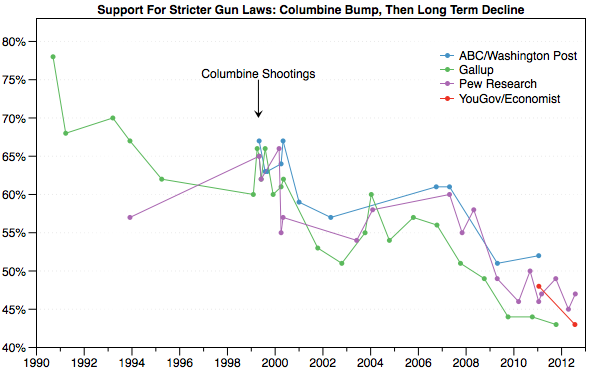
How Popular Is Gun Control?

Gun_Control_Polling

Blumenthal reviews polling on it. Two important points:

First, while support for stricter gun laws has declined in the polls across several measures, Americans remain roughly evenly divided on the issue. The Pew Research Center found about equal numbers of Americans preferring to protect "the right to own guns" (46 percent) and to "control gun ownership" (47 percent). A modest increase in the second category would be enough to create majority support for stricter gun laws.

Second, there is broader support among Americans for incremental changes to gun laws. Polls by CNN and YouGov earlier this year found overwhelming support for several specific gun control policies: background checks, bans on gun sales to those with mental health problems, waiting periods before gun purchases and a national registry of gun ownership.

Harry Enten's advice to gun control advocates:

More then three in four, or 76%, of Americans want laws "requiring gun owners to register their guns with the local government". And 60% of Americans are against "high-capacity or extended ammunition clips". Gun control advocates would be wise to push proposals that implement these two gun control policies. They have majority support that can only grow after Newtown. It would be more difficult for Republican senators to oppose them – as they did with a bill to ban high-capacity clips this past July, when Democratic senators introduced legislation.

Nate Cohn believes that gun control could be a winning issue for Democrats:

At the very least, the fact that Democrats can win nationally without southeastern Ohio or West Virginia means that they can address gun control without fear of jeopardizing the presidency. After all, national polls show the public roughly divided on the issue, even though Democrats haven't even argued for gun control in twelve years. But if Democrats are savvy enough to stress popular measures like an assault weapons ban, which commands the support of approximately 60 percent of voters, it could also help them consolidate their gains among suburban women. Of course, it's been a very long time since gun control was championed by Democrats, and it will require the party to realize that the conventional wisdom on gun control politics is out of date. Democrats do not need to be afraid of angering voters who they have already lost, stand no chance of recovering, and no longer need to win presidential elections. Perhaps the tragedy in Newtown will prompt an overdue reassessment.


Where’s The DMV For Guns?

Ambinder asks:

I take self-defense seriously. But getting a gun should be at least as hard as getting a driver's license. A citizen who wants a gun and a concealed carry permit should go through exactly the same training and recertification as a cop would… it's easier to get a gun as a citizen than as a cop.

Patrick Radden Keefe also wants better gun laws:

One obvious change would be to mandate a criminal background check for all gun purchases.

Under the Brady Act, federally licensed gun retailers are required to do a background check before selling a customer a firearm. But an estimated forty per cent of gun sales today are "private" sales not involving a licensed dealer: these transactions take place at gun shows, in parking lots, and increasingly, on the Internet. (One site, gunbroker.com, reported two billion dollars in sales this year.) Private sales do not require a background check, and because there is no mechanism for the A.T.F. to collect or maintain records on these sales, they are virtually untraceable. There are bills pending on Capitol Hill that would force checks for all sales, and there is considerable bipartisan support for this kind of measure. According to some recent polling conducted by Frank Luntz, seventy-four per cent of N.R.A. members and eighty-seven per cent of non-N.R.A. gun owners support requiring criminal background checks for anyone purchasing a gun.

Converting Climate Skeptics

Chasing Ice director Jeff Orlowski wants his film to make a difference:

[P]eople are really starting to understand that climate change is a reality. That is what I hope Chasing Ice can do. James has captured undeniable visual evidence of climate change. And when people see the film, they get it. We’ve had hundreds of people come up to us after screenings and tell us that they used to be skeptical of climate change, but now they understand it. One woman [seen in the video above] told us how she spent years arguing with her friends that climate change was not real, to the point of not allowing climate-change believers to visit her house. But after seeing Chasing Ice, she knew she had to make amends.

Earlier coverage of the film here.