More And More Mass Shootings

Amy Sullivan sounds the alarm:

As of today, there have been 70 mass shootings in the United States between 1982 and 2012, leaving 543 people dead (assuming the reports of 27 fatalities from today's shootings are correct.) Seven of those 70 shootings occurred this year. Sixty-eight of those 543 victims were killed this year. If the scenes of horror and heartbreak are now familiar, it's because the past six years have been particularly bloody. Fully 45% of the victims of mass shootings in America over the past three decades were killed since 2007. That is a crisis.

The Weekend Wrap

Wrapimage

This weekend on the Dish, Andrew provided somber reflections on the Sandy Hook shooting, linked to the video and transcript of the President's speech in Newtown, and further discussed the place of torture in the film Zero Dark Thirty.

In matters of faith, doubt, and philosophy, Ruth Franklin revealed the religious life of Madeleine L'Engle, Walter Russell Mead pondered how we read the Bible, Stephen Mansfield detailed Lincoln's religion-inflected last words, and Mark Vernon asked if we're living in a second Axial Age. Tim Falconer noticed an uptick in elaborately planned funerals, Adam English reported on the real St. Nicholas, Joe Hanson marveled at our place in the cosmos, and Leonard Jason investigated the various sources of human creativity. 

In literary coverage, Katherine Powers considered Dickens the dad, Dan Duray panned John Updike's art criticism, David Wood dissected our romantic notions of the writer's workspace, Anthony Gardner ranted about our increasing use of the plural, and Talitah Stevenson connected depression and writer's block. Keith Verones spiced up Latin lessons, Alan Jacobs ruminated on fiction's decline, Sunny Sea Gold explored why we re-watch films or re-read books, and both Michael Moynihan's "Ask Anything" videos touched on writers – he commented on Noam Chomsky here and Christopher Hitchens here. Read Saturday's poem here and Sunday's here.

In assorted news and views, Rachel Adams interviewed the author of Uganda's anti-homosexual bill and EJ Graff was confident that marriage equality will win in the end. Dan Savage applauded Amelia Earhart's monogamish take on marriage, Kat Stoeffel appraised the benefits of IUDs, and Brian Blickenstaff disrobed at a co-ed naked bathhouse in Germany. The Spectator nominated 2012 as the greatest year ever, Swati Pandey mediated on the fate of modern women, and Lapham's Quarterly tackled the theme of intoxication. Cool Ad Watch here, MHBs here and here, FOTDs here and here, VFYWs here and here, and the latest window contest here.

– M.S.

(Photo: People attend a prayer service to reflect on the violence at the Sandy Hook School at a church on December 15, 2012 in Newtown, Connecticut. By Spencer Platt/Getty Images.)

Breaking The Rules To Keep Us Safe

In a review of Harvey Molotch's new book, Against Security, Bruce Schneier reiterates that "effective security comes less from the top down and more from the bottom up":

In many of Molotch’s anecdotes and examples, the authority figure—a subway train driver, a policeman—has to break existing rules to provide the security needed in a particular situation. Many security failures are exacerbated by a reflexive adherence to regulations. Molotch is absolutely right to hone in on this kind of individual initiative and resilience as a critical source of true security. Current U.S. security policy is overly focused on specific threats. We defend individual buildings and monuments. We defend airplanes against certain terrorist tactics: shoe bombs, liquid bombs, underwear bombs. These measures have limited value because the number of potential terrorist tactics and targets is much greater than the ones we have recently observed.

Does it really make sense to spend a gazillion dollars just to force terrorists to switch tactics? Or drive to a different target? In the face of modern society’s ambiguous dangers, it is flexibility that makes security effective.

Previous discussion of Molotch's book here.

Will Work For 5-Across

Ben Tausig, who makes and edits crossword puzzles for a living, reveals the economics of crosswords:

If you’re hoping for riches, you’ll be disappointed. Pay is—to use a puzzle term—olid (foul). Most outlets offer less than $100 for a daily crossword and less than $300 for a Sunday-sized, despite the huge number of readers who presumably buy the paper in part or in whole for the crossword, and despite the substantial labor and creative energy that construction requires. For aspiring constructors, things don’t look so rosy—but that’s changing.

The financial stakes of the crossword are higher than a casual solver might realize. The New York Times, which runs the most prestigious American crossword series, pays $200 for a daily or $1,000 for a Sunday, which is certainly more generous than its competitors. However, The Times also makes piles of money from its puzzles. Standalone, online subscriptions to the crossword cost $40 a year ($20 for those who already subscribe to the dead-tree edition of the paper). In this 2010 interview, Will Shortz, the paper’s famed puzzle master, estimated the number of online-only subscribers at around 50,000, which translates to $2 million annually.

The Tea Market Goes Venti

With the acquisition of Teavana, a retailer of loose tea, Starbucks is getting serious about a next step:

The tea industry as a whole has seen remarkable market growth in the last few years. According to the Tea Association of the USA, the domestic market has grown from $1.84 billion in 1990 to $8.2 billion in 2011. That’s conservative: the Sage group suggests the domestic tea market is three times larger. Whatever your metrics, this is a good time to be in tea. Palates are developing, and good tea is valued enough in the United States to make importing it a worthwhile endeavor. At the same time, blended teas, hardly new to the market, have grown in popularity. They are a canvas for self-expression, an opportunity for western tea purveyors to claim craftsmanship.

With U.S. tea markets opening up so rapidly, Starbucks’ acquisition makes total sense. Teavana has a huge operation built up already, a supply chain, and a distribution network. And they know tea. Starbucks can use what it has learned about global domination, and start serving $4 specialty tea drinks.

The President In Newtown

Opening quote:

To all the families, first responders, to the community of Newtown, clergy, guests, scripture tells us, “Do not lose heart. Though outwardly we are wasting away, inwardly, we are being renewed day by day. For light and momentary troubles are achieving for us an eternal glory that far outweighs them all, so we fix our eyes not on what is seen, but on what is unseen, since what is seen is temporary, but what is unseen is eternal. For we know that if the earthly tent we live in is destroyed, we have a building from God, an eternal house in heaven not built by human hands.”

Full transcript here. Commentary to come tomorrow. But some initial reactions from readers:

“Are we prepared that such violence visited on our children year after year after year is somehow the price of our freedom?” Devastating. I started bawling. The most powerful statement I have ever heard uttered from him or any politician. Ever.

Another also seizes upon that line:

But freedom is not even what needs to be traded to win better control over gun safety. This is the way the gun lobby wants to frame it, in terms of freedom. But really it is merely the convenience and pleasure of gun hobbyists – not a glorious noble freedom – that is being preserved at the cost of these awful innocent deaths.

Nobody complains that their automotive freedom is under threat, yet automobile owners tolerate a host of limitations in the power of their equipment, licensing, registration and insurance requirements, safety standards, and rules of the road when enjoying the freedom of personal transportation. In both cases we entrust adults to own and operate dangerous equipment, but only gun owners scream and howl at the tiniest burden of inconvenience for the sake of safety and aid to law enforcement investigators. It does not kill the freedom to own guns to ask owners to comply with standards for safety reasons. It only adds a little to the cost of that freedom. What we must ask is if that small cost is worth the lives of these innocent babes.

Blocked From Mattering

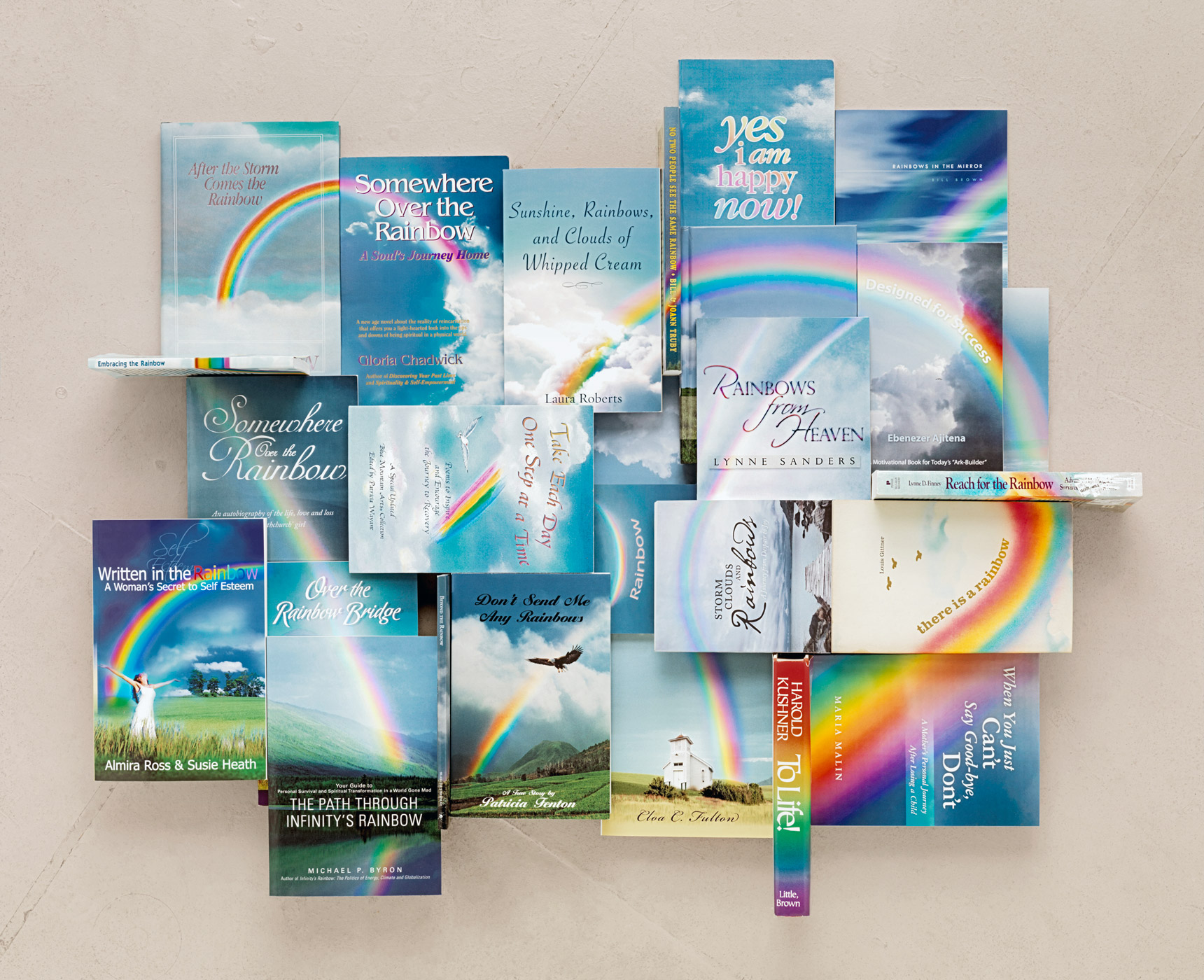
Rogowski-ThereIsARainbow

In a review of Anne Cvetkovich's new book, Depression, A Public Feeling, psychotherapist Talitha Stevenson connects writer's block to "solicitor’s block and banker’s block and designer’s block and surgeon’s block":

The degree to which the “block” gives rise to “depression” in writers, or non-writers, may depend on each individual’s adjustment to the impossibility of “mattering” in any way that obliterates the fact of death, the possibility that there is no God and the minuteness of the self in the grand scale of time. Existential fears, like the literary ones that give them a specific iteration, may be a grown-up way of recalling the first experience of powerlessness, of “not mattering” to a mummy busy with an independent life.

(From Kent Rogowski's project Everything I Wish I Could Be, using collections of self-help books, via Marina Galperina)

The Arc Of History Bends Towards Equality

EJ Graff is confident that marriage equality will win in the end:

If Kennedy loses his nerve, Congress can and will repeal DOMA—if not this term, then the next time the House, Senate, and presidency are all held by Democrats. And even if the Supreme Court issues a mean ruling on Perry—saying there's no fundamental right to marry and that California voters had every right to pass an amendment yanking equal marriage rights away—the Court will take it back in 15 years, when only ten Southern states are left banning recognition of same-sex marriages. The Court only took 17 years to overturn its ruling upholding sodomy laws in Bowers (which was a knife in the heart at the time, and pretty quickly became an international embarrassment). This one will come just as quickly, or even more so.

Face Of The Day

Monkey_Mask

For his series Monkey TownEd Wray photographed Topeng Monyet (performing monkeys) and their handlers in Jakarta. Many handlers would put baby doll heads on their moneys as masks. He discusses the project with Greta Rybus:

I did feel quite sorry for the monkeys. There was a particular monkey who had recently had a baby and her handler made her and her baby stand and perform in traffic. The poor monkey was trying to wave to cars with one hand, keep her hyperactive baby from jumping into traffic with the other, all the while being jerked by a chain around her neck. I generally wouldn’t describe most of the handlers as cruel people – though this I thought was very cruel.

While it was mainly a visual fascination with the surreal side of the Topeng Monyet that led me to this story, I’d also like to mention that I looked at this not so much as a story about cruelty to animals, though it certainly is, but as a look at the sometimes terrible things people are forced to do in extreme poverty. It’s a very sad situation.

Set It And Forget It

Kat Stoeffel appraises the benefits of IUDs, noting that the women converted to their use are likely to "extol the virtues of the device with the unsolicited but contagious conviction of the Avon lady":

Although it was once poised to be the pill’s sidekick in the sexual revolution, an aggressively marketed and fatally defective seventies model, the Dalkon Shield, waylaid the IUD’s popularity when it was recalled amid a highly publicized, asbestos-scale class-action lawsuit. Nonetheless, its reputation held in Europe, where about 20 percent of contraceptive-using women currently have one.

For those who came of age during the post-Dalkon blackout, learning about the IUD is like discovering that some benevolent God has been listening to your specific complaints about being a woman and will deal with them one at a time. Are you tired of refilling birth control prescriptions? Can’t remember where you left your pills? With the IUD, you’re baby-proof for up to ten years. (Doctors call it the “set it and forget it” method, like the rotisserie ovens sold on TV.) Do the hormones in birth control pills make you cry, as one IUD evangelist put it, “at the tiny hand in the March of Dimes commercial?” The copper IUD is hormone-free. Don’t trust him to pull out punctually? Sick of searching for the elusive Sponge? The IUD is as effective as sterilization until you take it out. (Although, as with tubal ligation, things happen.) As one IUD-using friend puts it in an e-mail she sends to potential converts, “it’s like being a man.”

Previous Dish on IUDs here.