Will We Fall Off The Fiscal Cliff?

Stan Collender thinks it's likely:

Back in September I said it was better than 50-50 that no deal would be in place by January 1. I raised that to 60 percent immediately after the election. Today, I'm raising my predicted likelihood of no deal before January 1 to 75 percent, and I may still be overstating the possibility that an agreement will be reached and put in place before the tax cuts and spending increases go into effect.

One reason why:

The fiscal cliff hits January 1 and  Boehner's formal election as speaker is January 3. Any deal with the White House and especially a deal that includes the tax increases the White House wants, could cause Boehner to lose enough votes at least on the first ballot on January 3 to prevent him from being speaker. Even if he subsequently wins on a later ballot, he will be seriously weakened.

Desperate For Doubt

A major climate change report has been leaked almost a full year early. The reason? One member of the 800-person group reviewing it, Alex Rawls, found one sentence to support his climate change denialism:

[Wrote Rawls:] "The addition of one single sentence [discussing the influence of cosmic rays on the earth's climate] demands the release of the whole. That sentence is an astounding bit of honesty, a killing admission that completely undercuts the main premise and the main conclusion of the full report, revealing the fundamental dishonesty of the whole." Climate sceptics have heralded the sentence – which they interpret as meaning that cosmic rays could have a greater warming influence on the planet than mankind's emissions – as "game-changing".

Steve Sherwood, a professor at the University of New South Wales Climate Change Research Centre, pushes back:

The single sentence that this guy pulls out is simply paraphrasing an argument that has been put forward by a few controversial papers (note the crucial word "seems") purporting significant cosmic-ray influences on climate.  Its existence in the draft is proof that we considered all peer-reviewed literature, including potentially important papers that deviate from the herd.  The rest of the paragraph from which he has lifted this sentence, however, goes on to show that subsequent peer-reviewed literature has discredited the assumptions and/or methodology of those papers, and failed to find any effect.  The absence of evidence for significant cosmic-ray effects is clearly stated in the executive summary. This guy's spin is truly bizarre.  Anyone who would buy the idea that this is a "game changer" is obviously not really looking at what is there.

Skeptical Science adds:

The body of peer-reviewed scientific literature is very clear: human greenhouse gas emissionsnot solar activity or galactic cosmic rays, are causing global warming.  The leaked IPCC report is entirely consistent with this conclusion. 

The Guardian captions the remarkable video seen above:

It's like watching 'Manhattan breaking apart in front of your eyes', says one of the researchers for filmmaker James Balog. He's describing the largest iceberg calving ever filmed, as featured in his movie, Chasing Ice. After weeks of waiting, the filmakers witnessed 7.4 cubic km of ice crashing off the Ilulissat glacier in Greenland. Chasing Ice, released in the UK on Friday, follows Balog's mission to document Arctic ice being melted by climate change.

The Dish also took a look at Chasing Ice last month.

Why Doesn’t Texas Have Civil Unions?

An October poll found that Texans are more gay-friendly than you might suspect. Even though "58 percent are against same-sex marriage in Texas," a sizable majority, 69 percent, "would allow some form of legal partnership." Erica Grieder explains why, regardless, progress towards equality isn't likely anytime soon:

If you were just polling elected officeholders, however, I bet you could easily find a 75% majority against gay marriage, and probably against civil unions for that matter. The usual reasons apply: years of Republican hegemony and Democratic torpor have created a situation in which the Republican primary is, in many cases, more important than the general election. The political battles are therefore being fought between the right and the far right. And both camps have reason to oppose gay marriage. The latter because they're against it, and the former because–even if they're not philosophically opposed to gay rights– public displays of moderation, or even disinterest, bring them nothing but trouble.

The Horror In Newtown, Ctd

158372562

A reader writes:

In a remarkable coincidence, just as people were learning about the Connecticut elementary school shooting, we were also reading about a knife attack on elementary school kids in China. While both events are horrific and indicative of mental illnesses in their perpetrators, the contrast is clear: Without a gun, one deranged maniac was able to severely wound 22 kids, but, as of this writing, none of them have died. With a gun, another deranged maniac was able to shoot dead more than two dozen people in a matter of minutes.

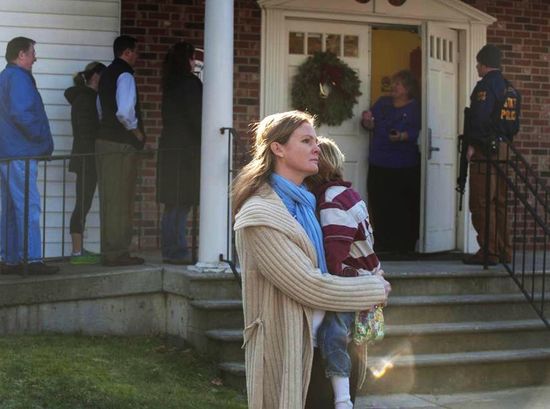
(Photo: A woman holds a child as people line up to enter the Newtown Methodist Church near the the scene of an elementary school shooting on December 14, 2012 in Newtown, Connecticut. According to reports, there are about 27 dead, 18 children, after a gunman opened fire in at the Sandy Hook Elementary School. The shooter was also killed. By Douglas Healey/Getty Images.)

The Horror In Newtown

The AP is reporting at least 27 dead, including 18 children, after a shooting at Sandy Hook Elementary School in Newtown, Connecticut. The Hartford Courant has other early details:

Many of the shootings took place in a kindergarten classroom, sources said. One entire classroom is unaccounted for, sources said. A person believed to be a shooter is dead. Earlier reports of a second shooter are unconfirmed. Three people were brought to Danbury Hospital, but their condition is unknown. The emergency room is on lockdown. Police were still searching the school at 11 a.m., and police dogs had been brought in. Around noon, the triage area was broken down, stretchers were taken away and the SWAT team left the building. Shortly after 9:40 a.m., police reported that a shooter was in the main office of the school. A person in one room had “numerous gunshot wounds,” police said. Groups of students — some crying, some holding hands — were being escorted away from the school by their teachers. Some students were still in the school at 10:30 a.m., parents said.

Update from a reader:

I love the Dish, but people who don’t know anything about guns should avoid making obfuscating and inflammatory statements about them. The AR style rifle labled was a “.223 caliber rifle” is hardly the only kind of .223 caliber rifle. Here is a photo of another common .223 rifle:

223rugermini

And the guns at this link can be had in .223. It’s a completely common varmint/light-deer cartridge that is the civvie version of the round NATO adopted for their assault rifles. On this issue, clarity is important or else you’re going to have crappy, knee-jerk, uninformed policy decisions.

Another:

Although your update is technically accurate, and we do not know the precise weapon used in the shooting, the rifle pictured on your site and in the link provided are not semi-automatic. They are bolt-fired, which makes it pretty much impossible that the shooter could have used such a weapon given the number of victims.

I wouldn’t be surprised to learn that the AR-15 is the weapon used. It is at the heart of our gun control debate, since the typical visit to your local gun range often involves firing a semi-automatic like the AR-15. They are easily accessible, and completely unnecessary for recreational hunting. Of course, we don’t know what kind of gun was used yet, but it’s a tad misleading to suggest that a bolt-fired weapon is an equally plausible alternative.

Just thought I’d clarify, since it seems to be about time that we start a serious discussion of just what type of guns are being bought every day in the United States.

Update from the first reader:

Actually, the rifle I sent in the picture IS semi-automatic. It’s a Ruger Mini-14, the same rifle used by Michael Lee Platt in the 1986 Miami FBI shootout the left seven agents dead or wounded and led to a complete overhaul of the FBI firearms policy. Hopefully the lesson is that we shouldn’t be drawing conclusions (or making policy) based on what a weapon looks like or how it’s perceived by the non-shooting public.

Quote For The Day

Ag13

"[T]wo people violently pulled his arms back . . . he was beaten severely from all sides. His clothes were sliced from his body with scissors or a knife. His underwear was forcibly removed. He was thrown to the floor, his hands were pulled back and a boot was placed on his back. He then felt a firm object being forced into his anus . . . a suppository was forcibly administered. He was then pulled from the floor and dragged to a corner of the room, where his feet were tied together. His blindfold was removed. A flash went off and temporarily blinded him. When he recovered his sight, he saw seven or eight men dressed in black and wearing black ski masks. One of the men placed him in a [diaper]. He was then dressed in a dark blue short-sleeved tracksuit.

A bag was placed over his head and a belt was put on him with chains attached to his wrists and ankles. The men put earmuffs and eye pads on him and blindfolded and hooded him. They bent him over, forcing his head down, and quickly marched him to a waiting aircraft, with the shackles cutting into his ankles. . . . He had difficulty breathing because of the bag that covered his head. Once inside the aircraft, he was thrown to the floor face down and his legs and arms were spread-eagled and secured to the sides of the aircraft," – from the European Court of Human Rights' report on the CIA's rendition program as it applied to a completely innocent German citizen.

The techniques used here are much less grave than what happened to suspects sent to black sites. But even these are regarded, rightly, as forms of illegal torture by the European court, with respect to Macedonia. I imagine the Polish government might now be getting a little queasy. And you can see how this begins to seep back into the US. But not quite yet. This stuff is still allowed.  Scott Horton notes:

The decision also focuses attention on the fact that the perpetrators of El-Masri’s torture have not been held to account under criminal law.  According to an investigation run by the Associated Press, CIA officer Alfreda Frances Bikowsky played a key role in El-Masri’s abusive treatment, ignoring his protests because her “gut told her” he was a terrorist. Bikowsky was quickly promoted following the El-Masri incident, and she now occupies a senior counterterrorism post, from which she exercises great influence on sensitive operations.

The President’s Pot Priorities

In an interview with Barbara Walters, Obama finally addresses the legalization of marijuana in Colorado and Washington:

President Obama says recreational users of marijuana in states that have legalized the substance should not be a "top priority" of federal law enforcement officials prosecuting the war on drugs. "We've got bigger fish to fry," Obama said of pot users in Colorado and Washington

Mike Riggs asks:

Do those "bigger fish" include licensed growers and suppliers of state-legal marijuana? Because that's the real issue here, as Jacob Sullum explained yesterday

I think Mike is being too, er, paranoid. All I can say is: thank you, Mr President, for hearing some of your most devoted supporters. And keep your word. We trust you; but we sure will verify.

Kathryn Bigelow: Not A Torture Apologist

Two of Zero Dark Thirty's actors address the controversy:

Millman reframes the conversation:

Why do I have to depict torture either as an obstacle to the quest, or as contributing to the success of the quest, or as an inevitable side-effect of the quest? Why can’t it just be a terrible thing that we did, with no particular implications for the quest? Because, I answer, if it’s not in the story for a reason, then why is it in the story you are telling? There has to be an answer for that question – the audience will look for one if you don’t provide one. And if your point is to say “this has nothing to do with the story” then I’m afraid that point is going to become your story, and will eclipse the story of the quest. So long as you are telling a story fundamentally about the quest, everything else is going to be understood in relation to that story.

I saw the movie last night at a screening. It is, before anything else, a brilliant piece of film-making. The direction, acting, and cinematography make it as good as The Hurt Locker. The attention to detail is stunning, and the raw, granular honesty of its dialogue manages to avoid the tired tropes of action movies. It's entirely believable. Having studied this subject for years, I saw nothing obviously wrong.

The first thing I'd say on the political issue is that the film shows without any hesitation that the United States brutally tortured countless suspects – innocent and guilty – in ways that shock the conscience. To my mind, that is, in fact, a huge plus for those of us who have been trying to break through the collective denial and the disgusting euphemism of "enhanced interrogation." No one can look at those scenes and believe for a second that torture is not being committed. You could put the American in a Nazi uniform and the movie would be indistinguishable from any mainstream World War II movie. Yes, that's what we became in our treatment of prisoners.

In that way, it exposes the Biggest Lie of the Bush-Cheney administration: that Abu Ghraib was an exception, and not the rule. What was done to suspects in Abu Ghraib was actually less grotesque, less horrifying, and less shocking than what Bush and Cheney ordered the CIA to do to human beings directly.

And so the anodyne phrase "stress positions" is actualized in front of our eyes. We see a suspect in a black site, held up by chains on his arms attached to the ceiling. He has been beaten to a pulp, his eyes barely visible behind the swollen sockets, his dignity completely stripped away. We see him strung up, and tormented. He cannot sit or stand for days on end. We see him stripped in front of a woman. We see him walked around on a dog leash. The acts that Lynndie England was convicted for are here displayed – correctly – as official policy, ordered from the very top. In that way, the movie is not an apology for torture, as so many have said, and as I have worried about. It is an exposure of torture. It removes any doubt that war criminals ran this country for seven years and remain at large, while they scapegoated the grunts at Abu Ghraib who were, yes, merely following their superior's own orders.

So why include the torture at all? It played no role in finding any clues as to the whereabouts of bin Laden in the movie and in reality. The breakthroughs in the movie come from traditional interrogation and intelligence. In only one instance is torture even remotely connected to a real clue. That's when a previously tortured suspect – driven to near insanity and oblivion by sleep deprivation – is tricked into believing he had already revealed something when he hadn't. That's classic good interrogation: bluffing. Yes, the suspect was more easily coaxed because the premise of the bluff is that he cannot remember what he may or may not have said because of torture. But the trick could have worked in other circumstances. And he gives up information while being outside the torture rooms, and offered food and drink in a restaurant.

The critical clue comes from traditional intelligence – a data point friendly countries gave to the CIA in the wake of 9/11 and then took a few years to percolate up to the analyst who saw its salience. Another critical break comes from old-fashioned bribery. Then we see the grueling, long, tedious, legal intelligence work that finds a needle out of a Peshawar haystack; and the interminable attempt to find out if bin Laden really was the inhabitant of that Abbottabad fortress. Even as those helicopters took off for the raid, the CIA analysts could only conclude that there was at best a 60 percent chance of the mass-murdering theocrat actually being there.

The movie also depicts waterboarding in a way that destroys the pathetic defense that this wasn't torture, because the tortured were not asked direct questions during it. They were, of course. Torture was followed by interrogation which was followed by more grisly torture. There is no doubt here that what the US did was almost a text-book definition of war crimes.

The controversial opening – actual audio of the victims of 9/11 calling 911 as they were consumed in flames cutting to the torture program – could be interpreted in many ways. It shows the horror of terrorism and then the horror of the torture that Cheney illegally used to respond to it. I suppose those who see no moral problems with torture – the neocon chorus – may cheer or see justice in this equation. They will love the fact that at one point, a tortured detainee is threatened with being sent to Israel as an even worse fate than Bagram.

But the simple juxtaposition of terror with torture in the film does not force an obvious conclusion. In some ways, like Spencer, I think it reveals the core truth behind Cheney's armchair warrior mindset. The torture was not for intelligence (and it provided nothing reliable as well as countless leads that were dead ends). It was for revenge. It was an emotional lashing out at often random Muslim suspects (and some genuine terrorists) for killing so many Americans. There was no reason behind it and no law. There was pure rage fueled no doubt by Cheney's guilt at being in charge when the worst attack on American soil since Pearl Harbor happened. Cheney subsequently acted out – and yes, it was acting out, it wasn't a rational strategy – as a lawless third world dictator for a couple of years. But by 2008, we see the long-term consequences of this war criminal's rampage. We hear the CIA officer in charge of trying to get the culprits of 9/11 say: "We are failing."

What the movie also shows – importantly – is the evil of Jihadism, and its fanatical religious roots. It shows the terrorism as well as the torture. The easy view that all of this torture was based on hallucinatory threats is rebutted. We see the 7/7 London bombings in horrific detail; we see the heroine's car suddenly peppered with bullets as she leaves the Pakistani embassy; we see her in a hotel blasted to smithereens; we see a key CIA analyst tricked and blown to bits by a suicide bomber. The evil of the enemy is as clear as the evil of Cheney. That matters. Evil begets evil.

And the heroine of the movie is at first appalled by what she sees in the torture rooms. Then she is made complicit, then numb, then desperate. But her strength comes from a passion to get bin Laden and a persistent insistence on tracing every tiny piece of evidence to its source, which means, in the end, on-the-ground human intelligence in Pakistan at great risk. In so many ways, this movie echoes what we are told the Senate Intelligence Committee report concludes. We got bin Laden when we stuck to Western values. When we acted like the Nazis or the Communists, we failed.

A word about the acting. Chastain is completely believable. Given the extremes to which this character is exposed, that is an acting feat of stupendous proportions. And the movie ends in deep sadness, not triumph. It may be that many people watching this movie will actually believe the torture was integral to the end-result. But that will be because they want to see that or because they are as dumb as Owen Gleiberman. It isn't there. And if they want to see that, they will also be forced, at least, to own the barbarism depicted on screen in a way that euphemisms like "sleep deprivation", "stress positions" and "enhanced interrogation" were designed to obscure. Maybe there are enough people in this country to be comfortable with that. But my view is that Americans were shielded by their government and, disgracefully, their press, into living with barbarism – because Orwellian language was used and propagated to disguise the true evil that was at the heart of the Cheney mindset.

No euphemism can obscure the truth here. And the truth is that this country was run by war criminals who have yet to be brought to justice in the way their underlings have been. That breach must be healed – not by prosecuting those at the bottom of the line of command (like the Abu Ghraib grunts), but by prosecuting those at the very top, Bush, Cheney, Addington, Rumsfeld, and their enablers. Without them, we could have found and killed bin Laden without becoming like him in our tactics. Cheney was too weak to stand up for American values in our hour of need. Bush was even weaker. But America came through in the end, despite them.

So when are we going to be able to read the entire Senate Report on the war crimes committed? It was approved yesterday. It would be immensely helpful to release it before the movie, so that we can all see what this movie reveals: torture was not just at Abu Ghraib. It was everywhere; and it was mandated from the very, very top. We brought bin Laden to justice. We have not yet done the same for Cheney.

Ask Moynihan Anything: Lessons Learned From Jonah Lehrer?

Read Michael’s writing for the Beast here. Above he explains what he learned from his expose of Jonah Lehrer last July:

I’m something of the Dylan obsessive—piles of live bootlegs, outtakes, books—and I read the first chapter of Imagine with keen interest. But when I looked for sources to a handful of Dylan quotations offered by Lehrer—the chapter is sparsely and erratically footnoted—I came up empty and in one case found two fragments of quotes, from different years and on different topics, welded together to create something that happily complemented Lehrer’s argument. Other quotes I couldn’t locate at all.

When contacted, Lehrer provided an explanation for some of my archival failures: He claimed to have been given access, by Dylan’s manager Jeff Rosen, to an extended—and unreleased—interview shot for Martin Scorsese’s documentary No Direction Home. Two of the quotes confounding me, he explained, could be found in a more complete version of that interview that is not publicly available. As corroboration, he offered details of the context in which the comments were delivered and brought up other topics he claimed Dylan discussed in this unreleased footage.

Over the next three weeks, Lehrer stonewalled, misled, and, eventually, outright lied to me. Yesterday, Lehrer finally confessed that he has never met or corresponded with Jeff Rosen, Dylan’s manager; he has never seen an unexpurgated version of Dylan’s interview for No Direction Home, something he offered up to stymie my search; that a missing quote he claimed could be found in an episode of Dylan’s “Theme Time Radio Hour” cannot, in fact, be found there; and that a 1995 radio interview, supposedly available in a printed collection of Dylan interviews called The Fiddler Now Upspoke, also didn’t exist. When, three weeks after our first contact, I asked Lehrer to explain his deceptions, he responded, for the first time in our communication, forthrightly: “I couldn’t find the original sources,” he said. “I panicked. And I’m deeply sorry for lying.”

Watch Michael’s previous videos here, here, here and here.