DOMA And Deportation

The reality:

Julia Preston explains why a coalition of gay and immigrant rights groups are lobbying the Obama administration as they await a June ruling on DOMA:

[The] groups urged the president to “hold in abeyance” cases currently under consideration by federal immigration authorities of United States citizens who are seeking permanent resident visas, known as green cards, for immigrants of the same sex they legally married.

She adds:

Nine states recognize same-sex marriages. But for the time being, an administration official said, DOMA “remains in effect and the Executive Branch will continue to enforce it unless and until Congress repeals it or there a final judicial determination that it is unconstitutional.”

In October, the Department of Homeland Security issued new guidance on the "family relationship" status of gay couples, giving law enforcement agents a discretionary basis for declining to initiate or carry out deportation proceedings. The administration has also hinted that it would include same-sex couples in immigration reform, which Obama indicated he will push for in January. According to Williams Institute researchers (pdf), as of 2010, some 40,000 binational or dual non-citizen gay couples would stand to benefit from immigration policies currently available only to straight married couples, as would the more than 25,000 children of such couples.

How Likely Is Compromise?

Why Douthat doesn't expect a grand bargain:

Because taxes are going up by $800 billion no matter what, it’s going to be awfully hard for John Boehner to persuade his members to vote for a deal that raises them even more, unless he’s extracted genuinely significant concessions from the Democrats on structural reforms to Medicare and Social Security. But by the same token, because taxes are going to go up by $800 billion no matter what, it’s going to be awfully hard for Democrats to accept a deal in which they have to swallow an unfavorable cuts-to-taxes ratio beyond that $800 billion baseline.

Lazy Lists

Shafer prepares for the coming deluge:

With few exceptions (and I can’t think of any!) best-of lists and year-in-review articles exist to fill the greatest number of pages with the least amount of effort. Filling the greatest number of pages with the least amount of effort is a pretty good definition of journalism. But at holiday time, two forces conspire to force journalists to fill an even greater number of pages in a very limited time: 1) ad pages from merchants pushing Christmas goods can double the size (if not the editorial hole) of a paper; 2) simultaneously, staffers beg for time off to travel during the holidays — and some even help themselves to unauthorized time, sneaking in late and leaving early.

Chart Of The Day

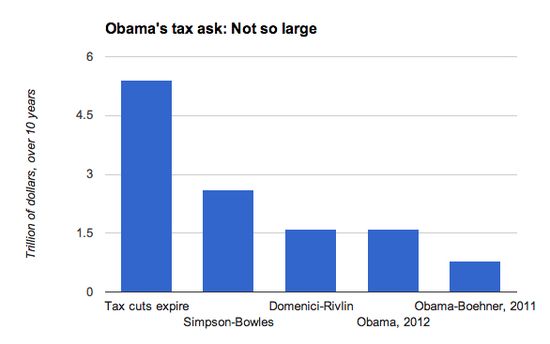
Ezra Klein puts Obama's proposed tax increases in perspective:

Obama_Taxes

Ezra's read on the executive branch:

The truth is, the White House wants a deficit deal for many reasons. They believe deficits are a problem. They want to move onto priorities like immigration reform. They’re committed to securing more stimulus. They think the fiscal cliff and the debt ceiling could do enormous damage to the economy. They think the American people want compromise. They think that a major deficit-reduction deal will be crucial to Obama’s legacy.

The Safest Way To Dry Your Hands

Paper towels:

Basically, paper towels win out over regular air dryers, jet air dryers, and cloth rollers, at least in settings like health care provision where hygiene is especially important…. Paper towels are the most hygienic of the hand-drying options: they dry skin faster, help remove contamination through friction, and don't risk spreading germs through the air.

The downsides: paper towels are more expensive and slightly worse for the environment than air dryers.

Overkill

Tim Heffernan pens a great little piece on the "deer paradox":

One: more white-tailed deer live in the United States today than at any other time in history. Two: fewer hunters are going after them than did even 20 years ago. And yet, three: deer hunting now rivals military combat in its technological sophistication. Outfitters’ shelves are crammed with advanced electronics, weaponry, chemicals, and camouflage, all designed to eliminate every last shred of chance from the pursuit. The average American hunter now spends nearly $2,500 a year on the sport, despite the fact that finding a deer to kill has literally never been easier.

A brief tour of the "advanced hunting arsenal" in Cabela's, the outdoor mega-store:

The chemical-weapons aisle alone boasts such products as Dead Down Wind ScentPrevent e3 Field Spray ("Prevents human odors from forming"), Team Fitzgerald Deer Dander Attractant ("Makes you smell like the deer you pursue"), and Wildlife Research Center Special Golden Estrus—that’s bottled urine, "taken right from does brought into heat early through the use of hormones and lighting conditions." Autonomous, infrared-triggered trail cameras such as the Reconyx Hyperfire HC500 help with surveillance. Target-acquisition systems include the Leupold RX?1000i TBR Compact Digital Laser Rangefinder With DNA, and ATN Aries MK?410 Spartan Nightvision Riflescope, which promises "resolution beyond current military standards."

Recent Dish on the rise of liberal urban hunters here.

When Heroism Beckons, Ctd

A reader shares a story with a much different ending than the previous one:

I’ve been a long time reader of the Dish, but this is the first time I’ve emailed you. When I was about 16 years old, my family and I took a vacation down to the Texas coast.  I was fishing on the end of a jetty with my father, when we saw a younger kid bobbing in the waves about 20 yards out.  The jetties are extremely dangerous to swim around and he was waving his arms, so it was immediately obvious that he was in trouble and drowning.  As soon as we registered the severity of what was happening, we both ran to the end of the jetty and climbed down into the water. 

However, the surf was incredibly rough that day, and each time we would shove off, a wave would smash us back into the rocks.  These jetties are made of giant boulders of granite, and are covered in razor sharp barnacles.  Our feet and hands were covered in deep cuts from these rocks and we were both bleeding heavily – we watched in desperation as the kid bobbed up and down, taking longer and longer to come back up until eventually he disappeared beneath the waves.

We climbed out and walked to the shore, only to see his mother, who had witnessed the entire thing, in hysterics.  The lifeguard showed up a few minutes later, and all night long from the hotel you could hear the helicopter going up and down the beach searching for the body (which was found a few miles away the next morning).  It was one of the most awful experiences of my life for many reasons, though I would not hesitate to do this again, even if it meant trying and failing.

Thanks for letting me share.

To read all of the stories in this thread, go here.

Brick By Brick

Enhanced-buzz-31955-1355155876-6

Chana Joffe-Walt examines Lego's dominance despite their products' high cost and lack of exclusive patent:

Lego goes to great lengths to make its pieces really, really well, according to David Robertson, who is working on a book about Lego. Inside every Lego brick, there are three numbers, that identify exactly what mold the brick came from, and what position it was in in that mold. That way, if there's a bad brick somewhere, the company can go back and fix the mold. For decades this is what kept Lego ahead. It's actually pretty hard to make millions of plastic blocks that all fit together.

Dreher recently sang the praises of the toy company.

(Image via Copyranter's "The 4 Best Lego Ad Campaigns Ever")

Will Readers Finally Pay For Content? Ctd

A reader writes:

Contrary to what a number of your readers have said, micropayment systems exist on the Internet.  iTunes has a micropayment system, as does Skype.  In both cases you have to prepay and have a credit in your account.  I have always thought that micropayments for Internet content is an obvious new business foe Skype.  I am sure that a system could be worked out for content providers to register with Skype with a portion of the revenues going to Skype and the balance to the content providers.

Another outlines "two fundamental problems that need to be addressed before paying for content at reasonable rates can come about":

1) Readers won't pay upfront. Think of it like busking: The performer doesn't pass the hat until the show is well underway. Any sooner and it feels – to the audience, at least – like begging. That's not so much of a problem for known commodities like the Washington Post or New York Times. Not only have their readers been reflexively paying for the hard copy for living memory, they also have a huge cachet trade on.

2) Readers can't pay a little. Due to the way online payments are handled, it's practically impossible to create a micropayment system without entirely subverting the major credit card companies and banks. They will not support such an effort, except under their own terms, and right now the cost of change is greater than the cost of continuing their existing business model.

But other models are possible.

Let's throw away the "box of writers" approach to content development and try a thought experiment: Why not leverage wit and intelligence, popularity, news … all the things that make a piece worth reading, but mix them more tightly into the warp and the weft of our online existence? Knowing what we do about human nature, what’s to stop someone from creating a social networking service that operates using cash as a measure of social connectedness and influence?

The mechanism would be simple enough. Members join for a nominal fee, not high enough to be painful, but enough so that someone would have to make a deliberate decision to join. It would have to be enough that, for many, peer pressure would be necessary to drive them into the fold. Once there, an algorithm would identify the most connected, popular and useful writers of the community and award them a share of the pot. Call it a Social Credit Union. (More on this idea here.)

Right, you’re probably thinking: Exactly how many seconds would it take for someone to begin gaming the system for money? The answer is alarmingly simple: as long as people like something and/or find it interesting, who cares? As Randall Munro so aptly put it: "Mission. Fucking. Accomplished."