The Daily Wrap

The headbutting king

Today on the Dish, Andrew differentiated his opposition to affirmative action from his support for marriage equality, ripped apart the bizarre reasoning of Justice Scalia’s anti-gay statements, responded to the European Court of Human Rights’ decision in favor of a former CIA-detainee, and raged against the GOP’s filibuster abuse and “legislative terrorism”.

In political coverage, readers rejected Andrew’s federalist idealism on marriage equality, Mike Kinsley made a counter-intuitive argument for right-to-work laws, Larison expected 2014 to magnify the GOP’s denial, Jacob Sullum looked at the DUI ramifications of legal weed, and Gary Gates gave us his analysis of how gays delivered the election for Obama, an assertion readers later disputed. Speaking of the election, Phllip Klein reminded Republicans that they lost (earning himself an Yglesias nod), while Robert Kuttner noted the judge deficit on the federal bench, Balko had trouble finding out how many people get killed by the police, John B. Judis believed taxing the rich might prevent them from damaging the economy, Razib Kahn suggested more fertility-freezing as a way to reduce health care costs, and Michael C. Moynihan explained how his only regret about Draw Mohommad Day was that not enough people participated. We also tried to figure out what the GOP would want to cut, discovered how much illegality adds to the cost of drugs, and our popular letters from millennials thread expanded to include the views of Generation X.

In international coverage, we came to better understand Cambodia’s car-racing problem, and Steve Coll thought through the complicated situation facing Egypt’s Muslim Brotherhood. In assorted coverage, Hunter Oatman-Stanford told us the nautical history of tattoos, Hamish McKenzie explored the micropayment options available to content providers, Paul Campos tracked the decline of law-school applications, Alyssa wished female fantasy-authors could keep their names, and Creative Review highlighted an ingenious ad campaign using faux self-shots. Readers chimed caroled in with their thoughts on how best to express our season’s greetings, while we finally located the news that Google had put an end to the Apple Mapocalypse, learned not to eat at our desks for a reason other than crumbs, examined new research into the gene “instructions” which may cause the trait of homosexuality, and watched the “head-butting king of the world” take on some honeydew. DMX knew the most famous reindeer of all in our MHB, Copts prayed for Egypt in our FOTD, and it was a sunny afternoon in Arizona through the VFYW.

– C.D.

Letters From Millennial Gen X Voters

A reader writes:

I just want to chime in on the (honestly fascinating) Millennial thread that you’ve been posting for the past few weeks.  As a member of Generation X, born in 1971, I find myself getting irritated when I see Millennials praising themselves for being so much more progressive and iconoclastic than the generation that preceded them. We members of Generation X were and are just as gay-friendly, pot-friendly, pro-equality, information-hungry and skeptical as these kids are; possibly more so.  We just had very limited political power due to our small numbers and the crushing weight of the generations above us. 

There were so few of us that in the 1990s, advertisers barely targeted us, and our mainstream cultural tastes were considered "alternative" – a contradiction I still find pretty hilarious.  I protested the Gulf War in 1991, voted in favor of medical marijuana in California in 1996, and wrote Bill Clinton an angry letter (which I sent via postal mail) when he signed DOMA that same year.  (I have to give him credit for sending back a well-written response, also via postal mail. In retrospect, I kind of wish I’d kept it rather than crumpling it up and throwing it away in anger.)

The recent political shift that so many of us are celebrating is decidedly not a millennial thing.  It’s the product of a combination of factors, including the explosive increase in availability of information to everyone, the fact that both Generation X (approx. 41 million members) and Generation Y (approx. 71 million members) are now of voting age, and the fact that those kids had us, their cool older siblings, to help shape their points of view as they were growing up.

Another:

I'm a Gen X'er, born in 1971. I graduated an Ivy League college and with scholarships, good paying summer jobs, and loans, ended up with just $20,000 in debt (though it seemed like a lot at the time). I worked for a few years and then went to a top public law school. Tuition was $7,000 a year when I started. I graduated with a combined $60,000 in debt, entered the workforce at the peak of the law firm boom, payed off my loans in a few years, bought a $400,000 house, and promptly quit my job to work for a non-profit at less than half my former salary. I haven't had a raise in four years, but I'm not complaining.

I'm interviewing kids who have no chance at the path I took.

The same law school education I got just 10 years ago now costs $25,000 a year (in-state), plus room and board. The little house I bought would today sell for $750,000. Mortgages are harder to get. Law firms aren't hiring and the non-profit I work for still starts lawyers at just $40,000 a year. Salaries haven't remotely kept pace.

So, on the economic issues, the millennials have it exactly right. And I fear even more for my children – what will college cost for them? How will they function saddled with so much private and public debt? I feel like there's very little I can do about it unless the millennials (a much bigger generation) rise up en masse. The boomers won't retire, so there's little upward mobility for my "sandwich generation." And the boomer politicians won't take even obvious steps to deal with the debt, climate change, and other issues. Gen X – the cynical generation, supposedly – may have it better, but many of us cast our voice with our younger peers. And that goes for social issues too.

Another is more cynical:

I am so sick of reading this thread: BOO HOO twenty-somethings. We're all knee-deep in it, so suck it up and deal.  I was born in 1970 and firmly in "Gen-X", whatever the hell that is.  AND I'm still paying off my student loans (I'm 42!!). I have about 8 more years to go and no, I don't have a fancy J.D. so I can make $250k a year to pay for it.  I have barely any debt except for a small house, a modest car and the student loans.

You think you're the only ones to have it bad: 1987 crash – no jobs to speak of, fresh out of college (see, we understand that too). Then I lost 60% of my 401k, all of my negotiated stock options, and my job in 2001 when I worked for a dot-com in Seattle. Then I lost even more of my retirement fund in 2008, so I'll be working until I'm 75 and eating Friskie's Buffet when I'm 90 if I don't figure out a way to make it up before my kids are in college.  If I can even help pay for that, because I'm sure I'll have to take in my parents who have no savings to speak of and have mortgaged their home three times over because yes, they're wasteful baby boomers.  And, I'm positive we'll be the first to have no Social Security benefits. 

But I don't care, because I have two beautiful kids who are funny as hell and enough money to keep us going just fine.  I'm sick of listening to the bitching and moaning about how bad it is for you, so shut it. At least you know what's in store. Consider yourselves lucky that your grandparents still have Social Security and pensions so your parents had money to raise you, not keep their parents alive and off the street.  You have plenty of time to keep saving, so do it.  No one is handing life to you on a platter.

Another Gen-Xer agrees:

I get sick of younger people whining about their college debt.  I graduated in 1997 with a B.S. in Computer Science.  My entire student loan debt was less than $18,000 from Stafford loans.  My interest rate was 7%. I worked part time and went to a local community college for my first two years and got an associate degree.  While in community college I completed some of my credits via CLEP to save money.  Then I transferred to an in-state public college and completed my bachelor degree.  All that really matters is that you get a degree from a four-year college.  It doesn't matter where you go for the first two years.

I know the cost of college has increased since I did my time, but there's no reason for anyone to finish school with $100,000 or more in debt.  It's simply not worth it.  No employer has ever asked me where I went to college or even asked for proof that I've graduated.  Even with my "no-frills" degree, my salary is still over $100,000 a year.

If you come away from your college experience with a mortgage-sized debt, it's nobody's fault but your own.

Freezing Your Fertility

Judith Shulevitz's new article explains, in detail, the fetal health risks associated with older parenthood. Razib Kahn's proposal to fix the problem:

As I don’t see a shift back to younger families among the professional classes, what’s the solution? Massive sperm and egg banking of 20 year old individuals seems like an economically feasible and effective strategy. I wouldn’t be surprised if the math works out that this reduces our long term health care costs, by cutting down on children born with congential defects and decreasing the lifetime morbidity rate of the population as a whole. Want to bend the cost curve? This might be a way!

Earlier Dish on Shulevitz here.

The Racing Cars Of Cambodia

A reader writes:

Funny as it sounds, I think that translation may be accurate. Friends who've reported from Cambodia all have stories about the young, rich, and protected – mostly young men – roaring around in their sports cars and running people down and getting away with it because of who their dads are. For example, this case. (The princeling in that story is the nephew of the same Hun Sen who made the statement about gays not racing vehicles … perhaps it was a sense of guilt slipping through.) The case was famous initially as a sign that perhaps the law would be applied fairly to such a princeling, then infamous as an example of the cynical reality. The whole phenomenon is a source of real bitterness there.

Another with first-hand experience:

I live in Cambodia, so I can understand what Hun Sen means by racing vehicles. Motor accidents are the leading cause of death here, and drivers must routinely look out for assholes with money driving Land Rovers and black Lexuses who WILL drive on either side of the road run motorcycles and bicycles out of their way, sometimes hitting them or forcing them to ditch.

Dissents Of The Day

52197513

A reader writes:

I know you don't mean it personally because you don't know me, but you remember who you were 20 years ago? I'm in a similar situation. SCOTUS should do as little as possible? Please God, no. Do away with DOMA. Give us equality now.

I'm an American man in love with a Chinese man. We've been together five years and I'm nearing the limit of my patience watching us win slowly. I want a family, I want children – all of it. I want to bring him to the US. I want him to be an American.

We're only nearing 30 now. We have enough time for a normal life together. The one we both want. I see it coming, I know it's inevitable. But I worry that it may come too late, when we're too old to have a child or we've had to quit because the stress is too much. If I have to wait another 5 or 10 years, it means my life will not be self-determined. And that is bullshit. I think it's close to anti-democratic that I have to rely on 9 people to give me equal rights. But I'll take it, because I just want to get on with my life.

Root for a win, Andrew. Damn the backlash. And thanks for helping us get here. Thanks for giving me the concept that I'm allowed to dream these dreams and hope this much.

Another is less polite:

Longtime reader, first-time emailer. I wish you would take more time to consider and empathize with those in committed, marriage-ready relationships right now who live in a state where marriage will be a long-time coming if a federalist approach is taken.  It’s easy to say ""hold back a bit" while sitting happily in New York or Massachusetts or Washington D.C. (or maybe sort of all three, right, Andrew?), where same-sex marriage has already been legalized, or in blue states that are on the verge of doing so.

My partner of six years and I are in Texas. We love living here in gay-friendly Houston, where nearly everyone around us is sympathetic to same sex marriage rights.  But those in more rural areas are a long, long time away from validating same-sex marriage, and such validation would likely only come after Supreme Court directive. 

We are Texans and don't consider anywhere else home, so the thought of having a marriage ceremony somewhere else seems inappropriate and emotionally lacking.  The merits of the case for marriage equality (and the flaws in the case against it) are as profound and definitive now as they were years ago.  But the strength of the case and the likely inevitability of marriage for all should not lead you to lose sight of the purpose of that case and cause, which is couples like my partner and I love each other, are (almost) ready to wed and start a family, and deserve the right to do so; and to do so right now, not in whatever indeterminate time-length that "restraint" and "inevitability" afford.

Another:

I’m a 43-year-old single gay man living in Raleigh, North Carolina.  I moved here for law school in Chapel Hill in 1993, fell in love with the area (and the state), and decided to stay and make my life here.  I’ve had a couple of long-term relationships that didn’t pan out, but my plan remains to fall in love and have a couple of kids to go along with my Cape Cod-style house with white picket fence and cat.  It’s a gag-inducing apple-pie version of things, but that’s what I want.

I grew up in New Jersey, where civil unions between gay couples are recognized, gay marriage now polls with majority support, and efforts to make gay marriage legal are ongoing and promising despite Governor Christie’s veto.  My parents, brother and nephew, and my extended family, live in northern New Jersey.  I love visiting them there. But North Carolina is my home.  I am attached to my friends and to this place as I’ve never felt elsewhere before. When I meet my life partner, and we are making plans for the future, I want those plans to include marriage.  And I want to get married and grow old together in North Carolina, my home.

Last May, a proposition to amend the North Carolina Constitution to effectively ban gay marriage was on the ballot.  In the months leading up to that day, yard signs about the proposed amendment began to pop up – one sign, then five, then ten, then a sea.  Nearly all in opposition.  The swell of support for equal rights for my friends and me – support I never knew existed, but now I could SEE – was startling and incredibly moving.  It made me feel even more welcome. Not surprisingly, and unfortunately, that support was primarily among urban voters.  Amendment One was approved by a 61 – 39 margin. Unless an appellate court strikes down that amendment by declaring it in violation of the due process rights of gay people, or a violation of equal protection, I will not be able to marry the man I love in the State that I love.

I could not agree more about wanting to win hearts and minds gradually, and my strong preference would be to win the right to marry in North Carolina legislatively or by popular vote, rather than by resorting to the courts.  But my state now has a Republican governor and a Republican-controlled General Assembly, and they all oppose gay marriage.  Given that, and the margin of victory on Amendment One, there is a very good chance I will not be able to marry in North Carolina for decades, if ever within my lifetime, without judicial enforcement of gay rights.

Some may say, if you want to marry, leave North Carolina.  Leave Home.  Why should that be required of me, to receive equal treatment under the law?  That advice is also easy to give if you live where gay marriage is the law or stands a reasonable chance of becoming the law in the near future. I share your fears about how the Supreme Court will rule on the rights of gay people to marry one another will full recognition under the law, and the potential repercussions.  But I am less concerned about a backlash than about having the chance to be treated fairly and not as a second-class citizen.  Personally, I am no worse off if the Court finds there is no federal constitutional right for gays to marry one another than I am now. 

So: Bring. It. On.

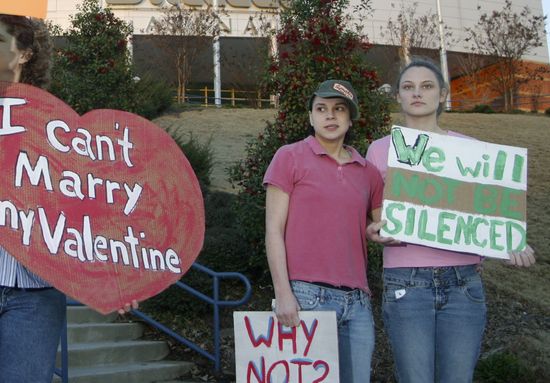
(Photo: Gay and lesbian activists picket outside the Alltel Arena in opposition to an event celebrating covenant marriages in Little Rock, Arkansas on February 14, 2005. In November, voters overwhelmingly approved a measure banning same-sex marriages and civil unions. By Mario Villafuerte/Getty Images)


Giving Your Byline A Sex Change

Alyssa hates that female fantasy authors are pressured to adopt masculine pseudonyms:

Yes, male authors may adopt female or gender-neutral pseudonyms when they're writing in that most female-oriented genre of romance novels. But nowhere else is it assumed that men have to prove their credentials when they're writing about issues particular to women. Critics may debate how well George R.R. Martin handles things like sexual assault as a weapon of war and the psychological impact of arranged marriages in his Game of Thrones books, but I can't imagine that anyone would have suggested he masquerade as a woman if he wanted his legion of female characters or his perspectives on those issues to be taken seriously.