Fighting Over The Small Stuff

R.M. puts the debt ceiling debate in perspective:

The Wall Street Journal has a handy little feature that allows you to create your own deficit-reduction plan by selecting some of the different options seemingly on the table in negotiations between the White House and Republicans. One of the interesting things one notices when doing this exercise is how little is saved from the two options getting the most attention at the moment: raising the Medicare eligibility age, and sending the tax rates for top earners back up to Clinton-era levels. Yet these are the trophies sought by each party.

Fortunately, the Onion has a solution.

The Vanguard Effect

As low-cost fund company Vanguard closes in on its best-ever year, Roben Farzad explains why it is thriving:

You’ve no doubt heard of the “Wal-Mart (WMTeffect.” Now the market is watching—with equal parts gratitude and trepidation—the rapid escalation of the “Vanguard effect.” It’s asymmetric warfare, as Vanguard’s sole ownership and constituency is its fundholders, the savings it wrings from its buying power are passed on to them, not to shareholders or partners. BlackRock (BLK),Charles Schwab (SCHW), Fidelity, and State Street cannot say the same.

Last month, Felix Salmon praised Vanguard's target-date funds and searched for something better.

Chart Of The Day

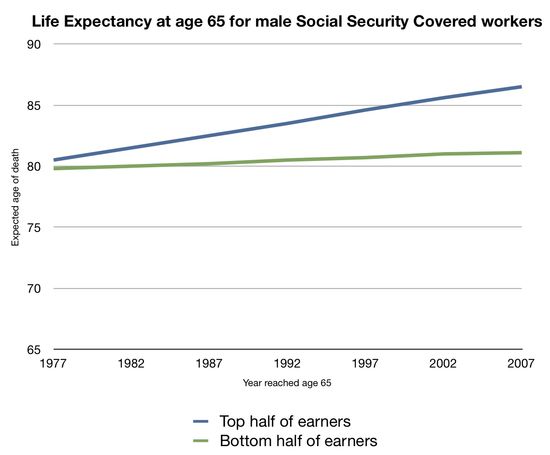
Life_Expectacy

Raising the Medicare eligibility age is being discussed as part of the fiscal cliff negotiations. Aaron Carroll uses the above chart to argue against the idea:

What you’re seeing is life expectancy at age 65 broken out in to the top half of earners and the bottom half of earners, from 1977 to 2007. I got these data from a study that appeared in Social Security Bulletin in 2007. The paper was entitled, “Trends in Mortality Differentials and Life Expectancy for Male Social Security–Covered Workers, by Socioeconomic Status.” We know that average life expectancy went up less than 5 years overall in this period. But what’s somewhat stunning is how much of a disparity there is in these gains. The top half of earners gained more than 5 years of life at age 65. The bottom half of earners, though, gained less than a year.

If you raise the age of eligibility by two years, then you are taking away more years of Medicare than half the country gained in longer life. Moreover, we’ve already taken away these people’s Social Security. The Greenspan Commission in the early 1980s made it so that the retirement age is already 66. It’s scheduled to rise to 67. So those at the bottom half of the socioeconomic ladder have already lost more years of Social Security than they’ve gained in years of life expectancy at 65.

Computational Bias

Nick Diakopoulos focuses on it:

Even robots have biases. Any decision process, whether human or algorithm, about what to include, exclude, or emphasize — processes of which Google News has many — has the potential to introduce bias. What’s interesting in terms of algorithms though is that the decision criteria available to the algorithm may appear innocuous while at the same time resulting in output that is perceived as biased.

Madrigal considers the ways news organizations try to game Google News:

I don't think Google News has ever taken enough responsibility for the cybernetics of the system it created. What is important is not just how the software works, but the ways it structures humans' thoughts and actions in new ways. To my eye, it created feedback loops with mostly deleterious effects not because the algorithm itself was bad, but because the service did not take the human repercussions seriously. That's not what Krishna Bharat, the product's creator, set out to do. But it's happened.

Seeing Your Kids Through Middle Age

Judith Shulevitz spells out the downsides to delayed parenthood. Among them:

A mother who is 35 when her child is born is more likely than not to have died by the time that child is 46. The one who is 45 may have bowed out of her child’s life when he’s 37. The odds are slightly worse for fathers: The 35-year-old new father can hope to live to see his child turn 42. The 45-year-old one has until the child is 33.

These numbers may sound humdrum, but even under the best scenarios, the death of a parent who had children late, not to mention the long period of decline that precedes it, will befall those daughters and sons when they still need their parents’ help—because, let’s face it, even grown-up children rely on their parents more than they used to. They need them for guidance at the start of their careers, and they could probably also use some extra cash for the rent or the cable bill, if their parents can swing it. "If you don’t have children till your forties, they won’t be launched until you’re in your sixties," Suzanne Bianchi, a sociologist who studies families, pointed out to me. In today’s bad economy, young people need education, then, if they can afford it, more education, and even internships. They may not go off the parental payroll until their mid- to late-twenties. Children also need their parents not to need them just when they’ve had children of their own.

Allison Benedikt shares her own experiences.

Must The GOP Change?

Not in order to win, argues Bouie:

As long as the GOP can offer the appearance reform—by placing the same ideas in new, multicultural packaging (see: Marco Rubio)—it can likely convince the public—to say nothing of key elites—that it deserves power. To wit, the mere mention of poverty by Rubio and Paul Ryan was enough for moderate Republicans David Brooks and Ross Douthat to declare a new era of reform.

Jonathan Bernstein foresees other consequences:

[T]he dysfunction in the current GOP makes successful governing if they do win extremely difficult. I think we've seen that for some time, and I think it was part of why George W. Bush was such a poor president; there really are major governing penalties for finding it hard to accept reality.

The Roid Age, Ctd

A reader quotes another:

In the same way that women are expected to be thin and have big breasts, men are generally expected to have a six-pack, a big chest and no visible body hair.

In the same way? Seriously? This is some "let-them-eat-cake"-level disconnection on gender issues. Have men experienced a mild push in this direction? Yes, they have. Mildly. Can anyone look at the consequences of noncompliance with aesthetic standards on people who aren't men and then look at them for men and say they are comparable at all?

Another illustrates that point:

I'm overweight by about 20 pounds, so not that much, but it does result in a bit of a gut. My fit wife gives me hell every time the ice cream comes out. I have a sweet tooth. She has said before if I don't lose the gut that she'd leave me. She wouldn't.

But she's trying to make a point. She runs, watches what she eats, and watches me be lazy with exercise, dismissive of the obvious cause and effect of what I eat and generally act as though I don't care about the weight I'm carrying. All true. I don't think it is fair when it comes to sex that my 30-year-old wife has the body of an 18 year old and her 38-year-old husband has the body of a lazy, overweight 38 year old.

If I'm honest, I appreciate the pressure she applies. And really when it comes down to it she is entitled to a man who takes care of himself. Forget the roids discussion. Eating well and exercising is a healthy approach to life. I think the weight issue is something women have hidden behind in these past decades. I'm overweight because I have a poor diet and I don't exercise. The same can be said for a lot of women and their men should be able to say, "This is unhealthy and it effects our relationship beyond issues of health alone."

There is some truth then to the argument of empowerment when objectification is applied to men as we men have been able to get away with a lot over the last whenever when it comes to our looks. A bit of pressure should be welcome. Steroids not so much.

On the other hand, another describes a standard that can't be mitigated with diet or exercise:

Women are only nominally attracted to big builds, but what really turns them on is height.  If you are a man over 5'7" you are in the safe zone. If you top 6'0" you barely need a personality, job or skill in bed.  The proof of this is in the study highlighted in the [above video].  In it, British women are asked to build their prefered body shape on a computer-generated male body.  Ripped torsos seemed like the favorite, until the same women were asked to select from a pool of non-virtual men.  The tall men won handily.

If you sense a note of bitter disappointment, yes – I am only 5'5". If there was a steroid that would make me taller, I would totally inject it into my veins, legal or not.

Read the entire Roid Age thread here.