Who Will Enforce Egypt’s Constitution?

Whether or not the Egyptian constitutional referendum passes may be less important than who controls the courts. Nathan Brown considers the "question of who will interpret and apply the constitution's Islamic provisions":

There are, at first glance, few differences between the clauses in this draft and those in the 1971 constitution. But the meaning of constitutional articles can change according to who is in charge of upholding the document. And the constitution introduces two new elements. The first is the provision that al-Azhar should be consulted on matters of Islamic law. The second is a carefully negotiated clause that defines the "principles of the Islamic sharia" (which have been Egypt's main official source of legislation since 1980). The language consists of a series of technical Islamic legal terms that are difficult to understand in Arabic and which defy translation into clear English: "The principles of the Islamic sharia include its general indications, its foundational jurisprudential bases, and the accepted sources, in the schools of Sunni community." On the one hand, parliamentarians and judges could use this language as a justification for writing large parts of traditional Islamic jurisprudence into law; on the other, they could ignore it since the constitution gives no guidance on how the new article is to be implemented.

Ellis Goldberg looks beyond the constitution:

The answer no longer lies in a draft constitution that very few of the demonstrators, on either side, are likely to have read. Egyptians along with the citizens of a great many other places have learned what is on paper is only a part of the constitution. The other, most important, part lies in the institutions that give the constitutional language presence in everyday life. To some degree this means the habits and choices of low level officials and to some degree it means the courts. And the simple and sad reality for the Brotherhood is that a great many Egyptians distrust, dislike, or fear them and worry that, having come to control the legislature and central executive, they plan to take over the courts as well as staff many of the lower levels of the government.

President Morsi has been unable to allay this distrust, fear, and dislike and over the last week he and his allies have, through words and actions, intensified it. This may be unfair and its results may be tragic, but it remains a profoundly political issue with which he and any Egyptian politicians who aspire to lead the country will ultimately have to deal.

Santa’s Demented Helper

Screen shot 2012-12-07 at 2.27.27 PM

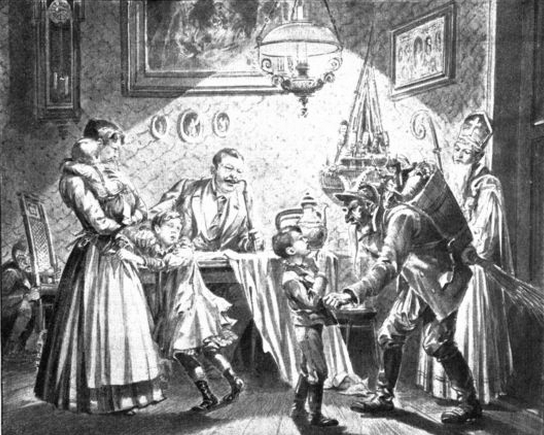
Clay Risen tells the story of Krampus, an "evil, goat-horned spirit" which was originally part of the Santa Claus story. Krampus "brought switches and bad dreams to the boys and girls of Austria, southern Germany, Switzerland, and far northern Italy":

Originally, Krampus had just the one day. A few men in each town dress up in furs, heavy boots, and a ghoulish mask topped with horns—with a switch in hand. Then they go to all the houses with small children, and when the parents open the door they run in and act menacing—growling and cracking their switches. The children scream. After everyone’s had a good fright, the parents invite the men to sit down and have a few shots of kirsch or schnapps, which they always accept. Not surprisingly, by the end of the night the Krampuses’ growls are a little slurred, their switch-cracking is a little too close to the children, and parents have to make sure their kids don’t look out the window, lest they catch a glimpse of the Krampus puking in a gutter. 

But Krampus Day soon morphed into Krampus Weekend; it’s likely that villagers got jealous of the lucky few who got to run around town in costumes, act like idiots, and get plastered. Thus was born the Krampusfest—or, as it is known in southeast Austria, the Kränchen. Typically held on the Saturday after Krampus Day, the Kränchen is a village-wide party held at a local school, community center, or other facility: anywhere large enough and sturdy enough to hold 300 or so drunken villagers.

(Drawing of Krampus and Saint Nick from Wiki)

Can Chemical Weapons Save Assad?

Dan Trombly doubts it:

While chemical weapons are horrific in effect, their lack of clear military efficacy against an opponent willing to absorb the casualties and capable of adapting their tactics does a significant part of explaining their relatively infrequent use. Against a casualty-averse opponent, such as a potential foreign intervening actor, they may be of great use, particularly if that foreign intervening state lacks the capability to escalate in response to CW use. Against a determined popular insurgency, CW use is not particularly efficacious outside specific tactical situations (such as clearing confined areas). That lack of efficacy has compounding effects. Not only does it make states less likely to employ CW, those ordered to employ CW who still fear losing are more likely to defect (particularly when combined with the issue of escalation), or else suffer at the hands of the victors.

Earlier Dish on Syria's chemical weapons here, here and here.

The Daily Wrap

Minneapolis-5pm

Today on the Dish, Andrew criticized the possible use of a torture-lie plot-device in Zero Dark Thirty, responded to British conservatives’ backing of marriage equality, and joined readers to discuss the maddeningly-high tolerance for Republican quitters. Andrew and others also wondered if the GOP could improve its image by opposing weed prosecutions, and he additionally took on Kleiman over federal drug enforcement and pot dependancy.

In political coverage, Charlie Cook previewed Democrats’ poor prospects for 2014, Michael C. Moynihan tried to debunk the anarchist-straw-man argument against libertarianism, a reader identified DADT and DOMA as historical growing pains, and we featured more letters from millennial voters, this time defending the generation from naysayers, as well as making us aware of the slightly-older voters whose childhoods lacked an “overarching boogeyman” to oppose. Suderman and Ezra debated a return to Clinton-era spending limits, Beinart explained Obama’s “standing back” policy with regards to Israel, McKibben took on Hillary for her possibly unethical support of the Keystone XL Pipeline, and if Obama goes after legal weed, Pareene advised drug reformers to wield a new litmus test for political candidates. We also rounded up more reactions to Friday’s SCOTUS decision to take up marriage equality and DOMA, tried to figure out if Obama would raise the Medicare eligibility age, and discovered that not only is Dick Morris always wrong, he’s likely a con artist too. Looking overseas, we tracked the developments in Egypt’s political crisis, as well as reviewed the country’s democratic chances, while Eyal Weizman detailed Israel’s use of “teaser bombs” to clear targets of civilians before larger airstrikes, and Kay Hymowitz examined how Sweden may be suppressing women’s careers with the very policies they designed to enable them.

In assorted coverage, we collected the best new commentary on journalism meters and paywalls, Josh MacPhee and Nick Carr considered Kickstarter’s fee structure, Paul Gabrielsen explored the use medical maggots, Wesley Law photographed bales of donated clothing, and another reader shared their experience being a sudden hero, this time at the beach. Readers also responded to toy companies’ gender neutral marketing, while Scott Adams dreamt of a better to-do app and Devin Leonard looked at the rise of luxury home-healthcare. Slavoj Žižek hated Gangnam Style to earn himself a poseur alert, video game characters died dumbly in our MHB, there was ample snowfall through our Minnesota VFYW, and we met a few of India’s hidden drug users in our FOTD. The weekend wrap is here.

– C.D.

Can Egypt’s Democracy Survive?

GT EGYPTIANPROTESTERS 20121210

Issandr El Amrani details the Muslim Brotherhood's militia-like role in last week's violence:

[Morsi] has pushed himself increasingly to rely solely on Islamists, and if this referendum takes places he will have only them to rely on for the rest of his administration. Moreover, he and his party last Wednesday incited people to go out into the street and "defend the presidency" — an unjustifiable action with predictable consequences (and an unnecessary one, after all he has the Republican Guards even if interior ministry forces are not to be trusted). Muslim Brothers went out there and held (and allegedly tortured) protestors for 12 hours, on presidency grounds, to extract confessions of a conspiracy. Morsi referred to these as "evidence" of a conspiracy in his speech the following day, but his own public prosecutor released these people. 

Ahdaf Soueif says Morsi has failed to lead the Egyptian people:

The demands of the revolution were clear: bread, freedom, social justice. Concerning "freedom", Morsi has refused to restructure the state's security apparatus; he appointed as interior minister the man who'd been Cairo's police chief in 2011 when protesters were massacred in the city's streets. People continue to be killed in jail and in police stations across the country.

Concerning the economy it's become clear that the Brotherhood's programme is basically Mubarak's: Morsi visited China accompanied by some of the biggest business allies of Mubarak; the banking communities talk of deals already being made by high-ranking officials and their relatives, and borrowing from the IMF and the World Bank is suddenly not sinful. Meanwhile, the president is able to issue the wildest constitutional declarations but is unable to make the smallest step towards establishing minimum and maximum wages.

Along the same lines, Rami G. Khouri considers the Morsi cohort to be amateurs:

The Muslim Brotherhood leaders who have spent much of the last 25 years in and out of jail were catapulted into the presidency without any previous experience in managing national politics. President Mohammad Mursi is revealing his inability to act as the president of all Egyptians and the shepherd of a historic constitutional transition in which basic governance institutions are being built. Unlike Nelson Mandela who spent decades in jail and then showed his compassion, flexibility and statesmanship when he became president of South Africa, Mursi seems focused on pushing through his agenda (presumably also the Brotherhood’s) and is unable at this stage to act as the magnanimous leader of all Egyptians. 

Ahmad Shokr goes over the Islamist-drafted constitution:

[It] does not reflect a democratic consensus, as many in the opposition have argued that it should. It reflects an emerging relationship between the Muslim Brothers and existing state institutions, like the army, along with a great deal of appeasement of the salafis, whom the Brothers have embraced as junior partners. The rush to a referendum suggests a deep anxiety among the state elites about continuing instability and a desire to seize the opportunity to cement a new political framework as quickly as possible. More worrisome than the text itself is the vision these leaders have for which voices count and which alliances matter in the new Egypt. Should this vision go unchallenged, the losers would be all those who have been calling for more pluralistic and inclusive system.

In his December 6 post, Jason Brownlee writes, "It is important that the ideological debate between liberalism and Islamism not be seen as a battle between democracy and authoritarianism." Perhaps recent events in Egypt call for a rethinking of these terms. True, liberalism and democracy are not automatic counterparts, no more than Islamism and authoritarianism are. But the battle in Egypt is indeed one between a democracy that reflects the country’s political diversity and a remodeled authoritarianism, led by the Muslim Brothers and their allies, that seeks to circumscribe it.

Another area of concern is women's rights, as Vivienne Walt explains:

Women’s organizations have for months pressed to have an article [added to the constitution] that guaranteed women’s equality only insofar as it did not clash with Islamic values deleted from Egypt’s draft constitution. Now [the sentence "the principles of Shari‘a are the main source of legislation" has been removed]  — but any specific assurance of women’s equality has also been excised. In its place is a clause guaranteeing government-funded maternal and child health care (something most Americans don’t have), but those benefits are offered specifically in order "to preserve the genuine character of the Egyptian family" and to balance "the duties of a woman towards her family and her work." That, says Coleman, is "a not-so-subtle code for keeping women in a traditional role."

Previous coverage here.

(Photo: Egyptian army soldiers stand on top of a tank as opposition supporters and protesters wave national flags outside the presidential palace on December 9, 2012 in Cairo. By Patrick Baz/AFP/Getty Images)
A Legalization Litmus Test

Pareene's advice to drug reformers:

If Obama is not persuadable, it should be every liberal’s job to ensure that the issue becomes a litmus test for the next candidate, and the one after that, as gay marriage has become. (We won’t see another anti-same sex marriage Democratic presidential candidate in our lifetimes, I promise you.) We should be making sure that the next generation of Democratic leaders is less awful on drug issues, and that means agitating at the local and state level. The money people — and money helped win legalization in Washington, just as money has funded so much of the marriage equality battle — should be convinced that the legalization fight is a good and just use of their money.

Let’s make his marijuana policy end up as Barack Obama’s DOMA, the thing he’ll most desperately wish he could take back.

Faces Of The Day

157261452

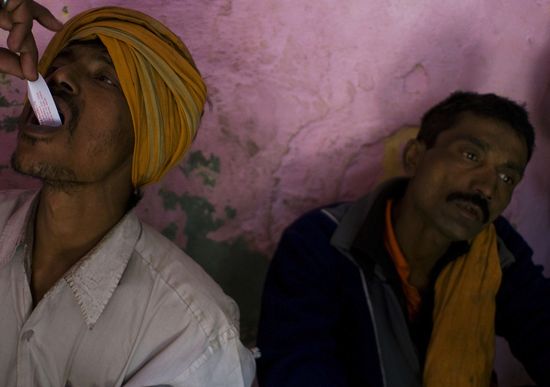
An Indian drug user is given an oral form of 'buprenorphine' as part of a harm reduction program at a drop-in centre in the old sector of New Delhi. Drug use in India is on the rise but there are no proper statistics on the number of people suffering from this 'hidden disease'. The first and last national survey on drug abuse carried out in 2000-01 and showed a figure of 70 million drug users in the country. By Anna Zieminski/AFP/Getty Images.

Kickstarter’s Cut

Josh MacPhee considers the downsides to Kickstarter. He uses a successfully funded $10,000 campaign as an example:

Kickstarter and Amazon [Kickstarter’s exclusive money broker] take 10 percent right off the top, so now you are down to $9,000. If the money is coming in to you as an individual, Kickstarter treats you like a self-employed contractor, so it’s on you to figure out your tax burden and pay it, likely at least another 15 percent, so now you’re at $7,650. For a $10,000 campaign, you will have around 200 donors, of whom 150 will want rewards. If your rewards are physical objects, and you were generous in your offerings (a good idea when raising money), you’re going to have to wrap 150 packages, all of which need shipping supplies and postage to get to their destinations. On average, you’re likely spending $8 per package, so that’s another $1,200 off your total; so now you’re at $6,450. Within a few weeks a third of the money you raised is gone, and you haven’t begun to spend it on the project you were raising it for.

Nicholas Carr appraises MacPhee's complaints:

MacPhee goes on to argue that Kickstarter isn’t all that different from a Tupperware-style pyramid operation. It grows by infiltrating its members’ personal networks of friends and acquaintances, through which it recruits an ever growing number of project-launchers and project-funders eager to donate their time and their money to the cause. Maybe MacPhee, in formulating his lengthy indictment, is guilty of overreaching, of finding nefarious dealings in every nook and cranny of what is, at least at some level, a worthy, socially productive business. Then again, when you have venture capitalists and entrepreneurs selling charity to the masses, it’s probably a good idea to do a little digging, to see who’s doing the work and who’s getting the money.

SCOTUS Takes On Marriage Equality: Reax II

Marriage_Washington_CityHall_GT

Emily Bazelon weighs in on SCOTUS' selection of both Windsor and Perry:

Does the Supreme Court agree—do five of the justices see this in terms of doom rather than progress? Or could they possibly side with Olson and Boies all the way and declare gay marriage legal in every single state? That would mean changing the laws of 41 states that have not yet taken that step. At a panel discussion I did with Yoshino and Jeffrey Toobin on Thursday night at New York University, Yoshino argued that the court will find some middle ground, some way to allow gay marriage in California without forcing it on the parts of the country that aren’t ready. He also pointed out that other state marriage bans, in Hawaii and Nevada, are also bubbling up through the courts, which could make the justices feel that delaying the big question (my own nervous Nellie preference) isn’t really an option.

Constitutional scholar William Eskridge and political consultant Hans Johnson look back at the response to decisions on miscegenation and abortion:

The Warren Court declined to disturb anti-miscegenation laws in the 1950s, when three-fifths of the states had laws barring different-race marriages. Bowing to the blatant affront to minority citizens, lawmakers in half of those states repealed their statutes between 1957 and 1967. When the Court did act, in Loving, its insistence on marriage equality for interracial couples had greater bite because the nation’s public law conversation was coming to an end on this issue.  

Contrast such a cautious approach with Roe v. Wade, issued forty years ago next month, an important ruling for which the Court has faced criticism, even from some abortion rights supporters, for ruling too broadly when the nation was not at rest on the issue of abortion rights and giving some traction to a legislative backlash.

Garrett Epps suspects that SCOTUS will decide "that states may restrict marriage, but if a state decides to open the institution to gay people the federal government may not refuse to recognize the resulting unions." Kenji Yoshino, on the other hand, explains ways the court can invalidate Prop 8 and stop short of affecting most states directly. An example of such a ruling:

[One] breakpoint on the spectrum would focus on the lack of justification for giving same-sex couples all the rights and responsibilities of marriage but withholding the word “marriage” from them. This resolution differs from the Ninth Circuit panel’s ruling because it removes any issue of retrogression from the analysis. What is important is not that California went all the way to same-sex marriage and then retreated, but rather that California went all the way to “everything but marriage.” Once it did so, it reached the point of no return. Currently, seven states besides California would be affected by such a ruling: Delaware, Hawaii, Illinois, Nevada, New Jersey, Oregon, and Rhode Island.

And, as far as public outcry goes, Greg Sargent isn't worried:

[M]y bet is that there won’t be any significant backlash to speak of this time. The circumstances are very different today. Public opinion is more favorable now towards gay marriage than it was, say, towards interracial marriage during the 1960s, when laws against it were ruled unconstitutional. Today there is far more media coverage of the Supreme Court — via the internet and cable — meaning the public will have time to grow familiar with its arguments over gay marriage, and won’t be hit out of the blue with a big SCOTUS decision.

What’s more, an American president has come out in support of gay marriage. And by the way, the backlash that was supposed to produce never materialized, either.

Earlier reax here.

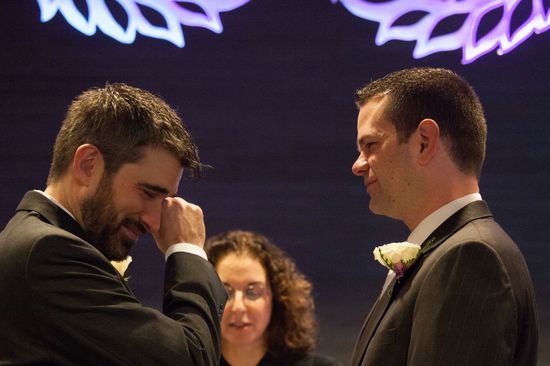
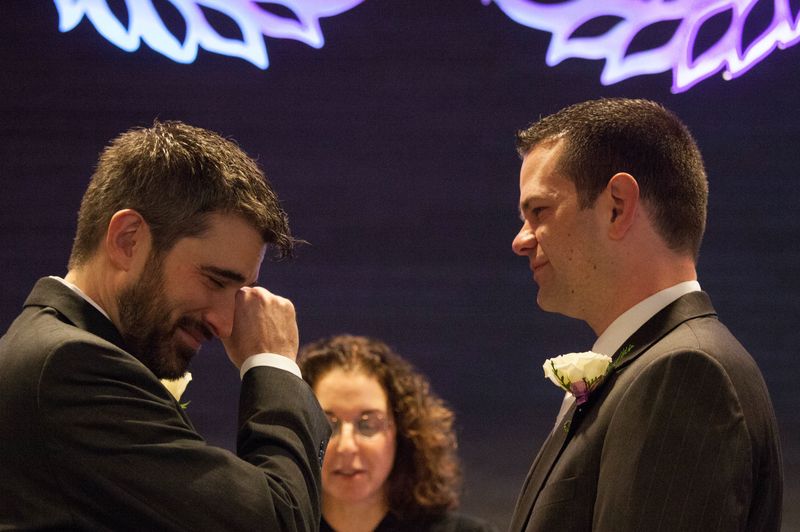
(Photo: Steven Austin and Michael Pirkle are pictured during their wedding at City Hall on December 9, 2012 in Seattle, Washington. The two have been together for 12 years. By David Ryder/Getty Images)

VIP MD

Devin Leonard tracks the growth of "concierge medicine":

Atlas MD’s two physicians, Josh Umbehr and Doug Nunamaker, don’t accept insurance. Instead, they charge most of their adult patients $50 a month for unlimited visits. They also offer free EKGs and biopsies and cut-rate prices on prescription drugs. Two-thirds of their patients have insurance but feel the fee is well worth it for personalized service, including house calls, the doctor’s cell-phone number, and quick responses to e-mails and Twitter messages. The rest of Umbehr and Nunamaker’s clientele are uninsured. For those patients, Atlas is the only way of seeing a family doctor regularly.

An example of the care provided:

It was midway through the month when the homeless woman arrived at Atlas MD, so Nunamaker asked her for $25 and examined her immediately. She told him she was always tired and couldn’t keep a job. She was living in a storage shed. Nunamaker gave her a blood test, which revealed an extreme case of hypothyroidism. That explained her exhaustion. “I get why you are so fatigued,” he said. “Your thyroid isn’t working as well as it should.” He put her on medication that would boost the hormone her thyroid gland wasn’t producing and restore her vitality.

The woman stayed with Atlas MD for three months until she was feeling better. Then she left. Nunamaker gave her three months of inexpensive prescription refills and wished her well. He would have preferred to see her stay on. But he and Umbehr are proud that they were able to restore her health for $147, including tests and prescriptions. (They made money on her monthly retainer, but not on the tests and labs. Atlas MD provides them at cost.) They estimate that she would have paid as much as $1,500 if she had gone to a regular doctor. It was undeniably a good deal for her; had she required hospitalization, however, the bill would have been enormous and not covered by Atlas.

One criticism, from Ezekiel Emanuel, a former White House health-care policy adviser and one of the architects of the Affordable Care Act:

"The problem is, it excludes specialty care, complex diagnostics, hospitalization,” he says. “People need insurance. They need the whole product.”